
What Is Quick Service and How Does It Drive Restaurant Growth?
· Thibault Le Conte
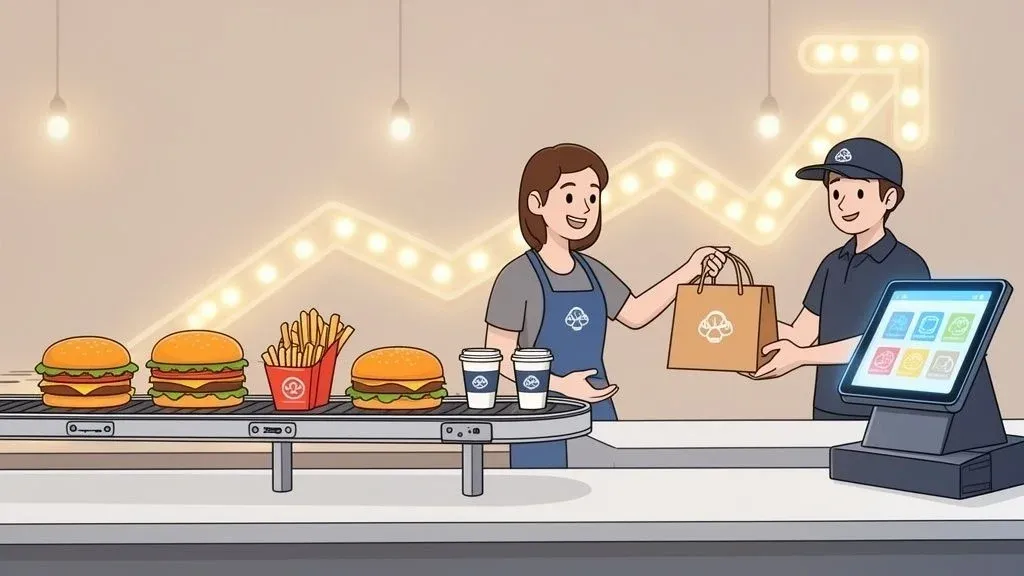
At its core, quick service is a restaurant model built from the ground up for speed, efficiency, and value. In simple terms, it’s about getting good food to customers as fast as possible. This model powers the entire fast-food industry by optimizing every step, from ordering to pickup, to serve a high volume of guests quickly.
Why It Matters: For restaurant owners, this model is the blueprint for maximizing customer throughput and revenue. By focusing on speed and efficiency through smart restaurant operations, you can serve more people in less time, directly boosting your bottom line.
What Exactly Is a Quick Service Restaurant?
A quick service restaurant (QSR) is a business that prioritizes speed of service above all else. It eliminates traditional table service in favor of counter-based ordering, drive-thrus, and streamlined kitchen processes. The goal is to minimize customer wait times and maximize the number of orders fulfilled.
Technically, this is achieved through a combination of a limited, standardized menu and highly efficient, repeatable workflows. This operational focus allows QSRs to handle a massive volume of sales, turning them into a dominant force in the food industry.
The numbers don’t lie. The quick-service sector is a massive piece of the American food service economy. In fact, the U.S. fast-food market alone is projected to pull in a staggering $412.7 billion in revenue in 2025. That’s a steady 3.7% annual growth over the last five years, proving just how much we all rely on a quick, convenient meal.
The Core Ingredients of a QSR
So, what are the key ingredients that make a restaurant a QSR? It really comes down to a few distinct elements working in perfect harmony:
- A Limited, Focused Menu: QSRs offer a specialized menu with fewer choices. This simplifies inventory management, makes staff training easier, and enables lightning-fast food prep. It’s all about doing a few things and doing them incredibly well.
- Counter Service is King: Customers order and pay at a counter, drive-thru, or self-service kiosk. This setup eliminates the need for a traditional waitstaff, which is a huge saving on labor costs and speeds up the entire transaction.
- Speed is the Name of the Game: Every part of the operation, from kitchen layout to employee workflows, is designed for maximum speed. This keeps lines moving and customers happy, which is the key to profitability.
The QSR model is surprisingly flexible. A great real-world example is the food truck scene. If you want to see how these principles apply on a smaller, mobile scale, this guide on how to start a food truck walks through the entire process.
And if you want to get into the nitty-gritty of what makes customers tick in this environment, we’ve got a whole guide on the QSR experience you’ll want to check out.
The Four Pillars of a Successful QSR Operation
It’s one thing to know the definition of “quick service,” but it’s another thing entirely to run a QSR that actually thrives. The most successful operations are built on four core principles. For any owner or manager, mastering these pillars is the difference between just getting by and truly dominating your local market.
Pillar 1: Speed of Service
Speed is the central promise of a QSR. It covers the entire customer journey, from placing an order to receiving the food. The faster you can serve customers, the higher your throughput—the total number of guests served in a set time. More customers served means more revenue.
Actionable Insight: Obsess over every second. Design a smart kitchen layout where every station is just a step away to minimize wasted motion. Create simple, repeatable workflows so your team can operate efficiently, even during the busiest rush. This directly increases staff productivity and sales capacity.
Pillar 2: Menu Simplicity
A focused menu is a QSR’s best friend. Limiting your offerings simplifies inventory, reduces food waste, and makes staff training a breeze. When your kitchen only has to perfect a handful of core items, they can build them with muscle memory, shaving precious seconds off every order.
Why It Matters for Delivery: This philosophy is just as important for your digital storefront. A clean, simple menu on platforms like DoorDash is less intimidating for customers, leading to faster decisions and fewer ordering mistakes. This is a foundational piece of solid restaurant operations and reduces costly errors.
A focused menu allows a QSR to perfect its supply chain, reduce prep time, and deliver a consistently high-quality product. It’s the engine of both speed and consistency.
Pillar 3: Value Pricing
Value isn’t just about being cheap. It’s about hitting that sweet spot where the customer feels they got a great deal for what they paid. This requires balancing your food and labor costs with customer price expectations.
Actionable Insight: Nail your value proposition by sourcing ingredients smartly, enforcing precise portion control, and running a lean operation. The goal is to offer a meal where the price, convenience, and quality align perfectly, making you the obvious choice for a customer in a hurry.
Pillar 4: Operational Consistency
Consistency turns a first-time customer into a loyal regular. A burger must taste the same on a slow Tuesday as it does on a slammed Friday night. This reliability builds trust and repeat business.
Actionable Insight: Achieve consistency through well-documented processes for everything. Our guide on creating restaurant standard operating procedures is packed with examples. This predictability is the secret sauce behind giants like McDonald’s; customers know exactly what they’re getting every time.
How Food Tech Is Reshaping Quick Service Operations
In today’s QSR world, technology is the engine keeping the whole operation running. Trying to run a modern quick service restaurant without the right food tech is like trying to manage a busy delivery night with pen and paper—it’s slow, inefficient, and full of costly mistakes.
This isn’t just a trend; it’s a fundamental shift in how customers order from and connect with restaurants. Technologies that seemed futuristic a few years ago, like mobile ordering and AI-powered drive-thrus, are now essential for competing. Just look at Chipotle, which pulled in a staggering $3.9 billion in digital sales in 2024. That’s 35% of their total revenue, proving how critical these digital channels are.
The Rise of Automation in QSR
Automation is one of the biggest game-changers for boosting restaurant efficiency. In simple terms, it means using technology to handle repetitive tasks so your staff doesn’t have to. It’s showing up everywhere, from self-service kiosks that reduce pressure on your cashiers to smart Kitchen Display Systems (KDS) that organize the flow of orders in the back. Even specialized equipment like a Summit Express Coffee Milkshake Vending Machine can add a layer of speed.
These tools work together to create a smoother, more productive workflow:
- Self-Service Kiosks: These let customers place their own orders, which improves accuracy and frees up your staff to focus on food preparation and guest experience.
- Kitchen Display Systems (KDS): A KDS sends orders directly from the POS to the correct kitchen station, cutting down on ticket times and eliminating the confusion of paper tickets.
- Automated Inventory Management: These systems track inventory in real-time, helping you avoid running out of a key ingredient mid-shift and reducing manual counting time.
To dig deeper into what’s out there, check out our guide on choosing the right SaaS for restaurants.
The Challenge of Third-Party Restaurant Delivery Integration
Delivery apps like Uber Eats and DoorDash are great for reaching more customers, but they can create an operational nightmare if they aren’t integrated with your systems. Each platform comes with its own tablet, forcing your staff to manually re-enter every single order into your Point of Sale (POS) system.
This manual re-entry is a massive bottleneck. It’s slow, it’s a recipe for mistakes, and it pulls your team away from helping the customers standing right in front of them. It directly torpedoes productivity and eats into your profits.
This is why direct POS integration is no longer optional—it’s essential for survival. When your delivery channels are synced with your POS, orders flow automatically. For a restaurant using a system like Clover or Square, a DoorDash order appears on the KDS just like an in-person one—instantly and accurately. This simple automation eliminates the “tablet farm” and frees up your staff, directly boosting productivity and reducing errors.
Optimizing Your Restaurant with Delivery and POS Integration
Wrangling third-party delivery orders can feel like a losing battle. The constant pinging of tablets and the flood of orders from different apps can quickly spiral into chaos. The secret isn’t working harder; it’s working smarter by embracing automated workflows that save time, slash costs, and reduce staff stress.
The most powerful tool for this is POS integration, which connects your delivery apps directly to your central sales system. It’s time to stop letting delivery apps run your kitchen and start making them work for you.
Actionable Strategies for Mastering Restaurant Delivery
First, you need to tame the delivery beast with a solid system that ensures speed and accuracy.
Here are a few practical places to start:
- Create a Dedicated Pickup Zone: This is a simple but game-changing move. Set up a specific, clearly marked area just for delivery drivers. This stops them from crowding your main counter, keeping your dine-in guests happy and getting drivers in and out faster. This small change can significantly improve your speed of service.
- Curate a Delivery-Specific Menu: Be honest about what travels well. A soggy burger or cold fries will earn you a one-star review. Analyze your sales data from delivery apps to see what’s popular, then optimize those items for transit. A smaller, smarter menu protects your brand and reduces customer complaints.
The Power of Direct POS Integration
Now, let’s talk about the real efficiency booster: POS integration. This technology acts as a bridge, connecting all your third-party delivery apps directly to your point-of-sale system. It completely eliminates the single biggest bottleneck in any QSR—manual order entry.
Here’s how it works: An order from Uber Eats comes in. Instead of an employee hearing the tablet chime and manually punching the order into the POS, the order flows directly from the app to your kitchen printer in a split second, with 100% accuracy. This is the power you get with integrated systems like Clover or Square.
Without it, you’re stuck in the manual-entry vortex, where mistakes are inevitable.
This flowchart isn’t an exaggeration—it’s the daily reality for thousands of restaurants. Every manual touchpoint is a chance for a typo, a missed modifier, or a costly delay.
When you automate this single task, you slash the risk of order errors to zero. Think about that. No more remakes, less food waste, and hours of payroll saved. Your staff can finally focus on the customers in front of them, not the tablets screaming for attention. This directly improves staff productivity and your bottom line.
This automation shifts your whole operation from reactive to proactive. If you want to go deeper, you can learn more about how an integrated POS system can completely change your workflow.
Your Practical Next Step: Do a quick audit. Time how long your team spends just punching in delivery orders during a single busy shift. Calculate the cost of one mistake—the food, the labor, the potential lost customer. The numbers will make the case for automation crystal clear.
Meeting Modern Consumer Demands in the QSR Market
The old QSR playbook of just being fast and cheap is no longer enough. Today’s customers have higher expectations; they want quality, choice, and healthier options alongside speed. The new mantra is “fast and good.”
This means restaurant owners must meet these rising demands without sacrificing the efficiency that defines the quick service model. Getting this balance right is the key to growth and building a loyal customer base in the modern market.
Balancing Quality with Quick Service Principles
Adding higher-quality ingredients or customizable options seems like it would slow down your kitchen. The secret is to integrate these elements smartly into your existing workflow using strategic menu design and food tech.
For example, instead of offering endless choices that create chaos, you can perfect a “build-your-own” model with a curated set of high-quality, pre-prepped ingredients. This gives customers the feeling of control they want without overwhelming your staff. Chipotle is a master of this, building an empire on customization within a highly structured assembly line.
Consumer tastes are changing fast. There’s a huge push for healthy, personalized meals, and the demand for vegetarian and plant-based options has exploded.
How to Adapt Without Losing Speed
Keeping up with modern tastes requires a smart approach to your restaurant operations. Here are a few actionable ways to introduce quality and customization while keeping lines moving:
- Pick a “Hero” Ingredient: Don’t try to reinvent your whole menu. Instead, focus on promoting one or two premium ingredients, like locally sourced beef or cage-free eggs. This instantly boosts your brand’s quality perception without a massive operational overhaul.
- Let Your POS Do the Heavy Lifting: A modern POS system is perfect for offering simple add-on customizations. A customer using a kiosk or one of the popular food delivery apps can add avocado or swap to a gluten-free bun with a single tap. This sends a perfectly clear, mistake-free ticket straight to the kitchen, preventing errors and delays.
- Prep for Personalization: Set up your prep stations with customization in mind. Keep your most popular add-ons and modifiers within easy reach. This turns what could be a disruptive special request into another standard, efficient step.
The goal is to make customization a natural part of your workflow, not a disruption. When you get this right, you can often charge a premium, attract a wider audience, and build a reputation for more than just being fast.
Your Practical Next Step: Look at your menu. Find one or two items that could be elevated with a better ingredient or a simple customization option. Test it as a limited-time offer to gauge customer reaction before making a permanent change.
Let’s Tie This All Together, Shall We?
So, what’s the big takeaway here? At the end of the day, a successful QSR is built on one thing: speed. And in the modern restaurant world, technology is what separates the quick from the dead.
We’ve walked through the ins and outs of QSR operations, but it’s impossible to ignore one of the biggest operational drags—manually punching in delivery orders from apps like DoorDash into your POS.
Think about it. That single, repetitive task creates a massive bottleneck right at your counter. It’s a recipe for errors, a drain on your payroll, and pulls your team away from the guests standing right in front of them. It flies in the face of everything a quick service restaurant is supposed to be.
The answer isn’t working harder. It’s working smarter with direct POS integration.
Your Next Practical Step
Imagine an order from Uber Eats hitting your kitchen printers the exact same way as one placed at the counter—instantly, accurately, with zero human intervention. By connecting your delivery platforms straight into your POS system, whether you run on Clover or Square, you kill manual entry for good.
This isn’t just about saving a few minutes. This is about reclaiming countless hours of labor, slashing food waste from order mistakes, and letting your staff actually focus on hospitality.
Let’s be clear: this is not some minor tweak. It’s a fundamental change in how you handle restaurant delivery. It is easily the most impactful move you can make to create a smoother, more profitable operation.
It’s time to stop letting delivery tablet chaos dictate your kitchen’s pace and eat into your margins. Automate that bottleneck and get back in control.
Ready to see what a truly efficient operation looks like? You can start onboarding for Free in a few clicks at https://dashboard.orderout.co.
Still Have Questions? Let’s Clear Things Up
Even the best-laid plans come with questions. Here are a few common ones we hear from restaurant owners who are fine-tuning their quick-service operations, covering everything from key metrics to the real-world impact of good tech.
What’s the One Metric That Matters Most in a QSR?
If I had to pick just one, it would be Speed of Service, sometimes called Throughput. In simple terms, it’s how many customers you can serve during your busiest hour.
This number impacts everything from revenue potential to customer satisfaction. Improving it means optimizing your entire workflow, from kitchen layout to how your POS system handles orders. A faster line isn’t just about moving people; it’s about making more money and building a reputation for not wasting your customers’ time. This is a direct measure of your restaurant efficiency.
Can a Small, Independent Restaurant Actually Compete Using a QSR Model?
Absolutely. You don’t need a massive franchise budget to make the QSR model work for you. It’s all about embracing the core principles: a tight, focused menu, standardized recipes for consistency, an efficient kitchen layout, and a strong value proposition.
By focusing on doing a few things incredibly well and incredibly fast, an independent restaurant can easily carve out a loyal local following and compete effectively against larger chains.
How Does POS Integration Really Cut Down on Mistakes and Save Time?
Let’s get practical. POS integration saves time and eliminates mistakes by getting rid of manual data entry for good. When a customer places an order on DoorDash, instead of a staff member having to stop what they’re doing to punch it into the terminal, the order flows directly into your system automatically. No more typos, missed modifiers, or wrong items.
We’re talking about getting as close to 100% order accuracy as humanly possible. This single change slashes food waste from remakes and stops customer complaints before they happen. The time your team gets back—often hours every single week—can be spent on what actually matters: serving in-house guests and keeping the kitchen running smoothly. This is a direct boost to staff productivity and your bottom line.
For instance, connecting your delivery apps to a POS like Clover (https://www.clover.com/appmarket/apps/NWHCH32XVYV40) or Square (https://squareup.com/us/en/app-marketplace/app/orderout) turns a clunky, error-prone headache into a single, seamless transaction.
Ready to stop punching in orders and give your team their time back? With OrderOut, you can hook your delivery platforms straight into your POS and get your whole operation in sync. Start onboarding for Free in just a few clicks at https://dashboard.orderout.co.