
What Is a Cloud Kitchen? A Restaurant Owner's Guide to Delivery-Only Operations
· Thibault Le Conte
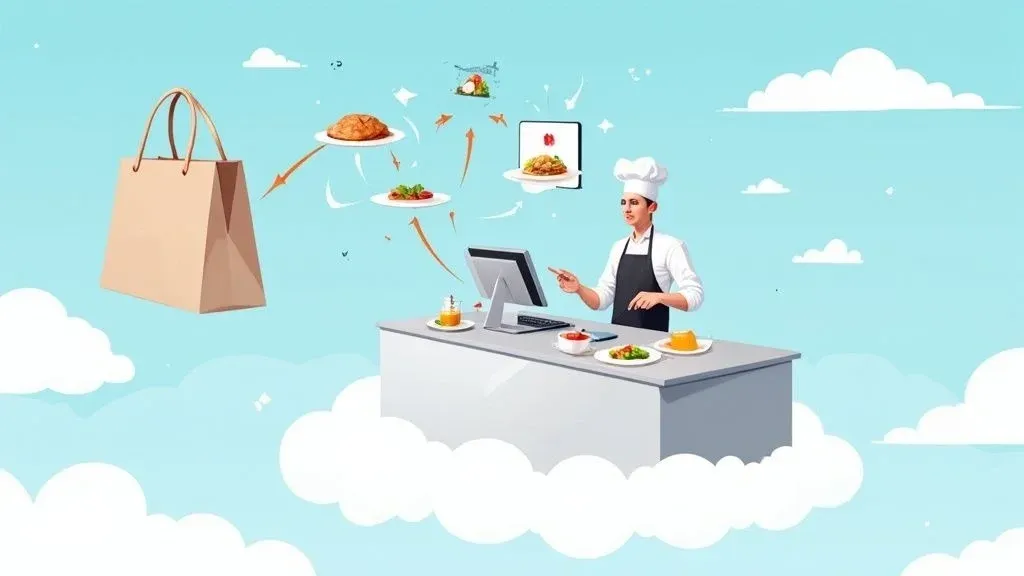
So, what exactly is a cloud kitchen?
In simple terms, a cloud kitchen is a restaurant designed exclusively for delivery. It has no dining room, no storefront, and no waitstaff. It’s just a professional kitchen focused on preparing food for online orders that come in through apps like DoorDash and Uber Eats.
Think of it as a high-efficiency food production hub. By eliminating the expensive, customer-facing aspects of a traditional restaurant, it allows operators to focus on one thing: making great food and getting it to customers quickly and efficiently. This streamlined model is a game-changer for restaurant efficiency, as it cuts costs and maximizes output for the delivery market.
How a Cloud Kitchen Works in Practice

The best way to understand a cloud kitchen is to see it as a “digital restaurant.” Instead of investing in prime real estate and expensive decor, every resource is channeled into kitchen efficiency and technology. Your entire relationship with the customer happens on a screen, not in a dining room.
This is a fundamental shift from a traditional restaurant, which has to balance the needs of dine-in guests, takeout customers, and delivery drivers all at once. A cloud kitchen has a single, clear mission: fulfill digital orders as accurately and rapidly as possible. This focus is its greatest strength, enabling optimized workflows that reduce costs and significantly increase order capacity.
The Core Restaurant Operations Workflow
The day-to-day process is built for speed and simplicity.
A customer places an order through an app like Uber Eats. That order is instantly sent to your kitchen’s display system. Your team prepares the meal, packages it securely for delivery, and hands it off to a driver at a dedicated pickup area. The entire cycle is designed to be fast and error-free.
Why It Matters: This entire model revolves around restaurant efficiency. By removing the complexities of a dining room, your kitchen can significantly reduce order fulfillment times, nearly eliminate errors from manual entry, and handle a much higher volume of sales, boosting staff productivity.
This approach is transforming the food industry. The global cloud kitchen market reached an impressive USD 64.47 billion in 2023 and is projected to hit USD 144.71 billion by 2032. The trend is clear: delivery-first food service is here to stay.
How Does It Compare to a Traditional Restaurant?
While both businesses prepare and sell food, their operational models are fundamentally different. Let’s compare them directly.
Cloud Kitchen vs. Traditional Restaurant: Key Differences
Feature Cloud Kitchen Traditional Restaurant Location Low-rent industrial or commercial areas Prime, high-foot-traffic locations Upfront Cost Low (kitchen equipment, basic rent) High (construction, decor, furniture) Staffing Lean (kitchen staff only) Large (chefs, servers, hosts, managers) Customer Interaction 100% digital (delivery apps, website) Face-to-face service in a physical space Primary Focus Restaurant delivery speed and accuracy In-person guest experience and ambiance Revenue Streams Digital delivery and takeout orders Dine-in, takeout, delivery, catering
The cloud kitchen model is engineered from the ground up to minimize overhead and maximize output for the modern food delivery ecosystem.
Why This is a Game-Changer for Restaurant Delivery
For any restaurant owner, the benefits are tangible and directly impact the bottom line. The cloud kitchen model significantly lowers the financial barrier to entry for new brands. For established restaurants, it offers a powerful, low-cost way to expand delivery reach without the massive expense of opening a new brick-and-mortar location.
Here’s what that means for your restaurant operations:
- Massive Cost Savings: Forget paying a premium for a downtown location. You also eliminate front-of-house labor, decor, and furniture expenses, leading to healthier profit margins.
- Fewer Mistakes: When orders flow directly from delivery apps into your kitchen, you remove the human error that occurs when staff manually re-enter orders. This directly translates to error reduction and less food waste.
- Higher Staff Productivity: Your kitchen team can focus entirely on cooking and packing. Without the distractions of a dining room, their productivity soars.
This operational model makes your food tech stack critical. A seamless POS integration between your delivery apps and your Point of Sale (POS) system is essential. For example, having DoorDash orders automatically appear in a POS like Clover or Square saves minutes on every order, prevents costly mistakes, and keeps your kitchen running smoothly. To succeed, you must first master the world of on-demand food delivery.
Actionable Takeaway: A cloud kitchen isn’t just a restaurant without seats. It’s a tech-driven food production engine designed for the delivery era. It trades the charm of a dining room for pure operational speed, efficiency, and profitability.
What Are the Different Cloud Kitchen Business Models?

Not all cloud kitchens are the same. Once you grasp the delivery-only concept, you can choose a strategy that fits your goals. Do you want to perfect a single culinary concept, or test multiple ideas at once? Your choice of model will define your entire operation.
First, let’s clarify some common terms. People often use “cloud kitchen,” “ghost kitchen,” and “virtual kitchen” interchangeably, but they have distinct meanings.
Think of cloud kitchen as the umbrella term for any delivery-only food business. A ghost kitchen is the physical, brick-and-mortar facility you operate from. A virtual kitchen is the digital brand—the “restaurant” that customers see and order from on apps like DoorDash or Uber Eats. Understanding these distinctions is key to a smart business plan.
The Single-Brand Model: Master of One
This is the most straightforward approach. You focus on one brand, one cuisine, and one menu, executing it perfectly from a kitchen optimized for delivery. Think of a high-end burger brand or an authentic noodle shop that exists only online.
This model is ideal for established restaurants looking to expand their restaurant delivery footprint without the high cost of a new physical location. It allows you to concentrate all your efforts on maintaining quality, building a strong digital brand, and ensuring consistency with every order.
The Multi-Brand Model: Conqueror of Cuisines
This is where things get truly strategic. With a multi-brand model, you operate several different virtual restaurants from a single physical kitchen. The same chefs, using a shared inventory of ingredients, could be preparing orders for “Speedy Wings,” “The Fresh Salad Co.,” and “Midnight Tacos” simultaneously.
This strategy is a masterclass in restaurant operations efficiency. You design menus around common ingredients, which significantly reduces food waste and increases your purchasing power. More importantly, you can capture different segments of the market on delivery apps, appealing to various tastes and price points from one location.
Why It Matters: The multi-brand model diversifies your revenue streams. If taco sales are slow on a Tuesday, your salad brand might be booming. This stabilizes your income and maximizes your kitchen’s productivity and profitability throughout the day.
Since cloud kitchens exist entirely online, success depends on understanding the digital marketplace, much like the broader e-commerce landscape in New Zealand demonstrates how online trends shape business.
The Shared Kitchen Model: The Low-Risk Launchpad
Often called a commissary or incubator kitchen, this model involves renting space in a larger, fully-equipped facility that hosts multiple food businesses. Instead of leasing and building out your own kitchen, you pay for a workstation or a block of time.
This is the perfect entry point for food entrepreneurs, pop-ups, or food truck owners who need access to a certified commercial kitchen. It allows you to test your concept, build a customer base, and generate revenue with minimal upfront financial risk.
Here’s a simple breakdown of the models:
Business Model Best For Key Advantage Potential Challenge Single-Brand Established brands expanding delivery. Strong brand focus & quality control. Limited customer audience. Multi-Brand Operators maximizing profitability. Diverse revenue streams & efficiency. Complex brand management. Shared Kitchen Startups and new concepts. Extremely low startup costs & flexibility. Less control over space and hours.
Each path offers unique benefits. To learn more about one of the most powerful strategies, explore our guide on the ghost kitchen business model.
Practical Next Step: Evaluate your business goals. If you run an existing restaurant, a single-brand kitchen is a smart way to expand. If you’re a new entrepreneur with multiple ideas, a multi-brand concept in a shared kitchen is your fastest path to market. Start by analyzing local delivery app data to identify unmet customer demands in your area.
Unlocking the Benefits for Your Restaurant Operations
So, why should a busy restaurant owner care about the cloud kitchen model? Because it offers powerful advantages that directly improve your bottom line by boosting efficiency and profitability. This isn’t just a trend; it’s a fundamental shift in restaurant operations that sharpens the focus on what matters most in the delivery era.
By removing the dining room, you unlock three game-changing benefits: radically lower costs, incredible business flexibility, and expanded market reach.
Drastically Reduced Costs
The most significant benefit is the massive reduction in overhead costs. A traditional restaurant invests heavily in prime real estate, front-of-house staff, and expensive decor. A cloud kitchen eliminates these expenses entirely.
You don’t need a location with high foot traffic; you can operate from a more affordable industrial area, potentially cutting your rent by more than half. This lean model means:
- No Front-of-House Staff: You eliminate salaries for servers, hosts, and bussers. Your entire team is focused on production.
- Minimal Build-Out: Your investment goes into high-quality kitchen equipment, not furniture and ambiance.
- Lower Utility Bills: A smaller, production-focused space consumes less energy and water.
These cost savings free up capital that you can reinvest into areas that drive growth, such as marketing, technology, or better ingredients, contributing to a healthier bottom line. This lean structure is a key driver of cloud kitchen growth.
Unmatched Flexibility and Agility
Imagine testing a new food concept without the crippling fear of failure. That’s the freedom a cloud kitchen provides. Because the initial investment is low, you can experiment with new menus and brands without risking your entire business.
For example, you could launch a virtual brand for gourmet grilled cheese on DoorDash. If it takes off, great. If not, you can pivot to a new concept next week using the same kitchen, staff, and core ingredients.
Why It Matters: This agility transforms your kitchen into a culinary laboratory. You can use real-time data from delivery apps like Uber Eats to identify local demand and launch a brand specifically to meet it. This data-driven approach gives you a massive competitive advantage and reduces risk.
Strategic Market Expansion
A cloud kitchen is your secret weapon for expanding into new territories. Instead of spending millions to build a new restaurant across town, you can launch a small, delivery-only kitchen in a new neighborhood for a fraction of the cost.
This allows you to tap into new customer bases that were previously outside your delivery radius. You can even use delivery platform data to identify “delivery deserts”—areas with high demand but limited options—and strategically place your kitchen there. It’s a data-driven way to grow your footprint and get your food to more people. For more on this, see our article on optimizing restaurant operations management.
Practical Next Step: Analyze your own delivery data. Identify where your orders are coming from and where they aren’t. You might discover an untapped market in your own city, perfect for launching your first low-cost cloud kitchen.
How Food Tech and POS Integration Drive Success
In a traditional restaurant, technology is helpful. In a cloud kitchen, it’s the central nervous system. It’s the engine that connects a customer’s order on their phone to the final handoff to a delivery driver. Without a seamless flow of information, the delivery-only model simply cannot operate profitably. Nailing your food tech stack isn’t an option; it’s a necessity.
Every modern restaurant operator knows the pain of the “wall of tablets.” One for Uber Eats, another for DoorDash, and more for other platforms, all demanding attention. This forces a staff member to manually re-enter every order from each tablet into your main Point of Sale (POS) system.
This manual process is slow, frustrating, and a primary source of costly errors. A single mistake can lead to a bad review and lost revenue. In a high-volume cloud kitchen, these small errors quickly add up, destroying your profit margins and grinding your kitchen to a halt.
The Power of Direct POS Integration
The solution is direct POS integration. This technology acts as a universal bridge between all your third-party delivery apps and your central POS system. Instead of orders appearing on multiple tablets, they are automatically and instantly injected directly into your main system, just like an order placed in-house.
Imagine an order from DoorDash appearing on your kitchen display screen (KDS) in seconds, without any manual intervention. This automation eliminates the manual entry step, the single biggest point of failure in any delivery workflow. It is this technological advantage that unlocks peak efficiency in a cloud kitchen.

By using tech to slash costs and increase flexibility, restaurants can significantly expand their market reach. This integration is the key to making a delivery-focused kitchen truly profitable.
Why It Matters: Automating order entry with a POS integration can reduce order errors by up to 95%. This not only saves money on remaking food but also protects your brand’s reputation on delivery platforms, where customer reviews are critical for success.
Streamlining Restaurant Operations with Automation
This automation delivers concrete benefits that improve both your profit and loss statement and your team’s daily workflow.
- Time Savings: Your team no longer wastes precious minutes juggling tablets and re-entering orders. They can focus on what they do best: cooking. This directly leads to faster ticket times, increased staff productivity, and quicker handoffs to drivers.
- Error Reduction: An automated order is a perfect order. There are no typos, missed special requests, or incorrect modifiers. This accuracy means significantly less food waste and happier customers who receive exactly what they ordered.
- Centralized Reporting: When all sales—from Uber Eats, your website, or DoorDash—flow into one POS, you get a clear, unified view of your business. This data is vital for making smart decisions about menus, marketing, and staffing.
Platforms like OrderOut are designed to be this critical bridge, connecting all your delivery channels directly into leading POS systems like Clover and Square to create a single, streamlined workflow. You can learn more in our guide to choosing the right POS integration software.
Let’s look at the real-world impact of automating your delivery order flow.
Impact of POS Integration on Kitchen Efficiency
Operational Task Manual Process (Without Integration) Automated Process (With POS Integration) Key Benefit Order Entry 30-90 seconds per order Instant (0 seconds) Frees up staff, accelerates ticket times Order Accuracy Up to 15% error rate on complex orders 99.9% accuracy Drastically reduces food waste & customer complaints Menu Syncing Manual updates on each platform (hours per month) Centralized updates pushed out instantly Ensures menu consistency, saves administrative time Financial Recs Manually compiling reports from each tablet All sales data unified in one system Accurate, real-time business performance insights
Manual processes are the enemy of profitability in a cloud kitchen.
Practical Next Step: Conduct a tech audit of your current delivery workflow. Identify every manual touchpoint in your order process, from receiving the order to entering it into your POS, and find technology to automate it. This is the fastest way to boost efficiency and profitability.
Measuring Profitability with the Right KPIs
Success in a delivery-only business is measured differently than in a traditional restaurant. Forget about table turnover or foot traffic. In a cloud kitchen, profitability is determined by a unique set of digital-first metrics.
Mastering these key performance indicators (KPIs) is essential for making smart, data-driven decisions that increase your margins and build a sustainable business.
The global demand for cloud kitchens is surging, driven by the consumer shift toward digital food ordering. The market was valued at USD 78.1 billion in 2024 and is expected to more than double to USD 176.4 billion by 2033. To claim your share, you must look beyond top-line revenue and focus on the numbers that indicate true financial health. You can find more data on this growing market trend.
Core Cloud Kitchen KPIs You Must Track
To get a clear picture of your virtual restaurant’s performance, you need to track these essential metrics. They provide direct insight into your operational efficiency, marketing effectiveness, and overall profitability.
- Average Order Value (AOV): This is the average amount a customer spends per order. A higher AOV is crucial because it means you’re generating more revenue from each transaction, which helps cover fixed costs and delivery commissions.
- Customer Acquisition Cost (CAC): This is the total cost to acquire a new customer. It includes expenses like social media ads and “first-time order” promotions on platforms like DoorDash.
- Delivery Commission Fees: These are the fees you pay to third-party apps like Uber Eats for each order they facilitate. Typically ranging from 15% to 30%, this is one of your largest variable costs and must be managed carefully.
Understanding these numbers is the first step toward building a profitable operation. For cloud kitchens, tracking KPIs related to customer loyalty is a game-changer for long-term success. Learn how to measure these effectively with this guide on customer retention metrics that actually matter.
Turning Metrics into Actionable Strategies
Knowing your numbers is important, but using them to improve your business is where the real value lies. KPIs should guide your strategy and help you fine-tune your operations.
Why It Matters: A busy cloud kitchen isn’t always a profitable one. By focusing on KPIs like AOV and managing commission costs, you shift your focus from just fulfilling orders to building a financially sound operation that can scale.
For example, if your AOV is low, it’s time to optimize your menu. You can create meal bundles, add high-margin sides, or offer family meal deals to encourage larger orders. This directly increases revenue per delivery, making each transaction more profitable. To see how these changes affect your bottom line, it’s essential to maintain a clear financial overview, as detailed in our guide to the restaurant profit and loss statement.
The Takeaway
Your immediate next step is to ensure your POS system can accurately track these KPIs. Whether you use a system like Square or Clover, having clean, centralized data is non-negotiable.
Start by calculating your current AOV and your total commission payout from the last month. This simple exercise will give you a clear baseline for improvement.
Ultimately, you can start building your restaurant with OrderOut. Set up your delivery integrations and start onboarding for Free in just a few clicks. Visit the OrderOut Dashboard to begin.
How to Launch Your Own Cloud Kitchen
Ready to launch your own cloud kitchen? Success depends on smart planning and implementing the right technology from day one. We’ve broken down the process into four actionable stages to provide a roadmap from concept to your first delivery order.
Let’s walk through it.
https://www.youtube.com/embed/8NQsUFbR_cg
Your first step isn’t in the kitchen—it’s in the data. Before you buy a single piece of equipment, you need to become an expert on your local restaurant delivery scene.
Step 1: Do Your Homework (Market Research)
Your primary goal is to identify a profitable gap in the market. This means diving deep into the delivery apps popular in your area, like DoorDash and Uber Eats, and analyzing what’s available in your target delivery zones.
What do you see? If there are a dozen burger joints and pizza places, the market is saturated. But what’s missing? Is there demand for high-quality, healthy lunch options? Are people searching for late-night food and finding limited choices?
Answering these questions will help you find your niche and is the difference between launching a thriving brand and a costly failure.
Step 2: Map Out Your Business Plan
Once you have a solid concept, it’s time to create a detailed business plan. This document will guide your decisions and is essential if you plan to seek funding.
Your plan should include:
- Startup Costs: List everything from kitchen equipment and initial food inventory to licenses and marketing.
- Operating Expenses: Detail your monthly costs, including rent, utilities, food costs, staff wages, and—most importantly—delivery app commission fees.
- Menu Pricing: Price your items to be profitable after accounting for all costs, especially the 15-30% commission taken by delivery platforms.
- Profitability Goals: Set realistic revenue targets for your first year to measure your success.
Step 3: Choose Your Tech Stack
In a business without a physical storefront, your technology is your operation. Selecting the right tools is a critical business decision that will determine your efficiency.
The two most important components are your Point of Sale (POS) system and a delivery integration tool.
A powerful POS like Clover or Square will serve as your central command center. Then, a platform like OrderOut seamlessly connects all your delivery apps directly to your POS, eliminating the need for multiple tablets.
This central hub allows you to view all your delivery orders in one place, manage menus across multiple platforms, and gain insights into your performance. By connecting your systems, you eliminate manual order entry, saving staff time and reducing costly errors.
Step 4: Market Your Brand Online
Without a physical location, your online presence is everything. You need a focused digital marketing strategy to generate buzz and drive orders.
Start with a clean website and active social media profiles. Your most powerful sales tool will be high-quality food photography, as customers eat with their eyes first when scrolling through an app.
Run targeted social media ads aimed at people within your delivery radius. Collaborate with local food influencers to get authentic reviews. Your goal is to build an online community around your brand that encourages repeat business.
Practical Next Step: The most impactful action you can take now is to build your tech foundation. Get your restaurant’s delivery integrations set up by visiting the OrderOut Dashboard and onboarding for free.
Still Have Questions? Here Are Some Answers
Diving into the world of delivery-only restaurants is a big step, and it’s natural to have questions. Here are answers to some of the most common queries from restaurant owners considering what a cloud kitchen is and how it can work for them.
What’s the Real Startup Cost for a Cloud Kitchen?
The short answer: it’s a fraction of the cost of a traditional restaurant. While a full-service restaurant can easily cost hundreds of thousands of dollars, a lean cloud kitchen can be launched for as little as $20,000 to $50,000.
This budget covers the essentials: kitchen equipment, the first month’s rent in an industrial space, licenses, and initial food inventory. The biggest savings come from what you don’t need: a dining room, expensive decor, or front-of-house staff. This significantly reduces both your startup risk and your ongoing operational costs.
Can I Add a Virtual Brand to My Existing Restaurant?
Absolutely. This is one of the smartest ways to enter the delivery-only market. If you already operate a restaurant, you have the biggest assets in place: a certified kitchen, a trained team, and established supplier relationships.
You can launch a completely new, delivery-only brand from your existing kitchen. For instance, if your pizza ovens are underutilized during lunch, you could launch a virtual sandwich brand on DoorDash. You’re leveraging your current space and staff to create a new revenue stream with minimal additional overhead.
How Do You Market a Restaurant Nobody Can See?
This is the key question. Without a physical storefront, your marketing must be 100% digital. You need to meet your customers where they are: online.
Why It Matters: Without a physical location, your online presence is your restaurant. Smart digital marketing isn’t just a “nice to have”—it’s the engine that brings in every single customer and drives your entire business.
Here’s where to focus your marketing efforts:
- Master the Delivery Apps: Your menu on platforms like DoorDash and Uber Eats is your new storefront. Invest in professional food photography—it’s the first thing customers see.
- Target Your Ads: Use social media platforms like Instagram and Facebook to run ads that specifically target potential customers within your delivery radius.
- Build Your Digital Reputation: Connect with local food bloggers and influencers. An authentic review from a trusted source can generate more buzz than traditional advertising.
By focusing your marketing online, you can engage customers at the exact moment they are making their dining decisions. This is where your food tech stack becomes your most powerful marketing tool.
Ready to streamline your delivery operations and embrace the future of the restaurant industry? OrderOut consolidates all your delivery apps into a single, simple dashboard that integrates with your POS. Eliminate tablets, reduce manual errors, and take control of your delivery business. You can get started for free in just a few clicks.