
What Is a Pop Up Restaurant? Essential Guide
· Thibault Le Conte
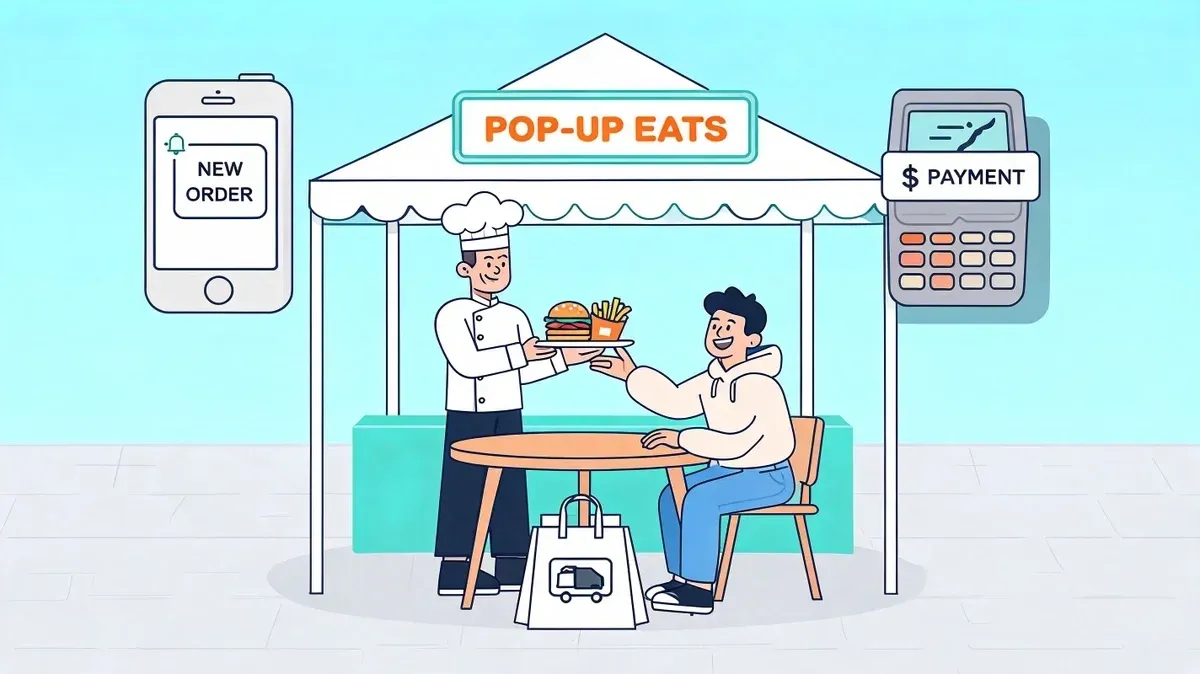
If you still think a pop-up restaurant is just a side project or a chef’s creative detour, the market says otherwise. Yelp data showed new pop-up openings rose by over 105% from 2022 to 2023, the highest surge among restaurant concepts, and the global market was valued at $4.1 billion in 2024 with a projection of $12.8 billion by 2033, according to Push Operations’ overview of the pop-up restaurant market.
A simple answer to what is a pop up restaurant is this. It’s a temporary food business that operates for a limited run, in a borrowed, mobile, event-based, or short-term space. The format is flexible. The margin for operational mistakes is not.
The operators who win with pop-ups don’t just have a strong concept. They run tight service, clean prep, fast payments, accurate inventory, and reliable order flow across dine-in, pickup, and on-demand service models. That’s what turns a short run into a real business instead of an expensive experiment.
The Rise of the Pop-Up Restaurant
A pop-up restaurant used to feel niche. Now it’s a legitimate operating model.
The appeal is obvious. A pop-up gives owners and chefs a way to test a menu, reach a new neighborhood, create urgency, and build buzz without committing to a permanent lease first. It can be a one-night chef collaboration, a weekend stall at a market, a month-long storefront, or a delivery-first concept running out of a shared kitchen.
Why operators are drawn to the model
Traditional restaurants demand long planning cycles and fixed overhead. Pop-ups give operators room to move faster. That speed matters if you’re validating a cuisine, launching a sub-brand, or filling downtime in an existing kitchen.
What matters just as much is control. A short-term concept lets you simplify the menu, tighten labor, and learn quickly from guest response. You can see which dishes sell, which service times break down, and whether your brand travels well on delivery apps like Uber Eats or DoorDash.
Practical rule: A pop-up works best when the concept is simple enough to execute consistently in an unfamiliar environment.
The creative side gets attention. The backend determines survival
Most pop-up advice stops at theme, menu, and location. That’s incomplete.
Temporary restaurants often run in spaces that weren’t built for full restaurant service. That creates pressure fast. Payment acceptance has to work. Online orders have to be visible in one place. Inventory can’t drift out of sync. Staff can’t waste service time retyping tickets from multiple tablets.
That’s why the strongest pop-ups behave less like passion projects and more like compact, well-designed restaurant operations. The operators who understand this early have a much better shot at running a profitable service instead of spending the night chasing missed tickets and stock problems.
Understanding Pop-Up Restaurant Formats and Models
Not every pop-up should look the same. The right format depends on what you’re trying to prove.
Some owners want a low-risk menu test. Others want a vehicle for a new brand. Some just need a temporary revenue stream using space they already have. If you’re also exploring off-premise concepts, it helps to compare these models with virtual brands on DoorDash, because the operational overlap is real.
Five common pop-up formats
Format Best use case What works well Common trade-off Guest chef takeover Testing a concept inside an existing restaurant Existing kitchen and front-of-house reduce setup friction You work around someone else’s layout and service rules Food truck or cart Markets, high-footfall areas, roaming service Mobility and strong street visibility Tight prep space and limited storage Temporary storefront Brand launch or neighborhood test Feels like a real restaurant without a long lease Build-out and staffing can become heavier fast Delivery-only pop-up New menu line or digital-first concept Easy to focus on online ordering and packaging Brand discovery depends on app visibility and menu clarity Event-based pop-up Festivals, private events, community activations Built-in audience and urgency Demand can spike unevenly and strain service
How to choose the right model
A guest chef takeover is often the cleanest starting point for a first-time operator. You’re using a kitchen that already has core infrastructure, which lowers setup stress. The downside is less freedom. Storage, line flow, prep windows, and cleaning standards are shared.
A food truck or cart is strong when your food is fast, tight, and portable. Fried items, handhelds, bowls, and drinks usually fit better here than menus that need layered plating or lots of finishing steps.
A temporary storefront gives you more control over guest experience. It’s a better fit when presentation matters, reservations matter, or you want to see how a neighborhood responds to your brand over a longer run.
A pop-up format should match the bottleneck you can manage best. If your team is strong on production but weak on front-of-house, a delivery-only model may make more sense than a seated concept.
Match the model to the business goal
Use a simple filter before you commit:
- Menu testing: Borrow an existing kitchen or run delivery-only.
- Brand launch: Temporary storefront or longer residency.
- Audience growth: Event-based pop-up or food truck.
- Extra revenue from existing capacity: Nighttime kitchen takeover in a restaurant that closes early.
What doesn’t work is choosing the flashiest format first and solving operations later. That’s backwards. Start with the format your team can execute cleanly.
Pop-Up Financials and Key Business Goals
A pop-up can serve different business goals, but the math gets real quickly.
Some operators launch one to test a menu before signing a lease. Others use it to enter a new market, create press-worthy demand, or add revenue from underused kitchen capacity. All are valid. What changes in a pop-up is the speed at which weak assumptions get exposed.
Daily economics matter more than monthly theory
A permanent restaurant can sometimes absorb a bad week and recover. A pop-up doesn’t get that luxury. Its selling window is compressed, and every service carries more weight.
According to Financial Model Templates’ pop-up restaurant benchmark, a pop-up with about $19,220 in monthly fixed overhead and a $33 contribution margin per cover needs roughly 20 covers per day to break even. That’s why every order matters. It’s also why slow order handling is more than an annoyance. It directly affects viability.
Common goals behind a pop-up
- Concept validation: You learn what guests buy, not what they say they’d buy.
- Market entry: You can test one neighborhood before committing further.
- Brand marketing: A limited run creates urgency and can sharpen your identity.
- Revenue extension: Existing operators can turn idle prep capacity into sales.
If your aim is growth, the pop-up still needs discipline. Brand buzz without throughput doesn’t pay the bills. Menu excitement without repeatable execution won’t survive the second weekend.
For operators tightening the commercial side of the model, this guide on how to increase restaurant sales is useful because it focuses on practical levers rather than vague promotion ideas. That mindset matters even more in a short-run concept.
The mistake that quietly kills margin
Manual order entry is one of the fastest ways to leak profit in a pop-up. If one staff member is bouncing between an in-person line, a phone, and separate Uber Eats and DoorDash tablets, errors multiply. Wrong modifiers get missed. Orders print late. Prep gets sequenced badly. Guests wait longer than they should.
That problem gets worse when the menu isn’t engineered tightly. If you haven’t already pressure-tested the numbers, review how to calculate food cost percent before launch. Pop-ups need a menu that’s operationally light and financially clear.
Bottom line: In a pop-up, speed and accuracy are financial controls, not just service standards.
Your Pop-Up Restaurant Operations Checklist
A pop-up succeeds before opening day. Most failures start in planning, not in service.
I’ve seen operators obsess over the menu and forget the loading dock, hand sink, Wi-Fi reliability, or garbage flow. Those aren’t glamorous details, but they decide whether your team can work fast without tripping over itself.
Pre-opening checks that deserve real attention
- Location fit: Choose a site that matches your service model. A dinner tasting menu needs a very different setup than a lunch counter or delivery pickup point.
- Licenses and permits: Temporary doesn’t mean informal. Confirm the local requirements for food service, event operations, and alcohol service if applicable.
- Utilities and access: Test power, water, refrigeration, ventilation, and delivery driver access before menu finalization.
- Insurance and liability: Make sure the venue agreement and your coverage align with how service will operate.
Staffing for a short run
Pop-ups punish overstaffing and understaffing in different ways. Too many people in a small space creates confusion. Too few creates delays, skipped checks, and rushed packaging.
A better approach is to build around stations, not titles. Ask who owns expo, who owns packaging, who watches incoming digital orders, who handles guest questions, and who resets prep during the rush. In a compact operation, role clarity matters more than hierarchy.
Keep training narrow. Staff don’t need a giant handbook for a three-night pop-up. They need a short, repeatable service flow they can execute under pressure.
A practical checklist for launch week
-
Run a mock service
Take test orders from multiple channels and walk them through prep, firing, packaging, and handoff. -
Limit the menu
Keep items that share ingredients and equipment. Complexity slows everyone down. -
Set packaging standards
Labeling, modifiers, sauces, and delivery readiness should follow one system. -
Build a cleaning rhythm
Temporary spaces get messy quickly. A simple restaurant cleaning checklist keeps sanitation from becoming an end-of-night scramble. -
Create a cutoff plan
Decide in advance when to pause orders if the kitchen hits capacity.
What doesn’t work
What fails most often is wishful thinking. Operators assume the venue will “figure itself out,” that staff will adapt on the fly, or that service can survive with ad hoc communication. Pop-ups are less forgiving than permanent stores because there’s no routine yet. You have to create the routine from scratch.
Building Your Pop-Up Restaurant Tech Stack
A modern pop-up without the right tech stack is harder to run than it needs to be.
Temporary venues create unusual pressure. You may be serving a short rush with a small team, limited prep space, and guests paying in different ways. Add delivery apps, and the operation becomes fragile if your systems don’t talk to each other.
According to Square’s pop-up restaurant guidance, pop-ups face concentrated high-volume periods and need technology that can process simultaneous orders and payments from multiple channels in real time. That same guidance notes the need to prevent stockouts and order errors. In practice, that means POS integration isn’t optional if you want consistent profitability.
Start with payment and order flow
Your first requirement is a flexible POS that can be deployed fast and accept the payment methods guests expect. For many operators, that means tools like Clover or Square, both of which fit pop-up environments well because they’re built for mobility and quick setup.
What matters isn’t the logo on the hardware. It’s whether the system fits the way your service runs.
Look for these basics:
- Mobile-friendly checkout: Staff should be able to take payment where the guest is, not force every transaction into one bottleneck.
- Real-time menu control: If an item sells out, you need to stop selling it across channels fast.
- Clear modifier handling: Pop-ups can’t afford remake-heavy service.
- Reliable reporting: You need clean sales data after each service, not a pile of manual reconciliation.
Why delivery integration changes the economics
Here’s where many pop-ups lose control. They launch on Uber Eats and DoorDash because those apps help them get discovered, but they manage the orders manually on separate tablets. During the rush, someone has to watch each screen, re-enter each ticket into the POS, and hope nothing gets missed.
That setup burns time and attention. It also shifts labor away from prep, packing, and guest service.
For operators trying to optimize restaurant labor spending, this is one of the clearest workflow problems to fix first. If a staff member spends service time acting as a human bridge between delivery tablets and the POS, you’re paying for avoidable friction.
The tech stack that works in practice
A clean pop-up stack usually includes:
Component Job in the operation Why it matters POS system Takes orders and payments Keeps front-of-house and reporting organized Delivery integration Pulls app orders into one workflow Reduces manual entry and missed tickets Inventory sync Updates item availability in real time Prevents overselling Kitchen printing or display Routes orders clearly to production Speeds prep and reduces confusion Cloud reporting Preserves service and sales records Helps you review each run accurately
If you want a deeper view of how the pieces fit together, this guide to an integrated POS system is worth reviewing before launch.
A short demo can also help operators visualize what connected ordering should look like in a live environment:
The best pop-up tech disappears into the background. Staff stop babysitting tablets and start focusing on production, packaging, and guests.
Marketing Your Pop-Up for a Sold-Out Run
Good pop-ups rarely rely on foot traffic alone. They create anticipation before the first service.
The strongest marketing plans use the temporary nature of the concept as the selling point. If guests think they can try it anytime, urgency disappears. If they believe they have one narrow window, they act now.
Build demand before you open
Start with visual platforms. Instagram is still one of the best channels for a pop-up because the format rewards atmosphere, plated food, and behind-the-scenes prep. Short clips of testing, packaging, and menu drops work better than polished brand language.
Email works differently but just as well. A short list of loyal customers can fill early seatings, push preorders, or create a “first access” release that makes the launch feel exclusive.
Try this sequence:
- One week out: Reveal the concept and dates.
- A few days later: Show the menu and explain the format.
- Closer to launch: Open preorders or release booking details.
- During the run: Post live service moments, sellouts, and guest reactions.
Partnerships beat generic promotion
Local collaboration is one of the simplest ways to make a pop-up feel established quickly. A coffee shop can host a breakfast sandwich concept. A brewery can pair with a taco pop-up. A retailer can help expose your brand to a different customer base.
What matters is fit. The partner’s audience should already overlap with the kind of guest you want.
If the venue or partner already has trust with the neighborhood, your pop-up borrows that trust immediately.
Delivery apps are also marketing channels
Operators often treat DoorDash and Uber Eats as pure fulfillment tools. They’re also discovery platforms. A customer browsing for dinner may never see your Instagram post, but they can still find your pop-up through a delivery app if the menu, photos, and availability are dialed in.
That changes how you think about your listing. Your item names have to be clear. Photos need to sell the product. Prep timing has to be realistic. And if your menu sells out in-house, app availability needs to update quickly so guests don’t order something you can’t make.
Marketing creates demand. Operations protect it. A sold-out first night doesn’t help much if service errors turn that attention into refunds and bad reviews.
Launch Your Pop-Up with Confidence
So, what is a pop up restaurant in practical terms?
It’s a temporary restaurant model that gives owners and chefs a fast way to test ideas, build a brand, and create revenue without following the full path of a permanent opening. That flexibility is the opportunity. The short runway is the challenge.
The operators who succeed usually get the same things right. They choose a format that fits the goal. They keep the menu tight. They plan staffing around stations and bottlenecks. They set up payment, delivery, and inventory systems before the first order arrives. They don’t wait until service to discover that tablets, printers, packaging, and prep flow don’t line up.
That’s the biggest practical takeaway. A pop-up is not easier than a traditional restaurant. It’s more compressed. Because the timeline is shorter, operational mistakes show up faster and cost more in the moment.
If you’re planning a pop-up, don’t start with signage or menu design alone. Start with the order path. Decide how in-person, pickup, and delivery orders will move from customer to kitchen to handoff without manual re-entry and without confusion.
Before you book the venue, make sure your tech is ready to support the run.
If you want to connect delivery apps to your POS and remove manual order entry before launch, OrderOut is built for exactly that workflow. Restaurant owners can get started in a few clicks by onboarding free through the OrderOut dashboard.