
What Is a Cloud Kitchen and How Does It Work?
· Thibault Le Conte
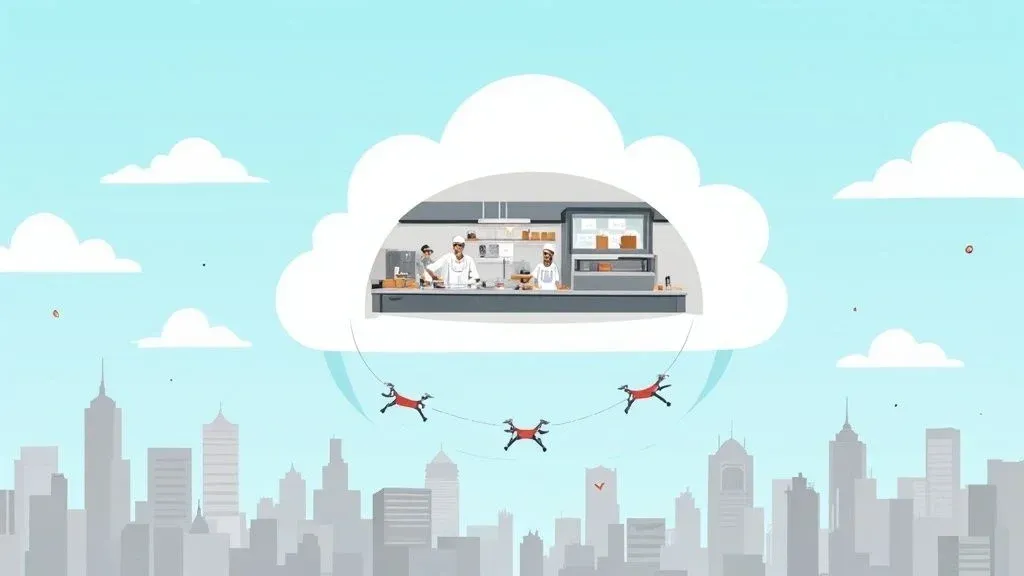
Imagine a restaurant with no tables, no waiters, and no storefront. In simple terms, it’s a kitchen built only for making food for delivery. This setup, often called a ghost kitchen, is laser-focused on one thing: getting amazing food out the door for restaurant delivery through apps like DoorDash and Uber Eats.
Why does this matter to a restaurant owner? It dramatically lowers costs and boosts efficiency. By removing the expensive dining room and front-of-house staff, you can focus all your resources on producing high-quality food quickly, which is key to succeeding in the competitive delivery market.
Breaking Down the Cloud Kitchen Model
So, what exactly is a cloud kitchen? It’s a professional cooking facility designed exclusively for delivery-only meals. You might hear it called a ghost kitchen or virtual kitchen, but the core idea is the same: a restaurant without a physical dining space for customers.
By ditching the entire front-of-house operation—the dining room, the hosts, the waitstaff—these kitchens can pour every ounce of their resources into what matters most: making fantastic food, fast. This lean approach directly impacts your restaurant’s bottom line.
This model completely flips the script on how restaurants operate. Forget paying a fortune for a spot with tons of foot traffic. Instead, you can set up shop in a much more affordable industrial space. This slashes startup costs and keeps your monthly overhead low, making it one of the smartest and most flexible business models in the food world today. It’s no wonder the global cloud kitchen market is exploding, projected to hit around USD 82 billion in 2025. This isn’t just a trend; it’s a massive shift in how people eat. You can dive deeper into the cloud kitchen industry’s rapid expansion to see what it means for restaurants like yours.
Why This Model Matters for Your Restaurant
The real magic of the cloud kitchen lies in its efficiency and cost-effectiveness. Here’s what that actually looks like on the ground:
- Leaner Operations & Higher Margins: With lower rent and no front-of-house payroll, your profit margins get a serious boost. This is a direct cost saving that you can see every month.
- Sharper Focus & Increased Productivity: Your kitchen team can concentrate purely on cooking, without the constant interruptions of a busy dining room. This means faster prep, fewer errors, and more consistent quality.
- Smarter Decisions with Data: When you’re all-digital, you get a firehose of useful data. You can easily track peak hours, see which dishes are selling, and truly understand what your customers love, allowing you to optimize your menu for profitability.
The coolest part? A cloud kitchen lets a single kitchen act like several different restaurants. You could be making pizzas under one brand name and slinging tacos under another, all from the same space. This lets you maximize your ingredients, appeal to different customers, and keep your staff productive without the expense of opening a second location.
This setup is perfect for experimenting. You can launch a new virtual brand online, see if it gets any traction, and then decide if it’s worth a bigger investment. That’s a level of flexibility a traditional restaurant just can’t match. At the end of the day, it’s about meeting customers in the delivery-first world, boosting your team’s productivity, and building a more resilient business.
To make it even clearer, let’s look at a side-by-side comparison.
Traditional Restaurant vs Cloud Kitchen at a Glance
This quick comparison highlights the fundamental differences between a traditional dine-in restaurant and a modern cloud kitchen model.
Feature Traditional Restaurant Cloud Kitchen Primary Focus Dine-in experience and customer service Delivery-only, food production efficiency Location High-traffic, prime retail space (expensive) Industrial or low-cost areas (affordable) Upfront Costs Very high (real estate, decor, FOH staff) Low (kitchen equipment, minimal space) Staffing Chefs, waitstaff, hosts, bartenders, managers Primarily kitchen staff and delivery coordinators Customer Interaction Face-to-face in a physical dining room Entirely digital, through apps and online platforms Menu Flexibility Difficult to change; requires printing new menus Easy to update and test new items or brands instantly Data & Analytics Limited to POS sales and manual feedback Rich data on ordering patterns, customer preferences
As you can see, the cloud kitchen strips away the non-essential elements to create a lean, agile, and data-driven operation built for the modern food economy.
How a Cloud Kitchen Works From Order to Delivery
Ever wonder what happens after a customer hits “place order”? In a cloud kitchen, that tap kicks off a high-tech, super-efficient process designed to get food to the customer’s door, fast.
It starts with a digital order from an app like Uber Eats. Instead of a jumble of tablets all beeping at once, a smart cloud kitchen funnels everything into a single, unified system. This is where POS integration with systems like Clover or Square becomes essential. The integration automatically accepts the order and sends it straight to the kitchen, eliminating the need for staff to manually punch it in. This single step saves time, prevents costly errors, and gets food cooking faster.
From Digital Order to Physical Meal
With the order locked in, the kitchen crew springs into action. Their workspace is a pure production zone. No front-of-house distractions, no tables to wait on—just a laser-focused environment where every station is optimized for cooking and packaging food for travel.
This setup is a massive productivity booster. Chefs can get in the zone, focusing entirely on making sure every dish is perfect and consistent. That level of quality is what brings customers back and racks up those five-star reviews. As you can imagine, having the right restaurant order management software is the backbone that makes this all possible.
This handy infographic breaks down the journey from your phone screen to your front door.
It’s a perfect visual of how tech acts as the glue connecting you, the kitchen, and the driver.
The Final Hand-Off
Once the meal is cooked and packed up to stay hot and fresh, it heads to a dedicated hand-off station. A delivery driver, tracked through the app, swings by for a quick, seamless pickup. Companies like Unidad Logistics specialize in this crucial final step, ensuring the food gets from the kitchen to the customer without a hitch.
Why it matters: The entire workflow is built for speed and accuracy. For a restaurant owner, that translates into handling more orders with less staff, reducing errors, and keeping customers happy. This efficiency directly impacts profitability and allows your business to scale without the usual growing pains.
The bottom line? A winning cloud kitchen is about more than just great food. It’s about mastering a tech-driven process that puts efficiency first.
Choosing Your Cloud Kitchen Business Model
So, you’re sold on the idea of a cloud kitchen. Great. But it’s not a one-size-fits-all game. Picking the right business model is the first real decision you’ll make, and it’s a big one that will shape everything from your budget to your day-to-day operations. This choice is a huge piece of your food tech puzzle.
Getting this right can set you on a path to serious efficiency and profit. Getting it wrong? You’ll be fighting uphill battles you didn’t need to. Let’s walk through the most common setups so you can figure out which one makes the most sense for your restaurant.
Independent Single-Brand Model
This is the most straightforward approach. You run a single restaurant brand out of your own private, delivery-focused kitchen. The easiest way to think about it is taking the delivery side of your traditional restaurant and giving it a new home—one without the massive overhead of a dining room.
This model is a fantastic fit for established restaurants that already have a loyal customer base. You get to expand your delivery footprint without sinking a ton of cash into another storefront. Best of all, you maintain total control over your restaurant operations. From the menu to the final product, every order is 100% your brand.
Multi-Brand Host Kitchen Model
Now, this is where things get really clever. With the multi-brand model, you operate several distinct virtual brands from a single kitchen space. Imagine your pizza joint using the same kitchen, staff, and ingredients to launch a separate online brand for killer chicken wings or another for gourmet Italian subs.
This strategy is a powerhouse for a few key reasons:
- Maximize Revenue: You’re not just a pizza place anymore. You can capture customers craving wings, sandwiches, and more—all from one kitchen.
- Improve Staff Productivity: Slow Tuesday afternoon for pizza? The wing orders might be flying in, keeping your team productive and your labor costs justified.
- Reduce Food Waste: That extra chicken, cheese, and bread? It can be cross-utilized across multiple menus, squeezing every last drop of value from your inventory.
For a real-world example, a restaurant operator could use their existing kitchen and staff to launch a “Wing World” brand exclusively on DoorDash. This allows them to capture a new revenue stream during slow periods without any additional rent or significant equipment costs, boosting overall efficiency.
Shared Kitchen or Commissary Model
If you’re looking to dip your toes in the water with the absolute lowest startup cost, the shared kitchen model is your on-ramp. Here, you rent a station and equipment in a larger, professionally licensed commercial kitchen, working alongside other food entrepreneurs. You only pay for the time and space you actually use, which completely changes the financial equation.
It’s the perfect way to test-drive a new concept before you even think about signing a long-term lease. While independent cloud kitchens still owned about 62.1% of the global market in 2024, shared kitchens are the fastest-growing segment for this very reason. You can dive deeper into the market dynamics from this research.
Making the right choice starts with knowing all your options. For a complete rundown, check out our detailed guide on the ghost kitchen business model.
Practical Next Step: Evaluate your current resources and goals. If you have an established brand, the independent model offers control. If you want to maximize existing assets, go multi-brand. If you’re launching a new concept, a shared kitchen is the lowest-risk way to start.
The Big Wins for Your Restaurant: Cost Savings & Efficiency
So, what’s the big deal? Why are so many operators jumping on the delivery-only train? It really boils down to some serious operational and financial perks that hit your bottom line and sharpen up your entire restaurant operation.
The most obvious win is just how much you save on overhead. It’s a game-changer.
When you ditch the dining room, you instantly cut out costs for high-street rent, fancy decor, and all your front-of-house staff. This lean-and-mean model completely flips your cost structure on its head. Suddenly, you have more cash to pour into what actually makes the food great: top-notch ingredients and smart kitchen tech. These cost savings directly improve your profit margins.
Test Ideas Without Betting the Farm
This stripped-down setup also means you can get creative and test out new menu ideas with almost no financial risk.
Got a killer concept for a new gourmet burger joint? You can spin it up as a virtual brand right out of your current kitchen. No need to spend a fortune on a brand-new brick-and-mortar spot.
This kind of agility is huge. You can react to what customers want on the fly, ditching concepts that aren’t hitting the mark and putting more gas behind the ones that are. It’s like having a low-risk food lab right at your fingertips.
Cloud kitchens are facilities built purely for preparing food for delivery, with no space for customers to dine in. They’re taking off because they offer convenience, slash operational costs, and let you run multiple virtual brands from just one kitchen. You can dig into more stats on the rise of cloud kitchens on imarcgroup.com.
Work Smarter, Reach Further
When your kitchen is 100% focused on delivery, your team can hit a whole new level of efficiency. There are no dine-in customers to worry about, no tables to turn. It’s all about getting orders out the door, fast and right. This laser focus cuts down on mistakes and makes your entire workflow hum, boosting staff productivity.
This model also plugs you into a much, much bigger audience through delivery apps. You’re not just relying on the people walking past your door anymore. By using smart SaaS for restaurants, you can get your menu in front of thousands of hungry customers who are already looking for their next meal online. Your kitchen becomes a powerful growth engine.
Want to learn more? Check out our guide on how SaaS is changing the restaurant industry.
The takeaway here is simple: a cloud kitchen is a smarter, leaner way to run a food business. It adds up to better profit margins, more freedom to adapt, and a much tougher, more resilient operation.
Why POS Integration Is Your Secret Weapon for Restaurant Operations
Great food is only half the battle in a successful cloud kitchen. The other half? Smart tech. In simple terms, your Point of Sale (POS) system is the brain of your operation. If it isn’t connected to your delivery apps, you’re creating unnecessary work and inviting costly mistakes.
Picture this: your counter is littered with tablets. One for DoorDash, another for Uber Eats. They’re all pinging, and your staff has to manually punch every single order into your main POS. This is a huge time-waster and an open invitation for human error. One typo means a wrong order, an angry customer, and a bad review. This chaos is a direct threat to your efficiency and profitability.

Unifying Your Food Tech for Maximum Efficiency
This is where a solid POS integration completely changes the game. By connecting all your delivery services directly into your central POS, you eliminate manual data entry. This automation is the key to unlocking a new level of efficiency for your restaurant operations.
An order placed on Uber Eats instantly shoots directly to your kitchen printers, looking just like an order placed in-house. This makes a massive difference:
- Error Reduction: No more typos. The kitchen gets exactly what the customer ordered, every time.
- Increased Staff Productivity: Staff can stop being data entry clerks and focus on what they do best—cooking and packing food. This directly impacts your labor costs and output.
- Faster Service: Orders hit the kitchen instantly, cutting down prep delays and getting food to the customer faster.
For example, a cloud kitchen using Clover can integrate with DoorDash and Uber Eats so that every online order automatically prints in the kitchen. This eliminates the need for a staff member to watch tablets, manually enter orders, and risk making mistakes, saving valuable time during the dinner rush.
This level of automation through a system like Square also means all your sales data is in one place, making accounting and inventory management much simpler. To really see how this works, check out our deep dive on POS system integration.
Practical Takeaway: Don’t let manual order entry slow you down. Integrating your delivery apps with your POS is the most powerful and actionable step you can take to improve speed, accuracy, and profitability.
How to Launch Your Own Cloud Kitchen
So, you’re ready to jump into the delivery-only restaurant game? Smart move. But launching a cloud kitchen isn’t just about cooking great food; it’s about blending that culinary skill with some serious restaurant operations savvy. Having a solid game plan from the get-go is what separates the success stories from the flameouts.

First things first: do your homework. Dive into your local market and see what’s missing. What are people constantly searching for on apps like Uber Eats? Is there an untapped niche for killer vegan tacos or gourmet grilled cheese? This research is gold—it’ll shape your entire concept and menu.
Next up, you need to pick a business model that actually works for your budget and goals. You could go it alone with an independent setup, rent a spot in a shared kitchen, or even spin up a virtual brand from your current restaurant’s kitchen. This decision will dictate your startup costs and how you run things day-to-day.
Building Your Foundation
Once you’ve settled on a model, it’s time to craft a menu built for restaurant delivery. This is crucial. You have to think about dishes that not only taste amazing but can also handle a 20-minute trip in a backpack. We’ve got a comprehensive guide for this; check out our opening a restaurant checklist to make sure you’ve got all your bases covered.
The last piece of the puzzle—and honestly, the most important—is getting your food tech sorted. Juggling orders from a half-dozen different delivery apps manually is a recipe for disaster. You have to automate this process to reduce errors and save time.
Here’s the bottom line: a solid tech foundation is non-negotiable. Your ability to streamline orders, cut down on mistakes, and free up your staff is what will make or break your business.
A powerful first step is to solve the biggest operational headache: managing all those delivery platforms. Integrating them directly into your POS system saves countless hours and prevents costly errors.
Practical Next Step: Start by automating your delivery order flow. You can see how OrderOut connects all your apps to your POS and start onboarding for free in just a few clicks at https://dashboard.orderout.co.
Your Top Cloud Kitchen Questions, Answered
Got questions about getting a cloud kitchen off the ground? You’re not alone. Let’s tackle some of the most common things operators ask about the costs, logistics, and day-to-day realities of running a delivery-only brand.
How Much Does It Really Cost to Start?
The biggest draw for most operators is the dramatically lower startup cost compared to a traditional restaurant. You can get a cloud kitchen up and running for a fraction of what a brick-and-mortar would cost, mainly because you’re ditching the most expensive parts: prime real estate, a dining room build-out, and front-of-house staff.
Instead, your main investments are focused on what really matters for delivery:
- The Right Gear: Ovens, prep stations, and coolers tailored to your specific menu.
- Affordable Space: Renting a spot in a less expensive commercial or industrial area.
- Licenses & Permits: The usual health and safety paperwork to operate legally.
- Essential Tech: Smart software for POS integration and managing a flood of online orders. This is a key area where investing upfront saves you money and time in the long run.
Can I Really Run Multiple Brands From a Single Kitchen?
Yes, and you absolutely should! This is one of the superpowers of the cloud kitchen model and a brilliant strategy for beefing up your restaurant operations.
Think of it this way: from one kitchen, you could be pushing out orders for a pizza joint, a wing spot, and a healthy salad concept all at the same time. This lets you capture totally different customer cravings and maximize your kitchen’s earning potential without adding a single square foot of space. It keeps your staff busy across different mealtimes and even helps you use ingredients more efficiently across menus, reducing food waste and boosting productivity.
Do I Need to Hire My Own Delivery Drivers?
Nope, and that’s a huge relief. The vast majority of cloud kitchens plug directly into the driver networks of third-party restaurant delivery apps like DoorDash, Grubhub, and Uber Eats.
This gives you instant access to their massive customer bases and sophisticated delivery logistics without the headache and expense of managing your own drivers. When you connect these apps to a POS system using a tool like Square, the whole process—from the moment an order is placed to when it’s handed off to the driver—becomes completely automated.
Ready to streamline your delivery operations and escape tablet hell? OrderOut integrates all your delivery apps directly into your POS, saving time and eliminating errors. Get started for free in just a few clicks at https://dashboard.orderout.co.