
What Is a BOH and How Can You Optimize It for Profit?
· Thibault Le Conte
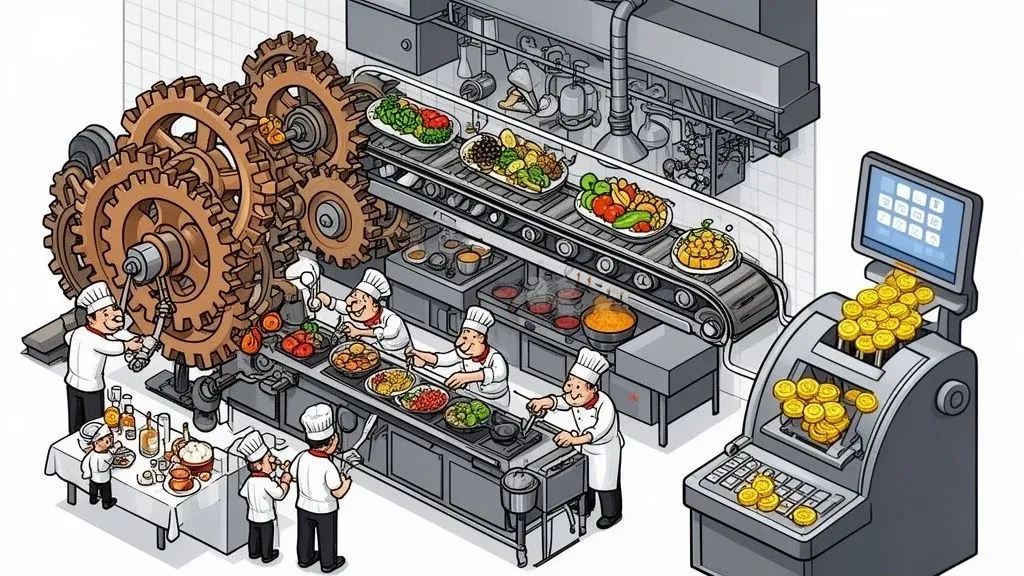
Ever wonder what happens behind those swinging kitchen doors in a restaurant? That’s the Back of House (BOH), the operational heart of your entire establishment. In simple terms, it’s everything your guests don’t see: the kitchen line, the prep stations, the walk-in coolers, dry storage, and even the small office where you manage inventory.
Think of it as the command center for your entire restaurant. While your Front of House (FOH) is the public-facing stage, the BOH is where the magic is actually made.
Why a Smooth BOH Is Critical for Restaurant Efficiency
It’s easy to think of the BOH as just the place where food is cooked. But in reality, it’s a complex system where your culinary vision becomes a reality. This is where raw ingredients are transformed, dishes are assembled with precision, and every plate is checked before it goes out to a guest. Understanding the BOH as an operational hub—not just a kitchen—is the first step toward running a truly efficient and profitable restaurant.
Why it matters: A well-oiled BOH machine has a direct and powerful impact on your restaurant’s success, especially when you’re juggling a full dining room and a constant stream of delivery orders. A small hiccup in one spot can quickly cause a major bottleneck for the entire operation.
Imagine an order comes in from Uber Eats or DoorDash. If a line cook has to stop what they’re doing, walk over to a tablet, and manually punch that order into the system, you’ve just created a weak link. This simple action pulls them away from cooking, opens the door for costly error reduction, and slows down service for everyone—both in-house and at home.
This is exactly where smart POS integration makes all the difference. When you automate the flow of information from delivery apps straight into your kitchen display system (KDS), you save critical seconds on every order, slash the risk of mistakes, and boost staff productivity by letting your team focus on what they do best: cooking.
A streamlined BOH doesn’t just mean faster ticket times. It creates a calmer, more organized atmosphere where your team can perform at their peak. This consistency leads directly to better food, happier customers, and a much healthier profit margin.
Meet the Unsung Heroes of the Back of House
The Back of House is powered by a dedicated team where every single person plays a crucial part in your success. To really get what a BOH is, you have to understand the people who make it all happen.
At the top, the Executive Chef is the visionary. They create the menu, define the culinary style, and lead the entire BOH. Their second-in-command, the Sous Chef, is the hands-on general. They’re the one on the floor, making sure the kitchen line runs like a well-oiled machine, especially during that chaotic Friday night dinner rush.
How Key BOH Roles Impact Your Restaurant Operations
A kitchen’s output is only as strong as its weakest link. A failure in one area can bring everything grinding to a halt, impacting both dine-in and restaurant delivery speeds.
- Line Cooks: These are your station masters, the experts at the grill, sauté, or fry station. Their focus and consistency directly determine the quality and speed of the food that lands on a customer’s plate.
- Prep Cooks: They’re the secret to an efficient kitchen. Long before the first ticket prints, they’re chopping vegetables, simmering sauces, and portioning proteins. This prep work shaves precious seconds off every single order. You can learn more about their critical role here.
- Dishwashers: Never underestimate the dishwasher. They are the true backbone of the operation, ensuring a constant flow of clean pans, tools, and plates. Without them, the kitchen quickly drowns in dirty dishes, and service stops dead.
Why it matters: When one of these roles falters, it creates a domino effect. If the dishwasher gets buried, line cooks run out of clean pans. If prep cooks fall behind, ticket times will soar as cooks are forced to prep ingredients from scratch. This chaos hits everything—food quality, delivery speed, and ultimately, the guest experience. Acknowledging how much each person contributes is the first step toward building a resilient BOH team.
An Actionable Insight for Empowering Your BOH Team
A strong Back of House begins with a team that’s confident, capable, and compliant. Providing practical food handler certificate training is one of the best investments you can make. It doesn’t just check a legal box; it equips your team with the knowledge they need to work safely and efficiently.
At the end of the day, a supported team is an effective one. When every member has the training and tools to do their job well, your entire BOH operates more smoothly. That means faster service, fewer mistakes, and happier customers—whether they’re sitting in your dining room or ordering for delivery.
BOH vs. FOH: Understanding Your Restaurant’s Two Halves
Think of a successful restaurant like a hit Broadway show. You have the stage—the Front of House (FOH)—where actors interact with the audience. Then you have everything backstage—the Back of House (BOH)—where the real magic is assembled before it ever hits the spotlight.
The FOH is the public-facing part of your business: the host stand, dining room, and bar. The team here—servers, bartenders, hosts—is all about creating an incredible guest experience. The BOH, on the other hand, is the engine room: your kitchen, prep stations, and dish pit. Here, the focus shifts entirely to production. Speed, accuracy, and consistency are the name of the game.
To truly see how they differ, let’s break it down.
BOH vs FOH Core Differences
Attribute Back of House (BOH) Front of House (FOH) Primary Function Food production, preparation, and plating. Guest service, order taking, and payment processing. Main Goal Consistency, speed, food safety, and quality. Customer satisfaction, creating a welcoming atmosphere, and upselling. Key Roles Executive Chef, Sous Chef, Line Cooks, Prep Cooks, Dishwashers. General Manager, Servers, Hosts, Bartenders, Bussers. Work Environment High-pressure, fast-paced, and task-oriented. Often hot and loud. Dynamic, people-focused, and communication-heavy. Customer Interaction None to very little. Communication is internal. Constant and direct. The face of the restaurant.
While their roles are distinct, neither side can succeed without the other.
The Critical Connection: Where FOH and BOH Meet
These two halves of the restaurant can’t operate in separate silos. They are completely dependent on each other, and a small hiccup on one side can create a massive wave on the other.
Why it matters: The communication pipeline from the Front of House to the Back of House has to be perfect. Every order, every modification, and every allergy warning is a critical piece of data. A breakdown leads to comped meals, wasted food, and shattered customer trust—all of which hurt your bottom line.
How Food Tech Bridges the Gap for Better Restaurant Operations
This is exactly where modern food tech and POS integration become so crucial. They act as a digital bridge, connecting the FOH and BOH so that nothing gets lost in translation.
Take an online order from a delivery app, for example. Without a direct connection, a server or host has to stop what they’re doing and manually re-enter it. But with a service that integrates delivery apps directly with a Clover POS, that ticket prints in the kitchen automatically and accurately.
- Error Reduction: Automating order entry wipes out the typos and missed details that come with manual work, saving you money on remakes.
- Time Savings: Your FOH team is freed up to focus on the guests in front of them, not on punching buttons, which improves service quality.
- Staff Productivity: Your kitchen crew gets clear, correct tickets the moment the order is placed, which keeps their workflow smooth and fast, increasing throughput.
When you sync the two sides of your restaurant, you eliminate friction and cut down on expensive mistakes. The best next step for any restaurant owner is to look closely at how information flows from your FOH to your BOH and pinpoint exactly where automation can build a stronger, more reliable connection.
Common BOH Challenges Costing You Money
Every restaurant manager knows the back of house can be a source of constant headaches. But these aren’t just minor frustrations—they’re profit leaks, quietly siphoning money from your bottom line. Poor inventory control leads to spoiled food, inconsistent plating results in bad reviews, and a disorganized line creates bottlenecks that slow down the entire operation.
The biggest wrench thrown into modern restaurant operations? The nonstop stream of online delivery orders.
Picture this: It’s 7 PM on a Saturday. Your dining room is packed, and the kitchen is already in the weeds. Then, the dreaded ping of an Uber Eats tablet goes off. One of your line cooks has to break their rhythm, walk over to the tablet, and manually type the entire order into your POS system. This constant stop-and-start is a massive bottleneck.
Why it matters: This isn’t just an inconvenience; it’s a productivity killer that directly impacts your restaurant efficiency. One study found that restaurants juggling multiple delivery tablets can lose up to 30 minutes per employee per shift just on this manual order entry. That’s valuable time your team should be spending cooking, not performing data entry. Every little error or delay has a ripple effect. A single wrong order has to be remade, which doubles the food and labor cost. A delayed order leads to a bad rating on DoorDash, hurting your visibility on the very platforms you need for growth.
How BOH Inefficiencies Impact Your Bottom Line
This cycle of inefficiency chips away at your finances and your team’s morale. Let’s break down the real-world costs:
- Increased Labor Costs: Pulling a skilled cook off the line to punch in orders is a huge waste of their talent and your payroll. Their expertise is in plating and timing, not juggling tablets. This directly impacts staff productivity.
- Higher Food Waste: Manual entry mistakes, like missing a “no onions” modifier, often mean the dish goes straight into the trash. As you learn how to calculate food cost percentage, you’ll see just how fast these errors decimate your margins.
- Reduced Staff Productivity: Constantly interrupting a cook’s focus creates a stressful, chaotic environment. This leads to burnout and higher employee turnover—one of the most expensive problems a restaurant can face.
- Lower Delivery Revenue: Slow service and incorrect orders create unhappy customers, which leads to poor reviews. Delivery apps boost restaurants with high satisfaction scores, so poor performance can literally make you invisible to new customers.
Actionable Insight: By getting to the root of the problem—manual order entry—you can stop the bleeding. Embracing food tech that integrates your delivery platforms directly with your POS, like Square or Clover, eliminates these bottlenecks entirely.
How to Fix Your BOH with POS Integration
If you’ve ever watched a team member frantically punch a delivery order from a tablet into your POS system while the kitchen is on fire, you know the weak link in the chain. The solution is straightforward: POS integration. This is the single most effective way to bring order to your Back of House operations and boost your restaurant efficiency.
In simple terms, POS integration automatically sends orders from delivery apps like DoorDash directly to your kitchen printer or KDS. It completely cuts out the need for a staff member to manually re-enter the order from a tablet.
Closing the Tech Gap in Your Restaurant Operations
Using a service like OrderOut, an order from DoorDash bypasses the tablet circus entirely. It flows directly into your restaurant’s POS and prints out in the kitchen instantly, looking just like any other ticket. No manual re-entry, no delays, and no chance for a costly typo.
The impact is immediate. You slash ticket times, achieve significant error reduction, and improve staff productivity by letting your kitchen team do what they’re paid to do—cook great food.
This flow chart perfectly illustrates the old, broken workflow that too many restaurants are still stuck with.
You can see exactly where the bottleneck happens. That manual entry step creates a frustrating delay before an order even hits the prep line. Connecting your delivery apps directly to your kitchen isn’t a small tweak; it’s a fundamental upgrade. And to take it a step further, modern phone systems that include seamless POS integration can tie your phone-in orders into the same efficient workflow.
Using Food Tech to Boost Restaurant Delivery and Your Bottom Line
The online delivery world is no longer optional. With giants like DoorDash and Uber Eats controlling a massive 92% of the U.S. market, ignoring them isn’t a strategy. For restaurants using a Square or Clover POS, this is a golden opportunity.
While delivery can drive a 20% revenue lift, those 15-30% commission fees mean there’s no room for inefficiency. To truly understand the market forces at play, you can read the full research on food delivery app economics.
Why it matters: By automating how information flows into your kitchen, you’re not just saving a few minutes per order. You’re building a foundation of clean, accurate sales data that helps you make smarter decisions about inventory, staffing, and forecasting. An integrated POS does more than print tickets; it becomes the central command center for all your sales. Want to see all the benefits in one place? Check out our guide on what makes an integrated POS system so powerful.
Key Metrics for Measuring BOH Performance
You can’t improve what you don’t measure. Turning your back of house efficiency into solid numbers is the only way to spot problems and make meaningful changes. These numbers are your Key Performance Indicators (KPIs), and they act as a report card for your entire BOH operation.
In clear terms, Kitchen Display System (KDS) ticket times tell you exactly how long it takes your crew to prepare an order. If that number starts to climb, it’s a huge red flag that something is wrong—it could be a poorly designed station or a staffing gap.
Turning Data into Action with POS Integration
Another make-or-break metric is your order accuracy rate. This tells you how often you’re getting every single order right. Getting this wrong doesn’t just annoy customers; it directly hits your wallet through comps and remakes, and it can sink your ratings on delivery apps.
Why it matters: Ultimately, these metrics are all tied directly to your bottom line and your overall restaurant efficiency:
- Cost of Goods Sold (CoGS): This tracks the raw cost of the ingredients going into your dishes. If your CoGS is creeping up, it’s often a sign that your BOH is struggling with portion control or waste.
- Food Waste Percentage: This KPI measures exactly how much food is ending up in the bin. Tracking it helps you diagnose problems with your inventory management or daily prep levels, leading to direct cost savings.
- Staff Productivity: This shows you how much revenue you’re generating per labor hour. It’s the key to building smarter schedules that match your busiest periods without burning out your team.
Customer habits have changed for good. With over 60% of people now ordering delivery at least once a week, the pressure on your BOH to be fast and accurate has never been higher. Integrating your delivery apps with a POS like Square is no longer a “nice-to-have”—it’s essential and can even lift your revenue by 20%. You can discover more insights about food delivery statistics to see just how big this market has become.
Actionable Insight: By integrating delivery apps directly into your Clover POS with a tool like OrderOut, your data suddenly becomes clean and reliable. You get rid of the manual punching errors that throw off your reports, giving you a crystal-clear picture of what’s really happening in your kitchen. For a deeper look at the numbers that matter, you might be interested in our guide on the top KPIs for restaurants.
It’s Time to Tame Your BOH Chaos
Let’s put it all together. Your Back of House is the engine of your entire restaurant. When it runs smoothly, you see it in your profits. When it’s chaotic, you feel it everywhere—from the bottom line to your team’s morale.
Right now, the single biggest headache for most kitchens is manually juggling a constant flood of delivery orders. It’s a problem you can solve, but ignoring it is costing you more than you think in time, money, and sanity.
The answer isn’t working harder; it’s working smarter with food tech. By using technology that pipes orders from platforms like DoorDash and Uber Eats straight into your POS, you can finally put an end to the “tablet farm.” This one change slashes errors, gets food out the door faster, and improves staff productivity. This is how you master restaurant delivery without sacrificing your margins.
Your Practical Next Step
Think about where your orders are coming from. In the US, DoorDash dominates the food delivery market with a 67% share, while Uber Eats holds a solid 23%. Understanding these food delivery market dynamics is key.
Integrating them directly with your POS systems, whether it’s Clover or Square, is a game-changer for your restaurant operations. It helps you avoid the manual entry mistakes that an estimated 90% of restaurants make when juggling different apps.
Taking manual order entry off your team’s plate does more than just save a few minutes. It builds a more accurate, efficient, and profitable BOH from the ground up, giving you the speed and consistency that customers notice.
There’s no good reason to keep losing money to a process that’s fundamentally broken. The benefits of automation in restaurants are real and immediate. Your next step is a simple one.
See what a difference it makes for yourself. Sign up for OrderOut for free and start getting your BOH in order in just a few clicks. Take back control of your operations by visiting https://dashboard.orderout.co to get started.