
What Does a Restaurant Manager Do? The Ultimate Guide
· Thibault Le Conte
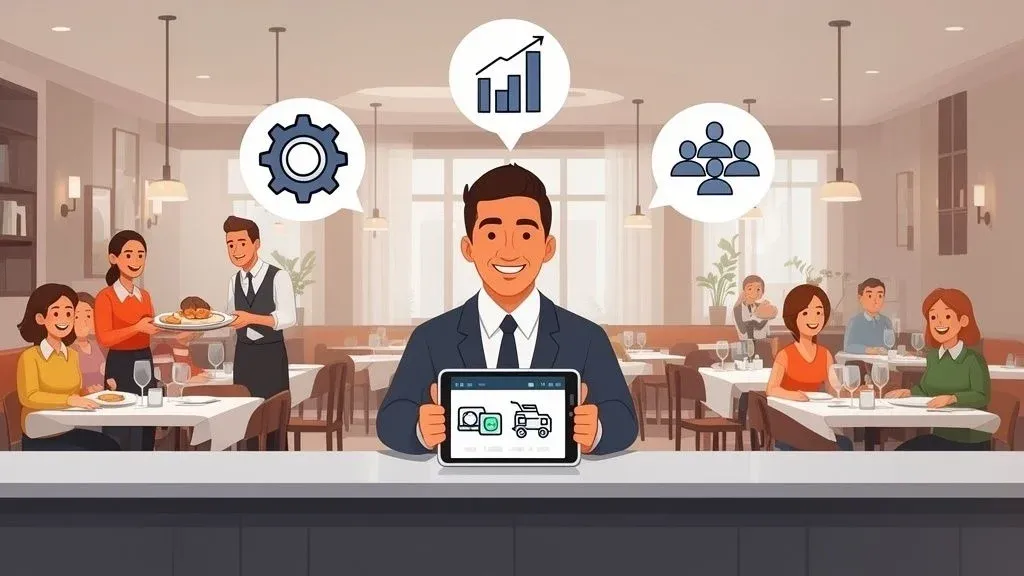
So, what does a restaurant manager really do? Forget the simple title. In simple terms, a great manager is the heart and soul of the restaurant, the person who ensures everything from guest happiness to the bottom line is humming along perfectly. They’re part operational guru, part financial wizard, and part team mentor, all rolled into one. Why does this matter? Because their leadership directly impacts your restaurant’s efficiency, profitability, and ability to handle the complexities of modern dining, including delivery and online ordering.
The Three Pillars of Modern Restaurant Management
Think of the manager as the conductor of a complex orchestra. Every section—the front-of-house, the kitchen, the bar, and now, the delivery tablets—needs to play in harmony. The manager’s job is to hold the baton and ensure the final performance is a hit with every single guest.
This role is more critical than ever. The U.S. Bureau of Labor Statistics projects a 6 percent growth for food service managers between 2024 and 2034. That translates to about 42,000 new openings every year, a clear sign of just how vital skilled leadership is to the industry’s success and ability to adapt to new food tech and delivery trends.
The manager’s wide-ranging duties can be understood by looking at three core areas of responsibility.
Core Responsibilities of a Restaurant Manager at a Glance
This table breaks down the multifaceted role of a restaurant manager into three core pillars, showing key duties within each area.
Operational Leadership (Front & Back of House) Financial & Business Management Team & People Management Upholding service standards Budgeting and P&L oversight Hiring and onboarding new staff Ensuring food quality and consistency Tracking sales and revenue Creating staff schedules Managing health and safety compliance Controlling food and inventory costs Training and ongoing development Overseeing daily opening/closing Optimizing labor expenses Motivating staff and building culture Troubleshooting on-the-floor issues Analyzing performance reports Handling payroll and HR duties
Mastering the balance between these pillars is what separates an average manager from a truly great one.
A manager’s decisions directly shape the restaurant’s success. Balancing these three pillars is the key to creating an efficient, profitable business and a memorable customer experience.
For example, think about a manager at a busy cafe. In simple terms, they need to know when they’re busiest to schedule enough staff. Technically, they don’t just use their Clover POS to ring up orders. A smart manager dives into that sales data to see when the afternoon rush really hits, allowing them to build a tighter, more effective staff schedule. That one move saves on labor costs and ensures there are enough hands on deck to keep service speedy, which is a direct boost to restaurant efficiency.
You can find more practical strategies in our complete guide to restaurant operations management.
Ultimately, a modern restaurant manager isn’t just ticking off a checklist. They are orchestrating an entire experience, day in and day out. By mastering these pillars, they can transform a simple dining spot into a thriving, beloved, and profitable business.
A Day in the Life: Improving Restaurant Operations Daily
If you really want to get what a restaurant manager does, you have to picture their day. No two are ever the same, but there’s a definite rhythm. Think of it as a cycle: prep for the day, manage the service, and review the results. It’s a constant juggling act, balancing what you planned to do with the curveballs a busy restaurant always throws.
A manager’s day usually kicks off by reviewing what happened yesterday. They’ll dig into reports from the last shift, looking for notes on equipment malfunctions, any staff who called out, or customer incidents that need following up on. This is all about getting ahead of problems before they can derail the day.
From there, they put on their finance and inventory hat. In non-technical terms, they make sure the restaurant has enough food and isn’t overspending. This means running sales reports, physically checking stock levels on key ingredients, and placing orders. Getting this right is fundamental to keeping food costs in check and the whole operation running efficiently, which directly impacts your bottom line.
Prepping for Peak Performance
As opening time inches closer, the focus shifts to the team and the floor. One of the most important rituals of the day is the pre-shift meeting. This is where the manager gets everyone on the same page.
In this quick huddle, they’ll cover the essentials:
- Reservations and VIPs: Giving the team a heads-up on big parties or regulars who deserve a little extra attention.
- Menu Specials and 86’d Items: Making sure everyone knows the daily specials and, just as importantly, what ingredients have been 86’d (are out of stock).
- Service Goals: A quick motivational speech to fire up the team and remind them of the service standards.
This huddle isn’t just a meeting; it’s the glue that holds a shift together. When everyone knows the game plan, the lunch and dinner rush feels more like a well-rehearsed dance than total chaos, boosting staff productivity.
Navigating the Rush and Beyond
Once the doors are open, the manager transforms into the ultimate problem-solver. They’re constantly on the move, reading the room, checking the flow between the kitchen and the dining room, and jumping in to help. Did a customer’s steak come out overcooked? The manager is on it. Is the kitchen getting buried in tickets? The manager is there, helping to expedite and communicate.
A manager’s presence on the floor is about more than just oversight; it’s about active problem-solving that directly impacts the guest experience and staff morale. The ability to spot a small issue before it snowballs is a true superpower.
Even as the last tables are finishing up, the work isn’t over. The manager oversees closing duties, then analyzes the day’s reports, comparing sales figures against labor costs. This is where modern food tech becomes a powerful tool. A manager might pull up data from their Square POS. Did that new happy hour special actually drive sales? What time did DoorDash orders spike? This isn’t just number-crunching; it’s finding actionable insights to improve restaurant delivery efficiency and make smarter staffing decisions tomorrow, saving both time and money.
Mastering Labor Management and Staff Productivity
After you’ve wrestled food costs into submission, your next big beast to tame is labor. Simply put, this is about managing your team to get the most value out of every dollar you spend on payroll. Honestly, managing people is where the best managers really shine. You’re not just filling shifts; you’re trying to boost sales and keep guests happy without overspending.
It all comes down to a couple of key numbers. First is your labor cost percentage, which is the slice of your revenue that goes to paying your staff, ideally between 20% and 30%. The other metric is sales per labor hour (SPLH). This tells you exactly how much money each hour of paid work is bringing in. The higher your SPLH, the more efficient your team is, a clear sign of strong restaurant operations.
Strategies for Smarter Staffing and Productivity
Controlling labor costs is one of the most stressful parts of the job. The numbers don’t lie—it can cost over $2,600 just to replace a single manager. That kind of turnover hurts your bottom line. Great managers connect scheduling, performance, and labor costs to stop problems before they start.
Here are a few actionable insights:
- Schedule with Data, Not Guesswork: Stop scheduling just to have bodies in the building. Dive into your POS data to see your actual sales patterns. If you know Tuesdays are dead until 7 PM, don’t have your full crew clock in at 5 PM. Adjusting your schedule to match reality prevents you from wasting money and directly boosts staff productivity.
- Cross-Train Your Crew: A server who can jump on the host stand or a line cook who knows the prep station is worth their weight in gold. Cross-training builds a nimble team that doesn’t fall apart when one person calls out sick. This reduces chaos and improves service speed.
- Build a Culture People Don’t Want to Leave: Your best weapon against high turnover is a positive work environment where people feel respected. A happy team works harder, provides better service, and sticks around. This alone saves you a fortune in recruiting and training costs.
To really develop your team, it helps to understand and apply current performance management best practices. This transforms performance reviews from a simple check-the-box exercise into a real opportunity for growth and retention.
The Takeaway on Labor Management
Start thinking of your team as an investment, not an expense. A manager’s job is to maximize the return on that investment. When you use data to build smarter schedules and build a culture that makes people want to stay, you’re turning labor management from a headache into a strategic advantage for your restaurant.
You can dig into more ideas for standardizing these efforts in our guide to creating effective restaurant operating procedures. Taking this proactive approach saves thousands in turnover, cuts down on service mistakes, and ultimately builds a team that can run a tight, profitable restaurant.
How Food Tech Boosts Restaurant Efficiency
If there’s one thing every restaurant manager is short on, it’s time. So much of a manager’s day gets swallowed by repetitive, manual work—the kind of stuff that creates bottlenecks and opens the door for expensive mistakes. We’ve all seen it: the infamous “tablet farm” on the counter, with a different device for Uber Eats, DoorDash, and every other delivery service, all beeping at once.
Someone has to take those orders and punch them into the point-of-sale (POS) system by hand. It’s a slow, frustrating process that pulls staff away from helping in-house guests and almost guarantees errors. This is exactly the kind of operational headache modern food tech is designed to solve.
The Magic of POS Integration and Automation
Think of a POS integration as a universal translator for your restaurant. It automatically captures incoming orders from all your third-party apps and sends them directly to the kitchen through your existing POS. Just like that, the need for a staff member to babysit a pile of tablets vanishes.
Why it matters is simple: when you automate this part of your workflow, you see immediate benefits:
- Error Reduction: Manual entry errors, like wrong items or missed modifications, practically disappear, saving you the cost of remaking food.
- Time Savings: Orders hit the kitchen instantly. That means faster prep, quicker delivery times, and happier customers.
- Staff Productivity: Instead of juggling tablets, your crew can focus on what they do best—taking care of dine-in customers, upselling, and creating a great guest experience.
For example, a manager running their floor on a Square POS can use a service like OrderOut to completely automate their delivery order management. The system handles the tedious work, ensuring every order is fast and accurate, while the manager gets to focus on leading their team. This saves hours of labor each week and drastically reduces costly mistakes.
Automation hands managers back their most valuable asset: time. Instead of constantly putting out fires caused by manual mistakes, they can invest that time in training staff, improving the guest experience, and actually planning for growth.
Manual vs. Automated Delivery Order Management
Task Manual Process (Without POS Integration) Automated Process (With POS Integration) Order Entry Staff member manually types each order from the delivery tablet into the POS. Orders are sent directly from the delivery app to the POS and kitchen printer. Time per Order 1-3 minutes of dedicated staff time. 0 minutes of staff time. Error Rate High potential for typos, missed items, and incorrect modifications. Extremely low; errors are virtually eliminated. Staff Focus Pulled away from in-house guests to manage tablets. Remains on dine-in customers and other high-value tasks. Cost Wasted labor hours and costs associated with remaking incorrect orders. Minimal subscription cost, with significant savings on labor and errors.
As you can see, automation isn’t just a minor improvement—it fundamentally changes the cost and efficiency of your delivery operation.
Connecting Tech to Your Bottom Line
This isn’t just about making life a little easier; it’s about building a smarter, more resilient business. For example, having reliable internet is the backbone of your entire tech setup. You can check out a complete guide to restaurant Wi-Fi to see how a strong connection supports everything from your POS to your delivery integrations.
When you free up a manager’s schedule, they can pour that energy back into the core parts of the job, like scheduling, training, and finding ways to reduce staff turnover.
By automating the repetitive stuff, a manager can stop being a reactive problem-solver and become a proactive leader who builds a strong team. That’s what leads to long-term success.
Ultimately, bringing the right tech into your restaurant is a direct investment in its efficiency and profitability. Automating order entry from DoorDash, Uber Eats, and others cuts costs, slashes errors, and empowers your manager to be the leader your restaurant truly needs.
Essential Skills and KPIs Every Manager Needs
So, what’s the real difference between a manager who just gets by and one who truly excels? Great managers are masters of a delicate balancing act, combining top-notch people skills with a laser focus on the numbers that actually drive the business forward.
In simple terms, they need to be good with people and good with numbers. On one hand, you have the essential soft skills. We’re talking about genuine leadership, clear communication, and the emotional intelligence to read a room. These skills are what keep your team happy and reduce staff turnover, which saves you thousands in recruiting and training.
But on the other hand, soft skills will only get you so far. A truly effective manager also lives and breathes the hard skills—the nitty-gritty of financial management. Technically, they rely on key performance indicators (KPIs) to get a clear, unbiased picture of the restaurant’s health. Think of these numbers as the restaurant’s vital signs.
Key Metrics to Master for Better Restaurant Operations
To make decisions based on facts instead of just gut feelings, a manager has to track a few critical KPIs.
- Food Cost Percentage: This is your total ingredient cost as a percentage of your food sales. If this number is creeping up, it’s a red flag that your profit margins are shrinking.
- Table Turnover Rate: How long does a table stay occupied? A faster turnover means more guests served and more revenue. It’s a direct measure of your front-of-house efficiency.
- Customer Satisfaction Scores: This is the unfiltered voice of your guests. A dip in satisfaction is an early warning that something—from the food to the service—is off.
A great manager doesn’t just stare at a spreadsheet; they see a story in the numbers and take action. If the table turnover rate is slow, they dig in. Are the hosts creating a bottleneck? Is the kitchen taking too long? They use the data to find the problem and fix it.
Imagine a manager using their Clover POS. They can pull a report and see that sales for their most popular burger are strong, but the food cost percentage on that specific item has jumped 5%. That’s an immediate signal to check recent supplier invoices or perhaps adjust the menu price. This is a practical example of how POS integration helps protect profits.
Want to go deeper on this? Check out our complete guide on the most important KPIs for restaurants.
At the end of the day, a successful restaurant manager is basically bilingual. They have to speak the language of people—empathy, motivation, and service—and the language of data—costs, revenue, and efficiency. Mastering both is what allows them to lead a happy, high-performing team while keeping the business profitable.
Your Next Step to Smarter Restaurant Management
When you peel back all the layers, it becomes clear that a great modern restaurant manager is part leader, part tech wizard. The answer to “what does a restaurant manager do?” has evolved. They’re no longer just operators; they’re strategic leaders who drive efficiency.
Think about all the time wasted on repetitive work, like manually punching in delivery orders. Automating tasks like this with food tech immediately cuts down on costly mistakes and gives your team a serious productivity boost. This frees up your manager to focus on what humans do best—mentoring staff and connecting with customers. An integrated POS system is the engine that makes this possible.
The real secret is to stop asking your managers to do a robot’s job. When you automate the tedious tasks, you empower your leaders to focus on the human side of the business—and that’s where real growth happens.
This shift has a massive ripple effect on both restaurant delivery and overall restaurant operations. It’s not just about shaving a few minutes off a task; it’s about creating a smarter, more resilient business. If you’re curious how all the pieces fit together, our guide on choosing an integrated POS system is a great place to start.
Ready to see what automation can do for your restaurant? Start onboarding for free in a few clicks and feel the difference.
Frequently Asked Questions
Being a great restaurant manager is about more than just keeping the doors open. We get a lot of questions about what the job really looks like day-to-day, so here are the answers to a few common ones.
What Is the Biggest Challenge for a Restaurant Manager Today?
The biggest challenge is the constant squeeze between rising labor and food costs on one side and customer expectations on the other. It feels like walking a tightrope.
To keep their balance, the sharpest managers are leaning on food tech and POS integration. Simply put, this isn’t about replacing people; it’s about making the entire operation smarter. Technically, automation helps cut down on costly mistakes from incorrect orders and provides the real sales data needed to build efficient staff schedules. This is a practical way to control major expenses without sacrificing service quality.
How Does Technology Like POS Integration Help a Manager?
A good POS integration is like an extra set of hands for your manager. It handles the repetitive, time-consuming tasks so they can focus on what matters: leading the team and talking to guests.
Instead of a team member manually punching in every single order from Uber Eats or DoorDash, the integration does it instantly and without errors.
It’s a game-changer. This one simple fix can slash order errors by over 99%, reducing food waste and saving money. Suddenly, the manager isn’t putting out fires caused by tablet-punching mistakes. They’re on the floor, coaching new servers, or making sure a VIP table feels special—tasks that directly boost restaurant efficiency and the bottom line.
For instance, a manager using an integration with their Clover system sees every order, whether from a server or a delivery app, on a single screen. The chaos of juggling multiple tablets just disappears, improving staff productivity.
What Are the Most Important Skills for an Aspiring Restaurant Manager to Develop?
Knowing your way around restaurant operations is the price of entry, but it’s the human skills that make a manager truly exceptional.
- Leadership: It’s one thing to give orders, but it’s another to inspire a team to pull together and smile through a chaotic Saturday night service. That’s leadership.
- Communication: This is the art of gracefully handling an unhappy customer and the skill of giving a server feedback that helps them grow, instead of making them feel defensive.
- Financial Literacy: You have to know your numbers. Understanding your food cost percentage, labor costs, and table turnover rates is the only way to make smart, data-driven decisions that protect your profit margins.
A manager who can nail these three skills won’t just run a restaurant; they’ll build a loyal crew and a business that thrives year after year.
By embracing smart food tech and doubling down on leadership, today’s managers are turning one of the toughest jobs in hospitality into a successful career. If you’re ready to get a better handle on your restaurant delivery and operations, OrderOut can help.
Start onboarding for Free in a few clicks and see for yourself how automation can give you back your time.