
What Are Ghost Kitchens? A Guide to Delivery-First Dining
· Thibault Le Conte
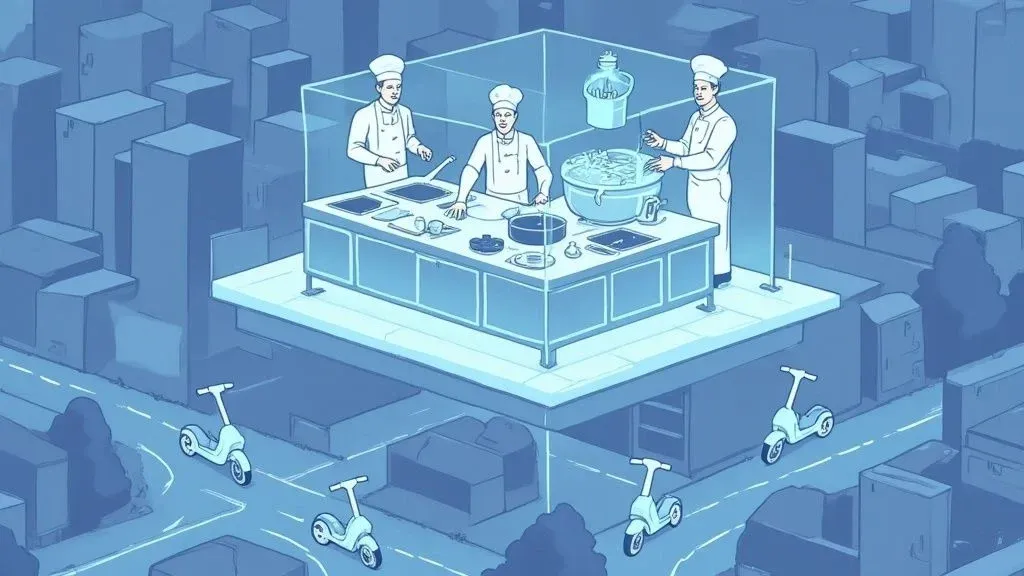
A ghost kitchen is a professional kitchen designed only for delivery and takeout. In simple terms, it’s a restaurant with no dining room, no storefront, and no walk-in customers. It’s a production hub built specifically to handle orders from apps like Uber Eats and DoorDash, without the costs and complexities of a traditional restaurant.
What Are Ghost Kitchens: A Simple Introduction
At its core, a ghost kitchen is a restaurant model built for efficiency and delivery. Imagine a kitchen where chefs can focus solely on preparing food for online orders. This model eliminates the most expensive parts of running a restaurant, such as front-of-house staff, premium real estate, and dining room decor.
This lean approach is why the model is exploding in popularity. By removing the physical storefront, restaurant operators can launch new brands or expand their delivery area with significantly lower startup costs and financial risk. It’s a business model designed for the modern diner who values convenience. For a closer look at the different terms used, check out our complete guide on cloud kitchens.
Why This Model Matters for Restaurant Operations and POS Integration
The real power of a ghost kitchen lies in its impact on restaurant efficiency and profitability. Without the expense of a dining room, you can invest resources where they matter most for delivery: high-quality ingredients, an efficient kitchen workflow, and smart food tech. This focus directly improves your bottom line.
Here’s why it matters for your restaurant:
- Lower Startup Costs: You can launch a ghost kitchen for a fraction of the cost of a full-service restaurant, saving significant money on seating, decor, and front-of-house payroll. This dramatically reduces financial risk.
- Increased Agility: Want to test a new menu or a completely new virtual brand? A ghost kitchen lets you experiment with minimal risk. If an idea doesn’t work, you can pivot quickly without being tied to a failing brick-and-mortar location.
- Expanded Delivery Reach: A strategically placed ghost kitchen can extend your delivery radius into new neighborhoods, connecting you with thousands of potential customers you couldn’t reach before. This directly translates to more orders and higher revenue.
The global ghost kitchen market hit an estimated $58.61 billion in 2022 and is expected to explode to around $177.85 billion by 2032. This isn’t just a trend; it’s a massive shift in how people get their hands on restaurant food, as highlighted in reports from Research and Markets.
Ghost Kitchens vs Traditional Restaurants at a Glance
To understand the operational differences, it’s helpful to compare the two models side-by-side. While both prepare food, their business structures, cost models, and customer interactions are fundamentally different.
Here’s a quick breakdown:
Feature Ghost Kitchen Traditional Restaurant Primary Focus Delivery & Takeout Efficiency Dine-In Customer Experience Customer Interaction Entirely Digital (via apps) Face-to-Face & Digital Startup Costs Low to Moderate High to Very High Real Estate Needs Small, low-cost industrial space Prime, high-foot-traffic location Staffing Model Kitchen staff only Kitchen & Front-of-House staff POS Integration Critical for order aggregation Important for all operations
This table highlights how the ghost kitchen model enables owners to build a business laser-focused on efficient restaurant delivery. The key to success is using technology—like POS integration with systems from Clover or Square—to centralize orders and streamline operations, reducing errors and saving valuable staff time.
Exploring Different Ghost Kitchen Business Models
The term “ghost kitchen” covers several different operational setups. It’s not a one-size-fits-all concept. Just like traditional restaurants vary, ghost kitchens come in different models, each designed for a specific business goal.
Some models are ideal for launching a new brand with minimal investment, while others help established restaurants maximize the efficiency of their existing kitchens. The key is to identify which model aligns with your objective, whether it’s expanding your delivery reach, improving restaurant operations, or testing a new culinary concept.
This infographic captures the core idea—it’s all about focusing on delivery, keeping costs low, and eliminating the expensive storefront.

As you can see, every model is built on this foundation, allowing you to focus purely on producing great food and getting it to customers efficiently.
The Commissary or Shared Kitchen Model
Think of a commissary kitchen as a co-working space for chefs. It’s a large facility divided into multiple private kitchen stations, rented out to different restaurant brands. You get your own dedicated cooking space while sharing expensive infrastructure like walk-in coolers, storage, and dishwashing areas.
This model is a popular choice for new entrepreneurs and food truck operators needing a licensed base for food prep.
- Why it matters: The primary benefit is the dramatically reduced startup cost. Instead of building a kitchen from scratch, you pay a monthly fee for a professional, health-code-compliant space. This significantly lowers the barrier to entry, allowing you to test a new concept with minimal financial risk.
Kitchen Pods and Pop-Up Locations
Kitchen pods are a flexible, agile solution for expansion. They are self-contained, fully-equipped kitchens—often portable—that can be placed in strategic locations like parking lots or underutilized urban spaces. For established brands, this is a game-changer. It allows you to quickly expand your restaurant delivery radius and test a new market without committing to a long-term lease.
The goal is to get closer to your customers. Placing a pod in a high-demand area reduces delivery times, ensures food arrives hot, and unlocks a previously unreachable customer base. If you want to dive deeper into these strategies, our guide on the ghost kitchen business model is a great resource.
Virtual Brands: The Ultimate Restaurant Efficiency Play
For existing restaurant owners, the virtual brand is arguably the most powerful model. A virtual brand is a delivery-only restaurant concept operated from your current brick-and-mortar kitchen. A customer ordering on DoorDash or Uber Eats sees a completely new restaurant, but it’s your staff, in your kitchen, preparing the food.
Why it matters: This model allows you to generate a new revenue stream using assets you already pay for—your kitchen space, your staff during slow periods, and your existing inventory. It is the most efficient way to boost your restaurant’s profitability with minimal new overhead, improving overall staff productivity.
For example, a pizzeria that’s quiet during lunch could launch a virtual brand selling gourmet sandwiches. You already have the ingredients and the staff is on the clock. This turns downtime into a profit center. Major chains like Wendy’s use this exact strategy to enter new markets without the cost of a physical restaurant, launching concepts that meet specific customer demands.
Ultimately, choosing the right model depends on your goals. A commissary is a low-risk launchpad for new ideas. For an established restaurant, a virtual brand is a brilliant way to increase sales and make your kitchen more efficient.
Weighing the Pros and Cons of a Ghost Kitchen
Ghost kitchens can be a powerful tool for growth, but they are not a guaranteed solution. Before committing, it’s essential to understand both the opportunities and the challenges. This model helps you avoid many traditional restaurant headaches but introduces new complexities, particularly in the delivery-only ecosystem.
Let’s break down the key considerations to determine if it’s the right move for your business.
The Major Advantages of the Ghost Kitchen Model
The most significant benefit of the ghost kitchen model is the dramatic reduction in overhead costs. By eliminating the dining room, you cut some of the largest expenses that can sink a traditional restaurant. This creates a leaner, more agile business from day one.
Here are the biggest wins for your restaurant operations:
- Significantly Lower Startup Costs: Opening a traditional restaurant can cost a median of $375,000, much of which goes to construction and design. A ghost kitchen lets you launch for a fraction of that price, reducing your financial risk.
- Reduced Labor Expenses: With no front-of-house, you don’t need servers, hosts, or bussers. This simplifies your payroll and reduces labor costs. Your team is 100% focused on food production, which boosts kitchen productivity and efficiency.
- Unmatched Flexibility and Agility: Ghost kitchens excel here. You can test new menus, experiment with different concepts, or run multiple virtual brands from one kitchen with minimal risk. If an idea fails, you can pivot without the financial burden of a failed physical location.
Why it matters: A ghost kitchen forces you to focus your resources on what counts for restaurant delivery: great food, quality packaging, and speed. By eliminating front-of-house distractions, your kitchen can achieve a higher level of consistency and efficiency—two factors that directly impact customer satisfaction and delivery app ratings.
The Real-World Challenges Operators Face
Of course, the model isn’t without its challenges. The biggest hurdles involve building a brand without a physical presence and navigating the economics of third-party delivery.
Here are some common challenges:
- High Third-Party Delivery Commissions: To be visible, you must be on platforms like Uber Eats and DoorDash, but their commission fees can be as high as 30% per order. This can significantly impact your profit margins.
- Building Brand Loyalty is Tougher: Without a physical location, it’s harder to create a personal connection with customers. You must rely on digital marketing and the quality of your food to build a loyal following.
- Intense Digital Competition: The low barrier to entry means the online food marketplace is crowded. Your brand will compete with countless other virtual kitchens and established restaurants, requiring a strong marketing strategy to stand out.
Managing commission fees is critical. For a deeper look, our guide on third-party delivery services breaks down what you need to know.
The Takeaway: A Strategic Decision
A ghost kitchen offers a lower-risk path to growth, but success hinges on mastering your restaurant operations and digital marketing. You trade the high costs of a dining room for the challenges of managing a digital brand and delivery partnerships. For operators who can master this new landscape, the potential for growth is immense.
The Food Tech That Runs Your Ghost Kitchen
In a traditional restaurant, technology is helpful. In a ghost kitchen, it is the central nervous system. Without a dining room or foot traffic, your entire operation depends on its digital infrastructure. This makes your food tech stack the most critical component of your business.
A seamless flow of information—from a customer’s app to your kitchen’s printer—is essential. The right technology is what separates a profitable, scalable ghost kitchen from a chaotic, failing one.

Escaping ‘Tablet Hell’ with Smart POS Integration
Many restaurant operators are familiar with the chaos of ‘tablet hell’: a line of tablets, one for each delivery service, all beeping and demanding attention. A staff member must manually re-enter every order into the main Point of Sale (POS) system, a process that is slow, error-prone, and a major drain on staff productivity.
This manual workflow is a recipe for disaster in a high-volume delivery environment. It leads to costly mistakes and slows down your entire operation.
The solution is a modern POS integration that connects directly to delivery apps. This technology acts as a central hub, automatically pulling orders from all platforms into one unified system.
Why it matters: Instead of juggling multiple tablets, your team sees every order in one place, automatically sent to the kitchen. This single change transforms your workflow from chaotic to controlled, saving time, reducing errors, and allowing your staff to focus on food quality.
How POS Integration Boosts Restaurant Delivery Efficiency
When all your orders flow into a single system, the benefits impact your entire operation. This isn’t just a convenience; it’s a fundamental upgrade that directly improves your bottom line and staff productivity.
Here’s how POS integration makes you faster and more profitable:
- Drastically Fewer Errors: Automating order entry eliminates manual mistakes like typos or missed modifications. This leads to happier customers and fewer profit-draining refunds.
- Faster Ticket Times: Orders are sent to the kitchen instantly. Shaving minutes off each order means faster delivery times and better ratings on the apps.
- A More Productive Team: Your staff can stop managing tablets and focus on cooking. This improves morale and allows you to handle more orders without adding staff.
For example, leading POS systems like Clover and Square are designed for seamless integration. By using an order aggregator, you can link your delivery channels directly to your POS, creating a highly efficient workflow. Our guide on restaurant order management software explains this in more detail.
Workflow Comparison: Manual vs. Integrated Order Management
To see the dramatic difference an integrated POS makes, let’s compare the workflows. The improvements in time, money, and stress are immediately clear.
Operational Step Manual ‘Tablet Hell’ Workflow Integrated POS Workflow Order Received Multiple tablets beep; staff must constantly monitor them. A single notification appears directly in the POS. Order Entry Staff manually re-enters the order into the POS/KDS. The order is automatically sent to the POS and KDS. Error Potential High risk of typos, missed items, or incorrect mods. Virtually zero risk of data entry errors. Prep Time Delayed start; kitchen waits for manual entry. Instantaneous; kitchen starts the order immediately. Staff Focus Divided between tablets, POS, and kitchen tasks. 100% focused on food preparation and quality. Reporting Requires manually compiling sales data from each app. All sales data is centralized for easy, accurate analysis.
Relying on a manual workflow is inefficient and unsustainable. An integrated system provides the tools you need to compete and succeed in the fast-paced world of restaurant delivery.
Your Most Important Next Step
For any ghost kitchen operator, the most critical tech decision is choosing a POS that seamlessly integrates with delivery platforms. This is the foundation of an efficient and scalable business. By eliminating manual entry, you save time, slash errors, and empower your team to perform at their best.
A Practical Guide to Launching Your Ghost Kitchen
Turning a ghost kitchen concept into a profitable business requires a clear, strategic plan. It’s a series of connected decisions—from market research and food tech to menu development and marketing—that lay the groundwork for long-term success.
Think of it as building a high-performance engine. Every component must be chosen carefully and fitted together perfectly to ensure your restaurant operations run smoothly from day one.

Step 1: Analyze Your Local Delivery Market
Before creating a menu, become an expert on your local delivery scene. Open delivery apps like DoorDash and Uber Eats and analyze the market. What cuisines are popular? More importantly, what are customers looking for that isn’t available?
Use the apps as a research tool. Identify gaps—perhaps there’s an oversupply of pizza but a lack of quality vegan options. Check competitor pricing and read customer reviews to understand common complaints. This research will help you develop a concept that meets a real need, giving you an immediate competitive advantage.
Step 2: Build a Realistic Financial Model
A successful ghost kitchen is built on a solid financial plan. Your model must account for all costs, not just the obvious ones. While you save on a dining room, other expenses will take its place.
Your budget must include:
- Kitchen Rent: The monthly fee for your commissary space or kitchen pod.
- Technology Subscriptions: Costs for your POS system, order aggregators, and other software.
- Marketing Spend: A budget for digital ads, social media, and professional food photography is essential.
- Licensing and Permits: Fees for health department approvals and business licenses.
- Third-Party Commissions: Factor in the 20-30% commission that delivery platforms take from every order.
A detailed financial map helps you set profitable prices and avoid unexpected costs that could derail your launch.
Step 3: Choose the Right Business Model and Location
With your market research and budget complete, you can select the right ghost kitchen model. Are you launching a new brand from a shared kitchen, or are you an existing restaurant creating a virtual brand to improve efficiency?
Location is equally important. It doesn’t need foot traffic, but it must be easily accessible for delivery drivers and located within a densely populated area. A strategic location means faster delivery times, which leads to hotter food, better reviews, and repeat customers.
Step 4: Select Your Technology and Equipment Partners
In a ghost kitchen, your tech stack is your business. The heart of your operation is your Point of Sale (POS) system. It is critical to choose a system that offers robust POS integration with delivery apps. Look for platforms like Square or Clover known for solid delivery integrations that centralize all your orders.
When equipping your kitchen, prioritize efficiency. To ensure you have everything needed for a high-volume setup, use an Essential Commercial Kitchen Equipment Checklist.
Why it matters: The right POS integration is non-negotiable. It automates order entry, eliminating the primary cause of costly errors and slow ticket times. This automation is a direct investment in staff productivity and customer satisfaction.
Step 5: Navigate Permits and Develop a Marketing Plan
Finally, address the administrative tasks and your go-to-market strategy. Obtaining the necessary permits and passing health inspections for a delivery-only business can be complex, so start the process early. This comprehensive checklist for opening a new restaurant is an invaluable resource.
Simultaneously, build a digital-first marketing plan to create buzz before you launch. Your social media presence, online ads, and high-quality food photos are your new storefront. A smart plan ensures you have customers ready to order from day one.
Your Top Ghost Kitchen Questions Answered
As you consider launching a ghost kitchen, it’s natural to have questions. This model is a significant departure from traditional restaurant operations. Here are clear, straightforward answers to the most common questions from restaurant owners.
How Much Does It Cost to Start a Ghost Kitchen?
Starting a ghost kitchen is significantly less expensive than a traditional restaurant, but it still requires investment. The costs are simply allocated differently—less on front-of-house and more on the operational core of delivery.
Here’s a realistic breakdown of your expenses:
- Kitchen Rental: Your largest ongoing expense will likely be a monthly fee to a commissary kitchen, which is far more affordable than leasing a prime retail storefront.
- Equipment: While major appliances may be included, you’ll need to purchase specialized equipment for your menu.
- Licensing and Permits: Business licenses and health department permits are mandatory and come with associated fees.
- Initial Marketing: Without a physical storefront, you must invest in digital marketing. Budget for professional food photography and online ads to ensure customers can find you.
Why it matters: The primary advantage is the massive reduction in startup capital. By avoiding the six-figure cost of a dining room build-out, you can launch a professional food concept with less financial risk, allowing you to become profitable faster.
How Do You Market a Restaurant Customers Can’t See?
When you operate a ghost kitchen, your brand exists entirely online. Success depends on creating a digital presence that makes people hungry.
Your marketing plan must focus on the delivery apps where your customers are:
- Optimize Your Delivery App Listings: Your profile on DoorDash or Uber Eats is your new storefront. Invest in high-quality food photos, compelling menu descriptions, and strategic promotions to stand out.
- Leverage Social Media: Platforms like Instagram are essential. Use stunning visuals to showcase your food, run targeted ads to reach customers in your delivery zone, and build a community around your brand.
- Build a Trusted Brand: Your logo, packaging, and brand voice must be consistent. This builds the trust and recognition that a physical location typically provides.
This digital-first approach is how you become a local favorite, even without a physical door for customers to walk through.
Can I Run a Virtual Brand from My Current Kitchen?
Yes, absolutely. For many restaurant owners, this is the most efficient and intelligent way to enter the ghost kitchen market. A virtual brand is a delivery-only concept operated from your existing brick-and-mortar kitchen, using the staff and equipment you already have.
It’s a low-risk, high-reward strategy to maximize your restaurant’s profitability. You can use your kitchen’s slower periods to produce orders for a completely different menu under a new brand name. This allows you to test new concepts, target different customers, and increase revenue from your existing assets, boosting overall restaurant efficiency.
What Is the Single Most Important Piece of Technology I Need?
The one non-negotiable piece of food tech is a modern Point of Sale (POS) system that offers seamless POS integration for restaurant delivery. This technology is the engine of your operation and is essential for managing a high-volume, delivery-only model effectively.
Without it, you face “tablet hell”—the chaotic and inefficient process of manually re-entering orders from multiple delivery app tablets into your main system. This workflow is a breeding ground for errors, slow service, and staff burnout.
Why it matters: An integrated system from a provider like Clover or Square solves this problem. It consolidates all orders from every platform directly into a single, organized queue. This automation eliminates errors, accelerates prep times, and enhances kitchen productivity. It is the foundational tool for a profitable delivery-only business.
The takeaway is clear: success in the ghost kitchen space hinges on operational efficiency and smart technology. By centralizing your orders and streamlining your workflow, you can reduce costs, minimize errors, and free up your team to focus on what matters most—making great food.
Ready to optimize your restaurant delivery and connect all your apps to your POS? Start onboarding for Free in a few clicks.