
Valentine Menu Ideas Restaurant: Top 8 for 2026
· Thibault Le Conte
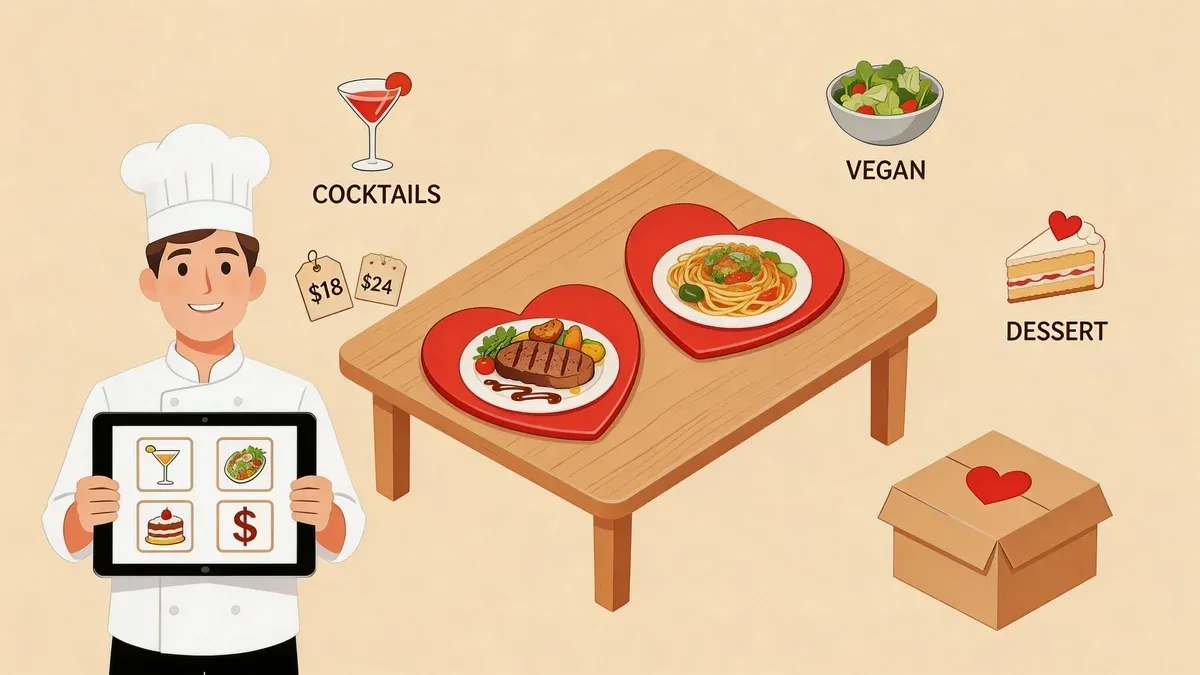
It’s 7 PM on Valentine’s Day. The dining room is full, tickets are backing up, and someone on the host stand is still retyping delivery orders from multiple tablets into the POS. The night can still be profitable, but the margin gets eaten by mistakes, comps, delayed orders, and staff stress.
This represents the core problem with many valentine menu ideas restaurant owners find online. The food sounds romantic. The operations do not. A steak special, dessert flight, or couples bundle works if the menu is easy to ring in, easy to prep, easy to package, and easy to sync across dine-in, pickup, and restaurant delivery.
Guests are still willing to spend for the occasion. Consumer research reported by Restaurant Dive says 74% of consumers plan to dine out or order takeout or delivery from restaurants on Valentine’s Day, with 49% planning to dine in and 25% planning delivery or takeout. The same report notes that 45.9% of diners say Valentine’s menu specials influence where they choose to order or dine, and average expected spending reached $192 in 2024. Read the reporting in this Restaurant Dive Valentine’s Day coverage.
So the best valentine menu ideas restaurant operators can run are not creative. They are built for execution. They fit kitchen flow. They reduce modifier chaos. They hold up in transit. They work cleanly inside Uber Eats, DoorDash, Grubhub, and your POS.
The eight ideas below are designed that way. Each one ties menu strategy to restaurant operations, POS integration, and delivery control so you can increase throughput without turning the night into a fire drill.
1. Multi-Course Tasting Menu with Delivery Optimization
A tasting menu can work for off-premise orders if you stop treating delivery like dine-in with a lid.
The practical version is a tightly curated multi-course menu with courses that travel well, reheat cleanly, and can be fired in waves without wrecking your line. Think chilled starter, hot entrée, structured side, and a dessert that survives motion. Avoid anything that dies in steam, breaks in transit, or relies on last-second plating finesse.
Tastewise reports that the average Valentine’s Day menu price reached $76.43, up 3.93% over the last 12 months, with operators leaning on bundled formats and premium ingredients rather than price-led discounting. That same report points to operators narrowing assortments to protect margins. You can review those Valentine’s menu trends in this Tastewise Valentine’s Day food trends analysis.
How to build it for restaurant operations
Start simple. In plain language, this means fewer choices and more control.
In technical terms, create each course as its own POS-mapped item, then bundle them into one fixed package across delivery apps. That gives your kitchen separate production visibility while still showing the guest one polished offer.
A good example is a steakhouse offering a four-course Valentine’s dinner on DoorDash. The customer sees one package. The kitchen sees separate prep steps for salad, steak, side, and dessert. That is much easier to execute than one catch-all note field.
Use a consolidated order workflow that acts as a real system of delivery instead of relying on tablet juggling.
Keep the tasting menu narrower than your regular menu. Valentine’s guests often want confidence, not endless choice.
What works and what does not
What works:
- Stable sequencing: Cold first course, hot main, durable dessert.
- Controlled radius: Keep delivery zones tight enough that proteins arrive correctly.
- Instruction inserts: Add reheating and plating cards so the guest finishes the experience well.
What does not:
- Fragile plating: Foams, stacked garnishes, and delicate crisp elements collapse fast.
- Open-ended substitutions: Every “can I swap this?” request slows production.
- Mixed timing logic: If one course requires immediate consumption and the next can sit, quality feels uneven.
If you use Uber Eats or DoorDash, preload the entire package in your POS before launch day and test one live order on each platform. One clean tasting menu sells romance. One broken modifier tree sells refunds.
2. Romantic Pairing Bundles
A guest opens your Valentine’s menu at 6:15 p.m., wants a safe choice fast, and does not want to compare twelve entrées with six drinks. Pairing bundles solve that buying moment well. They also protect the line if you build them for execution instead of novelty.
A Delish report on Valentine’s restaurant ordering noted higher wine demand on the holiday and strong steak preference, which supports a simple pairing strategy built around familiar premium items. See this Delish Valentine’s Day restaurant order article.
Build bundles around margin and station load
The best bundle usually has one hero entrée, one beverage path, and one finishing item. That could be dessert, a starter, or a packaged add-on. Keep the combinations tight enough that your grill, pantry, and bar are not all getting hit with custom requests at once.
A practical lineup looks like this:
- Steak for Two + red wine
- Lobster pasta + prosecco split
- Chicken parmesan + mocktail pair
- Dessert duo + after-dinner beverage
The menu language matters. “Steak Night for Two” sells better than a generic package name because the guest understands the outcome immediately.
For operators trying to increase average check without creating a giant modifier tree, this is one of the cleaner approaches. The same principles behind profitable bundling show up in this guide on how to increase sales in a restaurant.
Configure the POS before you market the offer
In Square or Clover, set up the bundle as a parent item with fixed components and only one or two controlled modifier groups. One beverage substitution group is manageable. Open-ended swaps are where the margin disappears and expo starts asking questions your cashier already answered badly.
I usually recommend this logic:
- Base bundle: Fixed entrée, fixed side, fixed dessert
- Beverage selector: Wine, mocktail, or premium upgrade
- Single upsell: Add truffles, flowers, or a better bottle
- Prep routing: Send beverage and food components to the right stations automatically
That setup keeps online ordering clean and helps staff sell the same offer in-store without memorizing pairings. If you run a virtual concept or hybrid operation, the same discipline used in a profitable ghost kitchen menu strategy applies here. Limit SKU sprawl, standardize modifiers, and route tickets clearly.
Real trade-offs
Bundles improve speed only when the kitchen can repeat them hundreds of times with very little interpretation.
The mistake I see most often with bundles is calling something a preset offer while still allowing full à la carte customization inside it. You end up with bundle pricing, custom-order labor, and uneven ticket times. That is a bad trade on Valentine’s Day.
Packaging also changes the economics. If alcohol is part of the offer, confirm local compliance rules for pickup and delivery before launch. If alcohol is off the table, premium NA pairings can still work well if the copy feels intentional rather than like a fallback. Guidance from content on pairing food with whiskey is useful here because it shows how flavor notes can sell the pairing without making the menu sound academic.
One more practical note. Add-ons should feel giftable. A small dessert upgrade, candle, or link to curated Valentine’s Day gift baskets can increase perceived value without adding strain to the hot line.
Package by station, price for contribution margin, and keep the guest decision simple. That is how bundles raise check average without creating a Valentine’s service mess.
3. Build-Your-Own Valentine’s Box
At 6:40 p.m. on Valentine’s Day, the kitchen does not need more creativity from guests. It needs clean tickets, predictable packouts, and a box format that feels personal without turning every order into a custom project.
A build-your-own Valentine’s box works best as a controlled menu architecture. Guests choose within fixed lanes. The kitchen repeats a small set of components. The POS enforces the rules.
That structure protects margin. It also protects timing on third-party delivery, where one missing modifier or vague note can stall an order long enough to wreck the guest experience.
Build the box around components, not dishes
Set the box up as one product with required choices inside it. Keep each category short and operationally different enough that guests feel they made real decisions.
Analysts at Datassential’s Valentine’s Day food analysis found strong consumer interest in familiar indulgent items such as chocolate, brownies, pasta, and donuts. For this format, that matters more than novelty. Valentine’s delivery performs better with items that travel well, plate cleanly at home, and do not need line-by-line explanation.
A practical box might include:
- Starter choice: Charcuterie cup or salad
- Main choice: Pasta or steak entrée
- Dessert choice: Brownie bite or chocolate treat
- Add-on choice: Beverage or premium side
That menu feels flexible. The kitchen still works from a disciplined ingredient set.
Configure the POS before you design the marketing
I usually recommend building these boxes inside the POS first, then writing the sales copy. That order matters because the modifier logic determines whether the concept is profitable.
Use one parent item for the box. Set each course as a required modifier group. Cap the number of choices. Remove free-text instructions unless they are tied to allergy handling. If you need a cleaner way to structure timed categories, modifier groups, and seasonal naming, this guide to menu design software is useful.
The same logic should carry across Square, Uber Eats, DoorDash, and Grubhub. If the guest can choose two proteins in one channel but only one in another, your staff ends up fixing orders by hand. That is where Valentine’s service breaks down. Synced menu rules reduce refunds, remake requests, and those “call the customer for clarification” delays that jam the expo line.
A good example. A Mediterranean restaurant can sell a Date Night Mezze Box with four required decisions: dip, protein, starch, dessert. The guest sees a polished builder. The kitchen sees a short, readable ticket with no paragraph-length notes.
Packaging is part of the product
Custom boxes fail when operators price the food correctly but treat packaging like an afterthought. For Valentine’s, presentation affects both conversion and review quality. Use inserts, labels, and compartment choices that keep hot and cold items separate and make the unboxing feel giftable.
Browsing premium Valentine’s Day gift baskets can help restaurant teams evaluate visual presentation, compartment use, and add-on opportunities without increasing hot-line complexity.
One rule is easy to remember. If staff need a training sheet longer than one page to build the box, the offer is too complicated for Valentine’s volume.
4. Limited-Edition Valentine’s Seasonal Menu
Scarcity works when it is real.
A limited Valentine’s menu should feel special because it is intentionally short, not because you renamed regular items with pink language. If you only have a brief sales window, every item needs a purpose. One item drives premium checks. One item drives impulse dessert sales. One item is built for delivery. One item anchors dine-in.
Why a short menu often makes more money
This is in non-technical terms. Fewer dishes means faster prep, better purchasing, and less waste.
Operationally, narrower assortments also protect your line. You buy fewer specialty ingredients, train staff on fewer builds, and improve consistency at the exact time demand spikes.
That is where menu engineering software helps. If you need a cleaner way to plan those limited items, a tool or workflow built around menu design software can make it easier to build timed availability, cleaner naming, and better category logic before the holiday rush.
A sushi operator, for example, might run one Valentine roll, one premium sashimi set, one boxed dessert, and one sparkling add-on. A burger concept might run one heart-branded shake, one limited burger, and one dessert package. The point is not variety. The point is sales focus.
Menu ideas that hold up
The strongest seasonal ideas usually fit one of these lanes:
- Premium hero dish: Filet, lobster add-on, or truffle-forward entrée
- Photogenic dessert: Boxed chocolate format, macaron pack, or polished single-serve sweet
- Holiday beverage: Wine pairing, mocktail, or sparkling bundle
- Giftable extra: Add-on dessert box for pickup or delivery
This idea also works well with timed publishing in Uber Eats and DoorDash. Schedule the menu to appear only during the selling window so staff are not turning items on and off manually.
What does not work is launching a “limited-time” menu that still depends on broad ingredient overlap, a large substitution matrix, and open inventory. Scarcity should lower complexity, not hide it.
When operators use this approach well, the floor feels calmer, the line fires more evenly, and managers spend less time apologizing for sold-out specials that should never have been listed in the first place.
5. Aphrodisiac-Focused Menu
This concept sells best when you treat it as ingredient storytelling, not gimmick marketing.
Guests understand the romantic shorthand already. Oysters, chocolate, strawberries, chili, pomegranate, and rich seafood all signal occasion. You do not need to overexplain. You need to build a menu that makes those ingredients feel intentional and premium.
Tastewise reports that chocolate holds 46.48% of Valentine’s Day menu share, and formats matter. Cake pops index far higher than traditional plated desserts, while survey data in the same report shows macarons outperform lava cake in consumer preference. That makes boxed, portable desserts especially useful for restaurant delivery and pickup. The details are in the Tastewise report cited earlier.
How to use the theme without sounding cheesy
Use ingredient-led descriptions:
- Wild oysters with citrus mignonette
- Dark chocolate tart with berry finish
- Strawberry and sparkling pairing
- Chili-honey glazed shrimp
- Pomegranate lamb skewers
Avoid fake science and medical promises. Romance sells. Overclaiming does not.
A good example is an oyster bar using Uber Eats for chilled shellfish platters and boxed truffles as an add-on, while the dine-in room sells the full raw bar tower. Same theme. Different operational build.
Where food tech helps
This menu style often includes expensive or finite ingredients. That means your POS and inventory logic need to be tighter than usual.
Track specialty items at the ingredient level where possible. If oysters or premium chocolate are your headline products, you need visibility before the last batch gets oversold on a third-party app. A synced POS setup is not glamorous here. It is protective.
Aphrodisiac menus also benefit from visual merchandising. Strong app photos, clear item names, and simple pairings outperform long romantic prose. In delivery, the guest decides quickly.
One more practical note. This theme does not need to dominate the entire menu. A focused section of four to six items is enough. A full menu built entirely around “seduction” language gets corny fast and can alienate guests who want a good meal.
The smartest version is subtle. Premium ingredients. Clean copy. Strong packaging. Tight stock control.
6. At-Home Date Experience with Instructions and Entertainment
A guest gets home at 6:45, opens the bag, and wants the night to feel easy within five minutes. If they are hunting for reheating steps, missing a sauce cup, or guessing which course comes first, the experience fails before dinner starts.
An at-home date package sells structure as much as food. The strongest version includes a fixed menu, clear timed instructions, and one or two atmosphere extras that do not create kitchen friction. A playlist card, printed course guide, candle, or short set of conversation prompts can add value. Ten loose items packed with no sequence do not.
That distinction matters on Valentine’s Day because demand spikes from couples who want restaurant quality without the reservation, parking, and wait-time hassle. The operator’s job is to remove decisions. Curated pacing is what makes the package feel premium.
I usually advise clients to build this like a product, not a special. Each box should have a defined bill of materials, a packing checklist, and an assembly flow that lives outside the hot line. The kitchen cooks the meal. A separate station handles inserts, candles, flowers, labels, and final presentation. That separation protects ticket times and reduces forgotten components.
Build the experience around sequence
The best boxes guide the night in order:
- Starter with a short plating note
- Main course with reheating time by container
- Dessert packed to stay intact through delivery
- One entertainment or ambiance touch
- A single card that explains the full flow in under a minute
Keep the instructions short enough to follow under pressure. “Heat covered entree tray for 12 minutes at 350°F” works. A full page of chef notes does not.
Entertainment also needs restraint. A QR code to a playlist is useful. A long video, multiple links, and a stack of cards usually ends up ignored. Guests bought dinner with a little atmosphere, not a homework assignment.
Use POS modifiers to protect margin
Profit disappears when staff assemble custom romance boxes from open-ended notes. Set the base package in Clover or Square as one parent item, then add controlled modifiers for flowers, candle upgrade, mocktail kit, wine pairing where legal, or late pickup window. That gives the front of house team a clean production view and lets you track which extras sell.
Keep non-food add-ons mapped as distinct components so your reports show attachment rate and contribution margin. If candles sell often but flowers create waste, you need that visibility before next year. The same logic helps with delivery menus. Limit custom text fields. Use modifier groups instead.
A good setup also makes third-party handoff cleaner. Drivers should see one sealed package count, not a confusing mix of meal bags and loose extras. If the order includes fragile items like flowers or glassware, flag that in the dispatch notes and package them as a single bundle wherever possible.
Guests will forgive a smaller menu. They will not forgive a premium box that feels improvised.
Presentation drives repeat orders here. Branded labels, numbered containers, and a tidy top layer photograph better and generate better post-purchase sharing. That is useful marketing, but the key win is operational. Clear packing and clean labeling cut remake calls, refund requests, and support messages on your busiest night.
7. Couples’ Cooking Kit with Pre-Prepped Ingredients
This idea attracts guests who want participation without hard work.
A cooking kit succeeds when the restaurant does most of the prep. The guest should finish, assemble, or heat. They should not need knife skills, timing instincts, or a pantry full of backup ingredients.
Build the kit for success, not for drama
Good kit candidates:
- Fresh pasta with finished sauce
- Hand-roll sushi components
- Steak with compound butter and simple finishing steps
- Taco or mezze kits with labeled containers
Bad kit candidates:
- Multi-pan dishes with exact timing
- Sauces that split easily
- Fried items
- Anything that depends on high-skill doneness control
Sequence is vital here. Pack ingredients in the exact order of use. Label every container clearly. Add one printed card with steps and one QR code to a short video. If the customer needs to hunt through the box to understand the flow, the experience starts badly.
A sushi restaurant on Uber Eats might sell a hand-roll date kit. A pasta restaurant might offer fresh ravioli, pre-portioned sauce, garnish, and dessert. Those are interactive but forgiving.
Use POS logic at the component level
The operational challenge is inventory. A cooking kit is one menu item to the guest, but it is many components to the kitchen.
Track those parts carefully. Proteins, sauces, garnishes, and packaging all need to be allocated before the holiday rush. If your POS can treats the whole thing as one generic item, prep teams lose visibility.
This format also needs stronger prep sheets than a standard special. Each kit should have:
- Assembly order: What gets packed first and last
- Customer instructions: The exact home sequence
- Recovery plan: Extra sauce, extra garnish, or backup seasoning in case the guest makes a mistake
Operationally, kits often produce fewer live-fire bottlenecks than full hot entrées because much of the work moves earlier in the day. That can be a major advantage when your line is already loaded with dine-in and delivery demand.
The trade-off is packaging labor. If your team is weak at labeling and assembly discipline, skip this idea. A cooking kit only feels premium when every part is organized and obvious.
8. Dynamic Pricing and Surge Premium
At 6:15 p.m. on Valentine’s Day, the same mistake shows up everywhere. The dining room is full, third-party tablets start firing, staff begins quoting different prices by phone, and someone updates one channel but forgets the others. Margin disappears fast when pricing is handled manually.
Set holiday pricing before service starts, and tie it to capacity instead of panic. A tiered structure works better than constant price movement because guests can understand it and staff can explain it without friction.
Keep the rules simple. Sell early pickup or early delivery windows at the base Valentine’s price. Raise the price for prime windows once you get close to your kitchen or driver handoff limit. Reserve the highest tier for the slots that create the most operational strain. This dynamic price strategy for restaurant demand spikes is useful because it treats pricing as an operations tool, not a last-minute markup.
A premium omakase delivery set is a good fit for this model. The 5:00 p.m. pickup slot can stay at standard holiday pricing. The 7:00 p.m. slot carries a premium because that is when labor pressure, courier delays, and remake risk all rise together. Guests are paying for access to a constrained time window, which feels more reasonable than a vague service fee.
Build pricing around channels and POS control
The operational failure point is sync. If your Square or Clover setup, online ordering menu, and delivery platforms do not show the same offer names and slot logic, your team inherits the problem at the worst possible time.
Use separate items or timed variants with clear naming such as:
- Valentine Dinner Early Access
- Valentine Dinner Prime Slot
- Valentine Dinner Last Call
That naming matters. It reduces refund requests, makes KDS tickets easier to read, and gives cashiers a script that matches what the guest saw online.
Dynamic pricing also protects throughput. Prime slots should carry enough margin to cover the extra packaging touches, courier wait exposure, and customer support load that come with peak-hour orders. If the premium is too small, you still get slammed, just at a lower profit.
One caution. Do not use surge pricing on items with unstable prep times or high substitution risk. If the kitchen is likely to 86 a component, the premium price becomes harder to defend and service recovery gets expensive.
Check competitor pricing, then check your own constraints harder. The goal is not to look cheap. The goal is to price each slot in a way your kitchen, POS, and delivery flow can support.
Valentines Menu Ideas: 8-Option Comparison
Option Implementation Complexity Resource Requirements Expected Outcomes Ideal Use Cases Key Advantages Multi-Course Tasting Menu with Delivery Optimization High - complex POS timing, staggered course sequencing and temp control Specialized temperature-controlled packaging, POS integration, trained staff Higher AOV and premium positioning; quality risk if timing fails Fine-dining or upscale restaurants targeting special-occasion delivery ⭐ Premium pricing, consolidated POS order control, sequential kitchen workflow Romantic Pairing Bundles (Food + Wine/Beverage) Moderate - single-SKU bundles but requires inventory coordination and alcohol compliance Wine/beverage inventory, sommelier curation, POS bundle setup ~30–40% AOV uplift; easy cross-platform promotion Casual-to-upscale restaurants seeking simple upsells and giftable options ⭐ Simplifies ordering, strong AOV lift, easy promotion across platforms Build-Your-Own Valentine’s Box (Customizable Delivery Box) High - extensive modifier trees and KDS coordination Advanced POS modifiers, ingredient-level tracking, flexible packaging Higher satisfaction and personalization; potential POS errors without integration Fast-casual and brands that thrive on customization ⭐ Personalization drives satisfaction and waste reduction; scalable upsells Limited-Edition Valentine’s Seasonal Menu (Time-Based Scarcity) Medium - menu planning, ingredient sourcing, POS scheduling windows Seasonal ingredient sourcing, chef development, targeted marketing Urgency/FOMO drives volume and social buzz; limited scale window Restaurants seeking PR, seasonal marketing, or chef-driven specials ⭐ Scarcity boosts demand and justifies premium pricing Aphrodisiac-Focused Menu (Wellness/Ingredient Marketing) Low–Medium - menu copy/training and ingredient sourcing Specialty ingredient sourcing, staff education, content assets Differentiation and content marketing traction; niche audience appeal Oyster bars, chocolate shops, wellness-focused restaurants ⭐ Unique positioning with strong content & ingredient storytelling At-Home Date Experience with Instructions/Entertainment Very high - multi-component bundling, partner coordination, QC Non-food accessories, partnerships (florists/musicians), premium packaging, content creation Very high perceived value and shareability; high cost and execution risk Luxury/restaurants offering experiential premium packages ⭐ Exceptional differentiation, viral unboxing potential, strong loyalty Couples’ Cooking Kit with Pre-Prepped Ingredients (Interactive DIY) High - mise en place prep, video production, safety considerations Prepped ingredient packaging, video tutorials, POS component tracking Engaging experience, premium pricing; outcome depends on customer execution Culinary-focused brands and experiential meal-kit providers ⭐ Interactive engagement, marketing content, reduced in-kitchen cook time Dynamic Pricing & Surge Premium (High-Demand Strategy) High - pricing logic, POS sync, real-time monitoring Analytics, POS capability for tiered/dynamic pricing, staff oversight Revenue maximization and demand smoothing; risk of customer backlash High-demand venues with data capabilities and limited capacity ⭐ Incremental revenue uplift and automated capacity management
Your Next Step Integrate and Automate for Valentine’s
At 6:45 p.m. on Valentine’s Day, the dining room is full, pickup guests are stacking up by the host stand, and three delivery apps are still firing orders into separate tablets. That is the point where a profitable menu either holds up or breaks down.
The winning valentine menu ideas restaurant operators run are built for execution first. A tasting menu needs coursing that prints clearly to the kitchen. A pairing bundle needs to ring in as one clean package with the right add-ons attached. A build-your-own box needs modifier limits, or the line gets buried under custom notes and remake risk.
That is why the final step is integration and automation.
When delivery orders flow straight into the POS, the team stops re-entering tickets, chasing missed modifiers, and reconciling multiple tablets at close. Hosts stay focused on guests. Managers spend less time policing order flow. The kitchen gets one consistent stream of tickets across dine-in, pickup, and delivery, which matters on a holiday built around timing and presentation.
The practical gains show up fast:
- Staff spend less time on manual entry
- Managers get fewer tablet and menu sync problems during service
- Kitchen tickets stay cleaner and easier to sequence
- Bundles, add-ons, and limited-time offers stay more consistent across channels
- Modifier rules are easier to control before they create ticket chaos
- Inventory issues become visible earlier, before you oversell high-cost items
I usually tell operators to treat Valentine’s setup like a stress test for the rest of the year. If your bundle logic is messy, Valentine’s exposes it. If your third-party menus do not map cleanly to the POS, Valentine’s exposes that too. If your packaging flow adds two extra touches per order, the bottleneck appears the minute the first delivery wave hits.
Keep the setup tight. Use fewer menu paths. Cap customizations where they hurt throughput. Test every bundle, every modifier group, and every channel with live orders before the holiday. Then check the kitchen ticket against what the guest saw at checkout. That one step catches a surprising number of expensive mistakes.
The margin protection is real. A premium holiday order can absorb a strong food cost if execution stays clean. It falls apart fast when staff miss a side, comp a dessert, refund a cocktail substitute, or remake an order because the POS and delivery menu were out of sync.
The restaurants that come out ahead on Valentine’s usually make the same operational choices. They shorten the menu, build obvious upsells, package with intent, and run every order source through one system as much as possible. That is how you protect speed, accuracy, and average check at the same time.
Ready to streamline your restaurant operations before the Valentine’s rush? Start onboarding with OrderOut for free in just a few clicks at https://dashboard.orderout.co and make this your most profitable Valentine’s Day yet.
If you want fewer tablets, cleaner POS workflows, and more reliable restaurant delivery on your busiest nights, OrderOut helps connect Uber Eats, DoorDash, and Grubhub directly into systems like Clover, Square, Pecan, and others so your team can focus on service instead of manual entry.