
Uber Eats vs DoorDash: A Restaurant's Guide for Better Restaurant Operations
· Thibault Le Conte
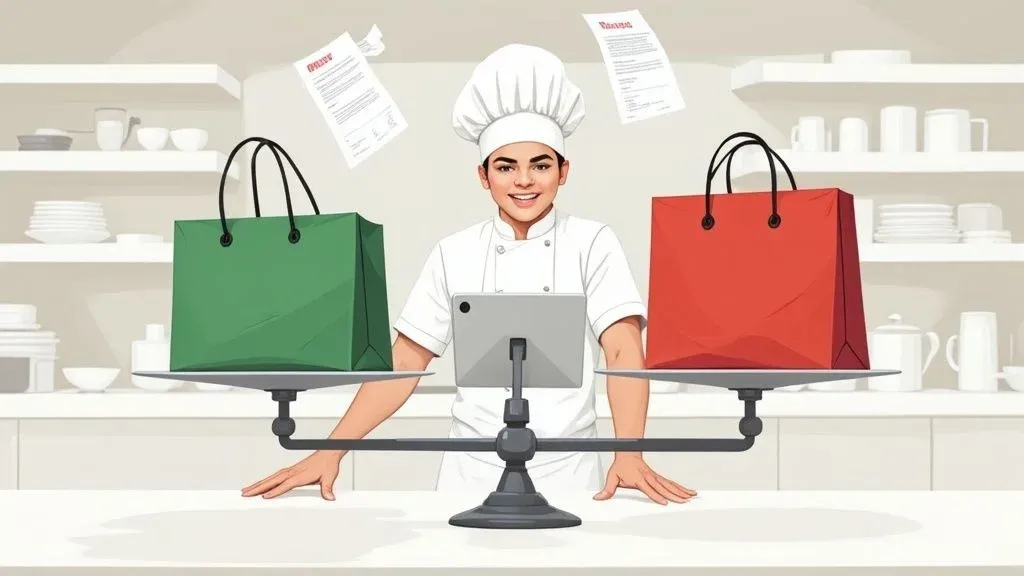
When comparing Uber Eats vs DoorDash, the core decision for a restaurant owner comes down to location and target audience. In simple terms, DoorDash is the undisputed king of the U.S. market, particularly in suburban areas, while Uber Eats excels in dense city centers and has a significant international presence. The best platform for your restaurant depends entirely on where your customers are and how you want to reach them.
This choice directly impacts your restaurant’s efficiency, delivery process, and POS integration.
Understanding the Food Tech Landscape and Why It Matters
Choosing a third-party delivery partner is one of the most important decisions for modern restaurant operations. These platforms are more than just delivery services; they are powerful marketing tools that represent your brand. The right choice can dramatically increase your customer reach and order volume, boosting your bottom line.
However, for most restaurants, the challenge isn’t just picking one. It’s about managing multiple platforms—like Uber Eats and DoorDash—without creating chaos in your kitchen with a mess of tablets and alarms. This guide is designed for restaurant owners, managers, and operators. We’ll focus on what truly affects your business:
- Commission Structures: How much does it really cost? We’ll break down the fees so you know how much profit you keep from each order.
- Market Coverage: Where are your potential customers searching for food? We’ll help you identify which platform dominates your specific area.
- POS Integration: How can you eliminate the clutter of multiple tablets and streamline orders directly into your kitchen? This is key for restaurant efficiency.
Our goal is to provide actionable insights for your restaurant delivery strategy. A smooth delivery operation can be a major growth engine, but it starts with understanding the key players. You can learn more about crafting these strategies in our guide to on-demand delivery.

At a Glance: Uber Eats vs DoorDash for Restaurants
Before diving deep, a quick side-by-side comparison is useful. Both platforms connect your restaurant with hungry diners, but their operational models and strengths have key differences that directly impact your experience and efficiency.
The data is clear: DoorDash leads the U.S. food delivery market with a dominant 67% market share as of early 2024, while Uber Eats holds a strong second place with 23%. This market leadership is reflected in DoorDash’s impressive USD 10.72 billion revenue in 2024.
Here’s how they compare from a restaurant operations perspective.
Feature DoorDash Uber Eats Primary Market Strength Dominant in U.S. suburban and residential areas Strong in dense urban centers and international markets Customer Base Broader U.S. audience, often including families Younger, urban-focused demographic; strong tourist and business user base Driver Network Dedicated “Dasher” fleet, strong suburban coverage Leverages existing Uber ride-share driver network for high urban density Subscription Program DashPass Uber One (includes ride-sharing benefits)
While this table provides a high-level overview, the best choice for your restaurant depends on the details and how each platform’s model fits your specific operational needs—a topic we’ll explore next.
Comparing Commission Fees and Pricing Tiers for Restaurant Delivery
Let’s talk about what matters most to your bottom line: profit margins. When you partner with a third-party delivery service, the commission fee is your biggest expense. This is simply the percentage of each order that the platform takes for marketing your restaurant and arranging the delivery.
Both Uber Eats and DoorDash offer tiered partnership plans, giving you more control over your costs. Think of these as different service levels. The plan you select directly impacts your delivery radius, your visibility within the app, and ultimately, your order volume.

Breaking Down the Partnership Tiers
Both DoorDash and Uber Eats structure their plans into three main tiers: Basic, Plus, and Premier. The concept is simple: a higher commission rate gets you more marketing exposure and a wider customer reach.
Here’s what that looks like in practice:
- Basic/Lite Plans: These are the entry-level options, with commission rates around 15%. They get your restaurant listed on the platform, but with a smaller delivery radius and minimal in-app marketing. This plan is best for serving existing customers who are already looking for you.
- Plus/Standard Plans: This is the most popular middle ground. Commissions are typically in the 20-25% range. In exchange, you get a larger delivery zone and access to their valuable subscriber bases—DashPass for DoorDash and Uber One for Uber Eats. This is a powerful tool for attracting loyal, high-frequency customers.
- Premier/Premium Plans: These top-tier plans come with the highest commissions, often 30% or more. This is your growth-focused option, providing the largest delivery radius, top placement in search results, and advanced marketing tools to attract new customers.
Why it matters for restaurant operations: Choosing the right plan is a balancing act. A Basic plan offers cost savings on each order, but might not drive enough volume to keep your kitchen busy. A Premier plan costs more per order but can significantly increase sales and build a new customer base, maximizing staff productivity and revenue. For example, a new pizza shop might use a Premier plan on DoorDash to quickly gain visibility in its suburban market, viewing the higher commission as a customer acquisition cost.
How to Choose the Right Plan for Your Restaurant
The best plan depends on your business goals. A small neighborhood café with a loyal following might thrive on a Basic plan to serve its regulars while protecting its margins.
In contrast, a new ghost kitchen needs to make an immediate impact. A Premier plan becomes a strategic investment in marketing and customer acquisition. The higher fee is the cost of being seen in a competitive digital space. A smart way to offset these costs is by using URL QR codes for direct ordering on your packaging, encouraging repeat customers to order directly from you, commission-free.
Before signing any agreement, it’s crucial to read the fine print. For a detailed checklist, our guide on evaluating a third-party delivery service is an excellent resource.
Ultimately, the decision should be data-driven. Calculate your average order value and food costs against each commission tier to see which plan supports your growth without sacrificing your profits.
Analyzing Market Share and Customer Reach in Food Tech
When evaluating Uber Eats vs. DoorDash, the first question is simple: where are your customers? While both are powerful platforms, their market dominance varies by location. Choosing the right one means meeting your local community where they already are.
Think of it like choosing a physical storefront. You wouldn’t open a high-end restaurant in a mall food court. The same logic applies here. Investing in the platform that’s popular in your neighborhood leads to more orders and a better return on your investment.

DoorDash: The Suburban Powerhouse
DoorDash has a commanding lead across the United States, especially in suburban and residential areas. This is where a huge portion of the takeout and delivery market resides. DoorDash has successfully built a loyal following among families and repeat local customers.
If your restaurant is outside a major downtown core, DoorDash is likely your strongest bet for reaching new customers. Its DashPass subscription program has created a large base of frequent users who instinctively open the DoorDash app first.
Real-World Example: A family-style Italian restaurant in a residential neighborhood will almost certainly see more orders through DoorDash. The platform’s deep penetration in these areas means the restaurant’s menu is seen by more potential customers, which directly translates to more orders flowing into their kitchen POS. This increases efficiency by maximizing order volume during peak hours.
Uber Eats: Dominance in Urban and Global Markets
Uber Eats leverages its massive global ride-sharing network to excel in dense urban centers and international markets. In a bustling downtown, the high concentration of both restaurants and customers, combined with Uber’s large pool of drivers, often results in faster pickups and deliveries, especially during a hectic dinner rush.
Uber Eats operates in 45 countries and over 6,000 cities with 890,000 restaurant partners. This global scale helped Uber Eats generate over $12 billion in food delivery revenue in 2023, making it a profitable global leader.
Why It Matters for Your Restaurant: A trendy taco spot in a major city like Miami or Chicago could find that Uber Eats connects them with a broader audience, including tourists and business travelers who already use the Uber app for rides. This opens up a valuable revenue stream that is harder to capture through other channels, improving overall restaurant performance.
Matching Your Restaurant to the Right Customer Base
Understanding this demographic split is crucial in the Uber Eats vs DoorDash debate. Your restaurant’s concept, price point, and location should drive your decision.
- DoorDash is often the better fit for:
- Restaurants in suburban or residential areas.
- Family-focused concepts (e.g., pizza, comfort food).
- Businesses relying on repeat orders from local customers.
- Uber Eats typically excels for:
- Restaurants in dense, urban downtowns.
- Trendy or niche concepts appealing to a younger, metropolitan audience.
- Businesses in tourist-heavy locations.
Remember that local preferences can vary. Dig into the data on the most used delivery partners on the US East Coast or your specific region.
Actionable Insight: Talk to other non-competing restaurant owners in your area. Ask them which platform generates more business. This ground-level intelligence is invaluable for understanding your local market.
Driver Networks and Delivery Reliability: An Operations Deep Dive
A great delivery experience doesn’t end when the food is cooked. It ends when a happy customer receives their meal, hot and on time. That final-mile journey is handled by the platform’s driver network, and its reliability directly reflects on your restaurant.
In simple terms, a late delivery or cold food is a bad experience. Customers often blame the restaurant, not the app, in their reviews. Understanding the logistics of each driver network is not just technical—it’s about protecting your brand, reducing food waste, and ensuring customer satisfaction.
How Each Platform Built Its Driver Fleet
DoorDash and Uber Eats approached their driver networks from different angles, which impacts driver availability and pickup times at your restaurant.
DoorDash created its “Dasher” network specifically for food and retail delivery. This focused approach, combined with their large market share, means a high concentration of drivers in suburban areas. Their DashPass subscription drives a consistent flow of orders, keeping a large, active fleet of Dashers on the road.
Uber Eats had a head start by tapping into its existing global network of Uber ride-share drivers. This provides an incredibly dense pool of couriers in major cities where ride-sharing is popular, often leading to faster pickup times during peak hours in busy downtown areas.
The Impact of Order Batching on Food Quality
Both platforms use order batching—where a driver picks up multiple orders from different restaurants along a similar route—to improve efficiency.
From a technical standpoint, this is a logistics optimization strategy that allows drivers to complete more deliveries per hour. For your restaurant, it can be a problem.
Why Batching Matters for Restaurant Operations: If your order is picked up first in a batched run, it could sit in the driver’s car for an extra 15-20 minutes. This delay can turn crispy fries soggy and a hot meal into a lukewarm disappointment, leading to customer complaints and negative reviews. This directly impacts your bottom line through remakes and refunds, and it hurts staff morale.
Actionable Insight: You can’t control batching, but you can prepare for it. Investing in high-quality, insulated packaging is your best defense against delays. This simple operational adjustment helps maintain food temperature, reduce complaints, and protect the quality you work hard to deliver. For a closer look at these logistics, check out our comprehensive look at top delivery partners on the US West Coast.
Which Network Is More Reliable for Your Location?
The reliability of each network depends heavily on your restaurant’s location.
- Suburban Restaurants: DoorDash often has the advantage. Its dedicated Dasher fleet is optimized for residential delivery patterns, providing more consistent coverage.
- Dense Urban Kitchens: Uber Eats frequently wins in bustling city centers. By leveraging its large network of ride-share drivers, they can often ensure faster pickups during chaotic lunch and dinner rushes.
Actionable Insight: Before committing, observe your surroundings. Pay attention to the delivery bags and car logos you see most often during your busiest hours. This real-world observation is one of the best ways to gauge which platform has a stronger local presence.
Streamlining Delivery With POS Integration for Better Restaurant Operations
Is your counter cluttered with multiple tablets, each one beeping and flashing during a busy service? This is “tablet hell,” a major operational bottleneck for restaurants managing third-party delivery. It forces your staff to manually enter orders from each device into your point-of-sale (POS) system.
This manual process is inefficient and prone to errors. Every re-keyed order is a chance for a mistake—a missed allergy note, the wrong side dish, or a completely incorrect ticket. These errors lead to wasted food, costly refunds, and unhappy customers. They also waste valuable staff time that could be spent serving in-house guests. This inefficiency directly hurts your productivity and profit.
The Solution: Direct POS Integration
The solution is direct POS integration, a crucial piece of food tech that automates the entire process. Instead of juggling tablets, integration sends orders from all your delivery apps—like Uber Eats and DoorDash—directly into your existing POS system.
From a technical perspective, this is achieved through an API (Application Programming Interface) that connects the delivery platform’s software to your POS. This creates a seamless data flow, eliminating manual work.
An order placed on DoorDash instantly appears on your kitchen display system (KDS) just like an order taken in-house. This means no manual entry, no typos, and no delays. Your kitchen receives accurate orders faster, reducing errors and improving staff productivity.
With DoorDash holding 67% of the market share and Uber Eats 23%, most restaurants need both to maximize reach, making an integrated solution essential for efficient restaurant operations.
How POS Integration Boosts Restaurant Efficiency
Automating your order flow with a POS integration isn’t just about convenience; it’s about improving your entire operation. It provides significant cost and time savings. For expert help, you can explore professional software integration services.
Here are the practical benefits:
- Drastic Error Reduction: Automation eliminates human error. Restaurants using POS integration can reduce order mistakes by over 95%, leading to fewer remakes, happier customers, and significant cost savings.
- Significant Time Savings: Eliminating manual entry saves your staff several minutes per order. Over a week, this adds up to hours of reclaimed labor, allowing your team to focus on higher-value tasks and improving staff productivity.
- Improved Staff Productivity and Morale: A streamlined workflow reduces stress and creates a calmer, more efficient work environment. This benefits both your online and in-person customers.
For a deeper look, our guide on POS software integration explains how this technology can transform your operations.
The difference is stark. Here’s a comparison of your daily workflow with and without integration.
Operational Impact With vs Without POS Integration
Operational Task Manual Entry (No Integration) Automated with POS Integration Order Entry Staff manually types each order from a tablet into the POS. Orders automatically appear in the POS and KDS instantly. Menu Updates Manually update menus and 86’d items on each delivery app. Update once in the POS, and changes sync to all platforms. Error Handling Time spent correcting wrong orders, issuing refunds, and remaking food. Errors are nearly eliminated, saving time, money, and reputation. Reporting Manually combine sales data from each app to see performance. All sales data is centralized in the POS for easy, accurate reporting.
Integration streamlines your entire delivery operation, from order placement to end-of-day reporting, giving you clear insights into your business.
A unified dashboard is essential for managing this streamlined workflow.
This centralized view empowers you to track performance without switching between apps, making data-driven decisions simple and effective.
Getting Started With Your POS System
Whether you use a popular system like Clover or Square, getting started with POS integration is easy. Both platforms have app marketplaces that allow you to connect third-party services like OrderOut, which consolidates all your delivery partners into a single, manageable feed.
Real-World Example: A busy restaurant using Square for its POS can connect OrderOut through the Square App Marketplace. Now, when an order comes from Uber Eats, it flows directly into the Square POS and prints in the kitchen, just like an in-house order. This eliminates the need for a separate tablet, reduces order entry time from minutes to seconds, and cuts down on errors, saving the restaurant money and improving customer satisfaction.
For Clover users, the integration is available on the Clover App Market.
By automating your order process, you take back control of your operations. You can start onboarding for free and see the difference at the OrderOut Dashboard.
How to Make Your Final Decision
So, how do you choose between Uber Eats and DoorDash? The decision depends on your restaurant’s specific location, customer base, and kitchen capacity.
DoorDash dominates the U.S. market, especially in suburbs and residential neighborhoods. Uber Eats excels in dense urban centers and has a strong international presence, connecting with a younger, more metropolitan audience.
Practical Steps to Choose a Platform
Here are a couple of common scenarios:
- You run a restaurant in a U.S. suburb. DoorDash is likely your best starting point. Its dominance in these areas gives you immediate access to the largest local customer base.
- Your restaurant is in a major downtown area. Uber Eats is essential. The platform thrives in bustling cities, with a large network of drivers and a customer base of city dwellers, tourists, and professionals.
However, the smartest strategy for most restaurants is to use both. Listing on both platforms maximizes your reach by tapping into two distinct customer groups. The key challenge then becomes managing both efficiently.

As shown, juggling multiple tablets leads to chaos and missed orders. The goal is to consolidate all orders into a single system. A POS integration solution like OrderOut achieves this by eliminating manual entry, reducing costly mistakes, and freeing up your staff’s time.
Clear Next Step: The most practical next step is to unify your entire delivery operation. You can consolidate all your orders and streamline your kitchen workflow by visiting the OrderOut dashboard.
Frequently Asked Questions
When deciding between Uber Eats vs. DoorDash, several common questions arise for restaurant owners. Here are some straightforward answers.
Can My Restaurant Use Both Uber Eats and DoorDash?
Yes, and you probably should. The best strategy is to be on both platforms to maximize your visibility. Your neighborhood might be a DoorDash stronghold, but you could be missing out on the business travelers and late-night crowd who primarily use Uber.
Why it matters for restaurant operations: Being on both platforms requires efficient management. A POS integration is crucial to avoid the chaos of multiple tablets, reduce errors, and prevent staff burnout. For example, using a tool to feed both Uber Eats and DoorDash orders into your Clover POS system ensures your kitchen runs smoothly, regardless of where the order originated.
Which Platform Offers Better Marketing Tools?
Both platforms offer solid marketing toolkits, including sponsored listings and promotions like “BOGO” deals. There isn’t a single “better” option; it depends on your restaurant and customers.
Actionable Insight: The best approach is to experiment. Run small, low-budget promotions on each platform and track the results. The data will show you where your marketing dollars generate the best return, whether it’s driving more orders or attracting new customers.
Do I Have to Use the Tablets They Provide?
No, you don’t have to live with a cluttered counter. This is a common operational headache that is completely avoidable.
A dedicated POS integration service is the solution. It funnels all your orders from both Uber Eats and DoorDash directly into your existing POS system, like Clover or Square. Orders appear in one place and print straight to the kitchen. This simple fix cleans up your counter, eliminates manual entry errors, and improves staff efficiency.
How Much Does It Cost to Start?
Getting started is often free, as both platforms frequently waive activation fees. The primary cost to consider is the commission fee taken from each order.
These fees are tiered. A basic plan with a lower commission (around 15%) gets you listed, while a premium partnership (costing 30% or more) includes a larger delivery radius and marketing features. It’s essential to discuss the current rates with their representatives to determine what makes financial sense for your restaurant.
Practical Next Step: Stop juggling tablets and streamline your restaurant’s delivery operations. OrderOut integrates all your delivery apps directly into your POS, eliminating manual entry and reducing errors. Get started for Free in a few clicks at https://dashboard.orderout.co.