
The Ultimate Guide to Creating a Tip Chart for Restaurants
· Thibault Le Conte
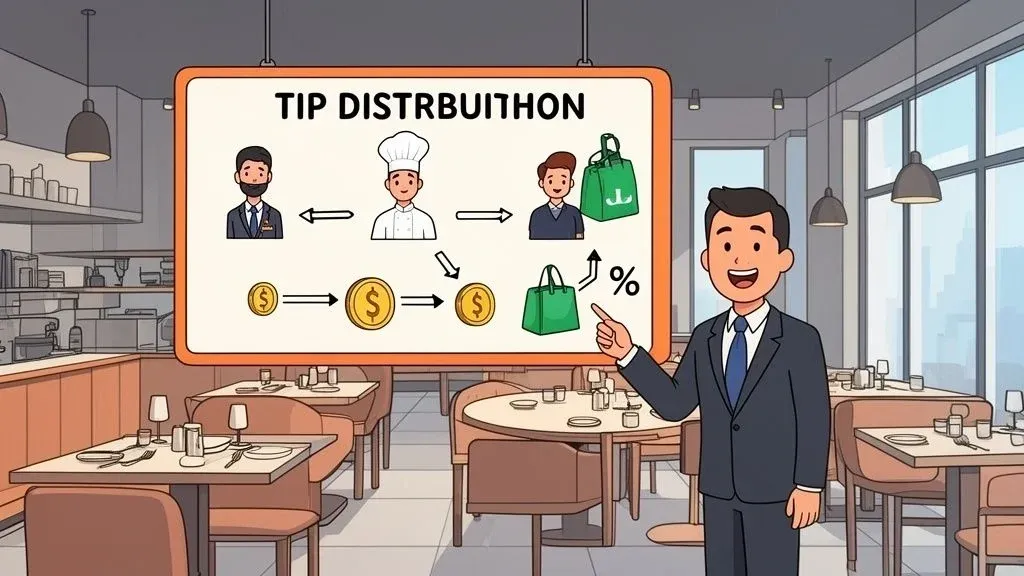
Let’s be honest—managing tips in a restaurant today is a minefield. The old days of servers just pocketing their cash at the end of a shift are long gone. Now you’re juggling tips from dine-in, takeout, and a half-dozen different delivery apps. It’s chaotic.
Without a clear, standardized system, you’re not just risking confusion; you’re risking staff morale, operational efficiency, and your bottom line.
A well-defined tip chart for restaurants is no longer just a nice-to-have. It’s a core operational tool for fairness, transparency, and survival, especially as the economic ground shifts beneath our feet. This guide will provide actionable steps to build and automate a system that saves you time and reduces errors.
Why a Modern Tip Chart Is Non-Negotiable for Restaurant Operations
The tipping landscape is changing, and not for the better. Recent data from over 900 million transactions paints a stark picture: the average tip on food and beverage orders cratered to a record low of 14.9% in Q2 2025. This isn’t a random dip; it mirrors sliding consumer confidence as diners get more cautious with their spending.
This trend is a direct hit to your team. With tips making up nearly 23% of a typical server’s income, that decline puts a real strain on their financial stability. And when your staff is stressed about money, turnover is sure to follow. You can dig into the full 2025 Summer Restaurant Report to see the detailed analysis.
Transparency Is Your Best Defense for Staff Productivity
In an environment like this, transparency is everything. A clear, well-communicated tip chart gives your team something they desperately need: predictability. When your staff knows exactly how tips are calculated and shared—whether from a big party on a Saturday night or a quick Uber Eats order—it kills suspicion and builds trust.
Why this matters for your restaurant: A happy, secure team is a productive team. When you eliminate confusion around pay, staff can focus on delivering great service instead of worrying about tip distribution. This leads to higher guest satisfaction and lower turnover, directly reducing your hiring and training costs.
A real-world example: a downtown bistro I know was struggling with staff retention, especially during the slow season. They implemented a simple point-based tip chart that smoothed out income fluctuations. The result? A happier, more collaborative team and a noticeable drop in turnover. This simple document solved a major labor headache and improved overall restaurant efficiency.
Improving Restaurant Delivery and POS Integration with a Tip Chart
This is where a good tip chart goes from being a document to a dynamic system. When you integrate your tipping rules directly into your food tech, especially your POS, you eliminate the manual-entry nightmare that eats up hours and causes costly mistakes.
Imagine this actionable workflow:
- All Tips in One Place: Gratuities from every source—credit cards at the table, your online ordering portal, and third-party apps like DoorDash—are all funneled directly into your POS.
- Automatic Calculations: Your POS, programmed with your tip chart’s rules, does all the math instantly and accurately for every employee on every shift.
- Flawless Payroll: The system then syncs this data directly to your payroll software. No more spreadsheets, no more manual data entry, no more errors. This saves your manager valuable time and reduces costly payroll mistakes.
Modern POS systems are built for this. Platforms like Clover and Square have robust features and apps designed to handle complex tip-outs. This is a prime example of how thoughtful automation in restaurants can solve some of your biggest back-of-house headaches and boost staff productivity.
Before you start building your chart, you need to decide on the right structure for your team.
Tipping Model Comparison for Your Restaurant
Choosing the right tipping model is the foundation of a fair system. Each approach has its own strengths and is better suited for different types of restaurants. This table breaks down the most common models to help you decide which one makes the most sense for your operation.
Tipping Model How It Works Best For Key Benefit Percentage-Based A percentage of each server’s tips is “tipped out” to support staff (bussers, runners, bartenders). Traditional, full-service restaurants where servers are the primary point of contact. Simple to calculate and directly rewards servers based on their individual sales and service. Point System Each position is assigned a point value. All tips are pooled, and the total is divided by the total points for the shift to find the value of one point. Each employee receives their share based on their points. Restaurants with high collaboration between FOH and BOH; team-oriented service models. Promotes teamwork and ensures all contributing roles, including the kitchen, are rewarded. Highly flexible. Tip Pooling All tips collected during a shift are pooled together and then distributed among the staff, often based on hours worked. Cafes, counter-service spots, and small restaurants where roles overlap significantly. Fosters a strong “all-for-one” culture and simplifies distribution, especially with fluctuating shift coverage. Hybrid Model Combines elements of different models. For example, servers might keep a percentage of their own tips and pool the rest, or a point system might be used for FOH while BOH receives a separate tip-out. Complex operations with distinct service zones or revenue centers (e.g., a restaurant with a busy bar and separate dining room). Offers the ultimate flexibility to create a custom-fit system that addresses the unique needs of your team.
Ultimately, the best model is one that your team perceives as fair and that you can administer consistently. Consider your service style, your team structure, and your restaurant’s culture before making a final decision.
Now, let’s get into the specifics of how to build your chart.
Selecting and Implementing Your Tipping Model
Getting your tipping model right is one of the most critical decisions you’ll make for your restaurant. This isn’t just about crunching numbers; it’s about building a system that your staff sees as fair and motivating. The perfect model for a bustling fine-dining room will look completely different from what works in a quick-service cafe. It all comes down to finding the structure that fits your unique service style and fosters a great team environment.
It’s amazing how much a simple, transparent tip chart can impact morale.
When the process is a black box, resentment builds, and service suffers. A clear chart cuts through the confusion, building the trust that holds a team together.
Exploring Common Tipping Models for Modern Restaurant Operations
Before you can even think about creating a chart, you need to decide on the logic behind it. Most restaurants use one of three main approaches: tip pooling, percentage-based sharing, or a point system. Let’s break down how each one works in practice.
-
Tip Pooling: This is the simplest method. All tips from a shift go into one big pot and are then divided among the staff, usually by the hours they worked. It’s a fantastic fit for places like coffee shops or counter-service spots where everyone is chipping in on every order and roles blur together.
-
Percentage-Based Tip Sharing: A classic in full-service dining. Here, servers keep their own tips but “tip out” a fixed percentage to the support crew. For instance, a server might give 3% of their total sales to their busser and 5% to the bartender who made their drinks.
-
Point-Based System: This is by far the most adaptable and, in my experience, the fairest model for restaurants with distinct roles. You assign points to each position based on responsibility and guest interaction. A senior server might be 10 points, a bartender 7 points, a food runner 5 points, and so on. All tips are pooled, and the total is divvied up based on each person’s slice of the point pie for that shift.
With digital payments becoming the norm, good tracking is non-negotiable. As of Q1 2025, digital and card tips at full-service restaurants are hovering around 19.4%, with nearly 75% of customers opting for cashless gratuity. For managers using a POS like Square, which can track these trends, a solid system for distributing these digital tips is key to keeping your best people. You can get a deeper look at the numbers in these restaurant tipping statistics and their implications.
Calculating Payouts: A Practical Example
So, how does a point system play out on a real shift? Let’s walk through it.
Imagine a busy night brings in $1,000 in total tips. The team on the floor consists of:
- One Senior Server (10 points)
- One Bartender (7 points)
- One Food Runner (5 points)
First, add up the total points for everyone working: 10 + 7 + 5 = 22 total points.
Next, you need to figure out what each point is worth. Just divide the tip total by the point total: $1,000 / 22 points = $45.45 per point
Now, you can calculate each person’s share:
- Senior Server: 10 points x $45.45 = $454.50
- Bartender: 7 points x $45.45 = $318.15
- Food Runner: 5 points x $45.45 = $227.25
Why this matters for your restaurant: A point-based system directly rewards staff based on their role’s contribution, fostering teamwork between the front and back of the house. One restaurant that switched to this model reported a 15% drop in staff disputes and a significant boost in team collaboration, leading to smoother, more efficient service.
It’s also crucial to know the legal lines between different kinds of gratuities. We cover this topic in detail in our guide comparing service charges vs tips.
The bottom line? Your tipping model is the engine of your team’s morale and efficiency. A point system might take a bit more work to set up, but it delivers unmatched fairness and grows with you, especially when you automate it through a modern POS like Clover. Once you’ve landed on your model, the next step is translating it into a simple, easy-to-read chart for your crew.
Designing a Clear and Effective Tip Chart
Alright, so you’ve landed on a tipping model. Now for the most important part: turning that policy into a simple, visual tip chart your team can actually use. An effective chart is one your staff can understand in about 30 seconds. If they need a calculator and a ten-minute huddle to figure out their pay, the system is broken.
The goal here is to create a document that shuts down arguments before they even start. This isn’t just about printing out a spreadsheet; it’s about building trust and showing your team that you’re committed to a fair and transparent workplace.
Core Elements of a Great Tip Chart
Whether you’ve chosen a percentage-based system, a point system, or a straightforward tip pool, the chart has to be crystal clear. Think of it as a key page in your operations manual—it needs to be the undisputed source of truth for all things tips.
At a minimum, every tip chart must spell out:
- The Model: State it plainly. Is it a point system, percentage sharing, or a total tip pool?
- Who’s Included: List every single role that gets a cut of the tips.
- The Math: Show the exact percentages or points assigned to each position. No fuzzy numbers.
- Tip Sources: Specify what’s being pooled. Cash, credit cards, delivery app tips—get specific.
For a point system, for example, your chart should have each position listed right next to its point value. This transparency removes any guesswork and reinforces how each role contributes to the team’s success.
Visual Clarity and Communication Best Practices
How you present the information is just as critical as the information itself. A messy, hard-to-read chart only breeds suspicion. Your goal is to make it an accessible, everyday part of your operations.
Here’s how you can make sure your chart hits the mark:
- Use Simple Language: Ditch the corporate jargon. Instead of calling it a “Gratuity Distribution Matrix,” just title it “Our Tipping Plan.”
- Make it Visual: A clean table with bold headings and plenty of white space is your best friend. It should be scannable, not a wall of text.
- Show, Don’t Just Tell: Include a quick, hypothetical calculation. For example, “If we make $1,000 in tips today, here’s how it gets split…” This makes the abstract numbers feel real.
Post the chart where your team will actually see it every day. The breakroom, next to the POS terminal, or even in your team’s scheduling app are all great spots. Constant, easy access is key.
Why this matters for your restaurant: A well-designed tip chart does more than just outline pay; it reinforces your commitment to fairness. When the rules are clear and visible, you free up managers to focus on guest experience instead of mediating staff disputes over tip-outs. This simple document is a cornerstone of efficient restaurant operations, saving management time and boosting staff productivity.
Real-World Examples for Different Restaurant Types
Let’s look at how this plays out in a couple of different settings. A chart for a busy coffee shop will look completely different from one at a fine-dining spot.
- Coffee Shop (Tip Pool by Hours): The chart might be as simple as this: “All credit card and cash tips are pooled daily. The total is distributed among baristas and counter staff based on hours worked that day. The kitchen receives a flat 15% of the total pool.” It’s direct, fair, and easy for everyone to calculate.
- Full-Service Restaurant (Point System): Here, a table is probably best. It would clearly outline the points for each role: Server (10 pts), Bartender (8 pts), Busser (5 pts), Host (3 pts), and Food Runner (4 pts). This structure is perfect for teams where different roles carry vastly different levels of direct service responsibility.
To make sure these policies stick, savvy operators bake them directly into their standard operating procedures. If you’re looking to build out these foundational documents, check out our guide on restaurant standard operating procedures examples.
Ultimately, think of your tip chart as a living document that reflects your restaurant’s reality. Once you’ve got it designed and communicated, the next logical move is to automate the whole process through your POS, turning a daily headache into an error-free, time-saving system.
Automating Tip Distribution with POS Integration and Food Tech
So, you’ve hammered out a fair and transparent tip chart. That’s a solid foundation, but a plan on paper is only half the battle. The real challenge comes at the end of a long, chaotic shift when it’s time to actually execute that plan.
Ask any restaurant manager, and they’ll tell you: manual tip-outs are a nightmare. It’s a tedious, time-sucking process that’s ripe for human error. A single misplaced decimal or a forgotten delivery order can throw off the entire night’s payout, leading to frustrated staff and a payroll headache you don’t need.
This is where your point-of-sale (POS) system can turn that piece of paper into a powerful, automated engine. Modern restaurant tech is built to handle this exact problem. By integrating all your revenue streams with your POS, you can apply your tipping rules automatically, ensuring everyone gets their fair share without the manual grind.
Think of it this way: your POS becomes the central hub that pulls in tips from every source and distributes them according to your preset rules. It bridges the gap between dine-in payments and third-party delivery apps, creating one single source of truth for all gratuities.
How POS Integration Streamlines Tip Management and Restaurant Delivery
What does this automation actually look like during a busy dinner service? Imagine your restaurant follows a point system and takes orders from dine-in guests, your own website, and delivery partners like DoorDash and Uber Eats. Without integration, your manager is stuck at a desk juggling reports from multiple platforms, trying to manually consolidate tips before they can even start the calculations.
With POS integration, that entire process just… happens. Here’s the actionable workflow:
- Centralized Tip Collection: An integration tool acts as a bridge. When an order comes in from Uber Eats with a generous tip, it flows directly into your POS system. No one has to manually key it in.
- Automated Rule Application: Your POS already has your restaurant’s point system programmed into it. It instantly recognizes the new tip and knows that the server gets 10 points, the kitchen gets 4, and the host gets 2.
- Instant Calculation: At closing time, the system tallies the total tip pool from every source—credit cards swiped in-house, online orders, and all third-party apps—and automatically divvies it up based on your rules.
Why this matters for your restaurant: Every single team member gets their exact share, from the line cook who fired the order to the server who bagged it. No more missed tips from a tablet that was offline, and absolutely zero math errors. This directly improves restaurant efficiency and staff productivity.
Of course, this all starts with having the right foundation. Choosing from the best mobile POS systems is a critical first step, as this will be the heart of your entire operational workflow.
The Real-World Impact on Restaurant Operations
The benefits of automating your tip chart go way beyond simple convenience. It creates a ripple effect that touches your efficiency, labor costs, and even your team culture.
- Massive Time Savings: We’ve seen managers get back 30-60 minutes every single day that used to be lost to manual tip-outs. That’s time they can now spend coaching new hires, talking to guests, or actually managing the floor.
- Elimination of Costly Errors: Manual entry is a recipe for mistakes. A typo can easily lead to underpaying one person and overpaying another, which creates compliance risks and erodes trust. Automation guarantees 100% accuracy.
- Improved Staff Morale: When your team trusts that they are being paid correctly and fairly for every single tip—especially complex delivery orders—it makes a huge difference. It cuts down on disputes and helps foster a more positive and collaborative environment.
A real-world example: a busy pizzeria using a Clover POS integrated their DoorDash and Uber Eats accounts, so all delivery tips started pooling automatically. The owner set up a hybrid tip-share where drivers got their cut, and the rest was split between the front counter and kitchen staff. Their end-of-night reconciliation went from a 45-minute headache to a 5-minute review, saving nearly 5 hours of administrative work each week.
The Takeaway: For any modern restaurant, automating your tip chart with POS integration is no longer a “nice-to-have”—it’s a necessity. It transforms a complex, error-prone chore into a seamless background process that boosts productivity and protects your bottom line.
If you want to learn more about how all these different systems talk to each other, check out our deep dive on POS software integration.
Now that you have a beautifully automated system, the next step is making sure it’s fully compliant with all the legal rules and regulations.
Navigating Tipping Laws and Payroll Compliance
You’ve worked hard to create a fair tip chart that motivates your team. But that’s only half the battle. Now you have to make sure your entire tipping system is airtight from a legal and payroll standpoint.
Running afoul of the complex web of federal, state, and even local labor laws is easier than you think. A single misstep can trigger costly fines, back-pay lawsuits, or an audit that can cripple your restaurant. Getting this right isn’t just about avoiding trouble; it’s about protecting your business and ensuring your payroll is accurate, every single time.
Understanding Key Legal Concepts in Clear Language
First, let’s get the terminology straight. The government uses very specific language to define how customer payments are handled, and confusing these terms is a common and expensive mistake.
-
Tips vs. Service Charges: A tip is a voluntary payment a customer leaves, and it belongs to the employee(s). On the other hand, a service charge—like that automatic 18% gratuity you add for large parties—is mandatory. Legally, that money is considered restaurant revenue. You can absolutely pass it on to your staff, but it must be paid out as regular wages, not tips.
-
Tip Credits: This is a technical term for when a restaurant pays tipped staff a cash wage below the full minimum wage. The Fair Labor Standards Act (FLSA) allows this in some states, with the employee’s tips making up the difference. Be careful, though. Many states have their own, stricter rules. Some don’t permit tip credits at all, meaning you have to pay everyone the full state minimum wage before tips are even factored in.
-
Valid Tip Pools: The FLSA is also very clear about who can be part of a tip pool. If you take a tip credit, your pool is generally restricted to front-of-house staff who customarily get tips, like servers, bartenders, and bussers. However, if you pay all your employees the full minimum wage (without taking a tip credit), you can include back-of-house staff like cooks and dishwashers in the pool.
The Power of Automated Compliance for Restaurant Operations
Trying to track all these moving parts with spreadsheets and manual calculations is a recipe for disaster. This is where your POS system and its integrations become your most important compliance tools. By automating tip distribution and payroll reporting, you create a solid digital paper trail that proves you’re doing everything by the book.
Why this matters for your restaurant: Automated compliance saves you hours of administrative work and drastically reduces the risk of costly legal errors. Properly reporting tips and wages on federal forms is non-negotiable. For instance, correctly handling Form 941 electronic filing is crucial for tax compliance. Modern POS systems can generate the specific reports you need for these filings, transforming a major headache into a simple, automated task. If you want to see how these reports fit into the bigger financial picture, our article on how to reconcile your restaurant’s books is a great resource.
Think about a restaurant using a system like Square for both its POS and payroll. It can automatically pull and sync tipping data from every single source—the floor, your website, and third-party delivery apps.
This screenshot gives you a real-world look at how an integration tool acts as a bridge, connecting all your ordering platforms directly to your POS. By centralizing all sales and tip data, you kill manual data entry and guarantee every dollar is tracked in one place. That’s the foundation of accurate payroll.
With this kind of setup, your payroll system already knows the exact breakdown of wages, credit card tips, and declared cash tips for every single employee. It can then automatically calculate tax withholdings and generate the reports you need, giving you back hours of administrative time and providing some much-needed peace of mind.
The Takeaway: Don’t treat legal compliance as a separate, dreaded task. Build it directly into your daily operations. Use your POS and integrated apps to automate tip reporting and payroll. This food tech is your best defense, providing the accuracy and documentation needed to protect your restaurant from costly legal trouble and improve overall efficiency.
Making It Happen: Your Tipping System Launch Plan
Alright, you’ve got the theory down. You know what makes a fair, transparent, and legally compliant tip chart. Now comes the most important part: turning that plan into a reality on your restaurant floor. Let’s get this system out of your head and into practice.
Remember, a modern tip chart for restaurants isn’t just about making payroll easier—it’s a huge competitive edge. In this labor market, showing potential hires you have a clear, automated system for their pay isn’t just a perk. It’s a massive selling point that tells them you run a professional and fair operation.
An Actionable Game Plan for a Smooth Rollout
Don’t try to do everything at once. The best way to implement this is to tackle it in stages. Here’s a practical game plan to guide you from paper to payroll.
-
Lock in Your Tipping Model: First things first. Settle on the structure that genuinely fits your restaurant. Whether it’s a percentage split, a points-based system, or a full tip pool, make the final call based on your team’s roles and your service style.
-
Create and Post the Chart: Design a simple, easy-to-read chart that shows every role included and exactly how the numbers are calculated. No frills needed. Post it somewhere everyone sees it daily, like the back-of-house bulletin board or near the POS station.
-
Automate Everything with Your POS: This is the single biggest time-saver and efficiency booster. By connecting your delivery apps and payment systems directly to your point of sale, you eliminate manual entry. For instance, an integration like OrderOut for your Clover or Square POS will pull all those tips automatically, getting them ready for distribution without you lifting a finger.
-
Hold a Team Huddle: Get everyone together for a quick meeting before the system goes live. Walk them through the chart, explain why you’re making the change, and run through a few examples so they can see the math for themselves. When people understand the logic, they buy into the system.
-
Listen and Adjust: Let the new system run for a couple of weeks, then check in with your team. Ask them what’s working and what isn’t. You might uncover a small snag you didn’t anticipate, and asking for their input shows you respect their perspective.
Why this matters for your restaurant: When you follow this plan, you’re not just shuffling numbers around. You’re building a foundation for higher staff morale, headache-free administration, and perfect payroll accuracy. All that time you get back from calculating tips can be poured right back into growing your business and improving restaurant operations.
Your Practical Next Step
If there’s one change that delivers the most bang for your buck in terms of time savings, error reduction, and improved staff productivity, it’s embracing automation. A solid POS integration is what makes a great tipping system truly effortless, stamping out errors and freeing up hours of your time every single week.
Ready to build a smarter, more efficient restaurant? You can start onboarding with OrderOut for Free in just a few clicks at https://dashboard.orderout.co.