
Using a Third Party Delivery Service Profitably
· Thibault Le Conte
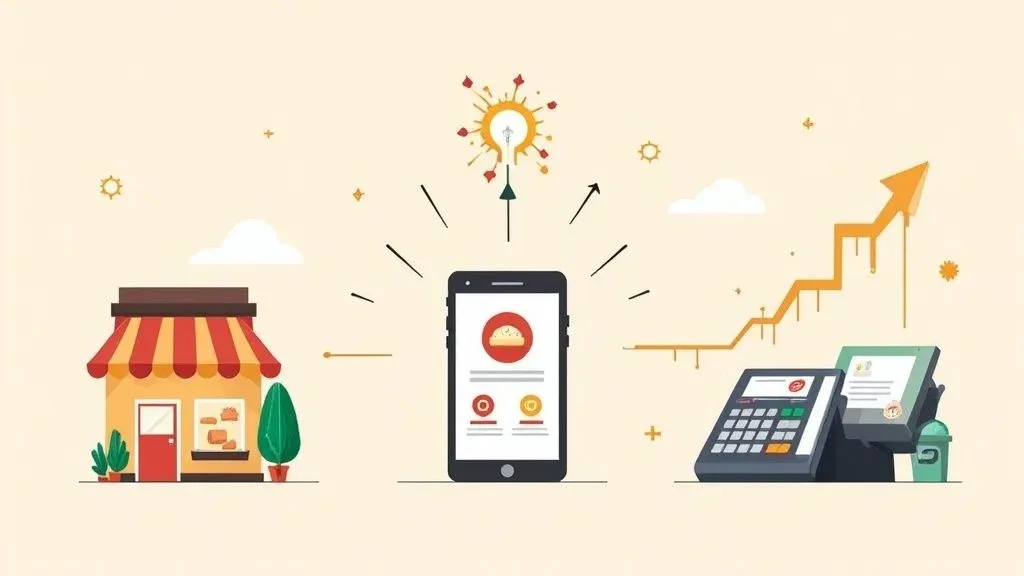
At its core, a third party delivery service is your restaurant’s digital partner. In simple terms, they handle online orders for you, from the moment a customer gets hungry to the moment food arrives at their door. This gives you instant access to a huge local audience without the headache and expense of building your own delivery team. Technically, these platforms are sophisticated marketplaces with built-in logistics networks, leveraging mobile technology to connect diners, restaurants, and drivers in real-time.
Why it matters: For restaurant operations, this partnership opens up a significant new revenue stream and stretches your reach far beyond your physical location. It’s a direct line to efficiency, allowing you to increase sales without a massive upfront investment in vehicles or staff.
What Is a Third Party Delivery Service?
Imagine a third party delivery service as a storefront in a massive, bustling digital food court. In plain language, platforms like Uber Eats and DoorDash list your restaurant alongside countless others, putting your menu in front of thousands of potential local customers. They can discover your food, place an order, and get it delivered, all with a few taps on their phone.
Technically, these platforms manage the entire customer journey: they market your restaurant on their app, provide a secure payment gateway, and coordinate the delivery logistics with a fleet of independent drivers. For restaurant owners today, this isn’t just a nice-to-have—it’s a fundamental part of staying competitive. Frankly, if you’re not on these apps, you’re invisible to a huge and growing number of diners who live by the convenience of ordering in.
The data backs this up. The global market for these services was valued at around USD 87.6 billion in 2024 and is expected to rocket to USD 197.1 billion by 2033. This explosion is all thanks to a major shift in how people eat, with 52% of global consumers in 2023 saying they prefer ordering online.
Core Functions of Delivery Platforms
So, what exactly do these platforms do for you? Let’s break down the key functions. Understanding these moving parts helps clarify how a third party delivery service can boost your restaurant’s efficiency and, most importantly, your bottom line. You can also read our deeper exploration of how third-party food delivery services work.
A great partnership with a delivery service isn’t just about moving food from point A to point B. It’s about using their technology and market reach to grow your business without having to make a massive upfront investment in drivers, vehicles, and marketing.
To give you a clearer picture, here’s a simple table outlining what these platforms handle.
Core Functions of a Third Party Delivery Service at a Glance
Function Simple Explanation Benefit for Your Restaurant Marketing & Discovery Your restaurant gets featured on an app or website with millions of users. Instantly reach new local customers who may have never found you otherwise. This saves significant time and money on marketing. Ordering & Payment The platform provides a secure system for customers to browse your menu and pay online. Simplifies the ordering process and reduces phone-in orders, freeing up staff time and reducing payment errors. Delivery Logistics A network of independent drivers is dispatched to pick up orders and deliver them. Eliminates the high cost and complexity of hiring, insuring, and managing your own delivery drivers, boosting staff productivity. Customer Support The service handles basic customer inquiries, order tracking, and issue resolution. Reduces the support burden on your in-house team, allowing them to focus on dine-in guests and core restaurant operations.
When you boil it down, these services are powerful growth engines. They provide the essential tech infrastructure you need to compete in a digital-first world, driving new sales and keeping your brand top-of-mind for hungry customers.
The Real Costs and Benefits of Delivery Platforms
Jumping into a partnership with a third-party delivery service is a huge business decision. On one hand, these platforms offer an incredible shortcut to reaching thousands of new customers. But on the other, that access comes with trade-offs that will impact your restaurant operations and bottom line.
The most obvious win is tapping into a massive, ready-made customer base and a complete delivery fleet. Right off the bat, you get to skip the logistical nightmare—and the huge upfront cost—of hiring your own drivers, buying cars, and sorting out insurance. For many restaurants, that alone makes the partnership a no-brainer, representing a major cost saving.
Understanding the Financial Trade-Offs
The biggest catch? The commission fees. These platforms charge anywhere from 15% to 30% of the order total. Think of it as the price of admission to their audience and their delivery network. But for a restaurant running on already tight margins, a 30% commission can completely wipe out the profit on an order if you’re not careful.
This is where you have to shift your thinking. A third-party delivery service isn’t just another sales channel; it’s a marketing and logistics expense. You’re basically paying for customer acquisition and order fulfillment, one order at a time. It can be incredibly effective, but it demands a smart strategy for your menu pricing and operational flow to make sure it’s actually making you money.
This image really drives home how these partnerships can pump up your order volume.

When you get it right, these platforms become a powerful engine for bringing in a steady stream of new business.
But the fees aren’t the only thing to consider. You also give up some direct control. When a customer orders from you through an app like Uber Eats, the platform owns that relationship. You lose direct access to their data, which makes it tough to build loyalty or run your own marketing campaigns. The delivery experience itself—from the driver’s attitude to whether the food arrives hot—is also out of your hands, but it’s your brand on the line.
Weighing Your Options Third Party vs In-House Restaurant Delivery
So, how do you make the right call for your restaurant? It helps to lay the two main approaches side-by-side. The best choice really comes down to your specific goals, what resources you have, and how much you’re willing to take on. Are you chasing rapid growth, or do you want total control over your brand and profitability?
The choice isn’t just about cost; it’s about strategy. A third-party service is an accelerator for growth and visibility, while an in-house system is an investment in long-term brand control and customer relationships.
This table breaks down the key differences to help you see the real trade-offs.
Factor Third Party Delivery Service In-House Delivery Upfront Costs Low to none. You pay commissions on orders, not for setup. High. Requires investment in vehicles, insurance, drivers, and ordering tech. Market Reach Immediate access to a massive, existing user base on the platform. Limited to your own marketing efforts, which takes time and money to build. Profit Margins Lower per order due to commission fees (15-30%). Higher per order, as you keep the full revenue minus operational costs. Customer Data Owned by the platform. You have limited access to diner information. You own all customer data, enabling direct marketing and loyalty programs. Brand Control Limited. The delivery experience is managed by a third-party driver. Full control over the entire customer experience, from order to delivery.
Why it matters: Many restaurants find a hybrid approach works best—using platforms to find new customers while pushing direct orders through their own website to keep more of the profit. For restaurants using systems like Clover or Square, integrating these services directly into your POS is the critical next step to make it all run smoothly and efficiently.
Practical Next Step: Look at your local market, run the numbers on your potential margins after fees, and figure out how these services fit into your overall game plan. To ditch manual order entry and streamline your operations, you can start onboarding for free in just a few clicks.
Streamlining Restaurant Operations with POS Integration
Once you partner with a third-party delivery service, you’ll quickly run into a new problem. That exciting stream of orders can easily turn into a chaotic mess, overwhelming your kitchen staff. This is where modern food tech, specifically Point of Sale (POS) integration, becomes a necessity.
In simple terms, POS integration is a digital bridge. On one side, you have delivery apps like DoorDash firing off orders. On the other is your restaurant’s command center—your POS system. Without that bridge, your staff has to manually take an order from a tablet and punch every single item into the POS. It’s a massive bottleneck.
Technically, POS integration uses an API (Application Programming Interface) to allow the delivery platforms and your POS software to communicate directly. This automates the flow of data, eliminating the need for manual re-entry.
Why it matters: This constant back-and-forth is slow and a perfect recipe for costly mistakes. A misread modifier or a simple typo leads directly to an incorrect order, an unhappy customer, and a hit to your bottom line. These small errors add up fast, draining your team’s productivity and your profits.
The Problem with “Tablet Farming”
We’ve all seen it: a restaurant counter cluttered with tablets, each one beeping with new orders. This setup, often called “tablet farming,” turns your staff into data-entry clerks instead of letting them focus on what they do best—making great food.
The fallout from this manual workflow is bigger than you might think:
- Skyrocketing Order Errors: Every time an order is manually re-entered, you open the door to human error. This leads to expensive remakes, refunds, and a direct reduction in profit.
- Slower Ticket Times: The minutes it takes for staff to transfer an order from a tablet to the POS add up. During a busy service, these delays can grind your entire kitchen to a halt.
- Wasted Labor: Your employees’ time is one of your most valuable resources. Paying them to punch in orders that could be automated is a direct drain on payroll and kills staff productivity.
How POS Integration Improves Your Food Tech Stack
POS integration is the tool that dismantles this inefficient system. It creates a direct, automated pipeline between the delivery platforms and your POS. When a customer orders on DoorDash, that order instantly flows into your POS and prints straight to the kitchen, just like an order placed in your dining room.
This one change fundamentally transforms your restaurant operations. No more manual entry. No more yelling orders across the kitchen. The entire process becomes a smooth, efficient, and error-free workflow.
The real goal of restaurant tech is to eliminate friction. POS integration removes the single biggest point of friction in delivery operations—that frustrating gap between receiving an order and getting it to the kitchen.
For example, a restaurant using a system like Square or Clover can use an integration tool like OrderOut to connect their POS directly to all their delivery partners. This turns a multi-tablet headache into a single, unified system. The impact on your restaurant’s efficiency is immediate, leading to significant time savings and error reduction.
You can read more about the state of the food delivery industry on deliverect.com. If you want to get into the nitty-gritty details, feel free to check out our guide covering some frequently asked questions about POS integration.
Your Next Step Toward Efficiency
For any restaurant serious about making its delivery channel truly profitable, embracing POS integration is a critical move. It directly solves the biggest operational pains of working with a third-party delivery service, saving time, slashing errors, and boosting your team’s productivity.
Practical Next Step: The clearest action you can take is to eliminate the tablets and automate your order flow.
How to Choose the Right Delivery and Integration Partners
Picking a partner for your restaurant’s delivery service isn’t as simple as going with the most familiar logo. The right choice can make a massive difference in your daily operations, your bottom line, and your team’s sanity. You need to look past the marketing and dig into the details that matter for your business.

This involves two connected choices. First, pick the best delivery platforms for your market. Then, find a solid integration partner to sync them all with your POS. Each decision requires asking tough questions to ensure you’re building a tech setup that saves time, cuts errors, and helps you grow.
Evaluating Third Party Delivery Service Platforms
When you’re looking at apps like Uber Eats or DoorDash, your goal is to find the one that gives you the best return.
Start with the numbers. Commission rates are the biggest factor, typically falling between 15% and 30%. A few percentage points might not sound like much, but a lower rate can add up to thousands of dollars in savings over a year.
But fees are only part of the story. You also need to investigate which platform has a strong presence in your neighborhood. A service that’s a giant nationally might be a ghost in your local area. Ask for real data on their user base and order volume right around your restaurant.
Finally, check their reputation for restaurant support. A platform with a responsive support team can be a lifesaver during a chaotic dinner rush.
Selecting the Right Restaurant POS Integration Partner
Once you’ve settled on your delivery apps, finding the right integration partner is the next make-or-break step. This software is the engine that powers your delivery workflow. Reliability and compatibility are essential.
The whole point of an integration partner is to build a seamless, automated bridge between the delivery apps and your POS system. To really grasp why this is so critical for smooth restaurant operations, it’s worth understanding why third-party integrations are so vital. A great partner makes sure every single order flows directly to your kitchen without anyone lifting a finger.
So, how do you vet potential integration solutions? Start by asking these critical questions:
- Does the tool automatically sync menu updates? Manually updating your menu on three or four different platforms is a time-consuming task. A good integration partner lets you make a change once in your POS, and it automatically pushes that update everywhere. This can save hours of admin work every week, directly improving staff productivity.
- What is the onboarding and support process like? You want a partner that offers a simple, guided setup and is there for you with responsive support, especially during your busiest hours.
- Is it compatible with my existing POS system? This is the most important question of all. Make sure the solution is pre-vetted and trusted by your POS provider.
Choosing an integration partner is like hiring a key employee. You need someone reliable, efficient, and ready to perform under pressure. A top-tier tool works quietly in the background, making your entire operation smoother and more profitable.
For instance, if you’re a restaurant owner using a Clover or Square POS, you can simply browse their app marketplaces. These platforms feature trusted, pre-approved integration solutions designed to handle the high-volume demands of a busy restaurant.
Practical Next Step:
Start by doing a little homework. Find out which delivery services are most popular in your zip code and ask for their commission structures. At the same time, check your POS app market for highly-rated integration partners that promise automatic menu syncing and great support. This two-pronged approach ensures both your customer-facing and internal partnerships are set up for success.
Making Your Food Delivery Operations Actually Profitable
Signing up for a third party delivery service is easy. The hard part? Making it a real profit center for your restaurant. Just having your name on an app isn’t a strategy. If you’re not careful, those high commission fees will eat your margins for lunch.

It all boils down to three make-or-break areas: engineering a delivery-friendly menu, pricing your items to cover the real costs, and running a tight ship in the kitchen. When you get these right—and back them up with a solid POS integration—your delivery channel can transform from a necessary evil into a powerful engine for growth.
Engineer Your Menu for Restaurant Delivery
Let’s be honest: your dine-in menu probably isn’t built for delivery. A simple, actionable insight is to create a separate, streamlined menu just for delivery customers. It’s all about items that travel well and have healthy profit margins.
Put yourself in your customer’s shoes. A dish can turn into a soggy mess after a 20-minute car ride. Focus on things that hold their heat and texture—think hearty grain bowls or well-packaged burgers. This move leads to happier customers and better reviews, which means fewer costly remakes and refunds, saving you both time and money.
Why it matters: A smaller, focused menu also makes life easier for your kitchen staff. It simplifies inventory, cuts down on prep time, and helps your team pump out orders faster with fewer mistakes. This directly boosts staff productivity.
Price Strategically to Protect Your Margins
The elephant in the room with any third party delivery service is the commission fee (15% to 30%). If you ignore that cost, you’re losing money on every order. To stay profitable, you must adjust your delivery prices to absorb those fees.
A common tactic is to bump up your menu prices on the delivery apps by 10-15%. This helps cover the commission without scaring off customers who are paying for convenience. It’s a necessary balancing act to protect your bottom line.
Your delivery pricing shouldn’t be an afterthought. It’s the financial lever that decides whether your delivery partnership is a profitable venture or just a very expensive marketing campaign.
Many restaurant owners don’t realize commission rates can often be negotiated. If you want to dive deeper, we’ve got a great guide on how to negotiate better third-party delivery fees.
Run a Flawless Kitchen Operation for Delivery
Profitability comes down to efficiency. An efficient back-of-house is the engine that drives a successful delivery business. One of the most impactful things you can do is create a dedicated packing station.
This is just a designated spot with everything your staff needs to get orders out the door accurately and fast: bags, containers, utensils, napkins, condiments. This simple setup stops your team from running all over the kitchen, which shaves precious minutes off ticket times and reduces order errors.
Why it matters: Integrating your third party delivery service with a POS system from a provider like Clover or Square is the final piece of the puzzle. This automation ensures orders are 100% accurate and frees up your team to focus on making great food, which is a massive boost to staff productivity.
Ready to Perfect Your Restaurant’s Delivery Game?
So, where does this leave you? We’ve walked through how third-party delivery services can be a massive engine for growth, but we’ve also seen how a counter full of tablets and manual order entry can grind your restaurant operations to a halt. The actionable insight is clear: don’t ditch delivery, integrate it directly with your POS. This single move turns chaos into a smooth, efficient process that protects your bottom line.
When you embrace this kind of essential food tech, you’re freeing up your staff from tedious data entry. This allows them to get back to making incredible food and giving your guests an experience they won’t forget. This is about building a restaurant that’s more resilient, scalable, and ultimately, more profitable.
From Bottleneck to Bottom Line
That switch from manual work to automation has a real, tangible impact. Instead of your team losing precious minutes on every single order and worrying about typos, you create a system that’s faster, far more accurate, and less stressful.
Why it matters: A more efficient kitchen can handle more orders without letting quality slip, which directly translates to more revenue. This isn’t just about convenience; it’s about reclaiming control. POS integration puts you back in the driver’s seat, ensuring every order contributes positively to your bottom line.
For instance, a busy pizza place using a Clover POS or a cafe running on Square can connect all their delivery partners into one place. The tablet farm disappears overnight, and so do the manual errors that come with it, saving both time and money.
Practical Next Step: Are you ready to finally clear off the counter and get your delivery workflow right? The most practical next step is to see how an integration partner can solve these headaches for you once and for all.
Still Have Questions? Let’s Clear Things Up
Diving into third-party delivery and POS integration brings up a lot of practical questions. Let’s walk through some of the most common ones.
Are Those High Commission Fees Really Worth It?
Seeing a 15-30% commission fee can feel like a gut punch. But instead of just seeing it as a fee, think of it as your marketing and logistics budget rolled into one.
Here’s the real question: what would it cost you to get that same customer on your own? Think about the price of running local ads, or the massive expense of buying a vehicle, hiring a driver, and covering insurance. Suddenly, that commission represents a significant cost saving compared to the alternative.
You’re paying for instant access to a massive local audience and an on-demand delivery fleet. For most restaurants, it’s a much smarter, less risky way to grow sales than trying to build a whole delivery operation from the ground up.
How Much Time Does POS Integration Actually Save My Staff?
The numbers are staggering. On average, a direct POS integration saves your team about 2-5 minutes per order.
If you’re doing just 50 delivery orders on a busy night, you’re getting back over two hours of labor every single shift.
But it’s not just about the clock. It’s about sanity. When your team isn’t frantically juggling tablets, the whole kitchen is calmer. That means fewer mistakes, happier staff, and better food for everyone. This is a direct boost to staff productivity.
Why it matters: This saved time also means fewer comped meals and less food waste from manual entry errors. It frees up your crew to focus on what they do best: taking care of the guests right in front of them and ensuring every plate that leaves the kitchen is perfect.
What’s the Plan If My Internet Goes Down?
This is a totally valid fear. Your entire operation depends on being connected.
Thankfully, the best integration systems are designed for the real world. Top-tier integration partners, like the ones you’ll find in the app marketplaces for Clover and Square, have built-in safety nets like offline modes.
In simple terms, if your connection drops, the system holds onto any new orders that come in. The second you’re back online, they all push through to your POS automatically. You don’t lose a single order, and your business can weather the storm without skipping a beat.
Practical Next Step: Ready to stop juggling tablets and get your restaurant running smoothly? At OrderOut, we plug your delivery apps straight into your POS system, saving you precious time and cutting down on costly errors. Get started for free in just a few clicks.