
A Restaurant Owner's Modern Guide to Your System of Delivery
· Thibault Le Conte
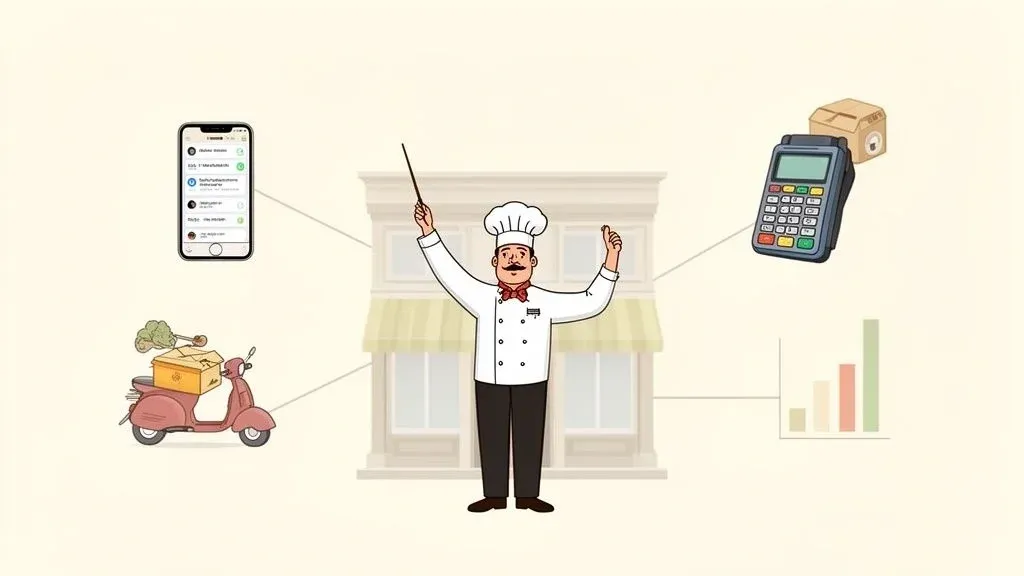
When we talk about a system of delivery, we’re not just talking about drivers and delivery bags. Think of it as the entire assembly line that gets food from your kitchen to a customer’s front door. In simple terms, it’s the combination of technology, your staff’s daily workflow, and even the physical packaging that makes the whole operation run smoothly. A well-oiled system ensures every order is handled efficiently and accurately, saving you time and money.
Why does this matter for your restaurant? An efficient system directly impacts your bottom line by reducing errors, speeding up service, and freeing up staff to focus on paying customers.
Breaking Down Your Restaurant’s Delivery System: Key Steps in Food Tech
Imagine your delivery operation is like a relay race. The baton is the customer’s order, and it has to be passed seamlessly from one stage to the next. If someone fumbles the handoff, you lose the race—and a customer. Each part of your delivery system needs to work in perfect sync to create a great experience.
This system really comes down to four critical stages:
- Ordering: This is the starting line. It’s when a customer places an order, whether it’s through a marketplace like Uber Eats, your own website, or over the phone.
- Processing: The baton is passed. This is how the order gets into your point of sale (POS) system, is confirmed, and then sent to the kitchen.
- Dispatching: This is where logistics kick in. The finished order is assigned to a driver, and the best route is planned for a speedy delivery.
- Fulfillment: The final leg of the race. The food is packaged to stay fresh, and it arrives at the customer’s door exactly as they expect.
When these stages aren’t connected, you get chaos. We’ve all seen it: a team member frantically trying to punch an order from a delivery tablet into the Clover or Square POS during the middle of a dinner rush.
That single manual step creates a massive bottleneck. It eats up valuable staff time, opens the door for costly order errors, and distracts your team from the customers standing right in front of them. This is exactly why a connected, streamlined delivery system isn’t just a “nice-to-have”—it’s essential for boosting restaurant efficiency and staying competitive. For a real-world example, DoorDash integrates with restaurant POS systems to automate this entire flow, preventing manual entry and reducing errors significantly.
The Delivery Boom Isn’t Slowing Down
The need for a rock-solid system is more urgent than ever, especially when you look at how much online ordering has grown. The global online food delivery market is projected to continue its massive upward climb, which tells you one thing: customer habits have changed for good.
This incredible growth means more orders, more complexity, and a ton more pressure on your kitchen and staff. You can find more detailed stats on this trend over at Statista.com. Without an efficient system to handle the volume, you risk angry customers, bad reviews, and lost money. For a deeper look at controlling the chaos, it’s worth understanding what an order management system is.
A truly effective system of delivery automates the entire journey of an order, from the moment a customer taps “confirm” on their phone to the ticket printing out in your kitchen. That automation is what frees up your team, kills costly mistakes, and ultimately makes your restaurant delivery operation profitable. It turns a stressful, manual process into a simple and reliable part of your business.
Choosing Your Restaurant Delivery Model for Optimal Restaurant Operations
Once you’ve got a handle on what a system of delivery actually is, it’s time to decide which operational model is right for your restaurant. Simply put, will you handle deliveries yourself, use a third-party service, or do a bit of both? This choice is a cornerstone of your delivery strategy, influencing everything from your profit margins to your brand’s reputation.
You’re essentially looking at three main paths. You can keep it all in-house, hand it off to third-party experts, or blend the two with a hybrid strategy. Each approach comes with its own mix of costs, brand control, and market access.
Think about it this way: a cozy neighborhood pizzeria might thrive with its own delivery team, building tight community bonds with that personal touch. But a brand-new virtual kitchen needs the instant customer base and marketing power that only third-party apps like Uber Eats can provide. You can dig deeper into how these delivery-only kitchens work by checking out our guide on what a cloud kitchen is.
The In-House Delivery Model
Going the in-house route means you own the entire delivery process, from the moment an order comes in until it reaches the customer’s doorstep. You hire your own drivers, set your own delivery zones, and manage all customer communication directly. This gives you complete command over the guest experience.
Why it matters for your restaurant:
- Total Brand Control: Every detail, from the driver’s uniform to their greeting, reflects your restaurant’s standards.
- Higher Profit Margins: You avoid the steep commission fees from third-party apps, which can range from 15% to 30% per order.
- Direct Customer Data: You own all your customer information. This is gold for building loyalty programs and marketing directly to your biggest fans.
Of course, this path isn’t without its challenges. It demands a serious upfront investment in vehicles, insurance, and driver payroll, making it a much heavier operational lift.
The Third-Party Delivery Model
Jumping on board with platforms like Uber Eats or DoorDash is the quickest way to get your menu in front of the masses. These services offer a turnkey solution: a massive network of drivers and a huge, built-in audience of hungry customers ready to order.
It’s a competitive space, to be sure. A handful of major players dominate the field, with DoorDash holding 56% of the U.S. market, followed by Uber Eats at 23% and Grubhub at 16%. For restaurant owners, this means staying active and integrated with these key platforms is essential to casting the widest net and pulling in the most orders.
This decision tree shows the first choice you’ll make when setting up a new system: manual versus automated processes.
Opting for an automated path for order processing is the first real step toward unlocking the kind of efficiency we’re talking about in this guide.
The Hybrid Delivery Model
Why lock yourself into just one model? The hybrid approach is a smart, flexible solution that combines the best of both in-house and third-party delivery. It’s all about striking a strategic balance between controlling your brand and maximizing your reach.
A hybrid system truly gives you the best of both worlds. You can use your own drivers for deliveries within a tight, profitable radius to build that local loyalty, while leaning on third-party apps to handle orders from further away or during those chaotic dinner rushes.
This model is a fantastic way to manage costs and resources. You capture the high-margin orders with your own team and use the marketing firepower of the big apps to attract new customers you might never have reached otherwise.
Making a decision requires weighing the pros and cons of each model against your specific business needs. The table below breaks down the key differences to help you see which path makes the most sense for you.
Comparing Restaurant Delivery Models
Factor In-House Delivery Third-Party Delivery Hybrid Model Brand Control Complete control over the customer experience. Limited; brand is represented by a third-party driver. Balanced; maintain control over local deliveries. Profit Margins Higher; you keep 100% of the revenue minus your costs. Lower; commission fees of 15%-30% per order. Variable; higher on in-house, lower on third-party. Upfront Costs High; requires investment in drivers, vehicles, insurance. Low to None; minimal setup costs to join a platform. Moderate; scales with the size of your in-house fleet. Market Reach Limited to your marketing budget and delivery zone. Massive; instant access to a large, existing customer base. Expanded; combines local marketing with app visibility. Customer Data Full Access; you own all customer data for marketing. No Access; the platform owns the customer relationship. Partial Access; you get data from your direct orders. Operational Lift High; you manage all logistics, staffing, and support. Low; the platform handles delivery logistics and some support. Moderate; you manage your own fleet plus platform orders.
Ultimately, the best system of delivery is the one that fits your specific goals, your budget, and the unique identity of your brand. There’s no single right answer, only the right answer for you.
The Essential Components of a Modern Restaurant Delivery System
A great system of delivery doesn’t just materialize out of thin air. It’s a carefully assembled machine with several interconnected parts. In simple terms, think of it like an engine—for it to run smoothly, every part needs to work together. If one part fails, the whole system sputters to a halt. The same is true for your restaurant delivery.
From the moment the customer taps “order” to the final handoff, every step matters. Getting these components right creates a seamless, profitable, and stress-free process that boosts restaurant efficiency.
Online Ordering Channels
This is the front door to your delivery business. It’s where customers find your menu and place an order, whether on a third-party app like DoorDash or your own website.
Why it matters: Consistency is key. If your Uber Eats menu is outdated, you’re setting yourself up for canceled orders and angry customers. Keeping menus synced across all channels is non-negotiable. This simple action prevents a huge number of order errors and saves your staff from making awkward “we don’t have that” phone calls, directly reducing costs and improving productivity.
Order Management and POS Integration
Once an order is placed, it has to go somewhere. This is the digital traffic controller for your operation. Without automation, this leads to the dreaded “tablet farm”—a counter cluttered with devices, with a stressed-out employee manually punching every order into the POS.
An automated order management system acts as a central hub. It grabs all incoming orders and injects them directly into your POS system, like Clover or Square, without anyone touching anything. This eliminates manual entry errors—which always spike during a rush—and frees up your team to focus on guests. This is the heart of restaurant efficiency.
Your order management process is the single biggest opportunity for improvement. Automating this step instantly reduces labor costs, cuts down on mistakes that lead to refunds, and creates a calmer, more organized kitchen environment.
Kitchen Operations and Workflow
Once the order is in your kitchen, how smoothly it moves from the ticket printer to the pass-through window is determined by your kitchen operations. A properly integrated system sends every ticket to your kitchen display system (KDS) or printers in a standardized, easy-to-read format.
Why it matters: This consistency is a game-changer for your back-of-house team. They no longer have to decipher five different ticket layouts. The result? Faster prep times, improved accuracy, and better pacing of orders. This reduces stress and boosts staff productivity.
Driver Dispatch and Logistics
Once the food is packaged, the dispatch component kicks in. This is about getting the order into a driver’s hands as fast as possible. If you’re using third-party apps, their driver network handles this. For in-house or hybrid models, you’re in charge.
Why it matters: Smart dispatching protects food quality. The longer food sits, the worse it tastes. Understanding the basics of what is route optimization can help, as it’s all about finding the most efficient path. The goal is simple: minimize shelf time so the food arrives hot and fresh.
Customer Communication and Tracking
The final piece is keeping your customer in the loop. Today’s customers expect real-time updates. This part of the system handles everything from the “We’ve got your order” confirmation to status updates like “Your driver is on the way” and a link to a live tracking map.
Why it matters: This transparency is a massive driver of customer satisfaction. It practically eliminates those “Where is my order?” calls, saving your staff’s time and building trust with customers. You can check out our guide on implementing an effective order status software to nail this part of your operation.
By looking at your delivery system through the lens of these five components, you can easily spot weak links and make targeted improvements that boost efficiency and cut costs.
Why POS Integration is the Heart of Your Food Tech Strategy
If you run a restaurant, you know your Point of Sale (POS) system is the command center. It’s the brain of the operation. But when online delivery orders start rolling in, that brain often gets disconnected from the rest of the body. That’s where the chaos starts.
Picture your busiest Friday night. The dining room is humming, and your team is swamped. Then you hear it—the dreaded chimes from a corner filled with delivery tablets. Each chime forces a team member to stop what they’re doing and manually punch that DoorDash or Uber Eats order into the POS.
This manual, multi-step process is the single biggest point of failure in most delivery operations. It’s like having a cashier try to shout every order across a loud, bustling kitchen. Mistakes are inevitable.
The Hidden Costs of Manual Order Entry
Without direct POS integration, you’re exposing your restaurant to frustrating problems that quietly eat away at your profits and staff morale.
The most obvious culprit is human error. A simple typo on a special request can spiral into an incorrect order. This isn’t just about the cost of remaking food; it leads to refunds, bad online reviews, and lost customers. Then there’s the time suck. Every minute your staff spends juggling tablets is a minute they aren’t helping an in-house guest or upselling a dessert. This directly hurts your service quality and leads to staff burnout, reducing productivity.
Unlocking Efficiency With Automated POS Integration
Now, let’s look at the alternative. When your system of delivery is built around a fully integrated POS, the entire workflow is transformed. Automation takes over the tedious, error-prone tasks, creating a calmer, more efficient, and more profitable environment.
POS integration is the bridge that connects your third-party delivery apps directly to your restaurant’s central nervous system. When an order comes in from a platform like Uber Eats, it doesn’t just ping a tablet. It flows automatically and instantly into your POS, appearing just like an order taken at the counter. From there, it prints in the kitchen on a standard ticket your cooks already know how to read.
This single connection eliminates manual entry entirely. It frees your staff from the “tablet farm,” reduces order errors by over 99%, and ensures every single sale is captured in one central place for clean, simple reporting.
This is precisely what a solution like OrderOut does. It acts as the go-between for the delivery apps and your POS. For example, when a customer orders on DoorDash, OrderOut instantly injects that order into your Clover or Square system. Seconds later, the ticket prints in the kitchen, with zero staff intervention needed.
The Real-World Impact on Restaurant Operations
This kind of automation creates a powerful ripple effect that you’ll feel across your entire business. You can dive deeper into the technical side of things in our guide to POS software integration.
The benefits are clear and almost immediate:
- Time Savings: Your team can be reassigned to tasks that actually make you money, like improving the guest experience, instead of performing mindless data entry.
- Error Reduction: You’ll see a dramatic drop in costly mistakes, which means fewer refunds and better customer reviews.
- Unified Reporting: All your sales data—from both dine-in and delivery—is consolidated right in your POS. This makes accounting accurate and hassle-free.
- Increased Throughput: With orders hitting the kitchen faster, your team can prep and dispatch food more quickly. That means shorter delivery times and happier customers.
Making POS integration the core of your delivery operation isn’t just about adding another piece of tech. It’s about fundamentally fixing a broken process. It is the single most impactful step you can take to make your delivery system efficient, reliable, and truly profitable.
How to Measure Your Delivery System Performance
You can’t fix what you can’t measure. To get a handle on your system of delivery, you have to move beyond just counting orders. You need to track the numbers that reveal the true health of your operation.
These numbers are your Key Performance Indicators, or KPIs. In simple terms, think of them as the dashboard for your restaurant’s delivery engine. They tell you exactly what’s working, what’s broken, and where you might be losing money, allowing you to stop guessing and start making smart decisions.
The Vital Signs of Your Delivery Operation
Monitoring the right KPIs is like checking a patient’s vital signs. A sudden drop in one area can signal a problem that needs your immediate attention, while steady improvement shows that your hard work is paying off.
Here are the essential metrics every restaurant owner should have on their radar.
- Order Accuracy Rate: What percentage of your orders get to the customer without a single mistake? A low number here is a red flag. It means you’re bleeding money on refunds, wasting food on remakes, and tanking your reputation.
- Average Delivery Time: This is the total time from the moment a customer clicks “order” to the moment the food arrives. It’s a huge factor in customer satisfaction and repeat business.
- Cost Per Delivery: How much does it actually cost you to fulfill a single delivery? This includes driver pay, packaging costs, and third-party commission fees. Knowing this number is crucial for pricing your menu correctly. For more on this, check out our guide on how to calculate average revenue.
- Order Volume by Channel: This shows you where your business is coming from. Are most of your orders from your own website, or from Uber Eats or DoorDash? This data tells you where to focus your marketing.
To make this easier to digest, here’s a quick-reference table of the most important KPIs.
Essential Delivery KPIs For Your Restaurant
This table breaks down the most important metrics to track for optimizing your delivery system, what they mean, and how to measure them.
KPI (Key Performance Indicator) What It Measures Why It Matters How To Track It Order Accuracy Rate The percentage of orders delivered to the customer perfectly, with no errors. High accuracy leads to happier customers, better reviews, and fewer costly remakes or refunds. (Number of Perfect Orders ÷ Total Orders) x 100. Track manually or through your POS. Average Delivery Time The total time from when an order is placed to when it arrives at the customer’s door. Faster delivery is a key driver of customer satisfaction and repeat business. Total time for all deliveries ÷ Number of deliveries. Most delivery platforms provide this. Cost Per Delivery The total expense to fulfill one delivery order (fees, labor, packaging). This determines the actual profitability of your delivery channel and informs menu pricing. (Total Delivery Costs ÷ Total Delivery Orders) over a specific period. Order Volume by Channel The number of orders coming from each specific platform (e.g., website, Uber Eats). Helps you understand which channels are most valuable and where to focus marketing efforts. Your POS or a delivery aggregator should provide a breakdown of orders by source. Customer Retention Rate The percentage of customers who order from you again over a specific period. Retaining customers is far cheaper than acquiring new ones. It’s a sign of a healthy business. Check customer data in your POS or online ordering system for repeat phone numbers/emails.
Tracking these metrics consistently will give you a clear, honest picture of your delivery performance.
Putting Your Data to Work
Gathering this data is just the first step. The real magic happens when you start using it to make smart changes.
For instance, is your Order Accuracy Rate dipping below 98%? It’s time to investigate. The problem could be as simple as messy, hard-to-read tickets printing in the kitchen. An integrated POS like Clover or Square can solve this by printing all incoming orders in a clean, standardized format, which dramatically reduces these kinds of errors.
If your Average Delivery Time consistently creeps up during the dinner rush, your kitchen workflow is likely the bottleneck. An integrated system that shoots orders directly to the kitchen the second they’re placed can shave precious minutes off your prep time and get food out the door much faster.
Your Practical Next Step
Don’t overwhelm yourself by trying to track everything at once. Pick two or three of these KPIs to focus on for the next month. First, establish your baseline—figure out what your numbers are right now. Then, make one simple change, like reorganizing your packaging station, and watch how it moves the needle.
By consistently measuring your performance, you can turn your delivery operation from a source of chaos into a predictable, profitable, and smooth-running part of your business.
Taking the Next Step Toward a Flawless Delivery System
Building a great system of delivery isn’t a one-time fix; it’s a constant process of refinement. The real goal is to get ahead of problems before they start, transforming your delivery operation from a chaotic necessity into a dependable profit center. That journey begins with an honest look at your current process.
Start by asking yourself: Are my team members still manually punching orders from tablets into the POS? Do I actually know what it costs to get a single order out the door, factoring in commissions and packaging? The answers will point you straight to your biggest opportunities for improvement.
A Quick Operational Health Check
Use this simple checklist to pinpoint where the real friction is in your workflow:
- Manual Overload: How much staff time is wasted on repetitive data entry every shift?
- Order Accuracy: Are you constantly dealing with the cost of incorrect orders and unhappy customers?
- Data Blind Spots: Is your sales data scattered across different platforms, making it impossible to see the full picture?
- Kitchen Chaos: Does your BOH team have to decipher a mess of tickets from different delivery apps, slowing down the line?
If you answered “yes” to any of these, your path forward is clear. These aren’t isolated issues; they’re symptoms of a disconnected system. The single most powerful solution is to bridge those gaps with automation, specifically through POS integration.
Think of technology not as another expense, but as a core investment in your restaurant’s efficiency. The right tools don’t add complexity—they remove it, freeing up your team to focus on what they do best: cooking incredible food and taking care of your guests.
The most impactful change you can make is to eliminate manual order entry for good. Integrating your delivery partners directly with your POS—whether you use a system like Clover or Square—is the bedrock of a smooth, scalable, and profitable delivery operation.
The practical next step is clear: Automate your order flow. By connecting your delivery apps to your POS, you can immediately reduce errors, save labor costs, and speed up your entire operation.
Ready to get a handle on the chaos? You can start onboarding for free in just a few clicks and put your delivery workflow on autopilot today.
Frequently Asked Questions
Jumping into restaurant delivery tech can feel overwhelming. Let’s tackle some of the most common questions from restaurant owners who are trying to build or fix their system of delivery.
What’s The First Step To Improve My Restaurant Delivery System?
Before you do anything else, stop entering orders by hand. The single most powerful first step is to connect your third-party delivery apps—like Uber Eats and DoorDash—directly into your POS system.
Why it matters: This one move is the cornerstone of a scalable delivery operation. It frees up staff time, slashes costly order mistakes, and gets every order to your kitchen instantly. It’s the most actionable way to boost restaurant efficiency and see an immediate return by reducing labor and error costs.
Can A Small Restaurant Afford A Modern Delivery System?
Yes, and honestly, you can’t afford not to. A modern system isn’t about expensive gear; it’s about smart, efficient tools. For a small restaurant, using third-party apps for marketing and logistics is far more cost-effective than building your own driver fleet.
The smartest, most affordable investment is an integration tool that funnels all those third-party orders into the POS you already own, like a Square or Clover system. This immediately cuts down on labor costs because you no longer need someone glued to a bunch of tablets. It pays for itself from day one by saving time and preventing costly mistakes.
The real cost isn’t the technology; it’s the hidden expense of inefficiency. Wasted staff time, incorrect orders, and customer refunds from manual errors add up much faster than the cost of an automation tool.
How Does POS Integration Help Beyond Reducing Errors?
Fixing mistakes is a huge win, but that’s just the beginning. True POS integration changes the entire rhythm of your restaurant. Suddenly, you have a single, clean report for all your sales data, whether a customer ordered at the counter or from their couch. This simplifies bookkeeping and performance tracking.
It also brings a sense of calm to the kitchen. Every order, no matter where it came from, appears on your existing printers or KDS in the same familiar format. Orders hit the line instantly, which means food gets prepped faster. Faster prep times lead to quicker deliveries, and that creates happy customers who keep coming back. See how it works with popular systems like Clover or Square.
Ready to finally stop juggling tablets and streamline your restaurant operations? With OrderOut, you can automate your delivery workflow and focus on what matters most. Start onboarding for Free in a few clicks.