
SOP in Restaurant: Your Guide to Efficiency and Consistency
· Thibault Le Conte
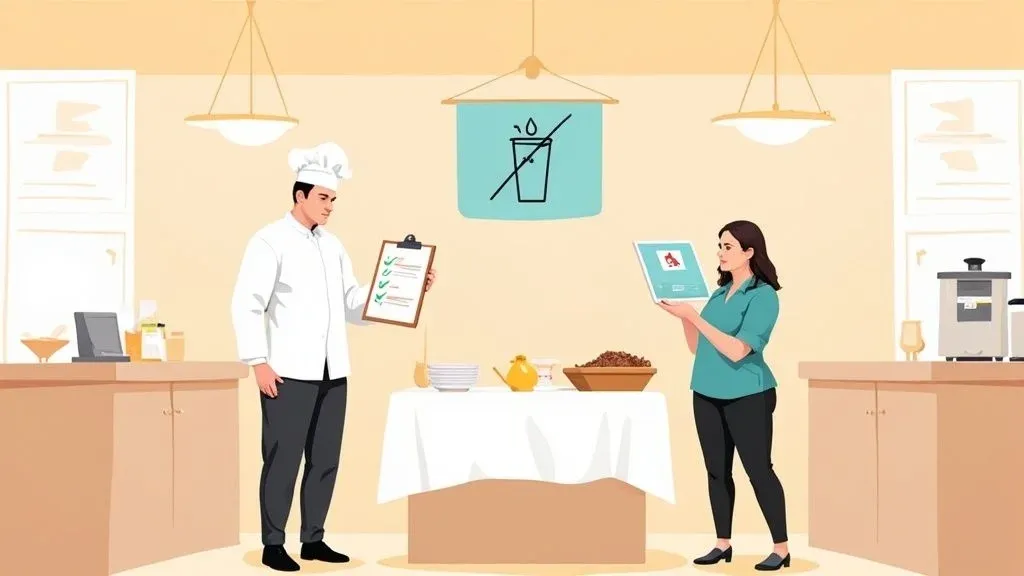
Think of a restaurant SOP (Standard Operating Procedure) as your team’s playbook. It’s a set of clear, step-by-step instructions that guides your staff to perform tasks perfectly every time. In simple terms, it’s the recipe for running your restaurant smoothly.
From greeting guests to prepping a delivery order, SOPs build a reliable system. This consistency is what turns first-time visitors into loyal regulars and is crucial for restaurant efficiency.
Why Your Restaurant Needs a Clear SOP
A well-defined SOP in a restaurant is the secret ingredient for consistency and efficiency. Without a solid game plan, even the most talented staff will make mistakes that cost you time, money, and your hard-earned reputation. This directly impacts everything from your delivery speed to your bottom line.
Picture a chaotic Friday night. A new DoorDash order arrives, an employee scrambling to keep up misreads a detail, and the wrong dish gets sent out. The result? An unhappy customer, a wasted meal, and a negative online review.
Now, imagine that same rush but with a smart SOP in place, especially one tied to your POS integration. The order instantly flows from DoorDash to your kitchen printer via your Square POS. A simple checklist guides the packaging process, catching any potential mistake before it leaves the counter. That error never happened, saving you money and protecting your reputation.

Connecting SOPs to Restaurant Efficiency and Food Tech
This guide is about building SOPs that boost efficiency, empower your staff, and sync perfectly with your food tech. These procedures are vital in areas like back of house operations, where consistency is everything.
When you nail your SOPs, you see real, tangible benefits that improve your entire restaurant operations:
- Fewer Errors: Clear instructions slash mistakes in order taking, food prep, and restaurant delivery handoffs, leading to significant cost savings.
- More Productive Staff: New hires onboard faster, and veteran team members have a reliable reference. This frees up managers to focus on growth instead of putting out fires.
- Happier Customers: Consistent quality and service mean happy guests who return and recommend you.
- Cost and Time Savings: Standardized portions cut food waste, while smoother workflows lead to faster table turns and quicker delivery times.
The Power of POS Integration in Your Restaurant Operations
The most effective SOPs today are woven directly into your technology. For example, when you connect a platform like Uber Eats directly to your Clover POS, your SOP for handling online orders becomes almost completely automated.
Instead of someone manually punching in the ticket, the order flows right into your system. This eliminates the risk of human error from the very first step. This is a perfect example of how an SOP, powered by the right food tech, creates a foolproof system that boosts efficiency and reduces costs.
The Anatomy of an Effective Restaurant SOP

A great SOP isn’t just a list of rules; it’s a roadmap that turns complex processes into simple, repeatable steps. Think of it like a chef’s recipe—it details the exact ingredients and steps to get a perfect dish every time. A restaurant SOP does the same for operational tasks.
For an SOP to work, it must be crystal clear. Use non-technical language first, then add detail where needed. A new hire should be able to pick it up on day one and get the job done right. This clarity is the foundation of strong restaurant operations management, as it slashes training time and boosts staff productivity.
Core Components of Every SOP
To make your procedures practical, every SOP needs a few key parts. These components answer the critical questions: what, why, who, and how.
A well-built SOP always includes:
- A Clear Title: Be specific. Instead of “Cleaning,” use “End-of-Day Kitchen Sanitization.”
- The Purpose or Objective: Explain why it matters. For example, “To meet health codes, prevent cross-contamination, and ensure a safe work environment.”
- Step-by-Step Instructions: This is the core of the document. Use a numbered list with clear, action-focused language.
- Defined Responsibilities: Spell out who owns the task (e.g., “Closing Shift Lead,” “Line Cook”).
- Required Tools and Equipment: List everything needed, from cleaning agents to kitchen utensils.
An SOP isn’t just a document; it’s a communication tool. Its job is to eliminate guesswork, ensuring the right way to do a task is also the easiest way for your team to follow.
How to Build SOPs for a Modern Restaurant
Once you have the basics, elevate your SOPs by weaving in standards that protect your safety, quality, and bottom line. Adding quality benchmarks—like “Burgers must be cooked to an internal temperature of 160°F”—turns an instruction into a promise of excellence. Embedding safety protocols, such as “Always use a cut-resistant glove when operating the slicer,” prevents costly accidents.
This structured approach is critical for POS integration and managing restaurant delivery. For example, an SOP for a new Uber Eats order should detail the exact steps for double-checking items on the ticket against the physical order before sealing the bag. This simple procedure, followed every time, dramatically cuts down on order errors. It saves you time, money, and negative reviews by standardizing quality control—key to staying profitable in high-volume delivery.
Key Components of a Restaurant SOP Template
Component Purpose Example Title To identify the procedure quickly. SOP-BOH-001: Daily Grill Cleaning Purpose To explain the “why” and importance. To maintain equipment longevity and meet food safety standards. Responsibility To assign ownership of the task. Closing line cook. Procedure To provide clear, step-by-step actions. 1. Turn off grill. 2. Scrape surface with grill brick… Standards To define what “done right” looks like. Grill surface must be free of all food residue.
Using a consistent structure like this ensures every task is performed with the same level of precision, boosting your overall restaurant efficiency.
Practical SOP Templates for Every Department

Let’s move from concept to action with practical templates you can adapt for your restaurant. Think of these as proven starting points to mold to your unique operation.
Each template is designed to tackle a common problem: reducing errors, improving staff productivity, and delivering a consistent customer experience. For an even more structured starting point, a good safe operating procedures (SOP) template can be a huge help.
Front of House SOPs
Your Front of House (FOH) team shapes your customer’s perception of your brand. These SOPs create positive, reliable interactions from start to finish.
Example FOH SOP: Greeting Guests
- Purpose: Make every guest feel genuinely welcome within the first 30 seconds.
- Responsibility: Host/Hostess
- Procedure:
- Immediately make eye contact and smile.
- Use a standard greeting: “Welcome to [Your Restaurant Name]! How many for your party?”
- Confirm their reservation or provide an honest wait time.
- Lead guests to their table, provide menus, and let them know who their server will be.
Why it matters: A warm welcome sets a positive tone, reduces frustration, and increases the odds of a glowing review. This directly contributes to higher restaurant efficiency by managing guest flow smoothly.
Back of House SOPs
The Back of House (BOH) is your engine room. Clear kitchen SOPs are your best defense against food safety issues, quality slips, and rising food costs.
Example BOH SOP: Kitchen Opening Checklist
- Purpose: Ensure the kitchen is 100% prepped, sanitized, and stocked for service.
- Responsibility: Opening Chef or Kitchen Manager
- Procedure:
- Turn on all equipment and verify correct temperatures.
- Review temperature logs for all refrigeration units to guarantee food safety.
- Sanitize all prep surfaces, cutting boards, and sinks.
- Stock all stations with necessary ingredients, tools, and plates.
- Review the prep list and delegate tasks.
Why it matters: This SOP prevents chaos, avoids service delays, and slashes staff stress, ensuring every dish meets your standard.
Restaurant Delivery SOPs
Your delivery service is just as crucial as your dine-in experience. A dedicated restaurant delivery SOP is the only way to protect food quality and ensure order accuracy.
A study found that 80% of customers blame the restaurant—not the driver—for mistakes like cold food or missing items. A bulletproof handoff process is essential.
Example Delivery SOP: Order Handoff to Driver
- Purpose: Ensure a quick, accurate, and secure handoff to delivery drivers, minimizing wait times and eliminating errors.
- Responsibility: Expeditor or designated delivery point person.
- Procedure:
- Verify the Order: Match the customer name and order number on your ticket (from a system like Clover) with the driver’s app.
- Double-Check Items: Before sealing the bag, do a final count to confirm every item, including drinks and sauces, is present.
- Confirm with Driver: Verbally confirm the customer’s name—“This is for Sarah, right?”—before handing over the order.
- Log the Handoff: Mark the order as “Picked Up” in your POS system to keep tracking accurate.
Why it matters: This simple check dramatically reduces wrong or missing items, the #1 complaint in food delivery. It saves you money on redeliveries and improves your relationship with drivers, getting food to customers faster.
How to Implement SOPs and Train Your Team
You’ve created a fantastic set of SOPs. Now, you need to bring them to life. A binder gathering dust won’t stop order errors. Proper implementation is about getting your staff to buy into the vision.
First, explain the “why” behind each process. In simple terms, show them how an SOP makes their shift less chaotic, cuts stress during a rush, or leads to happier guests and bigger tips. When your team sees what’s in it for them, they feel empowered, not micromanaged. This mindset shift is what turns rules into a powerful team culture.
A Strategic Rollout Plan
Trying to implement everything at once will overwhelm your staff. A gradual, structured rollout is far more effective.
- Tackle the Biggest Headaches First: Identify the area causing the most chaos, like delivery order accuracy. Implement an SOP that delivers an immediate, noticeable improvement to get your team on board fast.
- Make Training Hands-On: Demonstrate the new procedure right where the work happens. Let staff practice and ask questions without pressure.
- Use a “Train the Trainer” Approach: Choose your sharpest shift leads to become SOP champions. Train them thoroughly first, then empower them to train their teams. This builds leadership and ownership.
A perfect example of SOP-driven training is mandatory food handler certificate training, which ensures every team member follows critical food safety standards.
Fostering a Culture of Consistency
Implementation is a daily commitment. For SOPs to take hold, they must be reinforced from the top down. Managers who lead by example show that these standards are for everyone. This dedication directly impacts morale, a topic we explore in our guide on proven strategies to improve employee retention.
Key Takeaway: SOPs are about building a foundation for consistent, high-quality work. Your job as a leader is to coach, support, and reinforce these standards until they become muscle memory, which directly improves staff productivity and reduces errors.
Revisit and update your SOPs regularly. A 2023 survey found that 65% of restaurants that updated their SOPs quarterly reported higher staff compliance and fewer operational problems. Finally, make your SOPs easy to access. Whether on a shared cloud drive or laminated copies in key areas, your team should be able to find what they need in seconds.
Integrating SOPs with Your Restaurant POS System
Well-documented SOPs are great, but they still rely on your team to follow every step perfectly. In the middle of a dinner rush, mistakes happen. This is where your POS system becomes your secret weapon for enforcing your standards and improving restaurant operations.
A manual SOP is like a paper map—it shows the best route, but you still have to navigate on your own. Integrating your SOPs with your POS is like turning on GPS. It guides you turn-by-turn, making the correct procedure the easiest option.
The Problem with Manual Order Entry
One of the biggest sources of error in any modern restaurant is manual data entry. An online order from DoorDash or Uber Eats arrives. Someone has to stop, read the tablet, and punch it all into your POS.
Each step is a chance for mistakes. A “no onions” request is missed. An “extra cheese” modifier is forgotten. These small errors create big headaches: wasted food, unhappy customers, and negative reviews that hurt your bottom line. This is why a technology-driven SOP in restaurant delivery is essential.
How POS Integration Automates Your SOPs
True operational efficiency comes from eliminating manual work. When you integrate your delivery platforms with your POS system, you automate your entire order-handling SOP. Technology does the heavy lifting instantly and accurately.
A platform like OrderOut bridges the gap between third-party apps and your POS. When a new order comes in:
- The order is automatically accepted.
- It’s instantly sent to your POS system with zero manual keying.
- A perfectly formatted ticket prints right in your kitchen.
This simple connection transforms your order management SOP from a risky chore into a single, foolproof, automated action. You can learn more about integrating delivery platforms with your POS system.
Real-World Example: Clover POS Integration
Let’s say you use a Clover POS system and you’re slammed with orders from three different delivery apps. Without integration, your host is juggling tablets and re-typing orders while trying to greet guests. It’s a recipe for disaster.
With an integrated solution, those orders flow straight into your Clover system. The kitchen gets clean, standardized tickets. Your host is free to focus on dine-in customers. The SOP—“accurately enter all online orders”—is now handled by software, not a stressed-out human. This is a practical way food tech directly boosts restaurant efficiency.
By automating order entry, you embed your standard for accuracy directly into your workflow. It makes the right way to handle an order the only way, drastically reducing errors and saving time.
This makes leading your team much simpler when automation handles the most tedious steps for you.

The Immediate Benefits of an Integrated Workflow
Connecting your SOPs to your tech stack delivers immediate results that hit your bottom line.
- Drastic Error Reduction: Automation can slash order mistakes by over 95%.
- Significant Time Savings: Staff can get back 30-40 minutes per shift when not manually punching in orders.
- Increased Staff Productivity: A less frantic workflow means less stress and more focus on great food and service.
- A Smoother, More Profitable Delivery Operation: Faster, more accurate orders lead to happier customers, better reviews, and a healthier revenue stream.
Marry your SOPs and your technology to build a more resilient, efficient, and profitable restaurant.
Measuring the Success of Your Restaurant SOPs
You’ve created solid SOPs. But are they actually working? To know for sure, you must move beyond gut feelings and look at data.
By tracking key performance indicators (KPIs), you can see the real-world impact of your new procedures. KPIs are your restaurant’s dashboard, giving you a clear snapshot of your operational health. They show you where your SOPs are succeeding and where they need fine-tuning.
Key KPIs to Track for SOP Success
To get the full picture, look at metrics from different parts of your operation.
Start by focusing on these core categories:
-
Operational Efficiency: These numbers show how smoothly things are running.
- Ticket Times: A well-designed kitchen SOP should directly reduce the average time from order to customer.
- Table Turnover Rate: Efficient FOH procedures help you serve more guests during busy hours.
-
Financial Health: Good SOPs should directly boost your profitability.
- Food Cost Percentage: Standardized recipes and strict portion control are your best weapons against high food costs.
- Waste Reduction: Track how much food you throw out before and after implementing new prep SOPs to see the cost savings. For more detail, see our guide on the restaurant profit and loss statement.
-
Customer Satisfaction: Happy customers are the ultimate measure of success.
- Online Review Scores: A steady stream of great reviews is a strong sign your quality and service SOPs are working.
- Repeat Guest Rate: When people keep coming back, you know you’re delivering a consistently fantastic experience.
Measuring Your Restaurant Delivery Operations
For delivery, your SOP in restaurant success is tied to your POS integration. Zoom in on order accuracy rates and delivery prep times. If accuracy goes up and prep times go down, your system is working. You’re making fewer mistakes and getting food out faster.
Technology is a key player here. One study showed an AI-powered system increased SOP compliance by up to 40% in a restaurant chain by using analytics to monitor performance. You can read the full case study on evidence-based analytics to see how powerful this can be.
Your Practical Next Step: Don’t track everything at once. Pick one KPI from each category that addresses your biggest headache. Start tracking it this week. Watching those numbers improve is the best way to prove the value of your SOPs and get your team excited.
Time to Put Your SOPs to Work
We’ve covered everything from the basics of restaurant SOPs to integrating them into your tech stack. The biggest takeaway? SOPs are about creating a reliable framework that lets your team consistently deliver an exceptional experience. That’s the secret to sustainable growth.
When you put clear procedures in place, you tackle the biggest drains on your time and money. You’ll see fewer costly mistakes, discover new efficiencies, and build a more predictable, profitable business.
Your First Big Win
So, where do you start? The single most impactful step you can take right now is to automate the most chaotic part of modern restaurant life: managing online orders.
Connecting your delivery apps—like Uber Eats and DoorDash—directly to your POS system is the ultimate SOP in action. It completely removes manual order entry, where countless mistakes happen. This is a fundamental shift that drives restaurant efficiency.
- Slash Order Errors: No more missed modifiers or wrong items.
- Reclaim Staff Time: Your team can stop punching in tablets and focus on guests.
- Boost Team Morale: A smoother workflow means a happier, more productive team.
This one move illustrates the power of a great SOP: it makes the right way the easy way. For instance, connecting your apps to a system like Square creates a foolproof process that saves you money and protects your online reputation.
See for yourself how a simple integration can bring automated SOPs to life in your restaurant. It only takes a few clicks to start building a more efficient operation.
Ready to eliminate order errors and save your team hours every week? OrderOut can help. Get started for free by visiting https://dashboard.orderout.co.