
Service Charge Vs Tip The Definitive Guide for Restaurants
· Thibault Le Conte
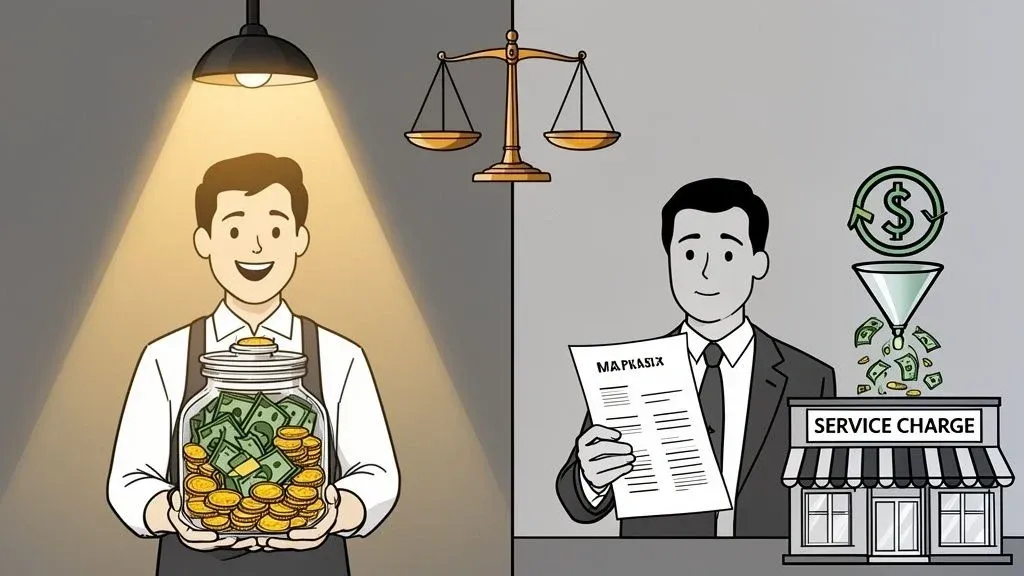
The real difference between a service charge and a tip boils down to two things: control and obligation. In simple terms, a service charge is a mandatory fee your restaurant sets and collects. Legally, it’s your revenue. A tip, on the other hand, is a voluntary gratuity the customer chooses to give, and by law, that money belongs directly to your employee. Understanding this distinction is the first step toward building a smarter, more efficient financial model for your restaurant.
Understanding The Core Differences
For any restaurant operator, deciding between a service charge and a tip is a much bigger deal than just picking a label for a line on the guest’s check. This choice gets to the very heart of your restaurant’s financial model, how you handle payroll, and even the morale of your team. In technical terms, it impacts revenue recognition, tax liability, and wage distribution. If you get it wrong, you could be looking at tax compliance nightmares and operational chaos. But getting it right can lead to a more stable business and a fairer workplace.

Ownership and Control
The most important distinction is who owns the money. Simply put, tips are the property of your employees. While you can set up legal tip pooling arrangements, those funds never actually belong to the business itself and cannot be counted as restaurant revenue.
A service charge is a different story entirely. It’s classified as restaurant revenue, giving you complete control over how that money is used. You can distribute it as wages to any employee you choose—from servers to line cooks—or even use it to cover other business expenses. This level of control is a primary reason many restaurants are making the switch.
Mandatory vs. Voluntary
Tips are always up to the customer. They decide what to leave, if anything, based on their perception of the service. A service charge is a fixed, non-negotiable fee that you automatically add to the bill, most commonly for large parties, private events, or as a restaurant-wide policy.
These charges are typically a set percentage, often in the 10-15% range, though it varies by location and concept.
Why It Matters for Restaurant Operations: This difference has a massive impact on your ability to forecast revenue and improve efficiency. Tip income is unpredictable; it can swing wildly based on how busy you are or even a customer’s mood. Service charges create a consistent, predictable revenue stream, making it far easier to manage your budget and payroll. This stability directly impacts your ability to manage cash flow and accurately complete financial documents like your restaurant income statement. This predictability reduces financial uncertainty and saves management time on budgeting.
Key Distinctions At A Glance
To break it down even further, here’s a quick side-by-side look at the fundamental differences every operator should know.
Attribute Service Charge Tip (Gratuity) Nature of Payment Mandatory, fixed percentage or amount Voluntary, amount determined by customer Legal Ownership Belongs to the restaurant (revenue) Belongs to the employee(s) Tax Treatment Treated as wages, subject to payroll taxes Treated as supplemental income, with specific reporting rules Distribution Control Full control by the restaurant operator Limited by labor laws (e.g., tip pooling rules) Primary Use Case Large parties, events, equitable wage distribution Standard reward for good service Customer Perception Often viewed as a required fee Seen as a personal thank you for service
Understanding these core attributes is the first step in deciding which model—or combination of models—is the right fit for your specific operational needs and financial goals.
Navigating Tax and Legal Compliance
Getting the definitions right for service charges versus tips is one thing, but the real risk for any restaurant operator lies in tax and legal compliance. In simple terms, misclassifying these funds isn’t just a minor bookkeeping error—it can trigger painful IRS audits, hefty fines, and damaging employee disputes. The technical reason is that the government views these two payment types completely differently for tax purposes.
A service charge is legally considered restaurant revenue. That means the money belongs to the business first. When you later pass that money to your staff, it’s treated as regular wages. As a result, those payments are subject to the same payroll taxes as their hourly pay, including Social Security and Medicare (FICA) and federal unemployment taxes (FUTA). Many states also require you to collect sales tax on mandatory service charges, adding another layer of complexity.
Tips, on the other hand, are legally the property of the employee. You’re simply the custodian, collecting and distributing the funds. They never hit your revenue line. This fundamental distinction completely changes your tax obligations, shifting the focus from paying payroll taxes to ensuring accurate reporting.
Tax Treatment for Service Charges vs Tips
The tax rules for each directly impact your payroll process and can eat into your profitability if you get them wrong. Failing to withhold and pay the right taxes on service charge distributions is a huge red flag for auditors and one of the easiest ways to get into trouble.
- Service Charges: The restaurant is responsible for its share of FICA taxes, which is 7.65% on every dollar distributed. You also have to withhold the employee’s portion of FICA plus federal and state income taxes from their paychecks, just like any other wages.
- Tips: While your employees are responsible for reporting their tips as income, your primary job is to report that income and withhold taxes once an employee reports earning more than $20 in tips in a given month. The upside here is that you can often claim a tax credit for a portion of the FICA taxes paid on employee tips, which can add up to serious savings.
Getting this right isn’t just about staying out of trouble; it’s a key lever for managing your labor costs and improving your restaurant’s financial health. To see how these numbers plug into the bigger picture, it’s worth taking a close look at your restaurant profit and loss statement.
Actionable Steps for Payroll and POS Integration
To stay compliant, your systems need to be smart enough to tell these two income streams apart automatically. This is where having your food tech and POS integration dialed in becomes absolutely critical for running an efficient operation. The IRS has very clear guidelines on employer reporting for tip income, making accurate, automated record-keeping non-negotiable.
Modern POS systems are built to automate this, taking the guesswork out of tracking and reporting. It’s also smart to stay on top of changes that can benefit your team. For example, be sure to learn more about the new tax deductions for service hourly workers, including tips.
Practical Next Step:
Here’s an immediate, actionable task: audit your POS configuration. Whether you use Clover or Square, you must have separate, distinct categories for “Service Charges” and “Tips.” The service charge button should be programmed to record the funds as restaurant revenue and flag them for payroll tax processing. The tip function should simply track the funds for employee reporting. For instance, in Square, you can create a service charge as an item with a fixed percentage that is automatically applied to certain orders, ensuring it’s taxed correctly. This one technical setup will drastically reduce manual errors, save you hours of administrative headaches, and create a solid foundation for a compliant payment system.
Implementing Fair Payroll and Distribution Models

How you handle pay isn’t just an accounting task; it’s the bedrock of your restaurant’s culture. In simple terms, this debate is about creating a payroll model that’s both fair and stable. Get it right, and you can shift your team’s dynamic from competitive to collaborative, boosting service quality and restaurant efficiency.
We’ve all seen the classic pay gap between front-of-house (FOH) and back-of-house (BOH). Servers can walk out with a pocketful of cash on a great night, while the line cooks and dishwashers are stuck with the same flat hourly wage. The technical term for this is wage disparity, and it breeds resentment and kills teamwork.
Comparing Tip Pooling and Service Charge Distribution
On the surface, tip pooling looks like a decent fix. You collect all the tips and divide them up. The problem is, federal and state labor laws are incredibly strict about who can be in that pool. Legally, managers, supervisors, and your entire kitchen crew are often barred from getting a cut.
This is where the service charge completely changes the game. Because a service charge is legally the restaurant’s revenue, you have total discretion over where it goes. You can use that money to pay higher, more consistent wages to everyone on your team—from the host to the person scrubbing pots.
Why This Matters for Staff Productivity: A service charge lets you promise a reliable living wage for your entire crew, reducing the volatility of fluctuating tips. That financial security is a huge deal for reducing employee turnover, which every operator knows is a massive expense. A stable, fairly paid team is a loyal and productive team, directly impacting your bottom line through improved staff productivity and lower hiring costs.
Bridging the Pay Gap with a Service Charge Model
Adopting a service charge is a direct move toward pay equity. By collecting a mandatory fee, you create a dependable revenue stream specifically to raise the base pay for your kitchen staff. Their compensation starts to reflect the immense value they bring.
This shifts pay from a fluctuating bonus to a predictable salary. That predictability is a win for your employees, but it’s also a win for you when it comes to financial forecasting. For a closer look at managing these figures, our guide on using a restaurant labor cost calculator can be a huge help.
For example, a restaurant might add an 18% automatic service charge. That revenue pool can be used to bump up BOH wages by several dollars an hour while keeping FOH pay competitive. This creates a much more balanced financial ecosystem. Modern POS systems like Square handle this beautifully, letting you program service charges as business revenue to keep payroll streamlined and reduce errors.
Practical Steps for Transparent Implementation
Making the switch to a service charge isn’t something you can do overnight. It demands thoughtful planning and, most importantly, clear communication. If your team feels left in the dark, they might see it as a pay cut, and the whole effort can backfire.
Here’s a simple framework to guide a smooth transition:
- Calculate New Wage Structures: Before you announce anything, model the new, higher hourly wages for every role based on your average sales and projected service charge revenue to ensure sustainability.
- Hold an All-Staff Meeting: Get everyone together and explain the why. Frame it around fairness, stability, and teamwork. Show them the math—how their new pay will be calculated and why it offers more security.
- Update Your POS System: This is non-negotiable. Work with your POS provider, whether it’s Clover or another system, to ensure the service charge is programmed as revenue, not a tip. Getting this wrong creates major tax compliance headaches and payroll chaos.
- Communicate to Customers: Be upfront with your guests. Add a clear note about the new policy on your menus, website, and at the bottom of receipts. Transparency avoids confusion and shows integrity.
The Takeaway: The ultimate advantage of a service charge is the operational freedom it gives you. It’s a tool that empowers you to build a compensation structure that values your entire team, cuts down on costly turnover, and fosters a more cooperative and successful restaurant.
Optimizing Your POS for Seamless Restaurant Operations
Your Point of Sale (POS) system is the command center for your entire operation. How you set it up to handle payments can either be a source of calm or a creator of chaos. When it comes to the service charge versus tip debate, getting the POS integration right isn’t just a good idea—it’s non-negotiable for restaurant efficiency.
A solid technical foundation prevents costly manual accounting mistakes, slashes management overhead, and ensures payroll is spot-on every single week.

The most critical task is programming your POS to differentiate between these two income streams. A tip left on a DoorDash order must be routed and taxed completely differently than an automatic 18% service charge applied to a large party’s bill through your in-house Square terminal. One is your employee’s property; the other is your business’s revenue.
If your POS accidentally treats a service charge like a tip, you could be liable for failing to remit correct payroll taxes. On the flip side, misclassifying tips as revenue means you might be illegally holding onto funds that belong to your team. The stakes are high.
Integrating On-Premise and Restaurant Delivery Orders
In today’s restaurant world, payments don’t just happen in the dining room. A huge chunk of your revenue flows through third-party delivery apps. This complexity makes a robust POS integration an absolute must-have for any modern operator managing restaurant delivery.
When a customer adds a tip on an Uber Eats order, that data needs to be correctly understood by your central POS. Without a direct connection, your staff is stuck manually punching in these orders—a process that’s a breeding ground for human error and a massive time-waster. An error rate of just 1-2% can easily add up to thousands of dollars in lost revenue or payroll mistakes over a year.
The Bottom Line for Efficiency: A proper POS integration automates everything. A tip from a delivery app gets mapped to the right employee or tip pool automatically. An in-house service charge is correctly flagged as revenue. This level of automation frees up hours of mind-numbing reconciliation work, reduces errors, and protects your business from serious compliance risks.
Configuring Payments in Your POS and Delivery Apps
Getting your settings right across all platforms is the key. A service charge on your dining room POS needs to match how it’s handled in your delivery apps to avoid confusion and accounting nightmares. Here’s a look at where to make these changes.
Configuration Point On-Premise POS (e.g., Square) Delivery App (e.g., Uber Eats) Integration Consideration Payment Type Setup Create separate line items or buttons for “Service Charge” and “Tip.” Label gratuity options clearly for customers during checkout. An integration tool should map the app’s “tip” field to the “tip” line in your POS, not a service charge. Tax Application Program the “Service charge” item to be taxable as revenue. The app handles its tax logic, but the data must be correctly interpreted by your POS. Your integration must be configured to recognize the service charge as business income subject to payroll taxes. Reporting & Payout Service charges appear on sales reports; tips go to a separate gratuity report. Tip data is typically passed to your system via the API for each order. Ensure your system pulls both charge and tip data separately for accurate bookkeeping and payroll runs.
Ultimately, consistency is everything. The goal is to ensure that no matter where the order originates, the financial data flows into your system correctly classified and ready for your accountant.
A Practical Configuration Checklist
Setting up your system correctly is a one-time job that pays you back over and over in cost savings and error reduction. Use this checklist as a guide when you audit your setup, whether you’re using Clover or another modern platform.
- Create Separate Payment Keys: Make sure you have two distinct buttons or line items in your POS: one labeled “Service Charge” and another for “Tip/Gratuity.”
- Program Tax Rules: The “Service Charge” key must be set up to be taxed as business revenue and be subject to payroll taxes. The “Tip” key should be programmed as a non-revenue item that passes through to staff.
- Sync with Payroll Software: Your POS must talk to your payroll system. This connection automates reporting so service charge distributions are treated as wages and tips as gratuities, ensuring withholdings are calculated correctly.
- Connect Delivery Channels: Use an integration platform to link apps like DoorDash and Uber Eats directly to your POS. This standardizes the data from every channel before it ever hits your books.
No matter which model you choose for your restaurant, having the right food tech is essential. To truly streamline your operations and manage finances effectively, consider using one of the Best Restaurant Management Software options built for businesses like yours.
Talking to Your Customers About Your New Policy
Switching to a service charge is a big move, and how you tell your customers about it is critical. Let’s be honest: nobody likes surprise fees. If you handle this poorly, you risk confusing guests, getting negative reviews, and hurting your reputation. The key is to be upfront and completely transparent.
When you explain the why behind the change, you can turn a potentially negative moment into a positive one. Frame it as a commitment to paying your entire team a fair, stable wage—from the servers you see to the dishwashers and line cooks you don’t. This shows customers you’re building a better, more equitable workplace.
Nailing the Message
Your explanation has to be simple, direct, and consistent everywhere a customer might see it. Ditch the industry jargon and complicated financial talk. The goal is to make them understand and respect the decision, not to bog them down in details. A clear message gets everyone on the same page and keeps things running smoothly.
Here are a few ways to phrase it on your menus, website, or receipts:
- Fair Wage Focus: “A 15% service charge is added to every bill. This helps us provide a living wage and benefits for our entire team, both in the dining room and the kitchen.”
- Team-Oriented Approach: “To ensure equitable pay for everyone who makes your meal possible, we add an 18% service charge. This allows us to share revenue with our talented back-of-house staff.”
- Simple & Direct: “We apply a service charge to all checks to support higher, more stable wages for our hardworking staff. Thank you for supporting our team.”
A clear policy isn’t just damage control; it’s a powerful marketing tool. When you’re open about your commitment to fair pay, you build a real connection with customers who share those values, and that turns them into regulars. For more insights, explore our guide on digital marketing for restaurants.
Getting Your Staff Ready to Be Ambassadors
Your front-of-house team will be the ones answering questions face-to-face. If they seem unsure, unprepared, or don’t believe in the policy, guests will notice immediately. Inconsistent answers can make the charge feel sneaky, which damages trust and creates an awkward vibe for everyone.
A smooth operation relies on a team that can handle these conversations with grace and confidence.
Actionable Training Steps:
- Hold a Team Huddle: Before you launch the new policy, get everyone together. Explain why you’re making the change and, most importantly, how it gives them more stable and equitable pay. Get them on board first.
- Give Them a Script: Arm them with the exact words to use. Run through a few common questions and scenarios so they feel comfortable and ready for anything.
- Empower Them with the “Why”: Make sure they understand the legal distinction—that a service charge is the only way you can legally share revenue with the kitchen crew, which isn’t allowed with traditional tips.
This kind of prep turns your servers from people who just take orders into confident advocates for your restaurant’s values.
The Takeaway: The success of a service charge comes down to communication. Be upfront, be consistent, and train your staff to be your biggest champions. A transparent approach protects your reputation, avoids friction with customers, and can even build loyalty by showing you genuinely care about your team.
Choosing the Right Model for Your Restaurant
Deciding between service charges and traditional tipping isn’t just a numbers game—it’s a fundamental choice about your restaurant’s culture and operational strategy. There’s no single “right” answer. The best model depends on your specific goals, local laws, and the kind of experience you want to create for both your customers and your team.
For instance, a fine-dining spot focused on pay equity between its sommeliers and chefs might find a service charge model is the only way to guarantee stability. On the other hand, a bustling, casual cafe could thrive with a classic tipping model that rewards fast, friendly service. The key is to analyze your own operation, not just copy the restaurant down the street.
A Decision-Making Framework for Your Restaurant
To make the right call, you need to honestly weigh a few critical factors. Each one plays a big part in whether you’ll see happier staff, smoother operations, and a healthier bottom line.
Ask yourself these key questions:
- What are we trying to achieve? Is the main goal to fix the pay gap between your front-of-house and back-of-house teams? Or is it about creating a more predictable revenue stream? A service charge is built to solve the first problem, while a hybrid model might be a better fit for the second.
- What’s our service style? Quick-service or fast-casual concepts often work perfectly with tipping. But if you have a more structured, team-based service, like in many upscale restaurants, the financial stability of a service charge can benefit the entire crew.
- What do our local labor laws say? This is a big one. Before you do anything, talk to a legal expert who knows the restaurant industry. Rules around tip pooling and how service charges can be distributed vary wildly by state and even by city. Getting this wrong can lead to some serious penalties.
This decision tree gives you a roadmap for the communication steps you’ll need to take when rolling out a new policy, making sure your menu, website, and staff are all on the same page.

As the flowchart shows, getting a new policy off the ground successfully is all about a clear, multi-channel communication strategy. This heads off customer confusion and helps build trust right from the start.
The Hybrid Approach: A Middle Ground
For some restaurants, a hybrid model offers the best of both worlds. You could stick with a traditional tipping system for most service but add an automatic service charge for large parties or private events. This gives you control where you need it most without having to completely overhaul your payroll.
Why this matters for POS integration: A hybrid model absolutely requires a flexible POS system. You’ll need to set up your Square or Clover terminal so it can easily switch between applying automatic service charges and processing standard tips. Proper POS integration is non-negotiable here—it prevents accounting headaches and makes sure every payment is taxed and paid out correctly, saving you hours of manual work and reducing errors.
The Takeaway: Your final call on the service charge vs. tip debate should be a thoughtful one, based on a clear-eyed look at what your restaurant actually needs. The right model won’t just clean up your financials; it will also show your commitment to building a fair and sustainable business for your entire team.
Common Questions About Service Charges vs. Tips
Even with a solid plan, you’re bound to run into some specific questions when you’re in the weeds of managing service charges and tips. Let’s tackle a few of the most common ones that restaurant operators ask.
Can I Use a Service Charge To Pay My Back-of-House Staff?
Yes, you can, and this is probably the biggest reason operators make the switch. In simple terms, because a service charge is legally the restaurant’s revenue, you have total control over how you distribute it. That means you can use it to pay wages to your entire team, including cooks, dishwashers, and other crucial back-of-house (BOH) staff.
From a technical standpoint, this circumvents the strict Fair Labor Standards Act (FLSA) regulations on tip pooling, which often prohibit BOH employees from participating. A service charge gives you a straightforward way to build a more balanced and equitable pay structure for everyone in your restaurant.
Do I Have To Pay Taxes On Service Charges?
Absolutely. The IRS is very clear on this: mandatory service charges are treated as regular wages, not tips. This means the money is part of your restaurant’s gross revenue, and you’re on the hook for paying your share of payroll taxes (like FICA and FUTA) on any amount you pay out to employees.
You’ll also need to withhold income tax and the employee’s portion of FICA from their paychecks. On top of that, many states require you to collect sales tax on the service charge itself. It’s essential to get your POS integration with systems like Clover or Square set up correctly to manage this automatically, which saves time and ensures compliance.
How Do Delivery Apps Handle Service Charges Vs. Tips?
This is where things can get tricky. Most major restaurant delivery platforms, like DoorDash or Uber Eats, are designed for the traditional tipping model. The customer adds a voluntary gratuity, which is then passed along to the driver and your staff. Trying to shoehorn a mandatory, restaurant-level service charge into that system is often a major headache.
The cleanest way to handle this is by using a direct POS integration tool. This kind of food tech acts as a translator, correctly mapping and processing all the different payment types from third-party apps directly into your main system. It ensures your accounting and payroll are always spot-on.
Without that kind of automation, you’re looking at someone on your team having to manually sort through and reconcile all those different charges. That’s not just a drain on labor; it’s practically an invitation for accounting errors that can mess with payroll and eat into your profits, undermining your restaurant operations.
Practical Next Step: Audit your payment and payroll systems now. Determine if your current model is creating pay gaps or compliance risks. Whether you stick with tipping, switch to a service charge, or use a hybrid approach, ensure your POS is configured correctly to automate the process, save time, and reduce errors.
Ready to eliminate manual entry and streamline your restaurant’s delivery operations? With OrderOut, you can connect all your delivery apps directly to your POS system, reducing errors and saving valuable time. Start onboarding for Free in a few clicks.