
Self-Ordering Kiosk for Restaurants Explained
· Thibault Le Conte
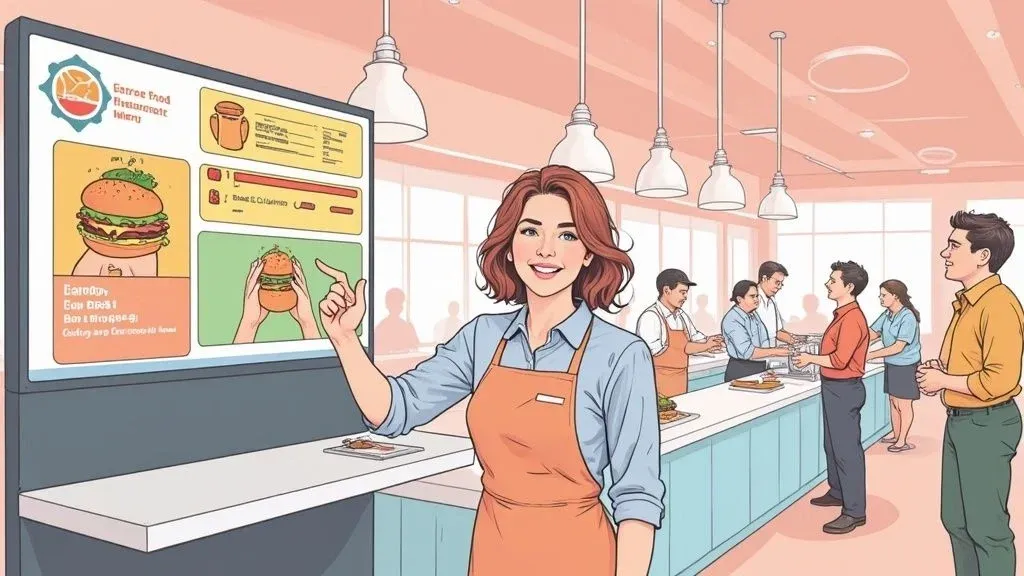
So, what exactly is a self-ordering kiosk for restaurants? In simple terms, it’s an interactive touchscreen that lets customers place their own orders. They can browse your menu, customize their food just how they like it, and pay on the spot—all without needing a cashier.
Technically, this system integrates with your restaurant’s Point of Sale (POS) and kitchen display systems (KDS). This means when a customer taps “confirm,” their order is instantly sent to the kitchen, and the payment is logged in your sales data. This direct link to your restaurant operations is why it matters: it eliminates manual entry, reducing errors and saving staff time.
Think of it as an automated front-of-house employee that streamlines your ordering process and allows your staff to focus on higher-value tasks, improving overall restaurant efficiency.
How Kiosks Are Changing Restaurant Operations
Picture your lunch rush. Instead of a long, stressful line, orders are flowing smoothly and accurately. That’s the impact a self-ordering kiosk has on your restaurant operations. It’s not just a piece of food tech; it’s like having your most reliable team member on the floor—one that never forgets to upsell and guarantees order accuracy every time.
This technology gives guests a visual, interactive way to explore the menu, tweak their order, and pay securely. For example, major players like Uber Eats and DoorDash have trained customers to expect this level of digital convenience. When you offer a similar experience in-store, you meet modern expectations for speed and control. In fact, a recent study showed that 66% of U.S. consumers prefer using a kiosk, citing speed as a key reason.
Empowering Customers and Improving Restaurant Efficiency
The real magic of a self-ordering kiosk is the control it gives the customer. Diners love being able to take their time to browse options and customize their meal without feeling rushed by a line. This leads to higher satisfaction and, often, larger orders.
This change doesn’t just benefit the customer; it has a massive impact on your restaurant efficiency and POS integration. When you automate the repetitive task of order-taking, several things happen:
- Cost and Time Savings: Kiosks have been shown to slash total order time by nearly 40%. This means you serve more people faster, increasing revenue during peak hours.
- Guaranteed Order Accuracy: With customers inputting their own orders, costly mistakes disappear. This directly reduces food waste and the need for comped meals, saving money.
- Increased Staff Productivity: Your team is your greatest asset. Freeing them from the register lets them focus on what truly improves the dining experience—like expediting orders, managing the floor, and ensuring the kitchen is running smoothly.
A self-ordering kiosk doesn’t replace your staff; it empowers them. By handling transactional duties, it allows your team to elevate the guest experience through better service and operational excellence.
Integrating Kiosks into Your Food Tech Ecosystem
A kiosk shouldn’t be an isolated piece of technology. For it to truly boost your restaurant operations, it must connect seamlessly with your other systems. The most critical connection is with your Point of Sale (POS) system. This integration ensures an order placed on the kiosk instantly fires to the kitchen and is logged in your sales data, keeping everything in sync and making your restaurant delivery and in-house orders manageable from one place.
The physical setup is also important. Proper installation ensures a good user experience and hardware longevity. You can explore different mounting and workstation solutions specifically tailored for the hospitality sector, including restaurants.
As you build out your modern restaurant, it helps to understand how all the pieces fit together. Learn more about the cutting-edge restaurant technologies transforming the industry to see the bigger picture.
Bringing in a self-ordering kiosk isn’t just about adding a new gadget. It’s a fundamental upgrade to your service model—one that meets modern customer expectations and helps you build a more efficient, profitable business.
Boosting Profits and Streamlining Restaurant Operations
Beyond the modern appeal, what really matters are the tangible results a self-ordering kiosk for restaurants delivers to your bottom line and daily workflow. These aren’t just fancy tablets; they’re powerful tools designed to increase revenue and streamline your restaurant operations.
Let’s focus on the actionable insights. This is a strategic decision that pays off by directly improving average ticket sizes, reducing waste, and making your team more productive.
Increase Average Check Size with Smart Upselling
One of the first things you’ll notice is a consistent increase in how much customers spend. A self-ordering kiosk is the perfect salesperson—it never gets tired and never forgets to offer that extra side or premium topping.
In simple terms, the kiosk automatically suggests add-ons. For example, when a customer orders a burger, the screen can prompt them with a mouth-watering photo to “make it a combo” for a few extra dollars. This is a low-pressure, visual suggestion that works.
This matters for restaurant efficiency because unlike a busy cashier who might forget during a rush, the kiosk presents these upsells every single time. The proof is in the numbers: restaurants often see their average order value jump by as much as 20%. These small, easy add-ons stack up fast, giving your daily revenue a serious boost and highlighting a clear cost/time saving for your staff.
Enhance Order Accuracy and Reduce Waste
Mistakes are inevitable, but in a restaurant, they’re expensive. A misheard order means wasted food, a comped meal, and an unhappy customer. Kiosks practically eliminate this problem.
By letting guests input their own orders, what they tap is what the kitchen gets. This direct line from customer to kitchen is a massive win for your restaurant operations.
- Drastically Reduced Food Waste: You’ll stop throwing out perfectly good food made incorrectly, which is a direct cost saving.
- Improved Customer Satisfaction: When customers get exactly what they ordered, they leave happy and are more likely to return.
- Error Reduction: With order accuracy dialed in, you won’t have to give away free meals or discounts to smooth over mistakes, protecting your profit margins.
Self-ordering kiosks are a core piece of modern food tech designed to tighten up operations. To see how this fits into the bigger picture, you can explore more effective restaurant operation management strategies.
Empower Staff and Optimize Restaurant Operations
It’s a common myth that kiosks are here to replace people. The truth is, they’re here to empower them. By automating the repetitive work of order-taking, you free up your team for more valuable tasks that enhance the customer experience. This shift directly improves staff productivity.
Instead of being stuck at a register, your staff can be redeployed to:
- Manage the Floor: Greet guests, help them find a table, and keep the dining room looking great.
- Expedite Orders: Act as a liaison with the kitchen, ensuring food gets to tables quickly and correctly, which is crucial for both dine-in and restaurant delivery orders.
- Provide a Personal Touch: Mingle with customers, answer menu questions, and create a warm, welcoming atmosphere.
This shift makes your entire operation run more efficiently. At the end of the day, a self-ordering kiosk for restaurants is a smart investment that helps you reduce costly errors, increase sales through automated upselling, and make your staff more effective.
Choosing a Kiosk with the Right Features
Not all kiosk systems are created equal. While the concept of a self-ordering kiosk for restaurants is a game-changer, its success hinges on the specific features that make it work for your restaurant operations, your staff, and your customers.
Think of it like buying a new oven. You wouldn’t just buy any box that gets hot; you’d look for one that holds a precise temperature. A kiosk that confuses customers is a liability, not an asset. Let’s cover the must-have features that separate a smart investment from just another gadget.
An Intuitive User Interface
This is the most critical feature. An intuitive user interface simply means the screen is easy to use. If a customer can’t figure out how to order within seconds, the kiosk has failed.
Technically, this means a clean layout, large, high-quality images, and a logical flow from browsing to payment. A great example is the user experience on apps like DoorDash or Uber Eats. Your kiosk needs that same level of simplicity. Why it matters: a clunky interface creates frustrated customers and defeats the purpose of improving restaurant efficiency.
Seamless Menu Customization
“No onions, extra cheese, sauce on the side.” Customization is key. Your kiosk must make it simple for guests to modify their orders.
In practice, this means customers can add or remove ingredients with a single tap. This control is a huge factor in satisfaction and is a core function for your POS integration. When it’s easy to get an order exactly right, you see fewer mistakes and happier guests. This is a direct win for error reduction and staff productivity, as your team isn’t manually adjusting orders.
A great self-ordering kiosk empowers customers with control. The freedom to easily customize an order without having to explain it to a cashier leads to higher satisfaction and a greater sense of personal service.
Smart Upselling and Cross-Selling
Here’s where a kiosk becomes a revenue-driver. Smart upselling is a built-in feature that automatically suggests upgrades and add-ons at the right moment. It’s your digital cashier asking, “Would you like to make that a combo?”—but better.
Unlike a busy employee, the kiosk does it every time. For example:
- When a burger is added, a pop-up can ask, “Add bacon for $1?”
- After an entrée is selected, it can show popular drink pairings.
- Right before payment, it can feature a “dessert of the day.”
This feature is a direct line to higher profits, often boosting check size by 15-20%, and is a clear example of how food tech can automate revenue growth.
Durable Hardware and Reliable Software
Finally, your kiosk must be tough. It will be used hundreds of times a day in a busy environment. This means looking for commercial-grade hardware, not a consumer tablet. The software must also be stable and fast. A kiosk with an “out of order” sign is a bad look for your brand and disrupts your restaurant operations.
Must-Have Kiosk Features and Their Impact
Feature Simple Explanation Why It Matters for Your Restaurant Intuitive UI An easy-to-navigate screen with large photos and clear text. Prevents customer frustration, speeds up ordering, and directly improves restaurant efficiency. Easy Customization Simple tap-and-select options for adding or removing items. Increases guest satisfaction, achieves major error reduction, and accommodates dietary needs. Smart Upselling Automated prompts suggesting add-ons, combos, and upgrades. Directly increases check size by 15-20%, a clear cost/time saving feature that boosts revenue. Durable Hardware A sturdy, commercial-grade build with a spill-resistant screen. Ensures reliability, minimizes downtime, and protects your investment in new food tech. Reliable Software A fast, stable operating system that rarely crashes. Guarantees the kiosk is always available, especially during peak hours, supporting consistent operations.
Practical Next Step: Once you’ve found a kiosk with these features, the next critical step is ensuring it integrates with your other systems. True efficiency happens when all your tech works together.
POS Integration and Restaurant Delivery Management
A self-ordering kiosk that doesn’t connect to your other systems is just a shiny, expensive paperweight. The real power comes from POS integration—getting all your different pieces of restaurant tech to speak the same language. This is what transforms a kiosk from a simple gadget into the command center of your restaurant operations.
Think of your Point of Sale (POS) system as the heart of your restaurant. When a kiosk plugs directly into that POS, every order a customer places instantly shoots to your Kitchen Display System (KDS). This matters because it creates a seamless, automated workflow from customer to kitchen.
Why Direct POS Integration is a Non-Negotiable
Without a solid POS connection, your staff would have to manually re-enter every kiosk order into the POS. That’s a recipe for slow service and costly mistakes.
Proper POS integration makes the process immediate and automatic.
- No More Manual Entry: Orders go straight to the kitchen, exactly as the customer typed them. This slashes errors, reduces food waste, and saves staff time.
- One Source of Truth for Sales: Every dollar is automatically recorded in your POS, giving you an accurate picture of your performance.
- Frees Up Your Team: Your staff can stop being messengers between the kiosk and the kitchen, allowing for improved staff productivity.
This infographic breaks down how these integrated efficiencies lead to real, measurable ROI.
The data makes it clear: a well-integrated kiosk is a direct path to higher profits by making your restaurant run smarter.
Bringing In-House and Restaurant Delivery Orders Together
Integration isn’t just about what happens inside your restaurant. Most businesses are juggling in-house diners, takeout, and a constant flow of orders from delivery apps like DoorDash and Uber Eats. A great kiosk system can act as the central hub, pulling all order sources into a single, manageable workflow.
Imagine ditching the “tablet farm.” An integrated system consolidates everything. For example, a solution from Square or Clover can sync your kiosk orders, online orders, and third-party delivery orders directly into your main POS. This gives you one command center, turning chaos into an orderly process. For a deeper dive, check out our guide on how API integration with delivery apps works.
When your self-ordering kiosk, POS system, and delivery apps all speak the same language, you stop managing devices and start managing your business. This consolidation is a critical step in building a more efficient and profitable restaurant.
The industry has caught on. Between 2021 and 2023, the number of restaurant kiosks in use worldwide jumped by 43%. This explosion shows that operators see them as an essential part of the operational puzzle. You can discover more insights about these restaurant statistics to see just how quickly the landscape is shifting.
Here’s an example of a solution built for POS integration with a major platform like Square.
By connecting through an official app marketplace, you know the software is vetted to work seamlessly with your existing Square or Clover POS, guaranteeing a smooth data flow.
Your Practical Next Step: As you evaluate any self-ordering kiosk for restaurants, make POS and delivery app integration your top priority. Ask providers which systems they support. Without it, you’re just buying a gadget; with it, you’re building a smarter restaurant.
Calculating the Real Return on Your Kiosk Investment
Let’s talk numbers. Bringing a self-ordering kiosk for restaurants into your operation is a big move, and you need to know it will pay off. This is about building a solid financial case that proves the value of this food tech for your business.
To get a real handle on the return on investment (ROI), you must look at both the initial cost and the long-term gains in restaurant efficiency and revenue.
Understanding Your Initial Investment
First, let’s look at the upfront costs. In simple terms, this is what you pay to get started.
Technically, this includes a few key components:
- Hardware Costs: The physical kiosk itself—the screen, stand, and payment terminal.
- Software Fees: The software that runs your menu and handles the POS integration. This is often an ongoing subscription.
- Setup and Installation: The cost to get it all running, including professional installation and menu programming.
Think of these as the one-time hurdles to unlock long-term gains.
Measuring the Key Areas of Return
Now for the rewarding part—seeing how a kiosk pays for itself. The return comes from a few key areas that directly impact your bottom line.
The most immediate impact is the revenue bump from a higher average ticket size. A kiosk is the perfect salesperson. By using visual prompts for add-ons, restaurants regularly see customers spend 15-20% more per order. This is a direct revenue increase with no extra labor cost.
Next is the money you save from improved order accuracy. With customers inputting their own orders, costly mistakes vanish. This error reduction means less food waste and fewer comped meals, which directly protects your profit margins.
Finally, there’s optimized labor. With kiosks handling routine order-taking, you can move your staff to more valuable roles, improving staff productivity without adding to the payroll. This is a prime example of a cost/time saving that improves the guest experience.
A self-ordering kiosk doesn’t just take orders; it actively generates more revenue through consistent upselling and saves money by cutting out human error. It’s this one-two punch that drives such a fast and measurable return.
A Real-World ROI Example
Let’s walk through a quick calculation for a typical fast-casual restaurant. This is an actionable insight you can apply to your own business.
Imagine your restaurant has an average check of $15 and serves 200 customers a day through the new kiosk.
- Initial Kiosk Investment: Let’s say the all-in cost for hardware and setup is $4,000.
- Revenue Boost from Upselling: Using a conservative 15% increase, that adds $2.25 to every transaction.
- Calculating Daily Gain: With 200 kiosk orders, that’s an extra $450 in revenue daily ($2.25 x 200).
- Calculating Payback Period: At that rate, the kiosk pays for itself in just under 9 days ($4,000 / $450).
And remember, this simple math doesn’t even account for the money saved on incorrect orders. The global self-service kiosk market is projected to jump from $36.06 billion in 2025 to over $64 billion by 2030, driven by this clear ROI. You can read the full analysis of the kiosk market growth to see the bigger picture.
Your Next Step: Run these numbers for your own restaurant. Plug in your average ticket size and daily customer count to see just how quickly a self-ordering kiosk for restaurants could stop being an expense and start being a profit center.
How to Get Started with a Kiosk System
So, you’re ready to bring a self-ordering kiosk into your restaurant. Jumping into new food tech can feel like a huge leap, but it’s more straightforward than you might think. Let’s walk through a clear, actionable roadmap for a successful launch.
By following a few logical steps, you can ensure a smooth transition that boosts your restaurant efficiency right from the start.
Start By Evaluating Your Current Operations
Before you even look at hardware, take an honest look at your restaurant. What are your biggest pain points right now?
- Are you dealing with long lines during the lunch rush?
- Do constant order mistakes lead to food waste?
- Is your front-of-house team stretched too thin?
This is an actionable first step. Pinpointing your specific problems clarifies what you need a kiosk to do, turning it from a cool piece of tech into a targeted solution for your business.
Your goal isn’t just to add technology; it’s to solve a problem. Identifying your key challenges first ensures you choose a kiosk system that delivers a real impact on restaurant efficiency.
Choose a Deeply Integrated Solution
Next, focus on connectivity. A standalone kiosk creates more work. It’s essential to find a system that syncs flawlessly with the Point of Sale (POS) system you already use.
This POS integration is the secret sauce for smooth restaurant operations. When a kiosk order flows directly to your kitchen, you eliminate human error and save time. For example, picking a solution that integrates seamlessly with major platforms like Clover or Square means your entire tech setup works as one cohesive unit. This is critical for managing both in-house and restaurant delivery orders efficiently.
Plan for Staff and Customer Onboarding
Finally, you need a rollout plan for the people who will actually use it. Your team needs to feel confident managing the new system. Show them how it makes their jobs easier by reducing manual tasks, a clear benefit for staff productivity.
For your customers, make the new experience welcoming. For the first few days, station a staff member nearby to act as a “kiosk ambassador.” A positive first impression is key to adoption.
The benefits of greater efficiency, fewer errors, and a better guest experience are well within reach.
Practical Next Step: The next move is yours. To see how simple it can be, you can start onboarding for Free in a few clicks.
Your Top Questions Answered
Bringing in new technology like a self-ordering kiosk naturally comes with questions. Let’s walk through the most common concerns from restaurant owners to give you the clarity you need.
Will a Kiosk Replace My Cashiers?
This is the biggest worry we hear, and the answer is no. A kiosk is here to supercharge your team, not replace them. In simple terms, it handles the repetitive tasks—punching in orders, swiping cards—which frees up your staff to focus on what builds loyalty: hospitality.
Why it matters for restaurant efficiency: instead of being stuck at a register, your team can greet guests, expedite orders, and improve the overall dining experience. This shift boosts staff productivity and morale.
How Much of a Hassle Is It to Update My Menu?
Modern kiosks have made menu updates incredibly simple. The best systems are cloud-based, meaning you can make changes from anywhere.
Technically, this is managed through an online dashboard where you can:
- Adjust prices instantly.
- Add a new dish or 86 a sold-out item.
- Highlight daily specials.
This immediate control is essential for smooth restaurant operations, as your menu is always current without needing a technician.
How Much Will a Kiosk Really Increase Order Sizes?
The numbers speak for themselves. A kiosk is your best salesperson because it never forgets to upsell with high-quality visuals. When a customer sees a great photo of loaded fries, they’re more likely to add it.
This combination of smart, automated upselling and great food photography is powerful. It’s not uncommon for restaurants to see their average ticket sizes jump by 15-30%. This is a serious revenue lift driven entirely by food tech, representing a significant cost/time saving as no staff effort is required.
Does My POS System Need to Be Compatible?
Yes, this is non-negotiable. The real power of a kiosk comes from its flawless communication with your POS system. Proper POS integration sends orders straight to your kitchen and logs every sale automatically.
Top-tier kiosk software is built to work with leading POS providers. For example, ensure compatibility with your system, whether it’s Clover or Square. This integration is the backbone of an efficient, automated workflow for your restaurant operations.
Your Clear Takeaway: Ready to modernize your restaurant with a system that boosts efficiency, increases order sizes, and integrates with your existing POS? A self-ordering kiosk is a proven tool for streamlining restaurant operations and empowering your team.
The practical next step is to explore a solution that fits your needs. You can Start onboarding for Free in a few clicks and see the difference for yourself.