
Restaurant Technology Solutions That Boost Profits
· Thibault Le Conte
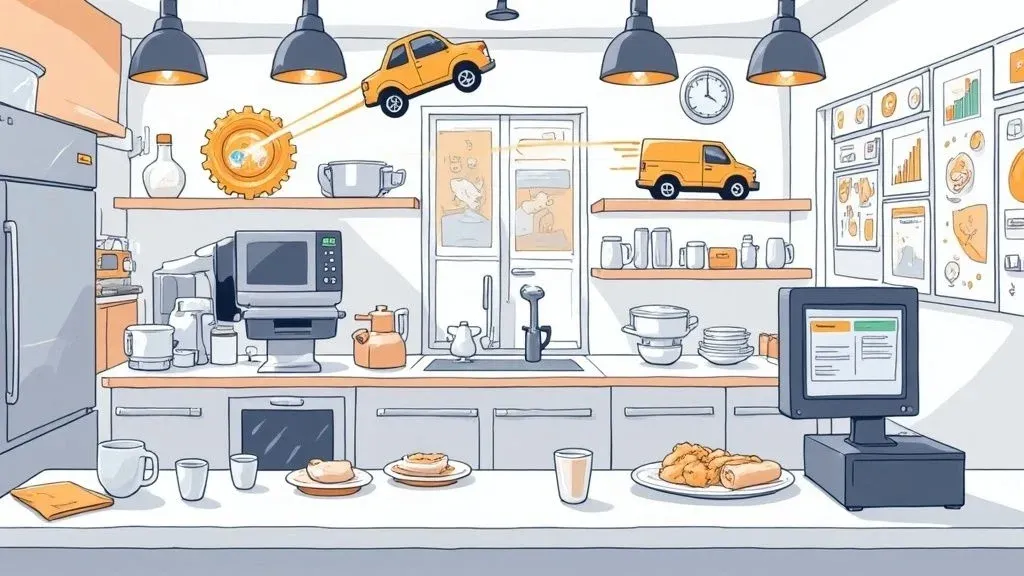
Put simply, restaurant technology solutions are the digital tools that help you run your business better. Think of them as the modern-day central nervous system for your restaurant. Your kitchen is the heart and your front-of-house is the face, but tech is what connects everything, providing the data and control you need to run a tight ship. It helps you dodge costly mistakes and, most importantly, grow your profits.
What Are Restaurant Technology Solutions Anyway?
Let’s cut through the buzzwords. At its core, “restaurant tech” is any piece of software or hardware that automates or simplifies the million and one tasks you do every day. This isn’t about chasing the latest shiny object; it’s about building a solid digital foundation that supports every part of your operation—from the moment a customer gets a craving to the second their payment hits your account.
Imagine trying to run a slammed dinner service where your kitchen staff, servers, and delivery drivers all speak a different language. That’s what it feels like to run a restaurant with disconnected systems. Good food tech makes sure every piece of your operation—your POS, third-party delivery apps, kitchen display system (KDS), and inventory—is speaking the same language. This creates a single, reliable source of truth for your entire business.
Why This Matters for Restaurant Operations and POS Integration
The impact of getting your tech stack right is almost immediate. When your systems are truly integrated, you’ll see massive improvements across the board, tying directly back to your restaurant’s efficiency.
- No More Manual Entry: Think about all the time spent punching in orders from DoorDash or Uber Eats into your POS. Automating that saves hours of labor every single week, directly improving staff productivity.
- Fewer Costly Errors: Automation nearly eliminates human error. That means fewer wrong orders, less food waste, and customers who are actually happy with what they receive. This is a direct cost saving.
- A More Productive Team: When your staff isn’t bogged down re-typing orders or double-checking tablets, they can focus on what really matters: great customer service and getting food out of the kitchen faster.
This isn’t just a trend; it’s a fundamental shift in how restaurants operate. The global restaurant technology market was valued at a staggering $59.30 billion in 2024 and is expected to explode to $314.85 billion by 2033. That kind of growth tells you one thing: what used to be a “nice-to-have” is now absolutely essential to compete.
Core Categories of Food Tech
While the sheer number of tools can feel overwhelming, most fall into just a few key categories. To give you a bird’s-eye view, here’s a quick breakdown of the main players in the restaurant tech world.
Core Restaurant Technology Categories at a Glance
This table simplifies the landscape, showing you the main types of tech and what they actually do for your business.
Technology Category Primary Function Key Benefit Point of Sale (POS) The central command for orders, payments, and sales data. Acts as the “brain” of your restaurant’s operations. Delivery Management Integrates third-party delivery orders directly into the POS. Eliminates “tablet hell” and manual order entry. Kitchen Automation (KDS) Digitizes and displays orders for the kitchen staff. Improves order accuracy and cook times. Inventory Management Tracks stock levels and helps manage food costs. Reduces waste and optimizes purchasing. Customer Loyalty Manages rewards programs and customer engagement. Drives repeat business and builds brand loyalty.
Understanding these core functions helps you see how each piece of the puzzle fits together to create a smarter, more efficient restaurant.
Beyond the daily operational tools, smart restaurant technology also helps you build long-term relationships with your customers. You can dive deeper into the power of using loyalty applications specifically designed for restaurants to keep regulars coming back.
One of the most powerful tools in this ecosystem is the https://www.orderout.co/solutions/3rd-party-order-engine, which acts as the ultimate middleman for all your off-premise orders. Think of it as a universal translator, ensuring that every order from every single app flows directly into your POS system without anyone having to lift a finger. Major POS systems like Clover and Square even have entire app marketplaces built around these kinds of integrations, making it simple to connect the tools you already use.
The bottom line is simple: integrating the right restaurant technology is no longer a luxury—it’s a core strategy for survival and growth. By automating the tedious stuff, cutting down on errors, and freeing up your team, you can build a more resilient and profitable business.
Why Your POS Integration Is the Heart of Restaurant Operations
A modern Point of Sale (POS) system is so much more than a digital cash register. It’s the central hub for your entire restaurant. Think of it as the air traffic controller for your business, keeping track of every order, payment, and scrap of sales data. But its real power gets unlocked through POS integration—the ability for all your other tech tools, especially for restaurant delivery, to “talk” to it directly.
Imagine trying to run a kitchen where every chef speaks a different language. Chaos, right? That’s what it feels like to operate a restaurant with disconnected technology. When your delivery platforms like DoorDash, your online ordering site, and your inventory system all connect with your POS, you create a single source of truth that everyone can understand. This seamless communication is the bedrock of an efficient restaurant.
Unlocking Efficiency with a Connected System
So, what does this actually look like day-to-day? A well-integrated system automates the flow of information, which gets rid of all those tedious and error-prone manual tasks that drain your team’s time and your restaurant’s profits.
When your systems communicate, your staff doesn’t have to. This simple principle is the key to reducing operational friction, minimizing costly errors, and giving your team the headspace to focus on delivering a great customer experience.
Without integration, an order from Uber Eats forces a staff member to stop what they’re doing, manually punch the order into the POS, and just hope they didn’t make a typo. With a connected system, that same order flows straight from the app to your kitchen display in seconds, with zero human touch. This simple bit of automation directly boosts your bottom line by saving labor hours and cutting down on food waste from incorrect orders. If you want to dig deeper into how these connections work, check out our guide covering frequently asked questions about POS integration.
The Power of App Marketplaces
Today’s food tech is built around this very idea of connectivity. Major POS providers like Clover and Square have built entire ecosystems, often called “app marketplaces,” that let specialized software plug directly into their platforms.
This screenshot from the Square App Marketplace shows exactly how a third-party application can connect right to your POS.

The big takeaway here is that you don’t need a single, giant, one-size-fits-all system to run your restaurant. Instead, you can pick and choose the best tools for each job—delivery, inventory, loyalty—and feel confident they will all play nicely together through your central POS hub.
Practical Benefits of POS Integration
Tying your restaurant tech together isn’t just a technical upgrade; it’s a strategic move that delivers real, tangible results. Here’s why it matters so much to your daily operations:
- Error Reduction: Automating order entry from delivery apps can slash order mistakes by over 95%. That means less food waste and happier customers.
- Time Savings: We see restaurants save 2-5 hours per day by getting rid of the need to manually reconcile orders from all those third-party tablets. That’s a significant staff productivity boost.
- Enhanced Staff Productivity: When your front-of-house team isn’t bogged down with manual data entry, they can focus on in-person guests, leading to better service and higher check averages.
- Accurate Reporting: All your sales data flows into one place. This means your reports are accurate and available instantly, giving you a real-time pulse on your restaurant’s financial health.
For instance, when an order from DoorDash is automatically injected into your POS, it does far more than just save a few minutes. It guarantees the sale is recorded correctly, your inventory is updated in real-time, and the kitchen gets the order instantly. It’s a level of synchronization you simply can’t achieve with disconnected systems.
Your Practical Next Step:
Start by auditing your current POS system. Go explore its app marketplace and see what integrations are already available for the tools you use, like your main restaurant delivery services. Identifying just one manual process you can automate—like order entry—is the perfect first step toward building a more efficient and profitable operation. You can start building these connections today by signing up for free at https://dashboard.orderout.co.
Taming the Chaos of Restaurant Delivery Tech
Remember the days of juggling a half-dozen tablets, each one chirping and flashing with new orders from DoorDash, Uber Eats, and your own website? It’s a scene that gives any restaurant manager a headache—a perfect recipe for missed orders, frustrated staff, and unhappy customers. We call this operational bottleneck “tablet hell,” and it’s where countless restaurants bleed profits and efficiency.
Modern restaurant delivery technology is designed to be your digital air traffic controller, built specifically to end this chaos. Instead of your team manually punching every single online order into the POS, these systems automatically pull every order from every platform. They then feed it directly into your kitchen’s existing workflow through direct POS integration, treating it just like an order placed in-house.

From Tablet Hell to Automated Heaven with POS Integration
At its core, this tech acts as an order aggregator. Think of it as a funnel. It takes everything—from third-party marketplaces like Uber Eats and your own online ordering site—and pours it all into one clean, manageable stream that speaks directly to your POS. This one simple change can have a massive, immediate impact on your restaurant operations.
The moment an order is placed on any app, the technology grabs it and translates it into a language your POS understands. This completely gets rid of the need for a host to stop what they’re doing, run over to a ringing tablet, and manually re-enter the entire order, item by item. It’s a tiny task that, when you repeat it hundreds of times a day, adds up to huge labor costs and opens the door wide for human error.
By automating the flow of information from delivery apps straight to your POS, you’re not just adding convenience—you’re reclaiming control over your entire off-premise business. This single move turns a chaotic, reactive process into a streamlined, predictable part of your day, boosting efficiency and reducing errors.
Imagine a customer places a complicated order with special allergy instructions through Uber Eats. Without integration, a busy host might easily mistype that allergy note or forget a modifier. With an automated solution, that order pops up on your kitchen display system exactly as the customer entered it, protecting both accuracy and your restaurant’s reputation.
The Real-World Impact on Restaurant Efficiency
The benefits of automating your delivery channels go way beyond just being convenient. They hit directly at the core challenges every operator is facing, like labor shortages and the rising cost of ingredients.
- Skyrocketing Order Accuracy: Automation practically eliminates manual entry mistakes, so the kitchen makes the right order the first time, every time. This drastically cuts down on food waste from remakes and reduces costs.
- Plummeting Kitchen Stress: A steady, organized stream of digital tickets is far less stressful for your BOH team than a constant barrage of ringing tablets and frantic handwriting. This creates a calmer, more productive kitchen.
- Freed-Up Staff: Your front-of-house team can finally get back to what they do best—taking care of your in-person guests—instead of playing a nonstop game of tablet whack-a-mole. This directly increases staff productivity.
This shift toward smarter, connected systems is really defining the modern restaurant. The data shows a huge push for tools that make operations smoother and keep customers happy. The widespread use of digital ordering systems makes it clear, with 75% of full-service restaurants in the U.S. now using them. You can learn more about how restaurants are adopting technology to tackle operational challenges.
Choosing Your Delivery Management Strategy
Ultimately, consolidating your delivery orders gives you a solid foundation for managing your off-premise business, whether you use third-party drivers or have your own team. Understanding the pros and cons of each approach is the critical next step, which we break down in our detailed guide on in-house vs. third-party delivery. Leading POS systems like Clover and Square make this easy, allowing powerful tools to plug directly into your operational hub.
Your Practical Next Step:
Count how many different sources your online orders come from. If you’re managing more than a single tablet, it’s time to seriously look into an order aggregation solution. The savings in time, error reduction, and money from automating this one process can completely change your daily workflow for the better. Ready to end the tablet chaos? You can start onboarding for free in just a few clicks at https://dashboard.orderout.co.
Boosting Kitchen Efficiency with Smart Food Tech
Think of your kitchen as the engine of your restaurant. To keep it running at peak performance, especially during a chaotic dinner rush, you need the right tools. Modern food tech offers high-performance upgrades that replace clunky, manual processes with smarter, faster systems. It’s all about boosting speed, nailing accuracy, and improving your overall restaurant efficiency.
The single most powerful starting point is a Kitchen Display System (KDS). It’s a simple concept with huge impact: replace the frantic mess of paper tickets with clean, digital screens. But a KDS is so much more than a glorified monitor. It intelligently routes orders to the right station—grill, fry, or pantry—and meticulously tracks ticket times from the moment a customer orders until the food is ready. This gives you hard data to pinpoint and eliminate bottlenecks in your workflow.
This one switch from paper to digital creates a quiet, efficient communication channel between your front-of-house and back-of-house teams, which is a massive win for your restaurant’s overall efficiency.

Connecting Your Kitchen to Your Inventory via POS Integration
The next piece of the puzzle is inventory management software. Forget about spending hours on tedious manual counts and making educated guesses. These tools can track your stock levels in real time, automatically flagging items that are running low. Even better, they can suggest reorder quantities based on your actual sales data, pulled straight from your POS.
This is where the magic of POS integration happens. When a burger is sold through your Clover POS, the system can instantly deduct one patty, one bun, and two slices of cheese from your digital inventory count. It’s that seamless.
This real-time tracking gives you a precise, up-to-the-minute picture of your food costs and usage. It transforms inventory from a reactive chore into a proactive strategy, preventing costly over-ordering and unexpected shortages, saving you significant time and money.
Having this level of control is absolutely critical for protecting your profit margins. When you know exactly what you have and what you’re using, you can make much smarter purchasing decisions and seriously reduce food waste. To get more ideas, check out our guide on 3 ways to help reduce food waste in a restaurant.
The Impact on Restaurant Operations
Bringing these kinds of restaurant technology solutions into your kitchen delivers real, tangible benefits that your team will notice on every single shift. This isn’t just theory; it directly impacts staff productivity and, ultimately, your bottom line.
- Faster Ticket Times: A KDS organizes the order queue, making sure cooks are firing the right items in the right sequence. This speeds up the entire line.
- Drastically Reduced Errors: Digital orders are perfectly clear. This eliminates the costly mistakes that come from illegible handwriting or verbal mix-ups.
- Smarter Purchasing: With real-time inventory data, you order what you need, when you need it. That means less cash is tied up in stock sitting on a shelf.
- Improved Staff Productivity: A less chaotic kitchen is a happier, more productive one. Your team can focus on creating amazing food instead of trying to decipher tickets or hunt for missing ingredients.
Even your specialized equipment can get smarter. Understanding how advanced controls improve your cooking is key. For example, exploring the benefits of commercial thermostatic griddle technology shows how precise temperature management can lead to better consistency and efficiency. Platforms like Square are often designed to integrate with these advanced systems, ensuring every part of your kitchen is connected and communicating.
Your Practical Next Step:
Take a hard look at your current ticket system. If you’re still relying on paper printers, a KDS is one of the highest-impact upgrades you can make. It’s the foundational step toward building a data-driven kitchen that runs with precision. To begin connecting your systems, get started for free at https://dashboard.orderout.co.
How AI and Automation Are Shaping Restaurant Operations
Let’s get one thing straight: the future of restaurant tech isn’t about replacing your team with robots. It’s about giving them superpowers. Artificial Intelligence (AI) and automation are here to handle the repetitive, data-heavy tasks that bog your staff down, freeing them up to focus on what really matters—the guest experience.
Think of an AI-powered inventory system as your new logistics expert. It doesn’t just count what’s in the stockroom; it actually predicts what you’ll need next week by analyzing past sales, upcoming local events, and even weather forecasts. That means fewer frantic supply runs and less food waste, which hits your bottom line directly by reducing costs and saving time.
Supercharging Daily Restaurant Operations with Food Tech
In the kitchen, automation can take over the simple, repeatable prep work, letting your skilled chefs concentrate on creativity and quality. This is where food tech stops being a passive screen and starts actively helping with the workflow. It’s all about making your team’s job easier and more focused, which boosts staff productivity.
The real goal of AI in a restaurant isn’t to remove the human touch. It’s to eliminate human error and repetitive labor, allowing your staff to deliver a better, more personal experience for every guest. This improves efficiency and the customer experience simultaneously.
For example, a smart system can dig into the order data from your POS and suggest menu tweaks based on what’s actually profitable and popular. It can pinpoint your busiest hours with incredible accuracy, helping you build smarter staff schedules that perfectly match demand. The result? You cut labor costs without ever sacrificing service quality.
From Manual Guesswork to Data-Driven Decisions
You don’t need to rip everything out and start over to bring these tools on board. You can start small. Begin by really diving into the data analytics your POS already provides to get a clearer picture of your peak hours and top-selling dishes. This simple step lays a solid foundation for adding more advanced, automated systems down the line.
The infographic below shows just how much of a difference automation can make for a common task like managing reservations. The gains in efficiency and guest throughput are crystal clear.

As you can see, automation isn’t just a nice-to-have. It directly slashes wait times and no-show rates, which means more table turns and more revenue in your pocket every single shift.
The shift toward automation and data-driven decisions is well underway. By 2025, a whopping 52% of restaurant operators plan to invest in kitchen automation. The payoff can be huge, with some restaurants seeing labor cost reductions of up to 15% while boosting monthly sales by 20%. You can learn more about how these future trends in restaurant technology are creating new paths to growth.
So, how do these new technologies stack up against the old way of doing things? Let’s break it down.
Emerging Tech vs. Traditional Methods
Operational Task Traditional Method Automated/AI Solution Primary Benefit Inventory Management Manual weekly counts, handwritten order sheets, and guesswork. AI-powered analytics predict needs based on sales, seasonality, and events. Reduces food waste, prevents stockouts, and saves hours of labor. Staff Scheduling Manager creates schedules based on gut feelings and past experience. Software analyzes historical sales data to build demand-based schedules. Optimizes labor costs, prevents over/understaffing, and improves fairness. Menu Engineering Infrequent reviews of sales reports to guess top/bottom performers. Real-time POS data analysis identifies profit drivers and duds automatically. Maximizes profitability by focusing on high-margin, popular items. Reservation Handling Pen and paper or a basic digital log, with staff managing calls. Online booking system with automated waitlists and table management. Frees up host staff, reduces no-shows, and improves table turnover.
Ultimately, the new tools aren’t just faster—they’re smarter, giving you insights that were once impossible to see.
Practical Steps to Embrace Automation
The key to making this all work is connecting these smart tools back to your central hub—your POS. A modern platform like Clover or Square can integrate with AI-driven analytics or scheduling software, pulling all your data into one place for truly intelligent decision-making. That POS integration is what turns a bunch of separate tools into a single, powerful system.
Here’s how you can get started:
- Analyze Sales Data: Use your existing POS reports to find your most (and least) profitable menu items.
- Optimize Scheduling: Look at your hourly sales trends to build schedules that put staff where they’re needed most.
- Automate Ordering: Start with a simple tool that aggregates your restaurant delivery orders automatically to cut down on errors and save time.
Your Practical Next Step:
Pick one repetitive task that eats up your staff’s time every week, whether it’s manual inventory counts or building the schedule from scratch. Research one automated tool designed to solve that specific problem. Making one small, strategic change is the best way to begin building a smarter, more efficient operation. To start connecting your systems, you can sign up for free at OrderOut.
Choosing a Technology Partner You Can Trust
Picking the right technology for your restaurant isn’t about chasing the flashiest new app. It’s about finding a genuine partner who can solve the real, everyday problems that keep you up at night. And the absolute most important piece of the puzzle is solid POS integration. If a new tool doesn’t play nicely with your existing Square or Clover system, it’s not a solution—it’s just another headache for your staff.
You’re trying to build a digital backbone for your business, not a Frankenstein’s monster of disconnected apps that just create more friction. When your systems can’t talk to each other, you end up with slow service, frustrated employees, and money left on the table. A great tech partner gets this and puts making your entire operation run like a well-oiled machine first.
A Practical Evaluation Process
Finding a partner you can actually rely on requires a simple, no-nonsense evaluation. Forget about getting bogged down in technical spec sheets; this is about focusing on what will truly make a difference to your restaurant’s efficiency and your bottom line.
Here’s a straightforward way to approach it:
- Identify Your Biggest Headache: Before you even start browsing websites, name your single biggest operational pain point. Is it the sheer chaos of juggling tablets for DoorDash, Uber Eats, and Grubhub? Or maybe you’re constantly battling food waste because of inventory guesswork. Get specific.
- Shortlist the Specialists: Look for companies that live and breathe that one problem. A provider that focuses exclusively on restaurant delivery integration will always outperform a generic, jack-of-all-trades platform.
- Demand a Live Demo: Never, ever buy software based on a slick video or a PDF. Insist on a live demo with a real person who can walk you through the system using your own menu as an example. This is your chance to see exactly how it would function during a busy dinner rush.
Questions to Ask a Potential Tech Partner
When you’re in that demo or on a follow-up call, don’t be afraid to ask the tough questions that cut through the sales pitch. Their answers will tell you everything you need to know about how much they actually care about your success.
- “What does your onboarding process really look like?” A good partner will hold your hand through the setup, not just send you a link to a support forum.
- “Who do I call when something breaks at 8 PM on a Friday?” The restaurant business doesn’t operate from 9-to-5. You need to know they have your back with responsive support when you’re in the weeds.
- “Show me—don’t just tell me—how this connects with my POS.” Make them prove the integration is as smooth and reliable as they claim.
The best technology partners don’t just sell you software; they invest in your success. They understand that their value is measured by the time you save, the errors you reduce, and the revenue you gain.
Looking Beyond the Monthly Fee
Finally, try to look past the monthly price tag and think about the total value. A solution that costs a bit more but saves your manager five hours of admin work a week and cuts order mistakes in half is going to pay for itself many times over. The right partner will help you map this out, talking through concrete cost savings, staff productivity gains, and efficiency improvements.
For a clearer picture of how to weigh the financial side, you can explore different restaurant technology pricing models to see what makes the most sense for your budget and goals.
Your Practical Next Step:
Figure out your number one operational bottleneck right now. Then, book demos with two or three companies that are experts in solving that exact problem. Use the questions above to drive the conversation and focus on choosing a partner, not just a product. To see how a true partner can streamline your operations, start onboarding for Free in just a few clicks at https://dashboard.orderout.co.
Where Do You Go From Here?
Getting started with restaurant technology can feel overwhelming, but it doesn’t have to be a massive, all-at-once project. Think of it as a journey, not a destination. The real goal is to make small, smart changes that add up to big wins in how smoothly your restaurant runs and how much money you make.
Start by taking a hard look at your current workflow. Where’s the biggest headache? Is it the jumble of delivery tablets cluttering your counter? Or maybe it’s the endless cycle of guessing how much inventory you actually have on hand. Find that one major bottleneck.
Once you’ve zeroed in on your main pain point, make that your top priority. Look for technology designed specifically to fix that problem. And here’s the most important part: make sure it has rock-solid POS integration. Any new tool should feel like a natural extension of what you already do, not another separate task for your busy team to manage.
Building Your Tech Stack, One Piece at a Time
By tackling one challenge at a time, you can carefully build an interconnected system of tools—a tech stack—that’s perfectly suited to your restaurant. This step-by-step method is so much more effective than trying to change everything overnight. It keeps things running smoothly and gives your staff a chance to get comfortable with one new tool before the next one comes along.
The right technology isn’t just another bill to pay. It’s a real investment that buys back your time, cuts out expensive mistakes, and directly boosts your profits. Each piece you add should make your business stronger and your life easier.
This dashboard gives you a glimpse of what that kind of control looks like.
What you’re really looking at is a command center. It’s a single screen where all the scattered pieces of information from your operation come together to paint a clear, simple picture of your business. That’s what great food tech does: it provides clarity, transforming messy data into straightforward decisions that help your team work smarter and your restaurant run better.
This gradual approach also makes it much easier for your team to get on board. For example, once they’ve mastered an order aggregator that automatically sends delivery orders from services like Uber Eats to your Clover or Square POS, they’ll be more confident and open to the next step, whether that’s a smart inventory system or a new scheduling tool. Every win builds momentum for the next one.
Ready to take back control of your restaurant operations and stop manual chores from eating into your profits? You can start building a smarter, more connected restaurant right now, without spending a dime upfront.
OrderOut connects your delivery apps directly to your POS system, saving you time and getting rid of order errors from the very first day. You can start your integration journey for free in just a few clicks.