
A Restaurant Profit And Loss Statement Example
· Thibault Le Conte
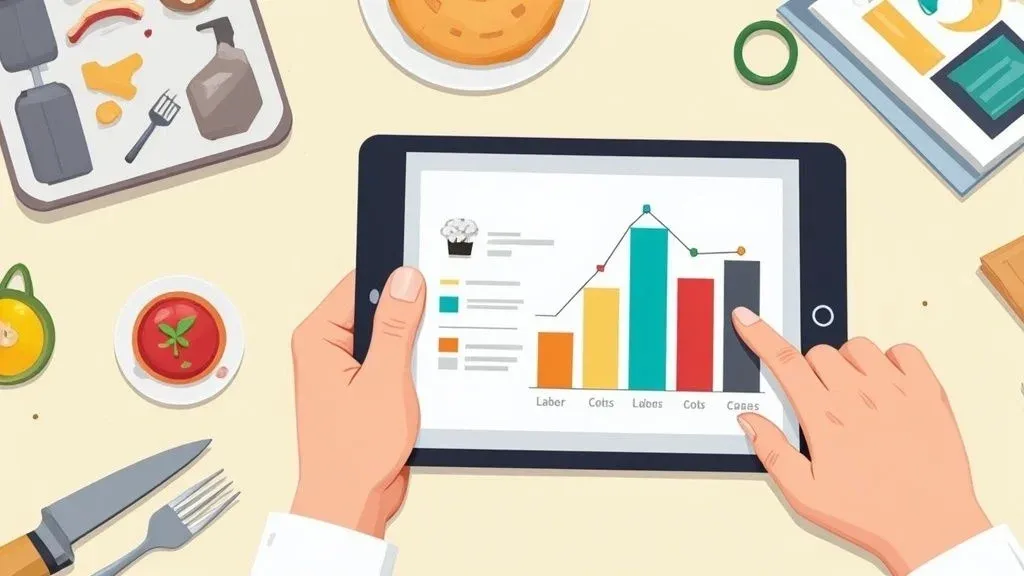
Think of your restaurant’s financial story, told entirely through numbers. That’s exactly what a restaurant profit and loss statement example is. In simple terms, it’s a report that lists all the money you earned versus all the money you spent over a specific period. The final number shows you the score: your profit or your loss.
Decoding Your Restaurant Profit And Loss Statement
The Profit and Loss (P&L) statement is arguably the single most important document for getting a real pulse on your restaurant’s financial health. Put simply, it subtracts all your costs from your total revenue to show you whether you’re making money or losing it. This financial snapshot is your best friend when it comes to making smarter, actionable decisions on everything from menu pricing to staffing levels and delivery operations.
To really get the most out of your P&L, it helps to see how it fits into the bigger picture of how you prepare financial statements for your business. The P&L boils down to three core pieces:
- Revenue: All the money your restaurant brings in from food, drinks, and delivery sales.
- Cost of Goods Sold (COGS): The direct costs of the ingredients and beverages you sell. This is the cost of the “stuff” you turn into menu items.
- Operating Expenses: Every other cost you have to pay to keep the lights on and the doors open, like labor, rent, and utilities.
Let’s take a quick look at how these parts come together.
Key Parts of Your Restaurant P&L Statement
A quick look at the main components of a P&L statement and what each part tells you about your business’s health.
P&L Section What It Measures Why It Matters For Your Restaurant Revenue (Sales) Total income from all sales channels (dine-in, takeout, delivery, catering) before any expenses are deducted. It’s your top line—the starting point for all profitability calculations. It shows you how much demand there is for what you offer. Cost of Goods Sold (COGS) The direct cost of all food and beverage ingredients used to create the items you sold. This tells you how efficiently you’re managing food costs. A high COGS can sink your profits, even with high sales. Gross Profit Revenue minus COGS. This is the profit you make just from selling your food and drinks, before accounting for operational costs like labor and rent. Operating Expenses All costs required to run the business, including labor, rent, marketing, utilities, and administrative fees. These are the day-to-day costs of being in business. Keeping a close eye on them is key to protecting your bottom line. Net Profit (or Loss) Gross Profit minus all Operating Expenses. This is the final number—the “bottom line.” It’s the money you actually take home after every single bill has been paid.
Understanding what each section means is the first step to making your P&L a powerful tool for growth and boosting restaurant efficiency.
Why Your P&L Is Crucial for Restaurant Delivery and POS Integration
Getting these numbers right is more critical than ever. While the global restaurant industry has seen massive growth, profitability is still a major hurdle for most operators. The average net profit margin for a restaurant floats somewhere between a tight 3% to 5%, constantly squeezed by rising labor costs, fluctuating food prices, and increasingly complex restaurant operations.
This is where good data and smart technology make all the difference. If you’re manually adding up sales from different places—like your dine-in register, Uber Eats, and DoorDash—you’re almost certainly leaving room for error, which leads to a P&L that doesn’t tell the whole truth. This directly impacts restaurant efficiency.
The actionable insight here is to leverage POS system integration with delivery services. This ensures every single dollar is tracked and accounted for automatically. For example, connecting your delivery apps directly to a Clover or Square POS completely removes the need for manual data entry. This change immediately reduces costly human errors and boosts staff productivity, giving you a clean, accurate revenue picture for your P&L. Not only does this save your team significant time, but it also provides reliable data so you can truly understand your bottom line.
A Line-by-Line Walkthrough of a P&L Statement
Alright, let’s move from theory to reality with a detailed restaurant profit and loss statement example. Think of this as the story of one month in your restaurant’s life, told through its finances. We’re going to dissect each major section—Revenue, Cost of Goods Sold, and Operating Expenses—to show you exactly where the numbers come from and why they matter so much.
The whole thing follows a simple, logical flow: we start with all the money that comes in the door and then subtract all the costs that go out.

This graphic nails the basic P&L structure. Your total Revenue gets chipped away by the Cost of Goods Sold (COGS) and all other Expenses, leaving you with the bottom line: your profit.
Revenue: Your Starting Point
Revenue, sometimes just called Sales, is the very top line of your P&L. It represents every single dollar your restaurant earned during a specific period before any costs are taken out. It’s the purest measure of what your customers are buying.
For a truly clear picture, you need to break your revenue down into different buckets. This helps you see which parts of your business are actually pulling their weight.
- Food Sales: This is everything you make from menu items, whether it’s for dine-in, takeout, or delivery.
- Beverage Sales (Non-Alcoholic): All the income from sodas, coffees, teas, and mocktails.
- Beverage Sales (Alcoholic): Money coming in from beer, wine, and liquor. Separating this from non-alcoholic drinks is crucial for tracking the true profitability of your bar program.
- Restaurant Delivery Sales: It can be really smart to create a specific line item for sales from third-party apps like Uber Eats and DoorDash. Isolating this data is the only way to understand the real cost-benefit of your delivery channels.
Modern POS systems are an absolute lifesaver for tracking these streams accurately. A system like Square, for instance, can automatically categorize sales as they happen. This cuts out the manual guesswork and drastically reduces errors, ensuring the revenue figures you start with are rock-solid. This POS integration directly improves restaurant efficiency by saving time and ensuring data accuracy.
Cost of Goods Sold: The Cost of Your Menu
The Cost of Goods Sold (COGS) is the direct cost of the ingredients and beverages you used to generate your revenue. In plain English, if you sold a burger, the COGS is what you paid for the patty, bun, lettuce, and cheese. It’s that simple.
COGS isn’t your total food spending for the month; it’s only the cost of the inventory you actually sold. This is a critical distinction for getting an accurate profit calculation.
Calculating COGS means getting a handle on your inventory. The formula is a classic for a reason:
Beginning Inventory + Purchases - Ending Inventory = COGS
Just like with revenue, you should break down your COGS to mirror your sales categories (e.g., Food COGS, Beer COGS, Wine COGS). Doing this lets you calculate the cost percentage for each one—a vital KPI for spotting waste, theft, or pricing problems. Effective restaurant operations management is all about keeping these costs on a tight leash.
Operating Expenses: Keeping the Lights On
Operating Expenses are all the other costs you have to pay to run your restaurant. These are the bills that aren’t for direct food or beverage ingredients. We usually group them into two main types.
Controllable Expenses
These are costs that can go up or down and that you have some power to manage in the short term.
- Labor Costs: This is almost always your biggest expense after COGS. It includes wages, salaries, payroll taxes, and any benefits you offer. Smart scheduling and boosting staff productivity are your best weapons for managing this.
- Marketing: All the money you spend on advertising, social media campaigns, and promotions.
- Utilities: Gas, electricity, and water. While you have to have them, conservation efforts can definitely make a dent in this line item.
Fixed Expenses
These are the non-negotiable costs that pretty much stay the same every month, no matter how busy you are.
- Rent/Mortgage: The cost of having a roof over your head.
- Insurance: This covers things like general liability, property, and workers’ compensation.
- Technology Fees: This bucket includes subscriptions for your POS system, accounting software, and any restaurant delivery integration tools. A platform like Clover can help by centralizing many of these functions, which simplifies this expense line considerably.
By meticulously tracking every one of these lines, you stop just reading a P&L and start using it as a strategic tool to actively drive your restaurant’s profitability.
Mastering Your Prime Cost for Better Profitability
If there’s one number that can make or break your restaurant, it’s the Prime Cost. Think of it as the true cost of what you sell. It’s the sum of your Cost of Goods Sold (COGS) and your total labor costs, plain and simple.
This single metric gives you the clearest, most honest look at how efficiently your core operation is running. It bundles together your two biggest expenses, and keeping it in check is fundamental to survival.
The golden rule in the industry is to keep your Prime Cost at or below 60% of your total sales. If you see that number creeping up, it’s a serious red flag. It means your food and labor expenses are gobbling up your revenue, leaving you with crumbs to cover rent, utilities, and, most importantly, profit.

The calculation itself is straightforward:
Prime Cost = Cost of Goods Sold (COGS) + Total Labor Costs
Wrangling this number requires a two-front battle: one fought in your walk-in cooler and pantry, and the other on the schedule and kitchen line.
Lowering COGS Through Smarter Restaurant Operations
Food cost is the first major piece of the Prime Cost puzzle, and it’s an area where profits often quietly disappear. While food costs should ideally hover between 28% to 32% of revenue, a shocking 75% of all inventory shrinkage can come from employee theft. Those losses hit your gross profit directly.
To tighten the reins, you need to get strategic:
- Engineer a Smarter Menu: Don’t just list dishes; analyze them. Figure out which items are your high-margin “stars” and push them. For the low-margin plates that are expensive to make, it might be time to rework the recipe or adjust the price.
- Track Inventory Religiously: Vague estimates won’t cut it. Implement strict, regular inventory counts. Doing this helps you spot discrepancies immediately, stop over-ordering, and catch spoilage before it ever hits your P&L.
Optimizing Labor Costs With Food Tech and POS Integration
Labor is the other half of the equation, and this is all about efficiency. An extra person on a slow shift or unproductive downtime can bloat your labor percentage in a hurry. You can find out more about the numbers with a restaurant labor cost calculator.
Beyond just smart scheduling, technology is one of the best tools for boosting productivity and controlling these costs.
Think about it this way: Imagine your host manually punching every single Uber Eats order into your Square POS. Each one takes time, focus, and opens the door for human error. A wrong modifier means an incorrect meal, wasted food, and a frustrated customer—all things that drive up your costs.
Now, what if those delivery orders flowed directly into your POS without anyone touching a thing? This simple automation has a domino effect on your Prime Cost:
- It cuts down labor: Your team is now free to focus on the guests right in front of them instead of being bogged down by data entry, boosting staff productivity.
- It slashes food waste: Order accuracy skyrockets, meaning far fewer expensive remakes. This reduces errors and saves money.
- It boosts throughput: Orders hit the kitchen instantly, helping you handle more business during those critical peak hours.
This is a perfect restaurant profit and loss statement example of how a small operational tweak can create significant cost and time savings on your biggest line items.
Take a hard look at your current order entry process. If it involves a human manually typing things out, you’ve found a major opportunity to automate and get your Prime Cost back under control.
Using Food Tech to Tame Restaurant Operations Expenses
After you’ve wrestled with your food and labor costs, there’s a whole other category of expenses that can quietly eat away at your profits. I’m talking about the everyday costs of doing business—marketing, utilities, maintenance, and administrative work. They might seem small on their own, but trust me, they add up and can take a serious bite out of your bottom line.
Your P&L is the map that shows you where this money is going. Are your utility bills creeping up every month? Is that new marketing campaign actually bringing people in the door? The clues are all there. Once you spot the problem areas, technology is often the smartest way to fix them.
Slash Overhead with POS Integration
The name of the game is efficiency. Modern restaurant tech isn’t just about fancy gadgets; it’s about making your operation run smoother. Think about all the time your staff wastes on tasks that have nothing to do with making great food or serving guests, like trying to manage a half-dozen tablets for different delivery apps. This is exactly where a small investment in the right tool can deliver a huge return on your P&L.
For example, connecting a service like DoorDash directly with your Clover POS can consolidate your entire delivery process into one place.
This isn’t just about being more organized. It’s a direct hit against your overhead. You’re cutting down on the manual, repetitive tasks your staff has to do, which means fewer labor hours and fewer chances for expensive mistakes. That’s a real-world cost saving.
Plus, when all that sales data flows into one system, your P&L reports become instantly more accurate. That saves you or your accountant a ton of administrative headaches.
How Food Tech and Restaurant Delivery Integration Boosts Your Bottom Line
Getting the right tools is a strategic financial move, not just a convenience. When your team isn’t glued to a screen trying to manage multiple devices, their productivity skyrockets. They can turn more tables or focus on upselling, both of which directly boost your revenue.
Here’s a quick look at how this tech-first approach helps your P&L:
- Fewer Errors: When delivery app orders are automatically punched into your POS system, like with a Square integration, you nearly eliminate the typos and misheard orders that lead to comped meals and wasted food. That’s a direct reduction in your operating expenses.
- Time Is Money: Every hour your team saves on manual data entry is an hour you’re not paying for, or an hour they can spend on activities that actually make you money.
- Clean Reporting: With consolidated data, your P&L is built on solid, reliable numbers. You get a true snapshot of your profitability without spending hours trying to piece everything together manually.
By zeroing in on these operational weak spots, you can turn what looks like a minor line item into a major source of savings. For a more detailed look at this, check out our guide on essential restaurant technology solutions.
So, what’s the next step? Take a hard look at your current technology. Find those manual processes, especially around your restaurant delivery and online ordering, that are ripe for automation. This is almost always the easiest way to start cutting costs and see an immediate improvement on your P&L.
Ready to stop juggling tablets and see the impact on your bottom line? You can start onboarding for Free in a few clicks and get all your delivery platforms working together.
How to Turn P&L Data Into Actionable Insights
A restaurant P&L statement is so much more than a financial report card. Think of it as your strategic roadmap. By really digging into the data, you can stop just reacting to your finances and start proactively shaping them. The first step? Never look at a single P&L in isolation.
Start comparing your statements month-over-month and year-over-year. This simple practice immediately starts to reveal trends. Are your labor costs slowly creeping up? Did that summer marketing campaign actually move the needle on sales compared to last July? Spotting these patterns is how you start making smarter, data-driven decisions for your restaurant.
Calculating Your Key Performance Indicators
Your P&L holds all the raw ingredients for calculating the most important metrics in your business—your Key Performance Indicators, or KPIs. These are the numbers that tell the real story of your financial health, cutting through the noise.
For instance, your profit margin is a huge one. You can figure this out by simply dividing your net profit by your total revenue. Knowing this percentage tells you exactly how much of every dollar in sales you actually get to keep. For a full breakdown, check out our guide and restaurant profit margin calculator.
Another essential metric is your break-even point. This is the sales volume you need to hit just to cover all your costs. Calculating this helps you set realistic sales goals and shows you exactly where your financial pressure points are.
From Numbers to Real-World Decisions
Connecting your P&L analysis to real-world actions is where the magic really happens. Let’s say your P&L shows that delivery sales are through the roof, but your net profit is disappointingly flat. The data is pointing you straight to a problem. A deeper look might reveal that the commission fees from third-party apps are eating you alive.
This insight is your call to action. It gives you the power to renegotiate rates with services like Uber Eats or DoorDash, or maybe launch a marketing push to get customers ordering directly from your own website, which instantly boosts your margins.
This is more critical now than ever. The U.S. restaurant industry is projected to hit $1.5 trillion in sales by 2025, but the profit margins are razor-thin. With food and labor costs soaring—some restaurants are reporting hikes of over 15%—and delivery apps taking up to 30% in fees, operators have to use their P&L to find every possible saving.
This is where your tech stack can be a game-changer. Integrating your delivery services directly with a POS system like Clover or Square gives you clean, automated data, which makes this kind of analysis much faster and more accurate. This connection cuts down on manual errors, saves your staff precious time, and gives you the reliable numbers you need to turn financial data into profitable strategy.
Here’s your next step: pull up your last three P&L statements. Compare your prime cost percentage across each one and find just one expense that has ticked upwards. This simple exercise is the first step in transforming your P&L from a document you file away into a tool you use to win.
From P&L Analysis To Real Profit Growth

Getting a handle on your P&L is a great first step. But the real magic happens when you start cleaning up the data that feeds into it.
Think about it. If your staff is manually punching in orders from Uber Eats or DoorDash, mistakes are bound to happen. A typo here, a missed order there—it all adds up. These small errors lead to bigger problems like food waste and bloated labor costs, which directly eat into your profits.
This is where automation becomes your best friend.
When you integrate your delivery apps directly with your POS system, whether it’s a Clover or a Square, every sale gets recorded instantly and accurately. No more manual entry. This one change cleans up your P&L, frees up your team to focus on guests, and gives you solid data you can actually trust to make smart decisions.
For a deeper, ongoing look at your restaurant’s financial health, understanding management accounts is key to continuously refining your strategies for real profit growth. The next step is to implement a solution that makes this integration effortless.
Ready to see how seamless POS integration can transform your operations and profitability? Start onboarding for Free in a few clicks and take control of your restaurant’s financial future.
Common Questions About Restaurant P&L Statements
Let’s tackle some of the most common questions restaurant owners have about their profit and loss statements.
How Often Should I Run a P&L Report?
For Uncle Sam, you’ll need to prepare a P&L statement at least once a year for tax time. But if you’re only looking at your numbers annually, you’re flying blind the other 364 days.
Smart operators live by their monthly P&L. This cadence is the sweet spot—it gives you a regular, up-to-date picture of your financial health, allowing you to catch rising food costs or a dip in sales before they turn into major problems. For high-volume spots where a few percentage points can mean thousands of dollars, many managers even track their prime costs weekly to keep the tightest possible grip on their biggest expenses.
What’s a Good Profit Margin for a Restaurant?
In the notoriously tough restaurant business, the average net profit margin usually hovers between 3% and 5%. This isn’t a one-size-fits-all number, though. A food truck with low overhead might see higher margins, while a fine-dining establishment with hefty labor and rent costs might operate on the lower end of that range.
If you’re consistently hitting a profit margin above 6%, you’re doing very well. Anything in the 10% or higher territory is exceptional and puts you in the top tier of operators.
How Does POS Integration Actually Help My P&L?
This is a big one. Integrating your delivery apps with your POS system isn’t just a convenience—it’s a direct-to-the-bottom-line financial strategy. It’s one of the clearest ways modern restaurant tech can slash the expenses on your P&L.
Think about what happens when you connect platforms like DoorDash directly to your Square POS system. Right away, you’re saving on labor because your staff no longer has to stop what they’re doing to manually punch in every single online order. This is an immediate time saving and boost to staff productivity.
Then there’s the reduction in errors. Every time a wrong order is fired to the kitchen, it’s money straight into the trash can. Fewer manual entry mistakes mean less food waste, which directly lowers your Cost of Goods Sold (COGS). Finally, the clean, unified sales data you get makes bookkeeping a breeze and gives you the real numbers you need to make smart decisions about everything from menu pricing to staffing.
Ready to stop juggling tablets and see the impact on your bottom line? With OrderOut, you can connect all your delivery platforms directly to your POS, saving time and cutting costs. Start onboarding for Free in a few clicks.