
A Practical Guide to Restaurant Operations Management
· Thibault Le Conte
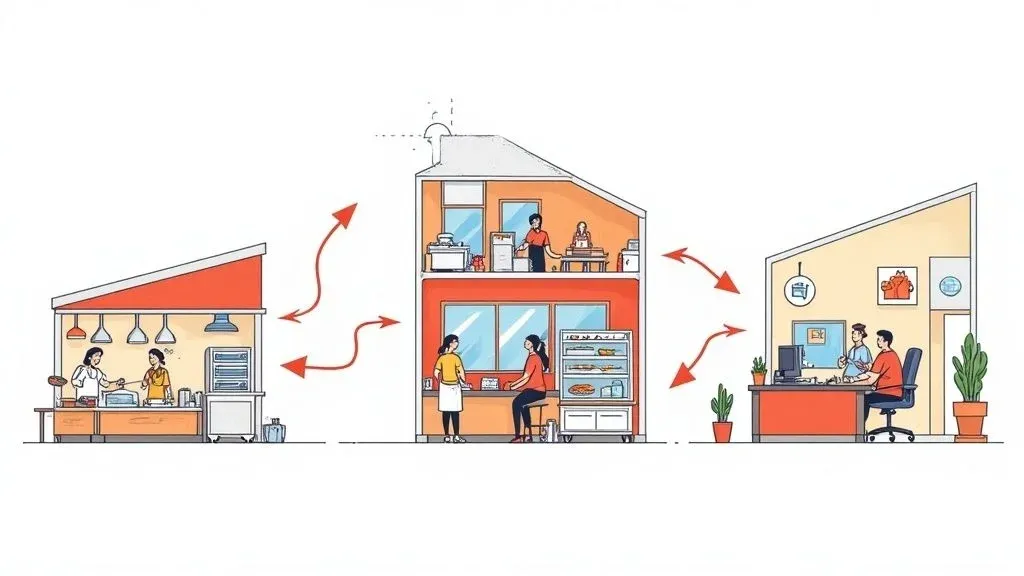
Think of restaurant operations management as the heartbeat of your business. In simple terms, it’s the master plan that connects every single action in your restaurant—from a supplier dropping off fresh produce to a customer taking their first happy bite. Getting this right is the secret to running a restaurant that doesn’t just survive in a tough market, but truly thrives by running efficiently.
What Is Restaurant Operations Management?
At its core, restaurant operations management is the craft of making all the different parts of your restaurant work together like a well-oiled machine. It isn’t about one specific task; it’s about creating smart, repeatable systems that deliver consistent quality, efficiency, and customer satisfaction every single day.
To really get a handle on it, it helps to break operations down into its three core components.
The Three Pillars of Restaurant Operations
These three areas—Back of House, Front of House, and Administration—are the foundation of any successful restaurant. They need to work in perfect sync for the whole operation to run smoothly. Here’s a quick look at what each one covers.
Operational Area Primary Focus Key Activities Back of House (BOH) The “engine room” where the food is made. Inventory tracking, food prep, cooking, quality control, order accuracy. Front of House (FOH) The customer-facing side of the business. Seating guests, taking orders, serving food, processing payments, managing ambiance. Administration The “brains” behind the business. Staff scheduling, payroll, accounting, marketing, supplier relationships, legal compliance.
When these three pillars are strong and interconnected, you create a business that can handle the daily rush while still planning for long-term growth.
The Real-World Impact on Your Business
Solid restaurant operations are more than just a way to keep things from going off the rails during a dinner rush. They’re your roadmap for building a lasting business in an incredibly tough industry. With over 15 million restaurants worldwide, the competition is fierce.
In fact, sloppy operations are a huge reason why only about 20% of new restaurants make it past five years. If you want to dive deeper into the numbers, these insightful restaurant industry statistics paint a very clear picture.
Think about it in practical terms. A sharp BOH inventory system cuts down on food waste, directly impacting your bottom line. Meanwhile, a well-trained FOH team that knows how to upsell can increase your average ticket size. Small operational wins add up to big financial gains. You can learn more by checking out our guide on mastering restaurant management with 15 expert tips for success.
Why Operations Matter for Restaurant Delivery and POS Integration
Today, your restaurant’s operations stretch far beyond its four walls. Juggling restaurant delivery orders from apps like DoorDash and Uber Eats has become a major operational headache for many. Without a good system, you have staff frantically punching orders from a tablet into the POS, which is a recipe for errors, delays, and frustrated customers.
This is where modern food tech and POS integration come into play. By linking your delivery apps directly to a POS system like Square, you can automate that entire chaotic process. An online order gets fired directly to your kitchen printers without anyone having to lift a finger.
Why it matters: This isn’t just a minor convenience. It frees up your staff, slashes order errors, and gives your delivery customers the same fast, reliable service your dine-in guests expect. This directly improves your efficiency and profitability.
Takeaway: Strong restaurant operations management turns complex, chaotic processes into a reliable, repeatable system that drives profitability and growth.
Ready to see how automation can transform your restaurant’s efficiency? Get started for free in just a few clicks.
Optimizing Your Back of House Restaurant Operations

The kitchen is the heart of your restaurant, no question about it. Think of your Back of House (BOH) less as a room where food is cooked and more as a high-performance engine. When that engine is humming, orders fly out accurately, quickly, and consistently. But if it starts to sputter, the entire guest experience grinds to a halt.
Effective restaurant operations management in the BOH all comes down to a concept called kitchen flow. Simply put, it’s about organizing your kitchen so that making a dish is like a perfectly choreographed assembly line. Each station has a distinct purpose, and the handoff between them is seamless. From the prep station to the grill, and finally to the expo window, each step is designed to eliminate wasted movement and time. A kitchen built on this foundation can handle the craziest dinner rush without breaking a sweat.
Establishing a Rock Solid Kitchen Flow
Building a great kitchen flow is about more than just arranging your equipment. It’s about putting systems in place that guarantee consistency, slash waste, and make communication second nature. One of the simplest yet most powerful strategies you can implement is a strict ‘First-In, First-Out’ (FIFO) system for all your inventory.
In simple terms, FIFO means you always use the oldest ingredients first. It sounds basic, but this single habit prevents spoilage and dramatically cuts down on food waste—a huge profit killer. This approach also ensures everything you serve is fresh, which directly impacts the quality of your dishes and, by extension, your guest satisfaction.
Beyond inventory, take a hard look at your physical layout. Are the most-used ingredients and tools within arm’s reach of their stations? Just cutting down the number of steps a chef takes to grab a pan or a specific spice can shave precious seconds off every single order. Over a full shift, those seconds add up to serious time savings.
The Role of Food Tech in BOH Efficiency
Bringing the right food tech into your BOH isn’t a luxury anymore; it’s a must-have to keep up. The Kitchen Display System (KDS) is a perfect example, swapping out old-school paper tickets for clean, digital screens.
A KDS wires directly into your POS, beaming orders to the kitchen the instant they’re punched in. This completely does away with lost tickets, hard-to-read handwriting, and verbal mix-ups between the front and back of house. The result? A massive drop in order errors, which means fewer comped meals and much happier customers.
Why it matters for delivery: The real magic happens when you connect your restaurant delivery apps like DoorDash and Uber Eats using a POS integration tool. Suddenly, an online order from Uber Eats pops up on the KDS just like a regular dine-in ticket. No more staff manually entering orders from a tablet, which saves a ton of time and prevents those costly input mistakes. To see how this all connects, you can dig deeper into how restaurant order management software pulls your entire workflow into one place.
Connecting BOH Operations to Profitability
Every single improvement you make in your BOH shows up on your bottom line. A well-oiled kitchen isn’t just about making your staff’s life easier—it’s a powerful profit center.
Think about these real-world benefits:
- Cost Savings: Using FIFO and cutting down on order mistakes directly reduces food costs and waste.
- Time Savings: A smarter workflow and tools like a KDS let your team push out more orders in less time.
- Increased Staff Productivity: With clear systems and less chaos, your crew can focus on what they do best: cooking incredible food.
Effective management of your back-of-house not only streamlines workflows but also significantly impacts your bottom line. Explore proven strategies for reducing operational costs to see how small changes can lead to major financial gains.
When you start treating your BOH as a critical piece of your business strategy, it transforms from a simple kitchen into an engine for profitability and guest loyalty. The upfront investment in organization and technology pays for itself over and over through fewer errors, lower costs, and a more efficient team.
Your Practical Next Step: Pick one BOH workflow this week—maybe it’s your inventory receiving process or how tickets are handled at the pass. Find just one bottleneck and make a small, actionable change to fix it.
Mastering The Front of House Experience
If your kitchen is the engine, then the Front of House (FOH) is the steering wheel, the interior, and the sound system—it’s everything your guests see, touch, and feel. This is where your brand’s promise of great food and a fantastic atmosphere is either delivered or broken. Great restaurant operations management for the FOH isn’t just about taking orders; it’s about crafting an experience that guests remember long after they’ve paid the bill.
Your FOH team is your single greatest asset in this mission. They’re not just servers; they’re brand ambassadors. A little training can go a long way in turning them into subtle, effective salespeople. Simply teaching staff to suggest a popular appetizer or a wine that pairs beautifully with a main course isn’t being pushy—it’s providing helpful guidance. This small touch elevates the guest’s meal and, not so coincidentally, boosts your average check size.
Likewise, when something goes wrong (and it will), empowering your team to handle complaints with grace can turn a disaster into a story of incredible customer service. That’s how you win a customer for life.
Optimizing FOH Efficiency and Customer Flow
One of the trickiest balancing acts in FOH management is maximizing table turnover without making your guests feel like they’re being rushed out the door. The real goal is a smooth, almost invisible, flow from the moment a guest sits down to the moment they happily pay. This is where smart processes and the right technology come together.
For example, a modern POS system, like those from providers such as Clover, can dramatically speed up payments with tableside devices. No more waiting around for the check. Another game-changer for managing customer flow is the self-service kiosk. As you can learn here, a self-ordering kiosk for restaurants takes the pressure off your staff by handling routine orders, freeing them up to focus on creating those higher-value, personal connections with guests.
Why it matters: These aren’t just minor tweaks; they have a huge impact on your bottom line by increasing efficiency. Faster payments mean quicker table turns, allowing you to serve more guests during peak hours.

This infographic lays it out pretty clearly. Strategic FOH improvements, from upselling to faster turnover, aren’t just about making people happier—they are powerful tools for growing your revenue.
Extending the Experience Beyond Your Walls with Restaurant Delivery
These days, your FOH doesn’t stop at your front door. It extends to every digital interaction a customer has with you, from reading your online reviews to the actual restaurant delivery they receive.
Think about it: a dedicated, organized pickup station for drivers from Uber Eats and DoorDash is no longer a nice-to-have. It’s an absolute necessity. A chaotic pickup scene creates a bottleneck, frustrates drivers, and is the fastest way to get cold food delivered to unhappy customers. A smooth handoff directly influences your delivery ratings and brings people back for more. This is a non-negotiable part of modern restaurant operations.
The Labor Challenge: Building a solid FOH team is tougher than ever. Labor issues are a constant headache, with U.S. restaurant employee turnover hitting an astonishing 61.7%. This means owners have to double down on training and retention just to maintain a consistent level of service. As detailed in this KPMG analysis on restaurant trends, holding onto skilled talent is a top priority for managers because it’s directly tied to success.
At the end of the day, a top-notch FOH experience—both in your dining room and online—is what drives repeat business and sparks the best kind of marketing there is: word-of-mouth. It turns satisfied customers into your biggest fans.
Practical Next Step: This week, set up a specific, clearly marked area just for delivery driver pickups. Make sure it’s organized and, importantly, out of the main flow of guest traffic. This one change will improve efficiency for both your team and the drivers.
The Power of POS Integration for Food Tech and Delivery

If you’ve ever found yourself drowning in a sea of delivery tablets during a dinner rush, you know the feeling. It’s pure chaos. Each tablet chimes with a new order, turning your front-of-house staff into frantic data-entry clerks.
This all-too-common scenario is often called “tablet hell.” It’s a clumsy, manual process where an employee has to accept an order on one screen, then turn around and punch every single item into your main Point of Sale (POS) system. This isn’t just inefficient; it’s a massive weak point in your restaurant operations management, creating bottlenecks and distracting your team from the guests standing right in front of them.
Bridging The Gap Between Online Orders and Your Kitchen
This is where POS integration comes in. In simple language, it builds a direct, automated bridge between delivery apps like DoorDash or Uber Eats and your restaurant’s central nervous system—the POS.
Instead of an order just sitting on a tablet waiting for a busy host to notice it, the integration grabs it and sends it straight into your POS. From there, it fires to the Kitchen Display System (KDS) just like any other order. This technology transforms a clunky, error-prone manual task into a smooth, hands-off workflow.
If you want to get into the technical nitty-gritty, our guide on point of sale integrations breaks down exactly how these systems talk to each other.
A Real-World Example: POS Integration in Action
Let’s look at what this means for a typical restaurant delivery order. Imagine a customer orders through DoorDash.
-
Without Integration: A customer orders a burger with no onions and extra pickles. The tablet dings. Your host, who’s also trying to seat a family of five, accepts the order. They then swivel to the POS, manually type in “Burger,” hunt for the “no onion” modifier, add the “extra pickles” note, and finally send it to the kitchen. That whole dance takes about 60-90 seconds and opens the door to at least three different ways the order could go wrong.
-
With Integration: The customer places the exact same order. The second they tap “confirm,” the order instantly appears in your POS system—whether it’s a Clover or a Square setup—and pops up on the kitchen screen with every modifier perfectly listed. No staff intervention needed. Zero.
Why it matters: This isn’t just a minor tweak. It’s a fundamental upgrade to your operational engine that saves significant time and virtually eliminates manual entry errors.
Key Insight: POS integration is more than a convenience. It’s a strategic tool that cuts labor costs by giving your staff their time back, slashes food waste from incorrect orders, and boosts the speed and accuracy of your entire delivery operation.
Manual vs Integrated Delivery Order Workflow
Seeing the two processes side-by-side really drives the point home. The table below illustrates the stark difference between juggling tablets and letting automation handle the load.
Process Step Manual Workflow (Without Integration) Integrated Workflow (With Automation) Order Reception Staff must constantly monitor multiple tablets for new orders. Orders are received automatically by the POS system. Order Entry An employee manually re-keys every item and modifier into the POS. The order is injected directly into the POS; no manual entry needed. Kitchen Ticket The ticket is printed only after manual entry is complete. The ticket is printed or displayed on the KDS instantly. Potential for Error High (missed orders, incorrect modifiers, typos). Extremely low (data is transferred digitally).
The takeaway is clear: automation removes the most time-consuming and error-prone steps from the equation entirely.
The Clear Benefits For Your Restaurant Operations
The impact of integrating your delivery platforms ripples through every part of your business. The results aren’t just theoretical; they show up on your bottom line and in your team’s morale.
- Drastic Error Reduction: When a computer handles the data transfer, typos and missed modifiers become a thing of the past. That means fewer comped meals, less food waste, and happier customers.
- Increased Staff Productivity: Your team is no longer tethered to tablets. They can now focus on what they do best: providing great service to dine-in customers and making sure every delivery bag is packed perfectly.
- Faster Order Fulfillment: Orders hit the kitchen the moment they’re placed online, not minutes later. Shaving seconds off every order adds up, leading to faster prep times, quicker deliveries, and better ratings on the apps.
- Centralized Financial Reporting: Suddenly, all your sales data—dine-in, takeout, and every third-party app—lives in one place. You get a true, accurate picture of your business without the headache of manually stitching together reports.
The single most effective change you can make to your restaurant operations is to take control of your delivery chaos. You can begin the process in just a few minutes and feel the immediate relief of a calmer, more efficient restaurant.
Ready to eliminate manual entry and reduce errors? Start onboarding for Free in a few clicks and see how POS integration can transform your delivery business.
Using Data to Make Smarter Decisions
In this business, your gut instinct gets you a long way, but gut feelings don’t pay the bills. Hard data does. The good news is, you don’t need a team of analysts to start making smarter decisions. The most valuable information you have is probably already sitting inside your Point of Sale (POS) system, just waiting to tell you a story.
In simple terms, think of your POS reports as a treasure map. They show you exactly where the profits are buried and which paths are dead ends. By taking a good look at this data, you can stop guessing what works and start knowing. That small shift is the key to unlocking some serious efficiency and profitability.
Turning Sales Reports into Actionable Insights
Your sales reports are so much more than a list of what you sold last Tuesday. They’re a direct line into your customers’ heads, telling you what they love and what they couldn’t care less about. The most immediate way to use this information is for menu engineering—the art of figuring out which dishes are winners and which ones are just taking up space.
To get started, just look for two simple categories in your POS data:
- Your Stars: These are the items that are both popular and highly profitable. Customers love them, and they make you great money. Your job is to sell more of these, period.
- Your Puzzles: These are the tricky ones. Maybe an item sells like crazy but has a terrible margin, or it has a fantastic margin but you only sell two a week. These dishes need a second look.
For example, digging into your Square reports might show your signature burger is a best-seller, but with high food costs, its margin is razor-thin. What if you found a slightly cheaper (but still delicious) bun or adjusted the patty size by half an ounce? Suddenly, your most popular item is also one of your most profitable. To really see how these small changes add up, it helps to run the numbers through a restaurant profit margin calculator.
Using Labor and Customer Data to Optimize Operations
Your POS data can also help you tackle your two biggest expenses: labor and inventory. When you analyze sales by the hour, you can see your exact peak and slow times with perfect clarity. This lets you build smarter schedules, so you have all hands on deck for the Friday dinner rush but aren’t paying people to stand around on a quiet Tuesday afternoon. It’s a direct path to cutting labor costs without ever sacrificing service.
This isn’t just a “nice-to-have” anymore; it’s essential. With restaurant traffic down 2.8% year-over-year, customers are being more careful with their money. The operators who are thriving are the ones using their data to adapt their menus, lean into digital ordering, and make smart pivots to stay ahead. You can see how other restaurants are using data to navigate these challenges in these key industry takeaways and trends.
Why It Matters: A POS integration for your restaurant delivery apps is a data goldmine. It pulls all your sales—whether from dine-in, Uber Eats, or DoorDash—into one clean report. This gives you a complete picture of your business, making it way easier to spot trends and make decisions that improve everything at once.
Your Practical Next Step: This week, pull a simple report of your top-selling and bottom-selling items. Look at the bottom five and ask one simple question for each: “Is this dish earning its spot on my menu?” That one small action can be the first step toward a much more profitable menu.
Your Next Step Toward Operational Excellence
Think of achieving operational excellence not as crossing a finish line, but as a constant cycle of tuning and improving. We’ve covered a lot, from making your Back of House a well-oiled machine to creating a Front of House experience that keeps guests coming back. We also saw how POS integration can be a game-changer, wiping out manual tasks and bringing all your data into one place.
But here’s the secret: real, lasting change doesn’t happen by trying to fix everything at once. The smartest path forward is to pick one thing—one high-impact change—and nail it. Progress begins with a single, deliberate step.
Focus on One High-Impact Change
It’s easy to get overwhelmed by the thought of a complete operational overhaul. So, don’t. Instead, find the one area that creates the most headaches and friction in your daily grind. For so many restaurants today, that bottleneck is the constant, chaotic flood of third-party delivery orders. It’s a mess of manual data entry, ripe for errors, and a huge distraction for your staff.
This is exactly where you can make a huge difference, fast. Automating your delivery orders is the most direct route to a quick win for both efficiency and accuracy. When you connect your delivery apps straight to your POS system, you’re not just solving one problem; you’re knocking down a whole row of dominoes.
Why it matters: This one change means your staff no longer has to manually punch in orders from a tablet. This immediately slashes the kind of costly mistakes that lead to wasted food and angry customers. It also gives your team their time back, letting them focus on the guests right in front of them while ensuring every online order is perfect.
Taking Control of Your Restaurant Delivery
Leading your team to be more productive means giving them tools that actually help, not just add another layer of complexity. The goal is to build systems that make their jobs easier. Look into simple tech that cuts down on manual work; for example, you can improve operational efficiency with QR codes to streamline ordering and payments.
At the end of the day, the best next step is one that saves time, eliminates errors, and gives you a much clearer picture of your business. Automating your delivery order flow does all three, creating a strong foundation for every other operational improvement you want to make down the road. It’s a practical, powerful move toward a smoother, more profitable restaurant.
Your Practical Next Step: Don’t let operational chaos run your day. Take back control of the most unpredictable part of your business by automating your delivery process. You can start onboarding for Free in a few clicks and see for yourself how much it lowers stress and boosts efficiency.
Frequently Asked Questions
Jumping into the world of restaurant operations management can feel like you’re trying to spin a dozen plates at once. Let’s break down some of the most common questions new and seasoned owners have, with practical answers you can use today.
What Should a New Owner Focus On First in Restaurant Operations?
If you’re a new owner, your absolute first priority should be getting a handle on your numbers. Specifically, you need to master your prime cost—that’s the combined total of your food costs and labor costs.
Sure, the food needs to be great and the service has to be on point. But at its core, a restaurant is a business, and businesses run on numbers. If you don’t know your prime cost inside and out from the very beginning, you’re flying blind when it comes to pricing your menu, scheduling staff, or ordering inventory. Nail down your cash flow and prime cost, and you’ll build a solid foundation you can actually grow on.
How Can I Improve Operations with a Small Budget?
You don’t need a huge budget to make a real difference. Some of the most effective improvements cost little to nothing.
Start with the basics: create simple, standardized checklists for everything—opening duties, closing procedures, and cleaning routines. This builds consistency and keeps everyone accountable. Then, invest your time in staff training. A team that knows exactly what to do is more efficient, makes fewer costly mistakes, and delivers better service.
Don’t forget to listen to the people on the floor. Your servers and cooks are a goldmine of brilliant, low-cost ideas for making things run smoother. Finally, get obsessive about tracking your inventory. Every bit of food you prevent from going to waste is money straight back into your pocket.
How Does Delivery POS Integration Actually Save Money?
Connecting your delivery apps like Uber Eats or DoorDash directly to your POS system isn’t just a fancy tech upgrade; it’s a powerful money-saving tool. It works in three key ways.
First, you slash labor costs. Think about all the time your staff spends manually punching online orders into the system, whether you’re using Clover or Square. Integration frees them up to focus on what matters most: the guests right in front of them.
Second, you eliminate expensive mistakes. Manual entry is a recipe for errors—wrong modifiers, missed items, you name it. Those mistakes lead to comped meals, wasted food, and frustrated customers. Automation means 100% accuracy from the app to your kitchen.
Finally, you get a clear, unified picture of your sales. When all your delivery and in-house revenue is in one dashboard, you can finally make truly smart decisions about your menu, promotions, and overall strategy to boost your bottom line.
Ready to see how much time and money you can save by eliminating manual order entry? At OrderOut, we connect your delivery apps directly to your POS for seamless operations. Start onboarding for Free in a few clicks.