
Restaurant Operating Procedures That Actually Work: A Guide
· Thibault Le Conte
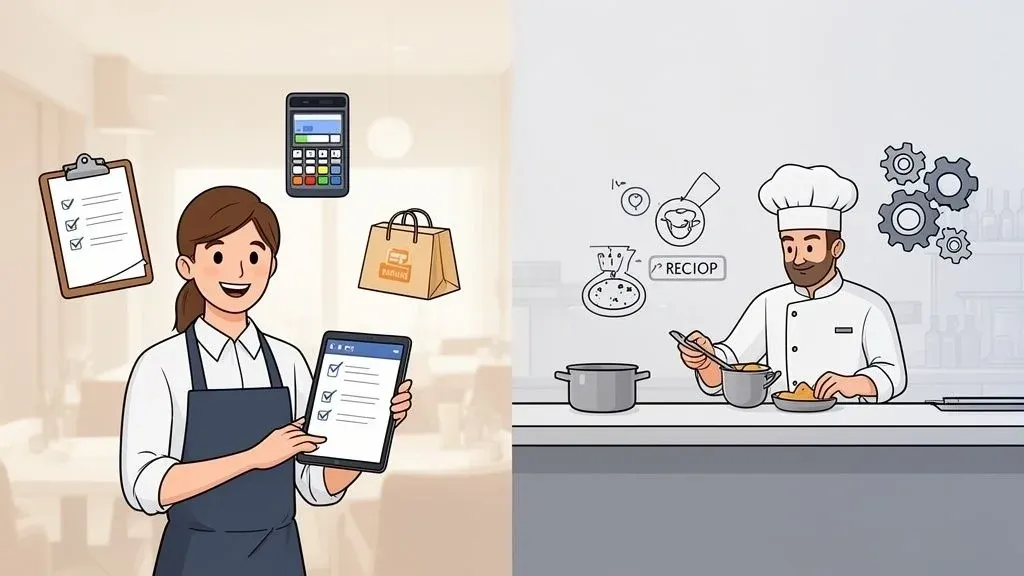
Think of restaurant operating procedures not as a set of rules, but as the DNA of your business. In simple terms, they’re the detailed, step-by-step instructions that guide every single task, from how a guest is greeted to the final kitchen lockdown. This is your playbook for creating a consistent, safe, and ultimately profitable restaurant, especially when dealing with the complexities of modern restaurant delivery and POS integration.
Building Your Foundation for Flawless Restaurant Operations
If you’ve ever felt like you’re just putting out one fire after another, you’re not alone. The secret to getting out of that cycle isn’t working harder—it’s working smarter with solid standard operating procedures (SOPs). They’re far more than just checklists; they are the blueprint for consistency and efficiency, forming the technical backbone that allows your business to grow.
The goal is to build a culture where clear procedures empower everyone. These aren’t just documents in a binder; they are daily tools that protect your profit margins and ensure every customer leaves happy. Why does this matter? Because consistent operations reduce costly errors, improve staff productivity, and create a reliable experience for both dine-in and delivery customers, directly impacting your bottom line.
Forget generic templates. The best SOPs are tailored to your restaurant’s unique brand. If you’re just starting, reviewing an ultimate checklist for opening a restaurant is a fantastic way to cover your bases.
The Core Pillars of Restaurant Procedures
When you boil it down, your operation rests on three pillars: your customers, their safety, and your profits. Each one depends on the others.
- The Customer Experience: This is what turns a first-time visitor into a regular. SOPs ensure every guest gets the same fantastic service and quality, whether they’re dining in or ordering from DoorDash.
- Safety and Compliance: Standardized procedures for food handling and employee conduct are non-negotiable. They’re essential for meeting health codes and creating a safe environment.
- Profitability and Efficiency: When your team has clear guidelines, you cut down on waste, minimize expensive mistakes, and boost productivity. This efficiency, especially in delivery and kitchen workflow, goes straight to your bottom line.
This flow is intuitive: a customer-first approach leads to safer practices, which in turn protects your profitability and fuels growth.
This drives home the point that a customer-centric mindset is the true starting point for building an operation that’s built to last.
Integrating Food Tech and POS Systems from Day One
In today’s world, technology must be part of your operational foundation. Integrating your systems—like connecting delivery apps such as Uber Eats directly to your Point of Sale (POS)—is a crucial, actionable step to prevent bottlenecks.
Why it matters: This integration streamlines your entire restaurant delivery process. Instead of staff manually typing orders from a tablet into the POS, the orders flow directly to the kitchen. This saves significant time, slashes order errors, and improves staff productivity.
Real-World Example: A restaurant using a Clover system can create an SOP where online orders from Uber Eats fire directly to the kitchen display. This single procedure eliminates manual entry, saves time, and cuts order errors by over 95%. Similarly, a cafe on the Square platform can set up a clear process for handling mobile order pickups, reducing wait times. You can learn more about the critical role of restaurants operations management in our detailed guide.
Key Takeaway: The strongest operational foundations align your team, brand, and technology. When your SOPs, staff training, and POS integrations work in harmony, you create an efficient system ready to scale.
Building this foundation is an ongoing commitment to excellence. It starts by defining clear expectations and giving your team the tools they need to meet them, shift after shift.
Nail Down Your Core SOPs for Front and Back of House
Alright, let’s get practical. It’s time to build the blueprint your team will use every day—your Standard Operating Procedures (SOPs). Think of these as the playbook that guarantees consistency. The best SOPs are simple, clear, and easy for anyone to follow.
For your front-of-house (FOH) crew, the focus is on every guest touchpoint. This covers everything from the first greeting to handling payments and managing the waitlist.
In the back of house (BOH), it’s all about precision, safety, and speed. Your BOH SOPs are the backbone of your kitchen, dictating recipe execution, plating standards, and critical sanitation routines.
Here’s a look at some of the most critical SOPs you’ll need.
Essential SOPs for Key Restaurant Areas
Area of Operation Key SOP Example Primary Goal Front of House Guest Greeting & Seating Protocol: A clear script for hosts, including how to quote wait times and manage the floor plan to avoid overwhelming servers. Create a welcoming first impression and ensure a smooth, balanced flow of service. Front of House Order Taking & POS Entry: A standardized method for taking orders, upselling specials, and inputting modifications and allergies into the POS system. Minimize kitchen errors, increase check averages, and improve communication. Back of House Recipe & Plating Guide: A visual “bible” for every menu item with exact portion sizes, cooking steps, and a photo of the final plate. Guarantee every dish meets brand quality and presentation standards, reducing food cost. Back of House Food Safety & Sanitation Checklist: Daily and weekly cleaning schedules, temperature logs, and clear instructions for handling raw ingredients. Prevent foodborne illness, maintain health code compliance, and ensure a safe working environment.
These examples are just the starting point. The goal is to build a comprehensive library of procedures that covers every critical task.
Building Your Front of House Playbook
Your FOH procedures create a frictionless guest experience. Each step should be designed to make customers feel looked after.
- Guest Greeting and Seating: Document how to greet guests, manage wait times accurately, and use the seating chart to distribute tables evenly.
- Order Taking and POS Entry: Standardize how your team takes orders, including prompts for upselling and a non-negotiable process for entering allergies into the POS. This keeps the kitchen running smoothly.
- Payment Processing: Create clear steps for handling all payment types. Include how to split checks, manage tabs, and close out reports.
- Complaint Resolution: Give your staff a framework to solve problems on the spot. Turning a bad experience around can create a customer for life.
Mastering Back of House Efficiency
The reputation of your restaurant is built on kitchen consistency. Your BOH SOPs make that happen. Food safety must be front and center, with rock-solid ways to prevent cross contamination built into every workflow.
Your essential BOH SOPs should include:
- Recipe Adherence: Create detailed, visual guides for every dish. Specify every ingredient and portion size to control food cost and ensure consistency.
- Plating and Presentation: Use photos to show exactly how each dish should look.
- Sanitation Protocols: Develop daily, weekly, and monthly cleaning checklists for all equipment and surfaces.
- Inventory Management: Create a system for receiving deliveries, storing products correctly (FIFO!), and tracking usage to cut down on waste.
By creating these connected playbooks for FOH and BOH, you build one cohesive operation where everyone knows their part.
Weaving Food Tech into Your Daily Restaurant Operations
Let’s be honest, traditional restaurant operating procedures often end up in a dusty binder. In a busy service, static documents can’t keep up. To truly boost efficiency, your procedures need to live inside the technology your team uses every day. Your Point of Sale (POS) system should be the central nervous system of your entire operation.
Modern food tech is built to handle the repetitive, error-prone tasks that bog down your staff. When you integrate these systems correctly, they take care of the tedious work. Why does this matter? It frees up your team to focus on creating incredible food and giving guests a memorable experience. This shift makes your restaurant run smoother, lowers staff stress, and dials in the accuracy of every single order, directly improving your restaurant efficiency.
Nail Your Restaurant Delivery with POS Integration
One of the biggest operational headaches is the constant stream of online orders. Without the right tech, your host is stuck manually punching orders from a tablet into your POS—a recipe for disaster. One typo can lead to the wrong food, a frustrated customer, and a scathing online review. This is where POS integration completely changes the game.
By directly connecting platforms like DoorDash and Uber Eats to your POS, you create a seamless, hands-off flow of information. This is a highly actionable insight you can implement quickly.
Real-World Example: Take a restaurant using a Clover system. With a good integration, an Uber Eats order automatically prints a ticket to the kitchen, fires the order to the Kitchen Display System (KDS), and adjusts your inventory. This level of technical automation means zero manual entry. The impact is immediate: staff productivity shoots up, and you can slash order errors by over 95%. Your SOP for handling online orders becomes incredibly simple, focusing on quality control instead of data entry.
You can learn more about crafting an effective online order management system in our dedicated guide.
Build a Flawless Pickup Procedure with Food Tech
The same logic applies to creating a better pickup experience. Long, confusing waits kill repeat business. Technology gives you the tools to build a smooth, efficient pickup workflow.
Real-World Example: Picture a busy coffee shop using the Square for Restaurants POS. They can build an SOP for mobile orders that uses the system’s features to create a fantastic experience:
- Instant Confirmation: An automated text confirms the order and provides an accurate pickup time.
- Smart Staging: The order pops up on the barista’s screen, who then places the finished drink in a dedicated, clearly marked staging area.
- Pickup Notification: The barista taps “complete” in the POS, triggering another automated text: “Your order is ready for pickup!”
This tech-driven procedure eliminates the “is my order ready yet?” bottleneck. It improves efficiency and provides a polished experience that keeps people coming back.
Why It Matters: Integrating your restaurant’s delivery and pickup channels with your POS is the single most impactful step you can take to improve off-premise efficiency. It saves dozens of labor hours each week, drastically cuts down on costly order mistakes, and creates a more reliable experience for your customers.
The Takeaway: Your restaurant’s operating procedures are only as good as the tools you use to implement them. By weaving POS integration into your daily workflow, you automate the mundane, empower your team, and build a more resilient, profitable business.
Ready to automate your delivery orders and streamline your operations? You can start onboarding for free in just a few clicks at OrderOut.
Training Your Team for Unbreakable Consistency
Even the most perfectly written restaurant operating procedures are just ink on paper if your team doesn’t execute them flawlessly. Your SOPs come to life through your people. This is where training becomes the engine of your restaurant, driving the consistency that builds customer loyalty.
Forget one-and-done orientations. A culture of continuous training is what separates good restaurants from great ones. The goal isn’t just to teach rules; it’s to instill an understanding of the “why” behind each procedure. When your team knows why a task is done a certain way, they develop a sense of ownership.
From Theory to Practice: Interactive Training Methods
Effective training needs to be hands-on, interactive, and grounded in real-world challenges.
- Role-Playing Scenarios: For FOH staff, run quick drills during pre-shift meetings where servers practice handling a guest complaint or a host manages a long waitlist. This builds muscle memory.
- Hands-On Kitchen Demos: Rolling out a new menu item? Gather your BOH team for a live demonstration. Let them taste it, feel the ingredients, and assemble the dish themselves.
- Digital Learning Tools: Create short, digestible training videos. A two-minute video on a tablet showing how to clean the espresso machine is far more effective than a dense page of text.
These active learning methods make training engaging and ensure the information sticks, which means fewer errors and higher staff productivity during a chaotic dinner service.
Empowering Managers as Consistent Coaches
Your managers are the glue that makes your training culture stick. Their role is to be consistent coaches, not just rule enforcers. This means leading by example and providing constructive feedback on the fly. A manager who calmly corrects a server on the proper way to enter an allergy modification in the POS reinforces that SOP’s importance without creating a culture of fear. For a deeper dive, check out our guide on essential manager duties in a restaurant.
Real-World Example: Let’s say you’re introducing a new POS integration for restaurant delivery with DoorDash. A great manager holds a brief training session using a Square terminal. They walk the team through the new, automated workflow: how an order pops up on the KDS, how to mark it as ready, and the new handoff procedure. This hands-on approach demystifies the new food tech and stops the team from feeling overwhelmed, ensuring a smooth transition that cuts down on errors from day one.
The Takeaway: Train for Understanding, Not Just Obedience
Ultimately, your training on restaurant operating procedures should focus on creating a team of problem-solvers. When every employee knows how their role contributes to efficiency, profitability, and the guest experience, they execute their tasks with precision and purpose. This commitment to practical training turns your SOPs into an unbreakable system for consistency.
Ready to streamline your delivery operations and make training even simpler? You can start integrating your delivery apps for free in just a few clicks at https://dashboard.orderout.co.
How to Measure and Continuously Improve Your SOPs
Great restaurant operating procedures aren’t created once and filed away. The best SOPs are living documents, constantly evolving based on what’s actually happening. In simple terms, you need a system to monitor, measure, and fine-tune your procedures. This is how you turn a rulebook into a powerful engine for continuous improvement.
Think of it like a feedback loop. Your SOPs guide your team’s actions, those actions produce measurable results, and you use those results to make the SOPs even sharper. Why does this matter? This cycle is what keeps your restaurant efficient, reduces costs, and consistently delivers an excellent customer experience.
Identifying Key Performance Indicators That Matter
You can’t improve what you don’t measure. The first step is to lock down the Key Performance Indicators (KPIs) that give you a clear picture of your restaurant’s health. Focus on metrics that tie directly to efficiency, profitability, and customer experience.
Here are a few essential KPIs directly shaped by your SOPs:
- Order Accuracy Rate: This is huge, especially for restaurant delivery. A low accuracy rate points to a breakdown in your order-taking, kitchen communication, or final check procedures.
- Average Ticket Time (Delivery): How long does it take from the moment an order hits your system to when it’s handed to the driver? Lagging times signal bottlenecks in your kitchen workflow.
- Food Cost Percentage: This classic metric reflects your BOH SOPs. If food costs are creeping up, it could be a symptom of poor inventory management or inconsistent portioning.
- Table Turn Time: For dine-in service, this KPI tracks the efficiency of your hosts, servers, and bussers. A slow turn time might mean your table-clearing or payment-processing SOPs need a tune-up.
Conducting Regular SOP Audits
Once you know what to measure, you need a process for how to measure it. Regular audits are practical checks to see if your procedures are being followed and if they’re still working. An audit can be as simple as a manager observing the dinner rush to spot workflow logjams.
Why It Matters: Audits provide the raw data for improvement. Diving into your DoorDash order data and finding that a specific side dish is missing 20% of the time reveals a clear gap in your final check SOP. Without that audit, the problem would just continue, costing you money and frustrating customers.
Using POS Integration for Data-Driven Decisions
Your POS integration is one of the most powerful tools you have for measuring your SOPs. Modern systems are treasure troves of actionable data that can highlight operational weaknesses with incredible precision.
Real-World Example: A restaurant using a Square POS system can run a report on item voids. A high number of voids on a particular menu item might mean the recipe SOP is too complicated, leading to frequent kitchen errors. Suddenly, you have a specific, data-backed problem to solve. Similarly, a manager at a cafe with a Clover system can analyze ticket times for mobile pickup orders. If they notice a delay between 8 AM and 9 AM daily, it’s a clear signal to adjust the morning prep SOP or add staff.
This kind of food tech removes the guesswork. You can use hard data from your own operations to pinpoint where your procedures need to be stronger. For a deeper dive into one of the most crucial metrics, check out our guide on how to calculate your food cost percentage.
The Feedback Loop in Action
Let’s pull this all together. Imagine you identify that order accuracy is slipping.
- Measure: You see your KPI (Order Accuracy) is down by 5%.
- Audit: You watch the packing station and discover most mistakes involve missing condiments and drinks.
- Analyze: You realize your SOP lacks a specific final-check step for “cold” items.
- Improve: You update the SOP to include a mandatory final check by a different team member for drinks and condiments.
- Train: You walk the team through the new, two-step verification process.
- Repeat: Next month, you monitor the Order Accuracy KPI to confirm your change worked.
Your Practical Next Step
Don’t try to fix everything at once. Pick one KPI that is a major pain point—like delivery ticket times. For one week, track it closely and observe the procedures tied to it. Use that focused data to make one small, measurable change to your SOP. This creates momentum and proves that small, data-driven adjustments can lead to significant gains in your restaurant operations.
Your Next Step to a Smoother Operation
We’ve walked through building powerful operating procedures for your restaurant—from the initial idea to integrating tech and training your team. The main takeaway is that SOPs are not just a binder on a shelf. They are the living system that fuels consistency, boosts your bottom line, and keeps your customers happy.
You now have a solid blueprint to cut down on errors, empower your staff, and build a restaurant that can grow without falling apart.
If you’re wondering where to start, the single most impactful first step is almost always the same: get your delivery apps talking directly to your POS system. Automating your off-premise orders is a game-changer that immediately improves restaurant efficiency and reduces staff stress.
Ready to take that step? Get started for Free in just a few clicks at https://dashboard.orderout.co.
Frequently Asked Questions
When you roll out new operating procedures, questions will pop up. That’s a good thing. Getting answers sorted out early is the best way to make sure your new systems stick.
How Often Should I Update My SOPs?
Think of your restaurant operating procedures as living documents. You should review them at least once a year, but you’ll likely need to update them more often. Any time a major change happens, it’s time for a refresh, such as:
- Rolling out new menu items.
- Bringing in new food tech, like a POS upgrade or a delivery integration.
- Adjusting to new health and safety codes.
- Getting consistent feedback that a certain process is inefficient.
The secret is building a culture where your team feels comfortable suggesting improvements.
How Do I Get Staff to Actually Follow the New Procedures?
Getting team buy-in is everything. The trick is to get them involved from the start. When your staff helps write the procedures, they take ownership of them.
Training is also non-negotiable. Don’t just tell them; show them. Real-World Example: If you’re integrating restaurant delivery with your Clover system, run a hands-on training where everyone sees how orders now fire directly to the kitchen display. When they experience firsthand how it saves them time (improved staff productivity) and prevents mistakes (error reduction), they’ll see the value immediately.
What’s the Best Format for Restaurant SOPs?
There’s no one-size-fits-all answer. The best format depends on what you’re explaining. For most restaurant operations, a mix of styles works best:
- Simple Checklists: Perfect for routine tasks like opening and closing duties.
- Hierarchical Lists: Great for breaking down bigger jobs into smaller steps.
- Flowcharts: Useful for processes with “if-then” scenarios, like handling a customer complaint.
For anything in the kitchen, photos are a must. A picture showing exactly how a finished dish should be plated is worth a thousand words. The goal is always clarity—anyone should be able to grasp the standard in seconds.
OrderOut is designed to automate one of your most chaotic procedures: juggling online orders. It hooks delivery apps like Uber Eats and DoorDash right into your POS system, which means no more manual order entry and way faster service.
Ready to make your restaurant run smoother? Get started for Free in just a few clicks.