
12 Actionable Restaurant Marketing Ideas to Boost Efficiency and Delivery Operations
· Thibault Le Conte
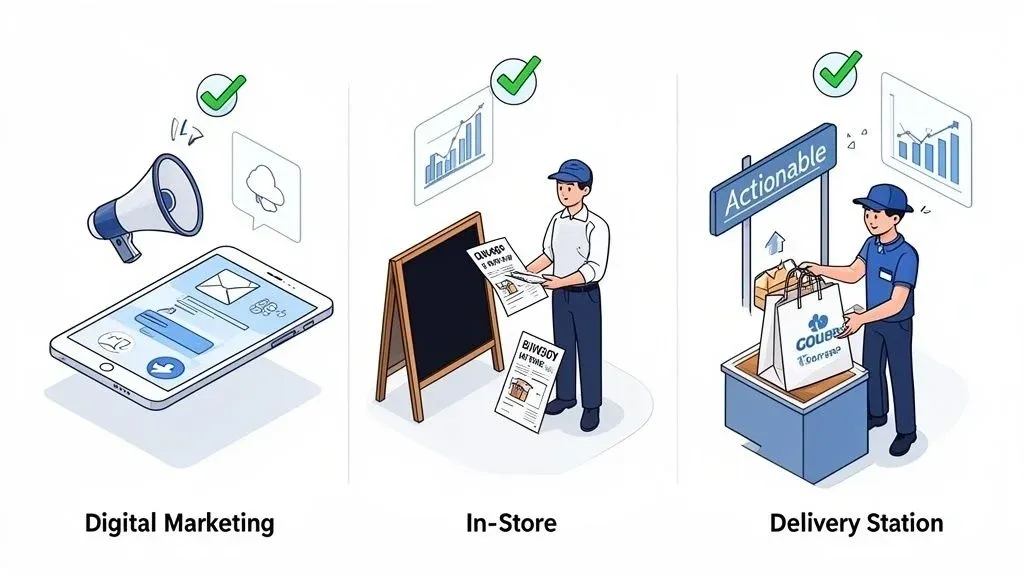
In the fast-paced restaurant world, marketing can feel like shouting into the void. You’re juggling staff, inventory, and a dozen delivery tablets, making it hard to focus on growth. What if your marketing efforts could also make your restaurant run smoother, faster, and more profitably? This isn’t just about getting more customers through the door; it’s about building a smarter, more efficient business from the inside out. Forget generic advice that ignores the operational chaos of a busy service.
This guide moves beyond basic promotions to deliver powerful restaurant marketing ideas designed for the modern operator. Each strategy is tied directly to improving your restaurant’s core functions, from streamlining delivery management with platforms like DoorDash and Uber Eats to optimizing your POS integration with systems like Clover or Square. We will show you how to turn everyday operational tasks into potent marketing opportunities.
We’ll break down how to implement each idea, its estimated cost and time commitment, and how it directly impacts your bottom line. You will learn how these concepts save precious time, cut costly order errors, and boost staff productivity, turning your marketing from a necessary expense into a genuine profit center. Let’s get started.
1. Launch a ‘Unified Delivery Experience’ Campaign
Excellent marketing starts with excellent operations. This restaurant marketing idea involves promoting your operational reliability as a key customer benefit.
In simple terms: Tell customers your delivery is faster and more accurate because you’ve upgraded your tech. Instead of staff juggling multiple tablets from Uber Eats and DoorDash, all orders go into one system, reducing mistakes and delays.
How it works: This is achieved through POS integration, where services like OrderOut connect delivery platforms directly to your restaurant’s main sales system. When a customer orders on DoorDash, for example, the order is automatically transmitted and printed in your kitchen without any manual data entry from your staff. This eliminates the “tablet chaos” that leads to errors.
Why It’s a Powerful Restaurant Operations Tool
This strategy directly addresses common customer frustrations with delivery: incorrect orders and long wait times.
Why it matters: By eliminating the manual re-entry of orders, you increase accuracy and speed up fulfillment. You can then market this efficiency as a promise of a better customer experience, which builds trust and sets you apart from competitors. A busy pizzeria, for instance, could run a social media campaign with the message: “Order from anywhere, get it right, get it fast. Our new system ensures your pizza is perfect every time.” This directly boosts staff productivity and reduces costly errors, improving your bottom line.
Promoting your operational efficiency isn’t just for investors; it’s a powerful marketing message for customers who value reliability and speed.
To truly turn this marketing into a profit center, you must understand your operational costs. A helpful tool for analyzing menu profitability is a food cost calculator, which helps you see how efficiency gains impact your bottom line.
Actionable Steps:
- Integrate Your Stack: Connect your delivery apps to your POS using a third-party integration service like OrderOut.
- Craft a Simple Message: Develop messaging like “Flawless Delivery, Every Time” or “We’ve Upgraded Our Tech for Faster, More Accurate Orders.”
- Promote Everywhere: Add this message to your website’s homepage, social media bios, and even as a sticker on your delivery bags. Learn more about creating an effective online order management system.
2. Data-Driven Menu Optimization Marketing
This restaurant marketing idea turns your sales data into a powerful promotional tool.
In simple terms: Use your sales data from platforms like Uber Eats and DoorDash to figure out what your most popular and profitable dishes are. Then, promote those winners and remove the items that don’t sell.
How it works: This process is made simple with consolidated order data from services that connect directly to your POS. Instead of guessing, you get a clear picture of performance across all delivery platforms. For example, an Asian fusion restaurant might discover through its integrated Square POS data that its Pad Thai is a top seller on Uber Eats while the Banh Mi sandwich leads on DoorDash. This insight allows them to run platform-specific promotions, driving more sales.
Why This Food Tech Strategy Matters
A data-driven menu is a menu designed to sell, leading to higher customer satisfaction and better sales.
Why it matters: By focusing on high-margin, popular dishes, you improve your bottom line directly. Some restaurants have seen margin increases of 15-20% simply by trimming their menu based on this kind of analysis. This efficiency means you can run your kitchen with less waste and market popular dishes with confidence: “Come try the neighborhood’s favorite pizza!” This direct POS integration gives you the data you need without manual spreadsheets, saving significant time.
Your sales data is a direct line to your customers’ preferences. Using it to shape your menu is one of the most effective restaurant marketing ideas available.
This approach lets you create a more profitable and appealing menu. You can strategically feature items that are not just popular but also cost-effective to produce. To explore how to get this level of insight, you can learn more about making sense of your restaurant menu data.
Actionable Steps:
- Consolidate Your Data: Use a tool that gathers all order data from every platform into one dashboard for easy analysis.
- Identify Winners and Losers: Analyze sales reports to find your most popular and profitable items, as well as those that aren’t selling.
- Optimize and Promote: Update your menu to feature top-performing items more prominently. Create marketing campaigns around your “customer favorites” or “best-sellers.”
3. Highlight Operational Efficiency & Labor Cost Reduction
Marketing isn’t just about ads and promotions; it’s also about building a strong, profitable business. This restaurant marketing idea focuses on promoting the internal benefits of automation.
In simple terms: Show how using technology to automate tasks, like entering delivery orders, saves you money on labor. This frees up staff to do more important work, making your restaurant more efficient.
How it works: This is accomplished by using POS integration services that funnel all digital orders from apps like Uber Eats and DoorDash directly into your main system, like a Square or Clover POS. Instead of an employee manually typing orders from multiple tablets into the POS, the process becomes entirely automated.
Why It’s a Powerful Marketing Tool for Restaurant Operations
This strategy directly addresses a primary pain point for any restaurant owner: high labor costs.
Why it matters: By automating manual order entry, you can save hundreds of hours of staff time per year. This translates directly into thousands of dollars in labor cost savings, which you can reinvest in your business. For example, a multi-location QSR chain could demonstrate savings of over $10,000 per month by eliminating the need for a dedicated order-entry staff member at each site. This improved staff productivity and reduced cost is a powerful message for investors, potential franchisees, and your own bottom line.
Focusing on operational efficiency isn’t just about saving money; it’s about building a more resilient and profitable restaurant that can weather economic shifts and labor market volatility.
Showcasing these gains helps justify technology investments and builds a case for further modernization. Understanding the benefits of automation in restaurants is the first step toward building a more efficient operation.
Actionable Steps:
- Quantify Labor Savings: Calculate the hours your staff spends manually entering delivery orders and translate that into a monthly labor cost.
- Present a Clear ROI: Use your labor savings calculation to show how quickly an integration tool pays for itself. Frame it as “This system saves us X hours per week, which equals $Y in monthly profit.”
- Promote Staff Satisfaction: Market the change internally by emphasizing that automation removes tedious tasks, allowing staff to focus on more engaging work like customer service, which can reduce employee turnover.
4. Leverage POS System Partnership & Integration Marketing
This strategy involves collaborating directly with Point-of-Sale (POS) system providers to promote your restaurant’s operational excellence.
In simple terms: Partner with your POS company (like Square or Clover) to get featured as a success story. You show them how your smart use of technology makes their system look good, and they promote your restaurant to their huge audience.
How it works: You can showcase how your integration with a POS system, facilitated by services like OrderOut, connects third-party delivery apps directly to their hardware. For example, Clover could feature your restaurant in its app marketplace, highlighting how OrderOut connects DoorDash orders directly to their terminal. This creates a powerful endorsement, positioning your business as tech-savvy and reliable.
Why This Food Tech Partnership is a Powerful Marketing Tool
This approach turns your operational setup into a B2B marketing asset, giving you credibility and exposure you couldn’t buy.
Why it matters: Becoming a success story for a major POS provider tells potential partners, franchisees, and even savvy customers that your restaurant is built on a solid, scalable foundation. Imagine a joint webinar with Square showcasing how your cafe eliminated order errors, reaching thousands of other restaurant owners. This builds your brand authority and drives growth without a massive ad spend, all by leveraging the efficiency of your POS integration.
Partnering with your POS provider for marketing is a signal of operational maturity. It tells the market that your restaurant runs so smoothly, it’s a case study for others.
Actionable Steps:
- Identify Key Partners: Determine which POS systems are dominant in your market (like Square or Clover) and which ones you currently use.
- Document Your Success: Track metrics on how integration has improved your accuracy, speed, and sales. Collect data on reduced order errors and faster ticket times.
- Create a Pitch: Reach out to the marketing or partnership teams at your POS provider with a simple proposal: feature your restaurant as a success story in exchange for co-promotion.
5. Specialize Your Marketing for Vertical Markets
Effective restaurant marketing speaks directly to a specific audience’s problems. This idea involves tailoring your message to distinct restaurant categories.
In simple terms: Instead of a one-size-fits-all message, target specific types of restaurants like ghost kitchens, pizzerias, or fine dining spots. Speak directly to their unique delivery and operational challenges.
How it works: A what a ghost kitchen is is a prime example. They might operate over ten virtual brands from a single location, creating a logistical nightmare with delivery tablets. Your marketing can focus on how a unified order management system solves this exact problem. A fine dining restaurant, conversely, worries about brand image, so your message would be about ensuring order accuracy and quality control through better food tech.
Why This Restaurant Delivery Strategy is a Powerful Tool
This strategy positions your restaurant (or service) as an expert solution provider, not just another option.
Why it matters: It builds credibility by showing you understand the specific operational pains of different restaurant models. For a QSR franchisee, standardizing delivery operations across all stores is critical for efficiency and brand consistency. Marketing that highlights solutions for franchise-wide reporting and POS integration will be far more compelling. For example, detailing how a ghost kitchen consolidated its Uber Eats and DoorDash orders into a single tablet using a tool like OrderOut provides tangible proof of value and cost savings.
Specializing your marketing shows you’re not just selling a product; you’re providing a targeted solution to a known industry problem. This expertise is a powerful differentiator.
Actionable Steps:
- Identify Key Verticals: Choose 2-3 restaurant types (e.g., pizzerias, ethnic chains, ghost kitchens) that align with your strengths.
- Develop-Specific Messaging: Create landing pages and ad campaigns with headlines like, “The Ultimate Delivery Solution for Multi-Brand Ghost Kitchens” or “Maintain Fine Dining Quality with Flawless Delivery.”
- Create Case Studies: Document how you solved a specific problem for a client in that vertical, including metrics on error reduction or speed improvement.
- Partner with Associations: Connect with industry groups relevant to your target vertical to expand your reach and build authority.
6. Thought Leadership & Educational Content Marketing
This restaurant marketing idea shifts the focus from directly selling your food to establishing your brand as an industry authority.
In simple terms: Become the go-to expert for topics like restaurant operations, delivery trends, and food tech. Share your knowledge through articles, webinars, or reports to build trust with customers and peers.
How it works: A restaurant group could host a webinar on “The Future of Off-Premise Dining,” sharing its own data and success stories with delivery integration. This positions the brand’s leadership as experts, attracting attention from both diners who appreciate a well-run establishment and other industry professionals. You could explain how your POS integration with partners like Square or Clover improves order accuracy.
Why It’s a Powerful Marketing Tool
Positioning yourself as an expert builds a strong brand that isn’t reliant on discounts. It creates a loyal following that trusts your judgment.
Why it matters: This strategy makes your restaurant more efficient by forcing you to document and perfect your own processes so you can teach them. It attracts high-value customers and can lead to free media opportunities. For instance, explaining how your POS integration with platforms like Uber Eats improves order accuracy is a powerful piece of educational content that doubles as a customer benefit, highlighting your operational excellence and reducing customer service issues.
Becoming an educational resource transforms your marketing from a sales pitch into a genuine conversation, building a community around your brand’s expertise.
Actionable Steps:
- Identify Your Niche: Determine what you can teach others. Are you an expert in ghost kitchen operations, menu engineering, or staff training?
- Choose Your Format: Start with a blog, podcast, or a quarterly webinar. For example, host a “Delivery Operations Masterclass” featuring a case study.
- Share Your Knowledge: Publish data-backed insights, create downloadable checklists for other operators, and repurpose long-form content into social media posts and videos.
7. Customer Success Stories & Case Study Marketing
Social proof is a powerful motivator. This marketing idea centers on showcasing it through detailed customer success stories.
In simple terms: Create and promote case studies from real restaurant partners that show how they grew their business or improved operations using your methods or technology.
How it works: A ghost kitchen operator could publish a story showing how they reduced order processing time by 65% after implementing a POS integration. Or, a regional pizza chain could highlight a 40% revenue increase from optimizing its delivery channels with consolidated data. These aren’t just claims; they are documented results from peers, making them incredibly persuasive.
Why It’s a Powerful Marketing Tool
This strategy offers tangible proof of value. It answers the crucial question, “Will this work for my restaurant?” by showing it has already worked for others.
Why it matters: When a restaurant owner sees that a similar business reduced order errors from 8% to just 0.5% or cut labor costs by thousands per month, the benefit becomes concrete. This directly showcases the efficiency, error reduction, and cost savings your restaurant operations can achieve. For instance, by integrating DoorDash orders directly into a Clover POS, a restaurant can easily track the reduction in manual errors and share that data, proving the ROI.
Numbers tell a story that marketing slogans can’t. Showcasing real data from happy customers is one of the most authentic restaurant marketing ideas you can implement.
Actionable Steps:
- Identify Top Customers: Reach out to restaurants that have seen significant improvements and ask if they’re willing to be featured.
- Quantify the Impact: Work with them to gather specific metrics: time saved, percentage of error reduction, or dollar amounts of revenue growth.
- Create Compelling Content: Develop short-form (one-page) and long-form (detailed) case studies. Use video testimonials for even greater impact and promote them on your website and in sales presentations.
8. Run a “Try Before You Buy” Campaign with Free Trials
This restaurant marketing idea lets your technology’s value speak for itself by offering a free trial or freemium plan.
In simple terms: Let restaurant owners test your service for free. This removes the financial risk and allows them to see the benefits firsthand, like how delivery integration solves their “tablet hell.”
How it works: A restaurant struggling with tablet overload can use a free trial of an integration service to connect their DoorDash and Uber Eats orders directly to their POS. A real-world example is OrderOut, which offers a free plan allowing restaurants to experience automated order flow firsthand. Within days, they see how order errors drop and ticket times improve without paying a cent upfront.
Why It’s a Powerful Marketing Tool
A free trial builds immediate trust and demonstrates tangible value, turning a skeptical prospect into an educated buyer.
Why it matters: It shifts the conversation from “What if it doesn’t work?” to “How did we operate without this?” By offering a taste of improved efficiency and staff productivity, you create a strong incentive for them to upgrade. This model is all about proving your impact on restaurant operations—reduced errors, saved time, and happier staff—making the paid subscription a logical next step for maintaining that efficiency. Before you can effectively use customer data for hyper-targeted campaigns, it’s essential to understand how to effectively build an email list to nurture these trial users.
A well-executed free trial is your best sales pitch. It proves your product’s worth by solving a real problem, making the upgrade decision a logical next step.
Actionable Steps:
- Define Your Offer: Create a time-limited free trial (e.g., 14 or 30 days) or a permanent “freemium” tier with core features.
- Automate Onboarding: Develop an automated email sequence that guides new trial users, highlighting key features and benefits they can explore.
- Showcase Value: Design a trial dashboard that visualizes key metrics like “orders processed” or “time saved” to reinforce the product’s impact on their restaurant.
9. Direct Sales & Relationship Marketing to Restaurant Chains
This approach shifts from broad marketing to a high-touch, direct selling focus on large-scale accounts like regional restaurant chains.
In simple terms: Instead of marketing to one restaurant at a time, build relationships with decision-makers at large chains or franchise groups to sell them a solution for all their locations at once.
How it works: This strategy involves creating customized proposals for major accounts. The sales process is consultative, focusing on solving complex operational challenges related to delivery order management, menu synchronization, and reporting across an entire enterprise. For example, pitching a unified integration for a franchisee who manages 30 Uber Eats storefronts across 10 locations.
Why It’s a Powerful Marketing Tool
This strategy unlocks substantial, recurring revenue by securing large contracts. It addresses a critical pain point for chains: a lack of standardized, efficient systems for handling restaurant delivery.
Why it matters: For multi-location operators, operational consistency is key to profitability. By providing a unified solution that integrates with their POS, you offer a clear path to reduced labor costs, fewer order errors, and a consistent brand experience. This improves efficiency across the board, from the kitchen to the corporate office, making it a high-value proposition that directly impacts their bottom line.
For multi-location operators, operational consistency isn’t just a goal; it’s the foundation of their brand and profitability. Solving their delivery chaos is a high-value proposition.
This focused sales effort positions you as a strategic expert. A well-crafted pitch to a ghost kitchen operator managing 50+ virtual brands could demonstrate how your integration reduces tablet clutter and streamlines kitchen workflow, directly impacting their bottom line.
Actionable Steps:
- Identify Target Verticals: Focus on high-volume segments like pizza chains, large franchisee groups, or ghost kitchens.
- Develop Executive Materials: Create ROI calculators and briefing documents that speak to C-level concerns like profitability and operational scale.
- Offer a Pilot Program: Propose a trial integration at one or two locations to prove the system’s value and reliability with minimal risk before a full rollout. Learn more about POS integrations for platforms like Square and Clover.
10. Community Building & User Group Marketing
One of the most effective restaurant marketing ideas is to turn your loyal customer base into a thriving community.
In simple terms: Create a space (like a Facebook group or Slack channel) where your customers can connect with each other and your brand. This fosters loyalty and turns customers into brand advocates.
How it works: A cafe could create a “Coffee Club” Facebook group where members get early access to new blends and share brewing tips. This transforms casual customers into an engaged community. For a B2B tech example, a service like OrderOut could create a user group for restaurant managers to share tips on optimizing their Square POS or delivery workflows.
Why It’s a Powerful Marketing Tool
Building a community creates a powerful feedback loop and a source of authentic user-generated content.
Why it matters: It strengthens loyalty and turns customers into a volunteer marketing force. This peer-to-peer validation is incredibly persuasive. For restaurant efficiency, this community can become a hub for sharing best practices on using your POS integration, managing delivery rushes, and improving staff productivity. The insights shared can lead to real-world operational improvements for all members.
A strong community can become one of your most valuable assets, driving both loyalty and new customer acquisition through genuine word-of-mouth.
Learn more about how to use community feedback for product roadmaps.
Actionable Steps:
- Choose a Platform: Create a community on a user-friendly platform like a private Facebook Group or a Circle community.
- Offer Exclusive Content: Host monthly webinars on topics like “Cooking at Home with Our Chef” or provide early access to new menu items for members.
- Encourage Interaction: Feature user spotlights, run contests, and ask for feedback on potential menu changes to keep the community active and engaged.
11. Competitive Positioning & Comparative Marketing
This restaurant marketing idea involves clearly communicating why your technology and operations are superior to the competition.
In simple terms: Show, don’t just tell, customers why your delivery service is more reliable. You can do this by comparing your organized, automated system to the chaotic, manual alternative.
How it works: Create content that highlights the benefits of a unified system. For example, a comparison chart could show the difference between manually juggling tablets for Uber Eats and DoorDash versus having all orders flow through one automated system that integrates with your POS. This positions your restaurant as a modern, efficient choice.
Why It’s a Powerful Marketing Tool
This strategy builds confidence by directly addressing a key concern: will my order be correct and on time?
Why it matters: By showing customers how you ensure accuracy and speed, you turn a behind-the-scenes operational strength into a compelling marketing message. This is especially effective for restaurants using POS systems like Clover or Square that integrate with consolidation tools. This proves your tech-forward approach reduces errors and improves staff productivity, directly enhancing the customer experience and justifying their choice to order from you.
Don’t just tell customers you’re better; show them the operational proof. Demonstrating your efficiency is a strong form of marketing that builds immediate trust.
Actionable Steps:
- Identify Your Advantage: Pinpoint what your unified system does better: fewer errors, faster prep times, or consistent order fulfillment.
- Create Comparison Content: Develop simple graphics or landing pages comparing “Our Way” (integrated, fast, accurate) vs. “The Old Way” (manual, error-prone, slow).
- Promote Your Superiority: Use messaging like, “See Why Our Delivery is More Reliable” on your website and social media, linking to your comparison content.
12. Digital Advertising & Retargeting Campaigns
This restaurant marketing idea focuses on capturing customer attention online with targeted ads.
In simple terms: Use platforms like Google, Facebook, and Instagram to run ads that reach people who are likely to be interested in your restaurant. Then, “retarget” people who have visited your website but didn’t order, reminding them to come back.
How it works: A family-style Italian restaurant can run Facebook ads targeting users in their local area who have an interest in “Italian food” and “family dining.” The real power comes from retargeting, where you can show ads to people who have already visited your website or online ordering page from a platform like DoorDash but didn’t complete a purchase.
Why It’s a Powerful Marketing Tool
Digital advertising provides a direct and measurable way to drive online orders and in-store visits, giving you a clear return on investment.
Why it matters: This precision allows you to reach high-intent customers at the exact moment they are ready to buy. By connecting your ad campaigns to your operational data via POS integration, you can see which promotions are most effective. For instance, run an ad for a specific menu item and use your integrated Square or Clover system to track the sales lift for that item. This ensures your marketing dollars are spent efficiently to drive real revenue.
Advertising to people who have already shown interest in your restaurant is one of the most cost-effective ways to increase conversions and build a loyal customer base.
Actionable Steps:
- Set Up Tracking: Install the Meta Pixel on your website and online ordering pages to enable retargeting for Facebook and Instagram ads.
- Launch a Local Search Campaign: Create a Google Ads campaign targeting keywords like “[your cuisine] near me” or “[your city] restaurants” to capture local search traffic.
- Create a Retargeting Audience: Build an audience of website visitors from the last 30 days and show them a special offer, like “Come back and get 10% off your order!“
12-Point Restaurant Marketing Comparison
Approach Implementation Complexity 🔄 Resource Requirements 💡 Expected Outcomes 📊 Ideal Use Cases ⚡ Key Advantages ⭐ Multi-Platform Order Integration & Consolidation 🔄 Medium — API work + POS compatibility 💡 Moderate — engineering, POS partnerships, staff training 📊 Unified orders, ↓ errors, ↓ processing time (examples: ~40%) ⚡ High-volume restaurants, multi-location, ghost kitchens ⭐ Centralized operations; scalable delivery management Data-Driven Menu Optimization Marketing 🔄 Medium — analytics pipelines and dashboards 💡 Moderate — analytics, reporting, case studies 📊 Higher AOV, improved margins, reduced waste ⚡ Restaurants with varied platform demand; chains optimizing SKUs ⭐ Data-backed menu decisions; profitability focus Operational Efficiency & Labor Cost Reduction 🔄 Low–Medium — workflow automation & KDS tuning 💡 Moderate — integration, onboarding, staff retraining 📊 Labor cost savings, faster throughput, higher accuracy ⚡ High-labor-cost markets, QSRs, busy service windows ⭐ Tangible cost reduction; improved employee experience POS System Partnership & Integration Marketing 🔄 High — partner agreements + multiple integrations 💡 High — BD, engineering, co-marketing resources 📊 Expanded distribution, co-sell opportunities, shared revenue ⚡ Restaurants tied to specific POS ecosystems ⭐ Access to partner customer bases; credibility via alliances Vertical Market Specialization 🔄 Medium — tailored features & messaging per vertical 💡 Moderate — vertical marketing teams, customized onboarding 📊 Higher relevance, better retention, premium positioning ⚡ Ghost kitchens, QSR, fine dining, ethnic chains ⭐ Deep domain fit; stronger customer loyalty Thought Leadership & Educational Content Marketing 🔄 Medium — regular content production cadence 💡 High — content creators, research, promotion 📊 Brand authority, qualified inbound leads, SEO gains ⚡ Executive audiences, long‑sales-cycle prospects ⭐ Trust-building; sustained organic demand Customer Success Stories & Case Study Marketing 🔄 Low — coordinate customers and produce assets 💡 Moderate — customer time, content production, video 📊 Strong social proof, shorter deals, improved conversions ⚡ Sales enablement, proof for risk‑averse buyers ⭐ Persuasive ROI evidence; sales tool for objections Free Trial & Freemium Model Marketing 🔄 Low–Medium — trial flows & onboarding automation 💡 Moderate — support, success managers, monitoring tools 📊 Increased product trials, measurable trial→paid conversion ⚡ SMBs and skeptical prospects wanting risk-free evals ⭐ Low barrier to adoption; real product experience Direct Sales & Relationship Marketing to Restaurant Chains 🔄 High — custom implementations, long sales cycles 💡 High — enterprise sales, dedicated support, integrations 📊 High CLTV, recurring revenue, strong references ⚡ Multi-location franchises and regional chains ⭐ Large predictable contracts; deep customer relationships Community Building & User Group Marketing 🔄 Medium — platform and event coordination 💡 Moderate — community managers, events, content 📊 Improved retention, referrals, product feedback loop ⚡ Mature customer base, markets needing peer support ⭐ Network effects; advocates and product insights Competitive Positioning & Comparative Marketing 🔄 Medium — ongoing competitive intel and content 💡 Moderate — research, battle cards, comparison pages 📊 Faster decisions by informed prospects; better objection handling ⚡ Buyers actively comparing vendors ⭐ Clarifies differentiation; equips sales to win deals Digital Advertising & Retargeting Campaigns 🔄 Low — campaign setup and optimization 💡 Variable — ad spend, creative production, tracking 📊 Fast lead generation, measurable ROI when optimized ⚡ Demand generation, seasonal push, top‑of‑funnel growth ⭐ Scalable, quick to test and iterate
Your Next Step: From Ideas to Action
We’ve explored a dozen powerful restaurant marketing ideas, all centered on a single truth: modern marketing is inseparable from efficient operations. The days of treating marketing as just running a social media ad or printing flyers are over. True growth comes from a smarter, more integrated approach where your technology choices directly fuel your marketing message.
The most successful restaurants recognize that their Point of Sale system, their delivery partners, and their kitchen workflows are powerful marketing engines. By consolidating orders, you’re not just saving staff time; you’re creating a seamless customer experience that builds loyalty. By analyzing menu data from your POS, you’re not just trimming food costs; you’re discovering which dishes to feature in your next campaign.
Key Takeaway: Your best marketing assets are often hidden within your operations. Improving how you manage restaurant delivery, track sales through POS integration, and utilize food tech directly creates compelling stories of reliability, speed, and customer focus that you can share with the world.
A Practical Next Step
Don’t try to implement all twelve ideas at once. Choose one that solves your most pressing problem right now.
- Identify Your Biggest Bottleneck: Is it managing multiple delivery tablets? Are you unsure which menu items are profitable? Is your staff bogged down with manual order entry?
- Match the Idea to the Problem: If “tablet hell” is the issue, then Multi-Platform Order Integration is your priority. If you’re guessing with your marketing spend, then Data-Driven Menu Optimization is where you should start.
- Start Small and Measure: Choose a single, manageable first step. Maybe it’s consolidating your Uber Eats and DoorDash orders into your Clover or Square POS. Track the results: Did order errors decrease? Did ticket times improve? Did staff report less stress? This initial win builds momentum and proves the value of investing in restaurant efficiency.
Ultimately, these restaurant marketing ideas are about building a more resilient and profitable business. When you invest in technology that streamlines restaurant delivery and provides clear POS integration, you give yourself the most valuable resource of all: time. Time to train your staff, engage with customers, and think strategically about your next move. A clean, integrated tech stack is the foundation upon which every successful marketing initiative is built.
Ready to stop juggling tablets and start building a more efficient, marketable restaurant? OrderOut integrates all your third-party delivery orders from services like Uber Eats and DoorDash directly into your POS system. See how you can unify your operations and unlock powerful data by visiting OrderOut or start onboarding for Free in a few clicks.