
A Guide to Restaurant Digital Transformation
· Thibault Le Conte
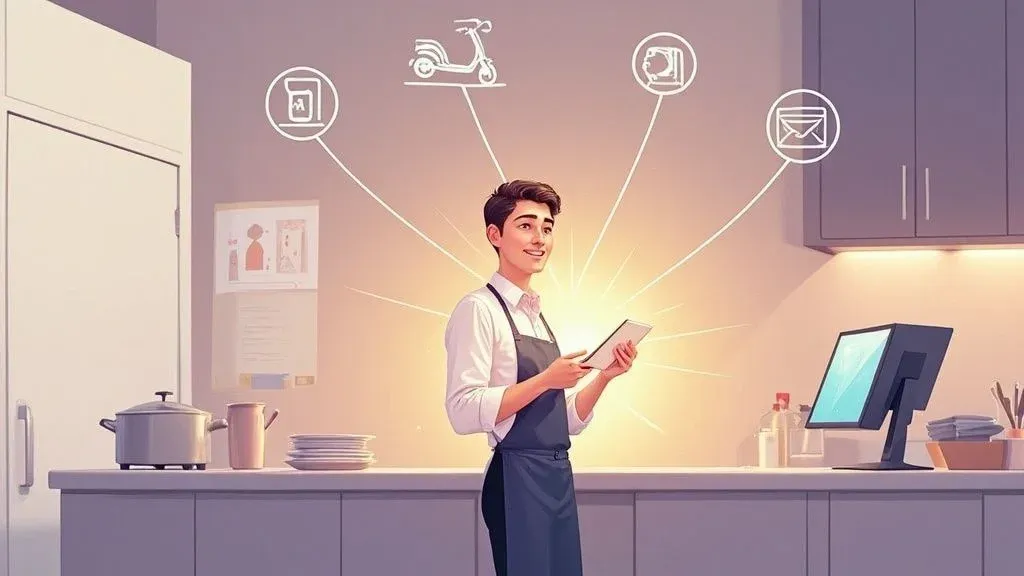
Restaurant digital transformation isn’t just about adding a few new gadgets to your kitchen. It’s about fundamentally rewiring your entire operation—from the moment a customer orders to the final delivery—so everything works together like a well-oiled machine.
Simply put, it means connecting all your digital tools so they can talk to each other automatically. The goal is to create a seamless flow of information where orders, payments, and kitchen workflows are all connected. This directly impacts your restaurant’s efficiency by slashing the manual work and costly mistakes that eat into your profits, especially when it comes to delivery and POS integration.
Understanding Restaurant Digital Transformation

At its heart, digital transformation is about leaving behind disconnected, manual tasks in favor of an integrated, automated system.
Think of it this way. In a traditional restaurant, every section is playing its own tune. The front-of-house staff is scribbling down orders, a manager is frantically punching delivery app orders into the POS, and the kitchen is shouting to keep up. It’s organized chaos, and mistakes are inevitable.
Digital transformation is the conductor that gets everyone playing in perfect harmony. Technically, this is achieved through POS integration, where an order from DoorDash doesn’t need to be touched by human hands; it flows directly into your POS system and pops up on the kitchen display. This is more than just tech for tech’s sake—it’s about building a smarter, more resilient business. To pull this off, you need a solid digital transformation roadmap.
Why This Matters for Your Restaurant Operations
This shift has a direct impact on your bottom line by tackling the industry’s toughest challenges: soaring labor costs, razor-thin margins, and the never-ending pressure to deliver a fantastic customer experience. When your systems are truly connected, you start seeing real improvements almost immediately.
- Fewer Errors: Automating how delivery app orders get into your POS system dramatically cuts down on manual entry mistakes. This means less food waste, fewer comped meals, and happier customers.
- More Productive Staff: When your team isn’t tied up managing a wall of tablets or running paper tickets back and forth, they can focus on what matters most—serving guests and turning tables faster. This boosts staff productivity and morale.
- A More Efficient Restaurant: A connected system creates a single source of truth for your entire operation. Orders fly out of the kitchen faster, inventory stays accurate, and managers get the data they need to make smart decisions on everything from staffing to menu engineering.
A Real-World Example of POS Integration
A perfect example of this in action is how a platform like Uber Eats can integrate directly with a modern POS. Instead of having a dedicated tablet for Uber Eats that someone has to watch like a hawk, orders can be injected right into a system like Square.
When a customer places their order on the app, it instantly shows up in the POS and is fired straight to the kitchen printer or KDS. This one simple connection gets rid of a massive bottleneck, nearly eliminates the chance of a missed order, and saves your staff several minutes per order. Over a week, that adds up to serious labor cost savings and faster service times.
The Takeaway: Restaurant digital transformation is no longer a futuristic idea; it’s a practical strategy for survival and growth. It’s about using affordable food tech to link your POS, delivery platforms, and kitchen operations to save time, slash errors, and empower your staff to do their best work.
By embracing these changes, you’re not just modernizing; you’re building a stronger, more profitable foundation for your business. For a closer look at specific tools, check out our guide to essential restaurant technology solutions. The journey begins when you recognize that your POS system should be the central hub of your entire operation.
Ready to connect your systems and boost your efficiency? You can start onboarding for Free in a few clicks.
The Pillars of a Modern Digital Restaurant
A truly successful digital restaurant is built on three core pillars, and they have to work together perfectly. Think of it like a three-legged stool—if one leg is wobbly or disconnected, the whole thing comes crashing down. That crash often looks like operational chaos, unhappy customers, and lost money.
These three essential legs are your Point of Sale (POS) system, your online ordering platforms, and your delivery management process. Each has a job to do, but their real power is only unleashed when they’re all communicating with each other seamlessly.
Your POS System: The Central Hub of Restaurant Operations
Your POS is so much more than a fancy cash register. It’s the central nervous system of your entire restaurant. Every single sale, every ingredient used, and every staff member’s clock-in should flow through it. For a restaurant to run like a well-oiled machine, the POS has to be the one source of truth connecting your front-of-house, kitchen, and back-office teams.
When your POS system is left on an island, it creates messy information silos. This is exactly why a simple order from a delivery app can cause so much stress—it exists in its own little world until someone manually types it into the main system, opening the door for human error.
This diagram shows how a modern POS should sit at the very top of the hierarchy, feeding information to and pulling data from your other critical digital channels.

This picture makes one thing crystal clear: without a strong, connected POS at the core, your efforts to nail online ordering and delivery will always feel disjointed and inefficient.
Online Ordering Platforms: Your Digital Storefront
Online ordering platforms are your new storefronts, giving you a presence right where your customers are already scrolling. Apps like Uber Eats and DoorDash have basically become the modern equivalent of a busy street corner, giving you instant access to millions of potential diners.
The problem? Managing the flood of orders. Without POS integration, each platform needs its own tablet screaming for attention. This forces a dedicated staff member to play “tablet-whack-a-mole,” transcribing orders from one screen and manually punching them into the main system. It’s a huge bottleneck that slows everyone down and is riddled with mistakes.
Why it Matters: A single mistake in manual order entry—a wrong modifier, a missed allergy note—hits your bottom line directly. It means wasted food, staff time spent on remakes, and a frustrated customer who probably won’t order from you again. This is why automated POS integration is crucial for restaurant efficiency.
Delivery Management: The Final Touchpoint
Delivery is the final, and most critical, piece of the customer’s journey. This pillar covers everything from dispatching drivers to making sure the food shows up hot and on time. It’s the last impression you make, and a bad delivery experience can ruin even the most amazing meal.
When your delivery process is tied into your POS, you get some serious advantages. The system can automatically track order prep times, giving you precise data on how long each stage of the process takes. This helps you give customers accurate delivery estimates, cut down on wait times, and keep people happy.
A unified system is everything. To really win, a modern restaurant has to focus on embracing omnichannel marketing strategies where the customer’s experience feels consistent and smooth, no matter how they order.
The Power of POS Integration in Action
To really understand the difference integration makes, let’s look at how a simple task can go two very different ways. The table below breaks down the before-and-after of bringing these systems together.
Manual vs Integrated Restaurant Operations
Operational Task Manual Process (Without Integration) Digital Process (With Integration) Order Entry Staff manually types orders from tablets into the POS, risking typos and missed items. Orders from all platforms flow automatically and instantly into the POS and KDS. Menu Updates Changes (like 86’ing an item) must be updated manually on each individual platform. Update the menu once in the POS, and it syncs across all connected ordering apps. Reporting Financial reports are fragmented. You have to pull data from each platform and stitch it together. All sales data is centralized in the POS, providing a single, accurate view of performance. Customer Data Customer information is scattered across different apps, making it hard to track loyalty. Customer profiles and order history are unified, allowing for targeted marketing and loyalty programs.
This comparison shows it’s not just about saving a few seconds here and there. Integration fundamentally changes your workflow, freeing up your team and giving you the data you need to make smarter decisions.
See it Live: A DoorDash Order Example
Imagine an order comes in from DoorDash. In a non-integrated restaurant, an employee hears the tablet chime, walks over, reads the order, and then re-types it into the POS. This takes precious time and is a prime opportunity for mistakes.
Now, let’s look at an integrated system. A restaurant using a modern hub like Square can connect it directly to DoorDash. The second a customer hits “Place Order” on the app, that order is zapped directly to the POS and pops up on the kitchen display system (KDS). No manual entry needed.
This single connection accomplishes several key things at once:
- Time Savings: It shaves minutes of manual work off every single order.
- Error Reduction: The chance of a typo or a missed instruction drops to virtually zero.
- Staff Productivity: Your team is freed from tablet duty and can focus on what matters most—the food and your in-house guests.
The Takeaway: The pillars of a modern digital restaurant—POS, online ordering, and delivery—simply can’t work in isolation anymore. Real efficiency and profit come from POS integration, which automates the flow of information and creates a single, unified command center. Choosing the right software is a critical first step, and you can dive deeper by exploring our guide on the best restaurant management software on the market today.
Streamlining Operations With Food Tech
Think of modern food tech as the engine powering your restaurant’s digital overhaul. It’s all about swapping out chaotic, manual tasks for smooth, automated workflows that connect your front-of-house and back-of-house teams. The real goal here is to create a single, unified operational flow that boosts efficiency and cuts right to the bottom line.
This isn’t about replacing your team with robots. It’s about arming them with better tools so they can focus on what really matters: crafting amazing food and delivering standout service. Let the technology handle the monotonous, error-prone tasks.

The Kitchen Display System: The Heart of a Modern Kitchen
A Kitchen Display System (KDS) is the perfect example of this tech in action. Picture it as the air traffic controller for your kitchen, completely replacing the messy blizzard of paper tickets with a clean, dynamic digital screen. It’s a game-changer for restaurant operations.
Gone are the days of a manager shouting orders or a chef squinting at a grease-stained ticket. Instead, every single order—whether from a diner at table five, your website, Uber Eats, or DoorDash—lands in one organized, easy-to-read queue.
The benefits are immediate and tangible:
- Faster Ticket Times: Chefs see orders the instant they’re placed, letting them fire up the grill without delay and get food out to customers quicker.
- Fewer Mistakes: A clear, digital ticket means no more mix-ups from messy handwriting or a misheard order. This error reduction directly saves money on food waste.
- Smarter Pacing: A KDS can color-code orders based on wait time, helping your kitchen crew prioritize what’s next and stay on top of a dinner rush.
POS Integration: Eliminating Manual Entry for Good
The real magic, though, happens when your KDS talks directly to an integrated POS system. When your delivery apps and online ordering platforms are siloed from your POS, you’re creating a massive operational bottleneck. Someone on your team has to manually punch every single one of those orders into the system—a slow, tedious process that’s a breeding ground for errors.
An integrated system means an order placed on DoorDash can pop up on your kitchen’s KDS without a single person having to touch it. This is the key to unlocking real restaurant efficiency, saving countless labor hours and preventing costly mistakes.
A classic example is the integration between a platform like DoorDash and a POS hub like Clover. The order data flows seamlessly from the customer’s app to your kitchen’s prep line, ensuring total accuracy. This kind of connection is fundamental, and you can learn more about how it works in our deep dive on point-of-sale integrations.
AI and Automation: The Next Frontier in Restaurant Operations
Looking beyond the KDS, artificial intelligence (AI) and automation are becoming surprisingly accessible and powerful tools for restaurateurs. This isn’t science fiction; it’s about using technology to make smarter decisions that reduce waste and boost your profits. For instance, AI-driven inventory tools can analyze your sales history to predict exactly how much steak or salmon you need to order, slashing food waste while preventing you from running out of a bestseller on a busy Saturday night.
The impact is real. Some restaurants using automation for their kitchen and order management have seen a 15% reduction in labor costs and a 20% increase in monthly sales. You can discover more insights about these technology trends and see how they’re actively reshaping the industry.
Your Practical Next Step
The takeaway is simple: investing in the right food tech is an investment in a more profitable, less stressful restaurant. By automating order entry and streamlining kitchen communication, you cut down on human error, speed up service, and free up your staff to do what they do best—create a memorable experience for your guests.
Ready to connect your systems and boost your efficiency? You can start onboarding for Free in a few clicks.
Fine-Tuning Your Restaurant’s Delivery Game

Delivery and takeout aren’t just an afterthought anymore. For a growing number of restaurants, they’re becoming as crucial to the bottom line as the dine-in experience. To really make it work, you need a smart, organized plan. Just having a profile on a delivery app isn’t a strategy—it’s just a starting point.
The first big decision is figuring out how you’ll get your food to customers. You can partner with third-party marketplaces like DoorDash and Uber Eats, or you can build out a first-party system right on your own website. Each route has its own set of trade-offs.
Third-Party vs. First-Party: A Tale of Two Models
Third-party apps offer a massive advantage right out of the gate: instant access to a huge audience you likely couldn’t reach on your own. They take care of the marketing, the payments, and the driver logistics, which lifts a heavy burden. The catch? Those convenience fees can eat into your profits, sometimes significantly. For a closer look, you can dig into the pros and cons of third-party delivery services.
On the flip side, a first-party system gives you total control. You pocket 100% of the revenue from every sale and, crucially, you own the customer relationship and all the data that comes with it. This direct line to your regulars lets you build real loyalty and run marketing that actually works. The industry is already leaning this way; by 2025, 40% of QSR brands expect first-party ordering to be their top source of revenue growth. You can read the full research about these digital restaurant trends to see where things are headed.
The challenge, of course, is that you’re on the hook for everything—from building the online portal to marketing it and figuring out the delivery logistics. Many restaurants are finding a sweet spot with a hybrid model, using third-party apps to attract new customers while pushing their regulars to order direct.
Why POS Integration Is Your Secret Weapon for Restaurant Delivery
No matter which path you take, the single most important piece of the puzzle is POS integration. When your delivery channels are siloed from your main system, it’s a recipe for chaos. It means your staff is stuck manually punching every order from a jumble of tablets into the point-of-sale.
This manual process isn’t just inefficient; it’s a breeding ground for expensive mistakes. One wrong key press can lead to a messed-up order, wasted food, a comped meal, and a customer who’s never coming back. True restaurant digital transformation is all about smoothing out these friction points.
When your delivery apps are hooked directly into your POS, the whole workflow becomes seamless. An order placed on DoorDash pops up on your Kitchen Display System (KDS) instantly, just like an in-house ticket. This simple connection eliminates the risk of human error and frees up your team’s time.
This kind of automation delivers some serious benefits for your restaurant operations:
- Slash Order Errors: Automatic order entry means what the customer taps is what your kitchen sees, protecting your margins and your reputation.
- Boost Staff Productivity: Instead of juggling tablets, your team can focus on what they do best: cooking great food and taking care of guests.
- Centralize Menu Updates: When you 86 an item, you change it once in your POS, and it updates everywhere automatically. No more angry calls about out-of-stock specials.
Turning Delivery Data into Smarter Decisions
An integrated system does more than just make things run smoother; it turns your delivery operation into a goldmine of data. By funneling all your orders through a single point, you can finally see the patterns that drive your business.
For instance, a modern POS like Clover can pull all that sales data together to give you a crystal-clear view of:
- Peak Order Times: Know exactly when the delivery rush will hit so you can staff your kitchen accordingly.
- Top-Selling Items: See which dishes are delivery all-stars and make sure you’ve got the inventory to match.
- Customer Hotspots: Discover which neighborhoods order from you the most so you can target your marketing spend more effectively.
This data-driven approach lets you make informed choices about everything from staffing to inventory. It transforms delivery from a chaotic necessity into a predictable, profitable engine for your restaurant.
Your Takeaway:
Stop letting delivery management cause headaches and lost profits. By integrating your third-party and first-party channels directly into your POS system, you can automate your workflow, eliminate costly errors, and get the insights you need to grow your business.
Ready to connect your systems and boost your efficiency? You can start onboarding for Free in a few clicks.
The Future of Restaurant Technology
So, what’s next? The next big leap for restaurants isn’t about just having technology, but about using it to get smarter. We’re moving past simply plugging in new software and into an era where our connected systems help us make intelligent, data-backed decisions every single day. The focus isn’t on futuristic, expensive gadgets; it’s on practical tools that help you anticipate customer needs and run a more profitable business.
This shift is happening for a simple reason: technology is now at the heart of the industry’s explosive growth. The global restaurant market is projected to reach an incredible $4.03 trillion by 2025. A huge slice of that pie—a whopping $380 billion—is expected to come from digital ordering alone. The tools that once seemed like nice-to-haves are quickly becoming the essentials for survival and success.
Using AI for Predictive Analytics and Marketing
Artificial intelligence (AI) is no longer just for tech giants. It’s becoming a game-changer for restaurants of all sizes. Think of AI as a brilliant analyst that can sift through all your restaurant’s data—sales history, customer feedback, even local weather forecasts—to spot patterns a person would never catch.
This is the magic behind predictive analytics. Imagine your POS system giving you a heads-up that you should prep for a surge in pizza orders this Friday night because it’s payday and rain is in the forecast. That’s a real-world insight that lets you adjust inventory and staffing before the rush hits, saving you from running out of key ingredients or paying for idle staff.
AI also brings a new level of precision to your marketing efforts.
- Targeted Promotions: Instead of sending a generic 10% off coupon to your entire email list, AI can pinpoint customers who haven’t visited in a month and send them a personalized offer for their favorite dish.
- Smarter Loyalty: It can also figure out which rewards will actually entice a specific customer to come back, like offering the free appetizer they always order.
Why it Matters: This isn’t just about cool tech. It’s about making your marketing budget work harder and building real loyalty. You stop guessing what your customers want and start giving them exactly what they’re looking for, right when they’re looking for it. A properly integrated POS system is the engine that collects this crucial data.
Data-Driven Menu and Staff Optimization
Every single order that flows through your integrated POS system is a goldmine of information. When your delivery apps, website orders, and in-person sales all report to one central hub, you get a crystal-clear picture of what’s happening in your business.
This unified data helps you answer the tough questions that directly affect your bottom line. By looking at sales reports, you can easily spot which dishes are your most profitable rock stars and which ones are just taking up space on the menu. This is the core of menu engineering—making sure every item you offer is actively contributing to your profitability.
You can apply the same logic to your staff scheduling. Data will show you, down to the hour, when you’re slammed and when things are quiet. This allows you to schedule with precision, avoiding the profit-killing mistakes of overstaffing during slow periods or understaffing during a rush, which tanks the customer experience. You can see how this fits into broader hospitality technology trends.
A flexible system like a Clover POS makes this much more manageable. Its App Market lets restaurants add new tools and analytics features as they grow, ensuring their technology can keep up with their needs.
Your Practical Next Step:
The future belongs to restaurants that don’t just collect data, but actually use it. The very first step is making sure all your revenue sources—especially all those third-party delivery platforms—are fully integrated with your POS. This is the foundation. Getting this right is what unlocks the insights you’ll need to stay competitive and profitable for years to come.
Your Next Steps for Digital Success
It’s easy to look at the idea of “digital transformation” and feel overwhelmed. It sounds like a massive, expensive project. But it doesn’t have to be.
Think of it less like a complete demolition and more like a smart renovation. You start with a clear plan, focusing on the changes that will make the biggest difference right away. This is all about making smart, targeted upgrades that build on each other over time.
The whole point is to move from juggling a dozen disconnected tasks to having one smooth, unified system. Let technology do the heavy lifting so your team can get back to what they do best: creating amazing food and taking care of your guests.
Creating Your Action Plan
So, where do you begin? It starts with an honest look at your current operations.
-
Find the Friction: Before you buy any new software, take stock of what you’re already using. Where are the real headaches in your day-to-day? Is it the jumble of tablets for different delivery apps? The time your staff spends punching in online orders by hand? Find the biggest bottlenecks—that’s your starting point.
-
Pick Your “Brain”: Your Point of Sale (POS) system should be the central hub of your entire operation. You need something that plays well with others. Look for a flexible system like Clover or Square that can easily connect to other tools. In today’s restaurant world, POS integration isn’t a luxury; it’s a necessity.
-
Automate the Obvious: The single most impactful step you can take is connecting your online ordering and restaurant delivery apps directly to your POS. This one move can practically eliminate order errors, free up your staff from mind-numbing data entry, and give them back hours every single week. It’s a direct boost to your bottom line.
-
Listen to Your Data: Once everything is connected, you’ll have a goldmine of information at your fingertips. Start paying attention to the analytics. What are your busiest hours for delivery? Which dishes are your online best-sellers? Use these insights to make smarter decisions about everything from staff schedules to inventory orders.
This dashboard gives you a glimpse of what it looks like when all your delivery channels feed into one place. No more guesswork.
When all your order data lives in one spot, you finally have the clarity you need to fine-tune your business. You can see what’s working, what’s not, and where the real opportunities are.
The journey to a more efficient and profitable restaurant can begin today.
Start your onboarding for Free in a few clicks at the OrderOut dashboard.
A Few Common Questions
It’s completely normal to have questions when you’re thinking about making big changes to your restaurant. Let’s tackle some of the most common ones we hear from owners just like you.
What’s This Going to Cost Me?
That’s the big question, isn’t it? The cost can swing pretty widely, but getting started is probably more affordable than you imagine.
Many of the best POS systems today, like Clover or Square, run on a subscription basis. This means you skip the massive upfront cost for hardware and can get powerful tools without draining your bank account.
Of course, third-party delivery apps have their commission fees, but a smart POS integration pulls all those orders into one place, making them far easier to manage. Think of it less as a cost and more as an investment. When you factor in the money saved from less manual work, fewer order mistakes, and a higher volume of sales, the technology often pays for itself pretty quickly by improving your overall restaurant operations.
Do I Have to Be a Tech Whiz to Use This Stuff?
Not in the slightest. The companies building this technology know you’re a restaurant owner, not an IT pro. They design their platforms to be intuitive and user-friendly—if you can use a smartphone, you can handle these systems.
Take a platform like Square for Restaurants. Its interface is designed to feel familiar and simple right out of the box. The whole point of this tech is to make your life easier, not to give you another headache. Most integrations are set up with just a few clicks, and good providers always have support teams ready to walk you through it.
Key Takeaway: Digital tools are meant to simplify, not complicate. They’re built to get you out from behind a screen so you can focus on what you do best: making great food and taking care of your guests.
I Only Have One Small Restaurant. Is This Really for Me?
Absolutely. In fact, these tools can be a game-changer for smaller, independent spots. They level the playing field, giving you the kind of operational power that the big chains have relied on for years.
Think about it: an integrated system for online ordering and restaurant delivery instantly opens up new ways to make money and reaches customers far beyond your local regulars. It’s also a huge efficiency booster, which is critical when you’re running on a lean team. When you automate all that manual order entry, your staff can put their energy where it really counts—crafting incredible dishes and delivering fantastic service.
Ready to see how simple it can be? OrderOut connects all your delivery apps directly to your POS system, cutting out the manual work and expensive mistakes. Start your onboarding for Free in a few clicks.