
10-Point Restaurant Cleaning Checklist for 2026
· Thibault Le Conte
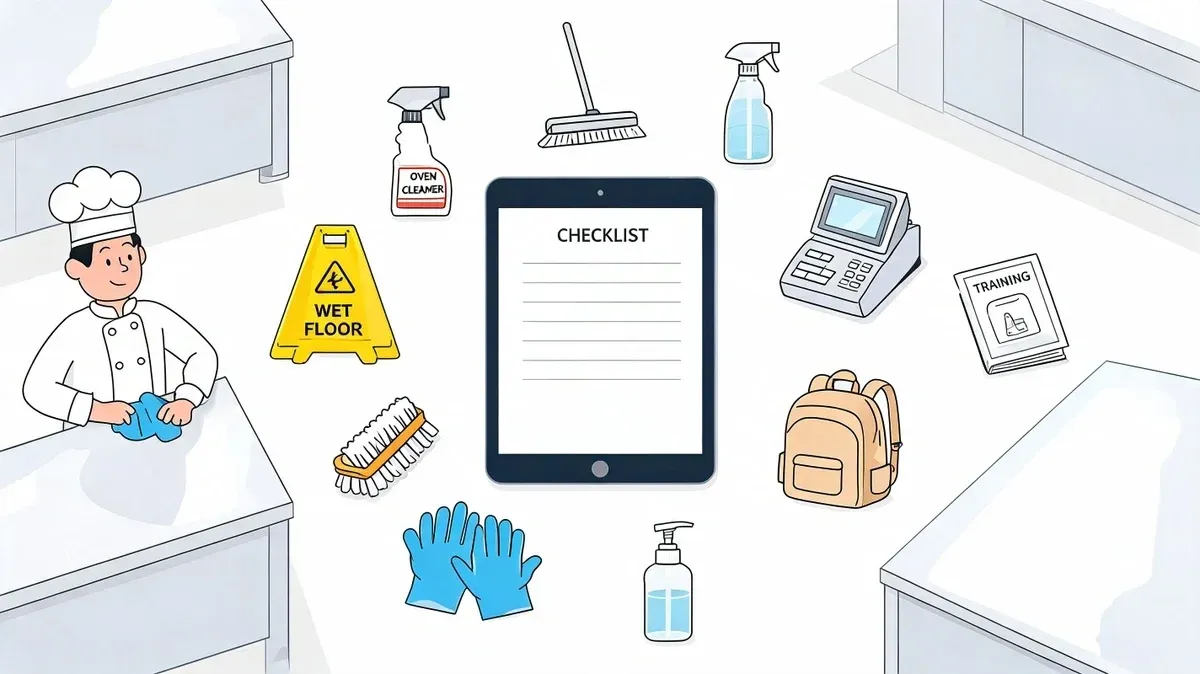
The rush ends, but the mess keeps working against you. Delivery bags are still stacked by the expo line, the pickup shelf is tacky, the card reader is covered in fingerprints, and nobody is fully sure whether the prep table got sanitized after the last raw chicken run.
That kind of cleaning routine costs money. It burns labor at the end of the night, creates avoidable inspection risk, shortens equipment life, and chips away at customer trust. In a delivery-first operation, it also slows service. A dirty staging shelf leads to order mix-ups. Grease on a touchscreen slows cashiers and hosts. Missed cold storage cleaning turns into product loss, then margin loss.
A useful restaurant cleaning checklist should do more than tell staff what to wipe down. It should tell them when to do it based on how the restaurant operates. POS timestamps, delivery order surges, and station bottlenecks already show where pressure builds during service. Use that information to schedule screen wipes before peak counter traffic, reset pickup shelves after delivery bursts, and assign bathroom checks and line cleaning during proven slower windows.
I have seen operators treat cleaning like a closing chore and wonder why labor runs high and standards slip by Friday. The better approach is operational. Build cleaning around sales patterns, handoff volume, and equipment use, then tie it to mid-shift checkpoints that keep service from drifting.
Cleanliness affects speed, accuracy, food safety, reviews, and maintenance costs. For stores running heavy delivery through Clover, Square, or similar systems, every repeated touchpoint adds wear and every misplaced task pulls someone off production at the wrong time. The goal is not a longer checklist. The goal is a smarter one that protects profit during service, not after it.
1. Daily Shift-Based Kitchen Cleaning Checklist
The strongest daily kitchen routine isn’t one long closing list. It’s a shift-based system that breaks cleaning into opening, mid-shift, and closing work.
That matters because kitchen mess builds with sales volume, not with the clock. If your Clover setup is routing delivery orders into one stream, your prep stations need resets between bursts, not just at the end of the night. Restaurants using Clover with OrderOut can line up cleaning reminders with order flow instead of hoping someone remembers.
Break kitchen cleaning by shift
Opening should focus on readiness. Sanitize food contact surfaces, confirm the previous close was completed, check drains, and reset sinks, towels, and sanitizer buckets.
Mid-shift cleaning is where most restaurants fall apart. Managers should use slower periods and mid-shift checkpoints to wipe counters, cutting boards, prep tables, refrigerator handles, and equipment controls, especially before and after raw meat work. Daily sanitizing of food contact surfaces after raw meat prep is one of the practical controls highlighted in commercial kitchen checklist guidance.
Closing should handle the grease, floors, trash, dish area, and end-of-day sanitation that can’t wait until morning.
Practical rule: If a task protects food safety during service, don’t leave it for closing.
A simple kitchen station card usually works better than a giant poster. Keep each station list short enough that a line cook can finish it during a real lull.
- Opening reset: Sanitize prep surfaces, check sanitizer setup, inspect cold line handles and controls.
- Mid-shift reset: Wipe high-touch points, clear spills immediately, refresh cutting boards, empty overfilled trash.
- Closing reset: Degrease equipment surfaces, sweep and mop, clean drains, break down and sanitize prep areas.
For a pizza shop using Square, order batch reports often reveal a quiet pocket between lunch and dinner. That’s the best time to scrape ovens, wipe warmers, and reset makeline surfaces instead of stacking all the work at 11 p.m.
2. Front-of-House Daily and Weekly Two-Tier Cleaning Matrix
A delivery driver walks in at 7:05, a pickup guest is waiting near the host stand, and the card reader has fingerprints all over it. Nobody sees the dust on the vent yet. They do see the handoff shelf, the front door glass, and the restroom. Front-of-house cleaning has to cover both.
Run it in two tiers. Daily tasks protect the guest impression during service. Weekly tasks prevent the slow buildup that turns a clean-looking dining room into a maintenance problem, a bad review, or a longer close on Friday night.
The mistake I see is simple. Teams clean what gets noticed in the moment and postpone the work that keeps the room from degrading. Tables get wiped. Booth bases, door tracks, menu holders, grout lines, and the underside of the host stand get skipped. After two or three busy weeks, that neglect shows up everywhere at once.
The smarter move is to tie front-of-house cleaning to traffic patterns from your POS and delivery platforms. If pickup volume spikes from 6 to 8 p.m., schedule handoff shelf wipes, entry glass touch-ups, and payment terminal sanitizing just before that wave starts. If your reports show a slower window mid-afternoon, use it for under-booth vacuuming, restroom detail work, and dusting around fixtures. Cleaning goes faster when it follows actual demand instead of a generic clock time.
A matrix also helps restaurant managers balance recurring duties without relying on memory alone.
Guests judge the room in seconds. Weekly detail work protects the impression your daily wipes create.
A good front-of-house matrix also helps reduce cognitive load for hourly staff. During a rush, they need a clear standard, not a debate about whether the pickup shelf, front mat, or bathroom mirror can wait another hour.
Use a simple split:
- Daily customer-facing tasks: Wipe tables and pickup counters, sanitize payment devices, sweep entryways, spot-clean front door glass, restock and check restrooms.
- Weekly detail tasks: Dust light fixtures, scrub corners and baseboards, clean under movable furniture, wash interior glass fully, wipe vents and door tracks.
- Manager check: Walk the room from the guest path, starting at the entrance and ending at the restroom and pickup area.
For ghost kitchens or small pickup-first stores, the matrix gets shorter, not looser. The handoff ledge, waiting area, pickup shelves, and restroom still need daily discipline because drivers, customers, health inspectors, and owners all judge the operation from those few visible touchpoints.
3. Monthly Deep-Clean Area-Specific Task Breakdown
Monthly cleaning should not be one giant punishment day. Spread it by area so your team can finish it.
Operators usually know the neglected spots. Behind reach-ins. Ceiling vents. Under shelving. Wall edges near fryers. The issue isn’t knowing. It’s assigning a date, a person, and proof of completion.
Build a rotating monthly calendar
Give each week a zone. One week for refrigeration interiors and shelving. One for vents, walls, and hard-to-reach dust. One for dry storage and chemical areas. One for equipment pull-outs and floor edges.
That structure works because frequency-based cleaning systems are easier to manage than open-ended “deep clean when possible” language. Coast notes that restaurants using frequency-based digital food safety tools have seen a 75% reduction in manual task tracking time, cutting manager admin work from hours to a few minutes.
Use that saved time to verify, not to rewrite lists.
- Week 1 refrigeration: Empty, wipe interiors, clean shelves, inspect seals.
- Week 2 air and overhead: Dust vents, light fixtures, upper ledges, fan guards.
- Week 3 storage: Rotate stock, clear crumbs, wipe dry storage shelving.
- Week 4 pull-out clean: Move portable equipment, clean beneath, scrub wall lines and corners.
POS data helps more than people expect. If your Clover reports show one Monday each month is consistently soft, block that for heavier projects. That’s smarter than delaying deep cleaning until “when we have time,” because restaurants never have random extra time.
For multi-unit operators, use the same monthly rhythm across stores but stagger execution. That makes photo verification and manager follow-up easier.
4. Delivery-Focused Staging Area Cleaning Protocol
The delivery staging area is one of the dirtiest places in modern restaurants, and it’s often missing from a standard restaurant cleaning checklist.
That’s a problem because the staging zone sits at the intersection of food, packaging, screens, drivers, labels, spills, and rushed hands. In delivery-heavy operations, this area turns over faster than the dining room and gets touched by more people.
Keep the handoff zone clean without slowing orders
Start with a one-page station list. Wipe shelving, sanitize the handoff counter, clear label scraps, remove spilled sauces, and clean any reusable warming surfaces. If you run Uber Eats and DoorDash through one order pipeline, assign one person each shift to own that area during peaks.
This matters even more for delivery-first formats. An underserved industry angle is ghost kitchens. Datassential data cited by Unilever Food Solutions says ghost kitchens represented 15% of new restaurant openings in major U.S. markets in 2025, as a projection discussed in that source. Yet many standard checklists still ignore packaging stations, reusable warming bags, and order consolidation screens.
That gap shows up in food safety performance too. The same source notes a 2025 NRA report describing higher food safety violations in delivery-focused operations tied to overlooked tech touchpoints and rapid turnover.
The pickup counter isn’t front-of-house or back-of-house anymore. It’s its own zone.
Practical fixes work better than long SOPs here:
- Strip the station down: Keep only what staff needs for the next hour. Clutter creates spills and missed wipes.
- Reset between surges: Use gaps between driver waves to sanitize shelves and clear sticker backing, cups, and bag debris.
- Separate plating from staging: Use different boards or trays so expo doesn’t become a contamination shortcut.
A wing shop with heavy game-night volume may need a quick reset after each rush. A Thai delivery kitchen may need wipes on every consolidation screen and bagging shelf. The pattern is the same. If this area drives sales, it needs its own cleaning protocol.
5. Bathroom Facility Hourly Compliance Checklist During Operating Hours
A restroom problem rarely stays in the restroom. A guest sees an empty soap dispenser or a wet floor, assumes standards are slipping everywhere, and that judgment hits the whole operation.
During service, bathroom checks need a fixed loop tied to traffic, not memory. Stores with steady dine-in volume usually check every hour. Stores that get sharp spikes from lunch, late night, or driver pickup waves should tighten that cadence when order volume rises in the POS. If tickets jump, foot traffic usually follows.
That matters for labor too. A bathroom issue found late costs more than a quick reset handled on schedule. Managers get pulled off expo, hosts leave the door, and someone ends up doing a rushed cleanup at the worst possible time. The better system is simple. Use sales and order pattern data to predict pressure, then assign the check before the problem shows up.
Teams run this best when the responsibility sits clearly inside the back-of-house structure and shift ownership, even if a front-of-house employee completes the check. Someone owns the log each hour. Someone else verifies stock at shift change. The manager checks exceptions, not every single wipe.
Build the hourly loop around traffic patterns
The checklist should stay short enough to finish fast and specific enough to catch what guests notice first.
- At each check: Inspect toilets and urinals, wipe sink and faucet surfaces, check mirrors, empty visible trash, restock soap and paper, and confirm the floor is dry and clear.
- After a traffic spike: Do a fast touchpoint reset on locks, flush handles, faucet handles, and the entry door, then log any supply refill or maintenance issue.
- At shift change: Refill backup stock, inspect odors and drain condition, and confirm the next employee knows the check time.
- At close: Disinfect all contact points, clean walls and partitions as needed, mop thoroughly, and reset the room for opening.
A mall food court and a neighborhood bistro should not run the same bathroom schedule. One gets constant volume and unpredictable misuse. The other may have lighter traffic but bigger guest expectations. Delivery-heavy stores still need discipline here because drivers and pickup customers use the same facilities, and one complaint can interrupt the line during a rush.
The goal is not a prettier log sheet. The goal is fewer interruptions, fewer complaints, and a cleaner store with less wasted management time.
6. Equipment-Specific Cleaning Schedule With Maintenance Integration
Equipment cleaning is where sanitation and maintenance become the same job. If staff clean badly, the machine degrades. If they skip cleaning, the machine still degrades. Either way, food quality drops first.
That’s why each major piece of equipment needs its own card. Fryers, ovens, slicers, steam tables, dishwashers, ice machines, and coffee equipment all get dirty differently and fail differently.
Treat each machine like a station
Post a short laminated guide near the machine. Include what gets cleaned daily, what gets cleaned weekly, who signs off, and when a manager checks it. That’s much better than one generic “clean equipment” line on a closing form.
A back-of-house team works best when ownership is clear, and that’s exactly what a defined BOH structure is supposed to support. One cook owns the slicer close. Another owns the fryer exterior and drip zone. The dishwasher closer owns the machine wipe-down and surrounding floor.
The practical core stays consistent:
- Daily machine care: Remove debris, clean contact surfaces, wipe controls and handles, inspect for buildup.
- Weekly detail work: Pull guards where safe, clean hidden residue, flush drains or lines if required.
- Service coordination: Track vendor cleaning, hood work, and preventive maintenance on the same calendar.
A sandwich shop using Square can also drop equipment notes into shift communication tied to order trends. If lunch volume was heavy, the slicer may need a more thorough end-of-day breakdown. If a pizza store has a soft afternoon, that may be the best time to tackle oven surround cleaning instead of waiting for close.
Here’s a quick visual reference before assigning tasks:
The trade-off is straightforward. Detailed equipment cleaning takes more discipline up front, but it prevents the slower, more expensive failures that wreck service later.
7. Cold Storage and Food Safety Zone Cleaning With Temperature Verification
Friday night gets expensive fast when the walk-in turns into a blind spot. A cooler packed after a delivery rush, labels half-missing, one shelf sticky from a sauce spill, and nobody has matched the actual temperature to what the unit should be holding. That is how good product gets lost, prep gets delayed, and managers end up comping orders because quality slipped before anyone caught it.
Walk-ins and reach-ins need one routine that covers sanitation, rotation, and temperature checks at the same time. Separate those jobs, and teams start assuming someone else handled the risky part.
Build the cleaning schedule around product movement
The smartest cold storage schedule starts with sales and prep patterns, not a generic once-a-week reminder. If POS and delivery reports show a spike in salads, proteins, or grab-and-go desserts on certain days, clean and reorganize those shelves right after the high-volume window. That keeps the busiest zones from becoming the dirtiest and least reliable.
I treat the walk-in like an extension of prep, not overflow storage. High-use shelves need more attention. Low-turn backup stock still needs inspection, but it usually does not need the same cleaning frequency as the sections your line opens all shift.
A practical routine looks like this:
- Every shift: Check shelf spills, container bottoms, labels, dates, and door handles. Confirm the unit temperature against your log, not just the display.
- Daily close: Remove loose debris, discard expired items, and clear cardboard that traps moisture and blocks airflow.
- Weekly: Empty one zone at a time, wipe interiors, clean gaskets, sanitize high-contact points, and verify FIFO order before product goes back.
- Manager review: Compare storage conditions and on-hand product against sales mix, prep sheets, and delivery volume to catch overproduction or neglected inventory pockets.
Temperature verification matters because cleaning a cooler that is holding the wrong temp does not solve the business problem. If your third-party delivery sales jump late at night, that may justify an extra reach-in check before the rush instead of waiting until close. If the POS shows one station pulling heavily from a single shelf all day, that shelf should be first in line for inspection and wipe-down.
Documentation matters too, especially during inspections and permit work. Teams operating under stricter local oversight should keep cold storage logs tight and easy to review as part of broader NYC food safety licensing requirements.
The common mistake is cleaning for appearance. Profitable operators clean for product protection, labor control, and fewer avoidable losses.
8. High-Touch Surface Sanitization Protocol During Peak Hours
The rush hits, the printer is firing, drivers are waiting, and three people touch the same POS screen in under a minute. That is when high-touch surface cleaning either protects service speed or gets skipped until the equipment feels grimy and the counter starts dragging.
These are the surfaces that create friction first. POS terminals, card readers, expo screens, refrigerator handles, door pulls, phones, printer buttons, and pickup counter pens all collect grease, moisture, and constant hand contact. In a delivery-heavy operation, they also sit in the middle of order flow. A dirty screen slows input. A sticky card reader holds up payment. A neglected staging tablet causes missed taps and repeat actions during the busiest part of the day.
Peak-hour sanitizing needs its own operating rule, not a vague reminder buried in side work. Build it into your restaurant standard operating procedure for shift execution and assign the task by station and by time window.
Use sales and order-channel data to decide when those rounds happen. If your POS and delivery dashboard show a lunch spike from 11:30 to 1:30 and a second wave of third-party pickup tickets from 6:00 to 8:00, schedule sanitizing just before the spike and once during it. That beats cleaning on a fixed hourly pattern that ignores how your store operates.
A practical round is short and repeatable:
- Sanitize the POS screen, payment device, and printer controls
- Wipe refrigerator and freezer handles near the line
- Clean host stand tablets, phones, and front door pulls
- Sanitize staging screens and pickup counter touchpoints
- Reset sanitizer towels or wipes before staff runs out mid-rush
Fresh Wave IAQ points to growing industry interest in digital verification and sanitation logging for busy restaurant environments in its restaurant cleaning checklist analysis. The practical lesson is simple. Teams under peak pressure miss memory-based tasks. Timed prompts and assigned ownership hold up better.
I have seen operators over-clean low-impact areas during service while the card reader and expo screen get ignored for two hours. That is backwards. Start with the surfaces tied directly to order entry, payment, and handoff. Those are the touchpoints that affect both sanitation and throughput.
9. Pre-Service and Post-Service Opening and Closing Cleaning Checklists
At 10:45 a.m., the dining room can look clean and the kitchen can still be unprepared for service. I have seen crews wipe visible surfaces, skip sanitizer checks, and miss the pickup shelf until the first delivery tickets start printing. That kind of opening costs time fast. Orders stack up, staff cleans reactively, and the first rush starts with avoidable friction.
Opening and closing checklists should solve different operational problems. Opening protects the first hour of revenue. Closing protects labor efficiency, food safety, and setup for the next shift.
Separate startup hygiene from shutdown sanitation
Opening work should focus on readiness. Are prep tables sanitized and air-dried? Are sinks stocked and sanitizer buckets mixed correctly? Are restrooms ready before guests arrive? Is the delivery handoff zone clean, labeled, and free of yesterday’s clutter?
Closing work goes deeper. Staff can break down equipment, clear drains, remove grease, empty trash, and reset the store for the next open without working around active tickets. A practical restaurant SOP framework for opening and closing duties helps because teams need a clear split between tasks that protect live service and tasks that require the line to be shut down.
That separation is also important for inspection risk and day-to-day execution. Open with missed cleaning, and the shift starts behind. Close carelessly, and the morning crew burns paid labor fixing last night’s shortcuts instead of getting ready to sell.
The smarter move is to tie both lists to store data, not habit. If POS reports show heavy breakfast delivery from 7:30 to 9:00, the opening checklist should prioritize the expo line, bagging counter, tablets, and payment devices before anything cosmetic. If late-night orders skew toward third-party pickup, the closing list should put more attention on shelving, driver-facing counters, and door glass than on low-traffic front-of-house areas that barely got used.
A few rules keep the system usable:
- Opening list: Verify sanitizer strength, inspect prep and handwash stations, clean order-entry devices, check bathrooms, and clear the pickup area before the first ticket.
- Closing list: Break down stations, wash and sanitize food-contact surfaces, remove trash, clean floors and drains, and restock the items the opener needs immediately.
- Shift ownership: First in signs opening. Last out signs closing. Shared responsibility usually turns into skipped tasks.
- Data review: Adjust the checklist by sales mix, order channel, and daypart every few weeks. Your highest-volume handoff points should get the most attention.
Fast casual operators learn this early. A rushed opening slows ticket times for the next two hours. A weak close raises labor the next morning and increases the odds that someone cleans around a problem instead of fixing it. Clean with the sales pattern in mind, and the checklist stops being a form. It becomes part of service prep.
10. Allergen and Cross-Contamination Prevention Cleaning Workflow
Friday dinner rush. A delivery ticket marked “shellfish allergy” hits the kitchen at the same time as a large shrimp order and three pickup bowls with modified sauces. If the station reset depends on memory, speed wins and safety loses.
Allergen cleaning has to follow the ticket flow. In a modern kitchen, that means pairing cleaning steps with POS alerts, item modifiers, and order-channel timing so staff know when to reset a station before the wrong order reaches the line.
Clean in production order
The best workflow starts before prep, not after a mistake. Allergen-sensitive tickets should trigger a defined cleaning sequence: wash hands, change gloves, clear the station, sanitize the surface, pull dedicated tools, verify ingredients, then start the order. That sequence costs a few extra minutes. It costs far less than remaking food, comping an order, or dealing with an allergy complaint tied to a contaminated board or squeeze bottle.
Tech helps if it gives the line a clear cue at the right moment. For restaurants using Square, POS notes can flag allergen orders inside the workflow through Square with OrderOut. The point is not the software alone. The point is using order data to trigger cleaning at the exact station where risk shows up.
Use a workflow staff can repeat under pressure:
- Dedicated setup: Keep allergen-safe boards, knives, tongs, pans, and squeeze bottles stored separately and labeled.
- Triggered reset: Require a full station wipe-down and sanitizer step whenever an allergen-tagged ticket appears.
- Prep timing: Run sensitive orders before nearby stations start high-risk items like shellfish, nuts, or flour-heavy prep.
- Ingredient control: Check sauce bottles, garnish bins, and shared containers, not just cutting boards and utensils.
- Digital clarity: Put allergy notes in the POS and kitchen display so cooks are not relying on a shouted warning.
Sales mix should shape the cleaning cadence here too. If delivery data shows a spike in customizable bowls, salads, or build-your-own orders between 11:30 and 1:30, that is when cross-contact risk usually climbs because ingredient bins stay open and stations get shared. Schedule extra sanitizer checks and tighter tool swaps during that window, not only during opening prep.
I have seen kitchens spend money on color-coded tools and still overlook the primary failure point. The miss happens at the handoff between the ticket, the station reset, and the ingredient check. Cleaning for allergen control works when the reset is attached to the order workflow, measured by who completed it, and timed to the parts of service where modifiers and special requests stack up.
10-Point Restaurant Cleaning Checklist Comparison
Checklist Implementation Complexity 🔄 Resource Requirements ⚡ Expected Outcomes ⭐ / 📊 Ideal Use Cases 💡 Key Advantages ⭐ Daily Shift-Based Kitchen Cleaning Checklist Moderate, requires POS integration and shift coordination Moderate staff time per shift, POS alerts/logs High ⭐⭐⭐⭐, continuous food-safety control; 📊 audit timestamps High-volume delivery kitchens with shift-based peaks Prevents violations; easy to audit Front-of-House Daily & Weekly Two-Tier Cleaning Matrix Low–Moderate, routine + scheduled deep cleans Regular staff time plus periodic deep-clean blocks Moderate ⭐⭐⭐, improves customer perception; 📊 better review scores Restaurants with pickup drivers and customer-facing areas Maintains curb appeal; batches reduce labor Monthly Deep-Clean Area-Specific Task Breakdown Moderate–High, monthly scheduling and coordination Dedicated monthly labor; occasional rental/pro services High ⭐⭐⭐⭐, prevents pests/mold; 📊 documented compliance Multi-unit or high-turnover kitchens needing scheduled downtime Reduces long-term risks; inspector-ready records Delivery-Focused Staging Area Cleaning Protocol Low–Moderate, frequent checks during peaks Ongoing hourly attention, clear staging space High ⭐⭐⭐⭐, improves driver experience; 📊 fewer pickup complaints Delivery-first venues and crowded pickup counters Enhances pickup hygiene and speed Bathroom Facility Hourly Compliance Checklist Moderate–High, hourly inspections required Significant recurring labor and supplies High ⭐⭐⭐⭐, demonstrable compliance; 📊 timestamped logs High-traffic pickup locations, malls, airports Reduces liability; visible customer assurance Equipment-Specific Cleaning Schedule with Maintenance Integration High, equipment-specific procedures and shutdowns Skilled staff, professional servicing, parts Very High ⭐⭐⭐⭐⭐, extends lifespan; 📊 fewer breakdowns Kitchens with heavy or specialized equipment Prevents failures; supports warranties Cold Storage & Food Safety Zone Cleaning with Temp Verification Moderate, routine logging + rotation procedures Digital thermometers, daily logging, reorganization time Very High ⭐⭐⭐⭐⭐, prevents spoilage/illness; 📊 temperature records Seafood, meal-prep, high-perishable inventories Preserves cold chain; reduces waste High-Touch Surface Sanitization Protocol (Hourly Peak) Low, simple hourly tasks if disciplined Disinfectant supplies, wipes, brief staff time High ⭐⭐⭐⭐, reduces transmission; 📊 visible safety measures Post-pandemic safety, busy POS and driver handoffs Easy to implement; high visibility Pre-Service & Post-Service Opening/Closing Checklists Low–Moderate, straightforward routines Time before/after service; digital/photo verification High ⭐⭐⭐⭐, consistent readiness; 📊 documented sign-offs All restaurants, especially with scheduled delivery windows Ensures consistency and security Allergen & Cross-Contamination Prevention Workflow High, strict sequences, training required Extra equipment, storage, staff training Very High ⭐⭐⭐⭐⭐, prevents allergic incidents; 📊 liability protection Restaurants offering allergen-free or diverse menus Protects customers; enables niche menus
Your Next Step From Checklist to Automated Workflow
A restaurant cleaning checklist works best when it stops being a side document and becomes part of daily operations. That shift is what separates stores that are always reacting from stores that stay ahead. Cleaning should move with service, staffing, delivery volume, and station pressure. It shouldn’t depend on whoever remembers last.
The practical version is simple. Tie recurring tasks to the rhythm of the store. Use opening checks before the first order. Use mid-shift resets between delivery surges. Use hourly bathroom and touchpoint rounds during active service. Use weekly and monthly schedules for the work that prevents breakdowns, inspection trouble, and surprise grime.
This approach also makes labor more productive. Staff spends less time asking what needs to be done and less time fixing avoidable messes. Managers spend less time chasing signatures and more time verifying that critical jobs were done right. If you run a restaurant with heavy Uber Eats, DoorDash, or Grubhub volume, that matters because your team is already balancing packaging, handoff, POS activity, and kitchen throughput at the same time.
The bigger payoff is operational clarity. A clean pickup shelf supports faster handoff. A sanitized POS screen supports fewer input mistakes. A disciplined cold storage routine protects product quality. A clear equipment schedule reduces breakdown risk. None of that feels like “just cleaning” when you’re in the middle of service. It feels like smoother execution.
There are trade-offs. Digital logging takes setup. Station ownership requires training. Shift-based checklists expose who’s following through and who isn’t. That can feel uncomfortable at first. But paper forms with vague task lines usually create the worst of both worlds. The work is inconsistent, and management still assumes the store is covered.
If you want this to stick, start small. Pick three zones where cleaning directly affects speed and revenue: the kitchen prep line, the delivery staging area, and the high-touch tech surfaces around your POS. Build short task lists, assign ownership by shift, and align the timing with order patterns. Once that holds, add cold storage, restrooms, and monthly deep-clean rotations.
Restaurants already use technology to route orders, consolidate channels, and manage sales. Cleaning should plug into that same system. When your POS and delivery data show where pressure builds, they also show where sanitation should tighten. That’s the mindset change. You’re not building a cleaning program that sits beside operations. You’re building one that supports operations.
If you’re ready to automate delivery orders and give your team more time for critical work like this, you can start onboarding with OrderOut for free in just a few clicks.
OrderOut helps restaurants connect delivery apps like Uber Eats, DoorDash, and Grubhub directly into POS systems such as Clover, Square, Pecan and others, so staff spends less time re-entering tickets and more time on the work that protects service quality, food safety, and margins. If you want cleaner operations with fewer manual handoffs, explore OrderOut.