
Relay Delivery App: Revolutionizing Food Tech
· Thibault Le Conte
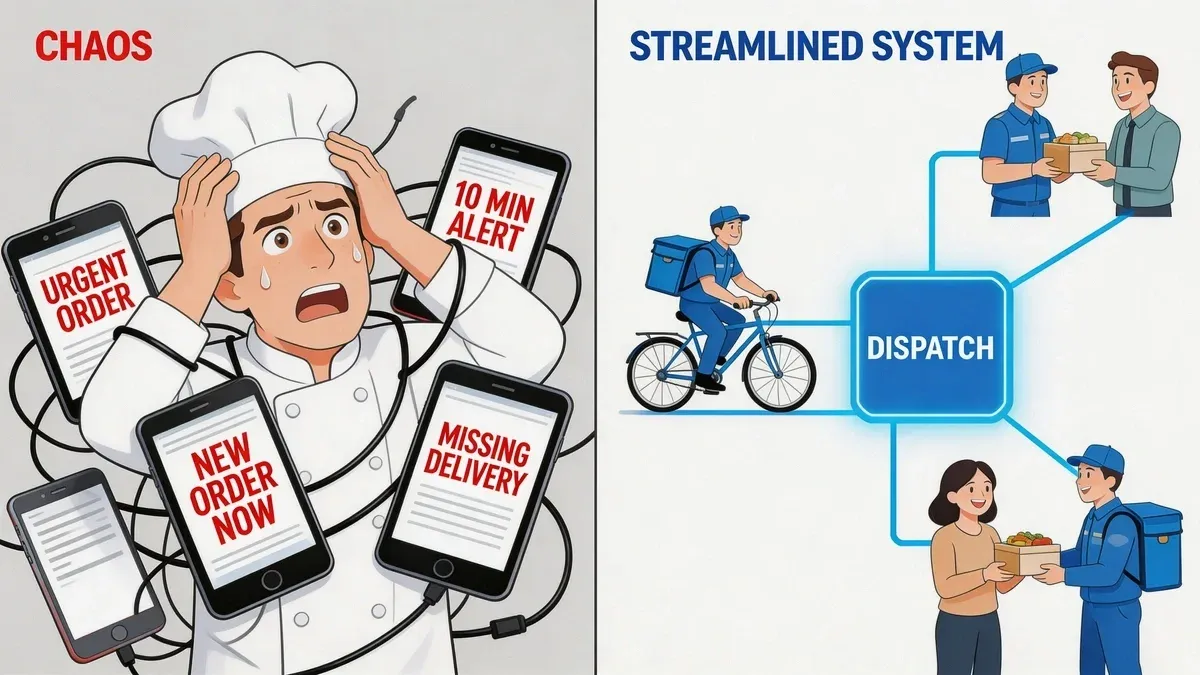
Friday night hits. The dining room is full, the phone is ringing, and three delivery tablets start chirping at once.
A DoorDash order needs to be accepted. An Uber Eats ticket has to be retyped into the POS. A Grubhub order is sitting on another screen while your expo is asking whether the fries on ticket two are for pickup or delivery. One missed tap, one wrong modifier, and you’ve got a refund, a remake, or a bad review.
That mess is why restaurant owners keep hearing about the relay delivery app model. On paper, it sounds like relief. One delivery partner. Fewer moving parts. Less chaos around drivers.
But there’s an important distinction many operators miss. A relay delivery app can reduce some delivery friction, yet it doesn’t solve the whole problem. In some cases, it introduces a new dependency that can hurt resilience when the market shifts.
If you run a restaurant, the core question isn’t whether a relay service sounds novel. It’s whether it improves your restaurant operations, protects your margins, and keeps orders flowing when something breaks.
The Chaos of Modern Restaurant Delivery
The problem usually starts small.
You add Uber Eats because customers ask for it. Then DoorDash starts pulling more volume in your area. Then Grubhub still matters for a slice of regulars. Before long, your host stand, cashier counter, or expo line looks like a small electronics store.
Tablet hell is an operations problem
This isn’t just annoying. It changes how your staff works.
Every extra tablet creates another place where someone has to:
- Watch for alerts: Different sounds, different screens, different timing.
- Re-enter orders: Staff copy items, modifiers, and special instructions into the POS.
- Fix mistakes: If a driver arrives and the order in the kitchen doesn’t match the app, your team has to sort it out fast.
That manual handoff is where small errors pile up. A missing sauce. The wrong side. A modifier skipped because the lunch rush got loud.
For busy operators, this isn’t a technology issue first. It’s a labor issue. Your employees spend time acting like human connectors between systems that should already talk to each other.
Practical rule: If your staff is typing delivery orders by hand, you don’t have a delivery workflow. You have a workaround.
The hidden cost is attention
Most owners track food cost and labor cost. Fewer track attention cost.
When a manager has to babysit tablets, they’re not coaching the line. When a cashier is re-entering app orders, they’re not helping guests. When expo is reconciling mismatched tickets, ticket times slip everywhere.
That’s why so many operators start looking for alternatives to the tablet pile. Some look for a better process. Some look for a delivery intermediary. Some start by learning how a stronger system of delivery can remove manual steps altogether.
Why the pressure keeps building
Third-party delivery isn’t going away for most restaurants. Customers want convenience, and platforms like Uber Eats and DoorDash are already where many orders start.
So owners end up stuck between two bad choices:
- keep the tablets and manual entry, or
- add another layer to manage the complexity
That second path is where the relay delivery app enters the conversation.
Defining the Relay Delivery App Model
A relay delivery app is easiest to understand as a dispatcher between your restaurant and the delivery platforms your customers already use.
Consider this analogy: DoorDash, Uber Eats, or Grubhub may help generate the order. But instead of relying on each platform’s own driver network, a relay company handles the delivery leg for the restaurant through its own courier operation.
What makes the model different
A relay delivery app is usually business-to-business, not consumer-facing.
That means the diner often never knows the relay company exists. The customer may place the order through Uber Eats or DoorDash, but the restaurant uses the relay service to fulfill delivery behind the scenes.
The relay provider becomes the restaurant’s delivery arm.
In plain language, the model looks like this:
- The customer orders through a marketplace app.
- The restaurant receives the order through its existing channels.
- The relay platform dispatches a courier from its own network.
- The courier completes the drop-off while the restaurant avoids relying on every marketplace’s native driver pool.
A real example from the U.S. restaurant delivery market
Relay Delivery in the U.S. became a well-known example of this model. According to Craver’s overview of Relay Delivery, it aggregated orders from platforms like DoorDash and Uber Eats, used a fixed hourly wage model for couriers, operated with a strict 2-mile delivery radius, and let restaurants keep 100% of customer data because it had no consumer-facing app. The same source says one restaurant reported saving over $90,000 annually by using Relay to handle all third-party deliveries (Craver’s Relay Delivery overview).
That combination is why the concept gets attention from operators. It promises:
- lower delivery friction,
- tighter local delivery zones,
- more control over customer relationships,
- and a different labor model than gig-style dispatching
Why operators find it appealing
For an independent restaurant, the pitch is straightforward.
You still get marketplace demand from apps like Uber Eats and DoorDash. But instead of surrendering every part of fulfillment to those apps, you insert a specialized partner focused on delivery execution.
That can feel more manageable than dealing with multiple driver systems at once.
There’s also a workforce angle. If you want context on why businesses in many sectors keep exploring flexible staffing and dispatch models, this overview of a workers on demand app gives useful background on the larger labor trend that made these service models attractive in the first place.
Where people get confused
Many owners hear “relay delivery app” and assume it’s the same thing as POS integration. It isn’t.
A relay delivery app changes who handles delivery logistics. POS integration changes how order information flows into your restaurant systems.
Those are not the same fix.
One helps with driver coordination. The other removes manual entry and system fragmentation. If you don’t separate those two ideas, it’s easy to adopt a tool that solves only half the pain.
A relay model can simplify fulfillment. It does not automatically simplify information flow inside the restaurant.
The Technology Powering Relay Delivery Operations
The relay model only works if the handoffs happen fast.
A customer taps “place order” in a marketplace app. The restaurant needs the order details immediately. A courier has to be assigned quickly. The pickup has to align with kitchen timing. If any part lags, food sits, drivers wait, and your service scores suffer.
The simple version of the tech stack
At a non-technical level, a relay delivery app does three jobs at once:
- Collects order signals: It receives incoming order information from restaurant systems and delivery channels.
- Decides courier coverage: It estimates where drivers should be available.
- Pushes instructions instantly: It tells the right courier where to go and when.
That sounds simple. Under the hood, it’s a constant stream of updates.
Restaurants are changing prep times. Weather changes traffic patterns. One neighborhood gets busy while another slows down. A relay platform has to keep adjusting in real time.
Why machine learning matters in restaurant delivery
Relay Delivery’s data platform used machine learning to dynamically provision hourly-paid couriers based on real-time information from restaurants and couriers. According to Built In NYC, that approach replaced manual forecasting, reduced provisioning errors that could cause 20-30% excess labor costs, and supported up to 50% cost savings for restaurants compared with traditional third-party apps by optimizing staffing at a neighborhood level (Built In NYC on Relay Delivery’s machine learning platform).
That matters for operators because delivery labor is unforgiving. Too many couriers and the service burns money. Too few and delivery times slip.
A relay provider tries to solve that by placing courier capacity where demand is most likely to show up.
What that means in plain English
If you’ve ever staffed too many people for a slow lunch or too few for a rainy dinner rush, you already understand the problem.
A relay platform is trying to answer the same scheduling question your GM asks every week: How many people do we need, where, and when?
The difference is speed. A machine can adjust faster than a manager with a spreadsheet.
How orders move without getting lost
There’s another layer operators rarely see. The systems have to pass messages constantly between courier apps, restaurant dashboards, POS hardware, and order gateways.
When those systems are well designed, the order status changes quickly and reliably. That’s how a courier knows an order is ready, and how a restaurant sees the handoff without chasing multiple screens.
For restaurants exploring delivery automation more broadly, this breakdown of change order integration is helpful because it shows why order handoffs fail when systems don’t communicate cleanly.
The technical depth behind the speed
Relay Delivery also used RabbitMQ as the backbone of a microservices architecture that connected courier mobile apps, restaurant dashboards, POS hardware, and order processing gateways. CloudAMQP explains that this setup supported real-time message exchange and automated work orchestration across channels, helping prevent latency-related mismatches and delayed pickups in dense urban delivery environments.
You don’t need to care about RabbitMQ itself to care about the outcome. You care because every missed or delayed system message can become:
- a cold order,
- an angry customer,
- a remake,
- or a refund request
If your delivery setup depends on humans noticing and correcting data problems, it will break at the worst possible time.
The operational lesson
Relay systems can be advanced. They can forecast better, dispatch faster, and reduce waste in local delivery coverage.
But the technology is mostly aimed at delivery execution. That’s useful if your biggest bottleneck is courier coordination.
If your biggest bottleneck is staff retyping orders into the POS, then even smart dispatching won’t remove the root problem inside the restaurant.
Weighing the Benefits and Drawbacks of a Relay Model
A relay delivery app can help. It can also expose your restaurant to a different kind of risk.
The best way to evaluate it is the same way you’d evaluate a new prep station or a new catering channel. Ask what problem it solves, what dependency it creates, and what happens if it fails.
Relay Delivery App Model Pros vs Cons
Pros Cons Can simplify delivery coordination by giving the restaurant one courier partner Creates dependence on a single intermediary May reduce commission pressure compared with traditional marketplace delivery models Doesn’t automatically remove manual order entry inside restaurant systems Can preserve customer data in models without a consumer-facing app Restaurant still has less direct control over the final delivery experience than with a fully owned process Hyperlocal routing can support faster local fulfillment Courier availability and earnings stability can affect service consistency Can reduce some operational strain for stores juggling multiple delivery channels If the provider exits a market, restaurants may have to scramble quickly
The upside for restaurant operations
For some operators, the main attraction is simplicity.
Instead of managing separate fulfillment behavior across Uber Eats, DoorDash, and Grubhub, the restaurant deals with one delivery partner. That can reduce confusion at pickup and make delivery coverage more predictable in dense neighborhoods.
The model can also support customer retention if the provider doesn’t own the consumer relationship. If your restaurant keeps the guest data, your team can market directly instead of watching repeat customers drift into someone else’s ecosystem.
That’s a meaningful advantage for loyalty, remarketing, and long-term margin protection.
The hidden downside is dependency
The biggest risk isn’t always obvious on day one.
A relay provider sits between your operations and the customer handoff. If that provider changes pricing, service areas, labor model, or market presence, your restaurant feels it immediately.
That risk gets sharper when the business depends on a courier network that restaurants don’t directly control.
A related concern is labor stability. Relay’s courier-facing materials promote hourly averages of $20-$35/hour, but note that earnings depend on city rates and tip volume. That same context raises questions about retention and network reliability, especially after the post-NYC shutdown displacement of thousands of workers (Relay couriers page).
For restaurant managers, that creates a practical question. If courier economics become less attractive in your market, what happens to pickup times and delivery consistency?
A relay model can still leave operational clutter
Another misconception is that a relay service automatically cleans up the front-of-house workflow.
Sometimes it helps. Sometimes it just adds another dashboard.
If your host still has to monitor incoming marketplace orders, and your staff still has to reconcile what happened across platforms, then your operation may have shifted the delivery problem without removing the data-entry problem.
For restaurants trying to tighten daily reporting and resolve order mismatches, this guide on how to reconcile the difference is worth reviewing because it highlights how small order discrepancies become accounting and service headaches later.
Watch the service layer, not just the savings pitch
Restaurants often focus on fee reduction first. That’s understandable.
But operators should also evaluate:
- Pickup reliability: Are couriers consistently nearby when your peak hits?
- Guest experience: Who owns the communication when a delivery runs late?
- System load: Did you remove tablets, or just add another operational layer?
- Exit risk: Could you switch fast if the provider changed terms or left your market?
Here’s a short explainer that frames the model from the customer side and helps clarify why the handoff chain matters:
The right delivery model isn’t the one with the most appealing pitch. It’s the one your team can still run smoothly during a bad week.
A Cautionary Tale The NYC Relay Delivery Shutdown
The relay model’s biggest weakness showed up in practice, not in a slide deck.
On February 17, 2026, Relay Delivery announced its shutdown in New York City due to intensified enforcement of worker protection laws. According to Craver’s write-up, that left independent restaurants that relied on the company’s B2B model scrambling for alternatives and undermined the 75%+ commission savings they had counted on from the setup they were using (Craver on the NYC Relay shutdown).
What restaurants should take from that example
If a restaurant built its delivery process around one intermediary, the shutdown wasn’t just a vendor issue.
It affected:
- delivery capacity,
- staff workflow,
- customer expectations,
- and short-term margin planning
A restaurant can recover from a broken printer in an afternoon. It can usually recover from a missing line cook shift by reshuffling labor. Losing a delivery intermediary is different because it breaks an external dependency that sits across multiple sales channels at once.
The operational risk was concentration
Owners often talk about food suppliers this way. You wouldn’t want only one possible source for a core ingredient if your whole menu depends on it.
The same logic applies to delivery infrastructure.
When one outside partner controls the movement between incoming orders and customer drop-off, your operation inherits that partner’s regulatory, labor, and market risks. Those may have nothing to do with your food, your service standards, or your internal management.
Vendor concentration in restaurant delivery is a business continuity issue, not just a tech issue.
Why this case matters beyond New York City
Even if you’re nowhere near NYC, the lesson travels well.
Restaurant operators in every market should ask:
- What part of our delivery stack do we control?
- How quickly could we switch if a provider exits?
- Are we solving the core workflow problem, or renting temporary relief?
The NYC shutdown didn’t just expose one company’s vulnerability. It exposed the fragility of building restaurant delivery around a middle layer you don’t own.
Beyond Relay Why Direct POS Integration Is the End Game
If a relay delivery app is like hiring a dispatcher to coordinate outside the restaurant, direct POS integration is more fundamental.
It connects your delivery channels directly to the system your staff already uses to run the business.
That matters because the POS is the center of restaurant operations. It’s where orders, modifiers, kitchen tickets, reporting, and often payment workflows come together. If delivery orders don’t flow directly there, your staff has to bridge the gap by hand.
The difference in plain language
A relay model helps answer, “Who delivers this order?”
Direct POS integration answers, “How does this order enter my operation without someone touching it?”
That second question is often the bigger one.
If your staff is still copying orders from Uber Eats or DoorDash into the POS, you still have:
- re-entry errors,
- slower handoff to the kitchen,
- split reporting,
- and more work during rushes
With direct integration into systems like Clover or Square, the goal is simple. Orders from delivery apps flow into the POS automatically so the restaurant operates from one source of truth.
Why this is more resilient than a relay layer
A relay intermediary can remove some delivery headaches. But it also adds another outside dependency.
Direct integration removes a manual task instead of adding a middleman.
That’s why I call it the end game for most operators. It solves the root information problem inside the store:
- staff no longer retype orders,
- tickets reach the kitchen faster,
- reporting becomes easier to trust,
- and training gets simpler for new employees
It also fits how modern restaurant systems are evolving. If you’ve followed changes in other industries, you’ve seen the same pattern. Companies move from manual reconciliation to connected infrastructure. That’s one reason technical discussions around things like Open Banking API integration are useful. They show how mature systems stop relying on humans to move data between platforms.
The technical layer behind direct integration
CloudAMQP’s explanation of Relay Delivery’s architecture highlights an important point for restaurant tech more broadly. With a microservices architecture using RabbitMQ as the backbone, platforms can handle high-throughput order volume from phone, app, website, and third-party channels while reducing latency-related errors. That same kind of architecture enables systems to consolidate orders directly into a POS without manual intervention or intermediary couriers required by a relay model.
You don’t need to build that architecture yourself. You just need to understand why it matters.
A well-connected food tech system should make the order appear where your staff already works. No extra typing. No extra tablet watching. No extra handoff points.
Why operators should think from the POS outward
A lot of restaurants choose delivery tools from the outside in. They start with the marketplace app and then keep layering on fixes.
A better approach is to start with the POS and work outward.
Ask:
- Can every delivery channel feed the POS cleanly?
- Can my kitchen trust the tickets without human re-entry?
- Can I train one process instead of three?
- If one external service changes, does my core in-store workflow still hold?
For operators reviewing this strategy, this article on the integrated POS system is a strong reference point because it centers the system your restaurant already depends on every day.
If your POS is the heart of the restaurant, every delivery workflow should connect to it first, not circle around it.
Choosing Your Path Forward A Practical Checklist
Most restaurants don’t need more delivery jargon. They need a cleaner decision.
If you’re evaluating a relay delivery app, direct POS integration, or both, use a short operator checklist.
Audit your current restaurant delivery workflow
Walk one order from start to finish.
Look at:
- Where staff touch the order: acceptance, re-entry, confirmation, dispatch, reconciliation
- Where delays appear: kitchen ticket timing, driver pickup confusion, missing modifiers
- Where errors start: tablet mismatch, menu sync issue, human typing mistake
If you want a broader framework for spotting repetitive workflow waste, this piece on automation in restaurants is useful.
Put a dollar value on the mess
Don’t stop at fees.
Add up the hidden costs:
- labor time spent monitoring tablets
- remakes caused by wrong entries
- refunds tied to bad handoffs
- manager time spent fixing order discrepancies
- training time for new staff learning multiple systems
You don’t need a perfect spreadsheet. You need an honest one.
Identify the primary bottleneck
Many owners make the wrong purchase at this point.
If your issue is courier access, a relay-style service may address part of the problem.
If your issue is manual order flow, fragmented reporting, and tablet overload, a relay model may not solve the root cause. Direct integration is usually the cleaner answer because it fixes the information path inside the restaurant.
Build for resilience, not just relief
Short-term relief feels good. Resilient operations age better.
Choose delivery infrastructure that:
- reduces manual work,
- avoids single points of failure,
- supports your existing POS,
- and keeps your team working from one reliable system
The smartest delivery setup is the one your staff can run calmly on a slammed night and your managers can still trust when a vendor changes policy, pricing, or availability.
If your restaurant is still living in tablet chaos, start by fixing the flow of information first. Everything else gets easier after that.
If you’re ready to remove manual order entry and connect delivery apps directly to your POS, OrderOut is built for exactly that. Restaurant owners can start onboarding for free in just a few clicks at https://dashboard.orderout.co.