
Optimizing Your Restaurant Operations with Popular Food delivery apps in 2026
· Thibault Le Conte
Choosing the Right Delivery Partner: A Restaurant’s Guide to Growth
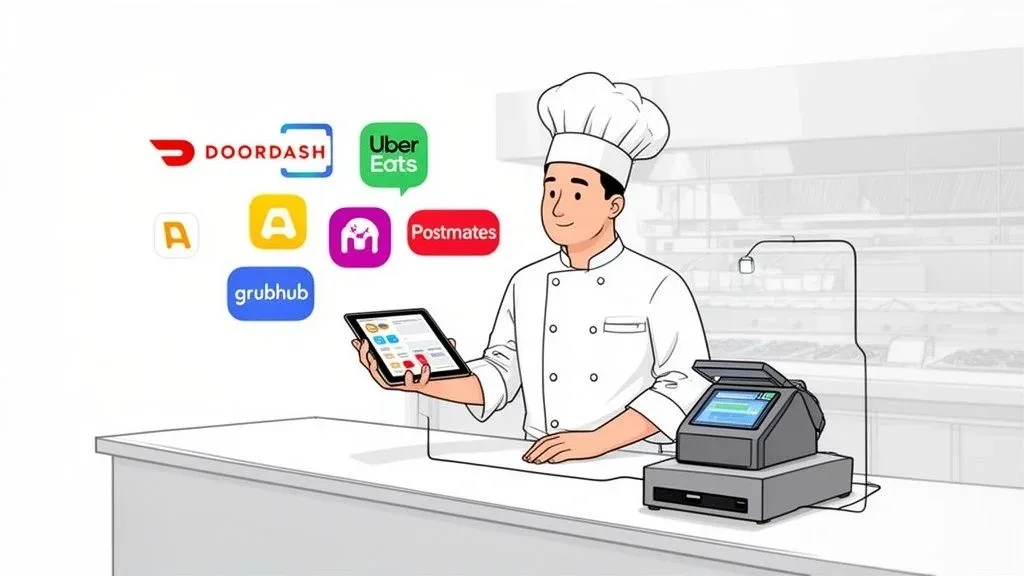
Scouting the right popular food delivery apps is the first step, but integrating them into your workflow is what cuts order errors, boosts staff productivity, and drives revenue. This guide offers actionable insights for restaurant owners, managers, and operators on how to turn delivery chaos into operational efficiency. You will learn:
- Market reach and typical customer profiles for leading platforms like Uber Eats and DoorDash.
- How to connect these apps directly to your Point of Sale (POS) system.
- Why POS integration matters for restaurant efficiency, cost savings, and staff productivity.
- Real-world examples of connecting apps to POS systems like Clover and Square.
- How automation reduces errors and saves time on every single order.
Each section breaks down a popular food delivery app and explains, in simple terms, why connecting it to your restaurant’s systems is critical. We’ll show you how automating your orders saves money, reduces staff stress, and improves the customer experience. We’ll also cover practical tips, like using the right Guide to Thermal Bags for Food Deliveries, to ensure food arrives fresh every time.
This guide provides:
- Clear comparisons of top delivery apps.
- Actionable steps to connect apps to your POS for better restaurant delivery.
- Key takeaways on time savings and error reduction.
- A practical next step to improve your restaurant operations today.
Let’s dive into the top platforms and explore how to make them work for your business, not against it.
1. Uber Eats: Global Reach and a Massive User Base
Uber Eats leverages a huge, built-in user base that already trusts the Uber brand. For restaurants, this means you can instantly reach millions of potential customers, making it one of the most popular food delivery apps for driving a high volume of orders.
Why It Matters for Restaurant Operations
Simply put, more orders can lead to more chaos. Without a direct connection to your restaurant’s Point of Sale (POS) system, your staff has to manually type every Uber Eats order from a tablet into your register. This is slow, tedious, and a major cause of mistakes, especially during a busy service. This manual work directly hurts your restaurant efficiency.
Actionable Insight for POS Integration
The solution is to automate the process. A direct POS integration sends Uber Eats orders straight to your kitchen printer, just like an order from a server. For example, using a service like OrderOut, you can connect Uber Eats directly to your Clover or Square POS. This single, actionable step has immediate benefits:
- Error Reduction: It eliminates typos and mistakes from manual entry, leading to more accurate orders.
- Time Savings: It saves your staff 3-5 minutes per order, freeing them up to serve in-house guests.
- Staff Productivity: It reduces stress and allows your kitchen to focus on cooking, not deciphering tablets.
By integrating this popular food delivery app, you turn high order volume into pure profit instead of an operational headache.
2. DoorDash: U.S. Market Leader with Suburban Strength
DoorDash is the biggest player in the U.S., giving restaurants access to a massive customer base, especially in suburban areas. Its popular DashPass subscription service encourages frequent ordering, making it a vital channel for growing your delivery business.
Why It Matters for Restaurant Operations
The massive volume from DoorDash can overwhelm your staff. Every order that comes in on the DoorDash tablet must be manually re-entered into your main POS system. This slows down your kitchen, creates opportunities for costly mistakes, and can lead to negative customer reviews when orders are wrong or delayed. This directly impacts your restaurant’s bottom line.
Actionable Insight for POS Integration
To handle DoorDash’s volume efficiently, you need to connect it directly to your POS. This is a core principle of modern food tech. An integration solution sends orders from the app straight to your kitchen, appearing on a Square or Clover system just like a dine-in ticket. This is a practical, quick-to-implement solution that:
- Increases Staff Productivity: Frees up your team from being glued to a tablet, allowing them to focus on service.
- Reduces Errors: Ensures the order the customer placed is exactly what your kitchen sees.
- Saves Time: Speeds up your entire delivery workflow, resulting in happier customers.
Automating your DoorDash orders is an actionable step that improves restaurant delivery speed and accuracy.
3. Grubhub: Capturing Urban and Corporate Diners
Grubhub has a strong foothold in big cities and college towns. Its partnership with Amazon Prime, giving members a free Grubhub+ subscription, connects restaurants to a large group of loyal, high-value customers.
Why It Matters for Restaurant Operations
Grubhub often brings in large corporate or group orders, which are great for revenue but can be complex. Manually entering a large, customized order from a tablet into your POS is a recipe for disaster. One small mistake can ruin a big order, costing you money and a valuable corporate client. This manual process is a major bottleneck in your restaurant operations.
Actionable Insight for POS Integration
Connecting Grubhub to your POS is the most effective way to manage these orders. In simple terms, this automation makes Grubhub orders appear in your kitchen just like any other. For example, a business like DoorDash uses a vast driver network to fulfill orders; similarly, an integration service uses technology to fulfill the data transfer from Grubhub to your POS. This practical step helps you:
- Reduce Errors: Drastically cuts down on mistakes, especially on large, complicated group orders.
- Save Time: Your staff no longer needs to waste time typing in long orders, boosting kitchen efficiency.
- Improve Staff Productivity: Allows your team to manage high-value orders without the stress of manual entry.
This integration is a key piece of food tech that makes your restaurant delivery process smoother and more profitable.
4. Seamless: Tapping into the NYC Market Legacy
Seamless is a powerhouse in New York City and is owned by Grubhub. This means if you’re on Grubhub, you’re also on Seamless, giving you access to a huge, loyal base of city diners without any extra work.
Why It Matters for Restaurant Operations
Because Seamless runs on Grubhub’s system, it comes with the same problem: the separate tablet. Your staff has to watch the tablet and manually punch every Seamless order into your POS. In a fast-paced market like NYC, those seconds wasted on every order add up quickly, leading to delays and mistakes that can damage your reputation with loyal customers.
Actionable Insight for POS Integration
The solution is to connect your Grubhub/Seamless account directly to your POS. This is a simple concept: make the technology do the work for you. Using an integration tool, Seamless orders can be sent straight to your Clover or Square POS system, eliminating the tablet. This is an actionable insight you can implement quickly to:
- Save Time: Instantly frees up staff from manual data entry during your busiest hours.
- Reduce Errors: Guarantees order accuracy, which is crucial for retaining demanding urban customers.
- Boost Staff Productivity: Lets your team focus on preparing food and serving guests, not managing tablets.
This POS integration is essential for efficient restaurant operations in any competitive market.
5. Caviar (by DoorDash): Targeting a Premium Foodie Audience
Caviar, owned by DoorDash, is a curated platform for high-end, independent restaurants. It attracts “foodie” customers who are willing to pay more for quality, making it a great choice for unique, chef-driven concepts.
Why It Matters for Restaurant Operations
While Caviar brings in higher-value orders, it still operates on the DoorDash system, meaning you get another tablet. For a premium restaurant, manual order entry is not just inefficient—it’s a risk to your brand. A mistake on an order can damage the high-end experience you promise, undermining the very reason customers choose you on Caviar.
Actionable Insight for POS Integration
To protect your brand and maintain efficiency, connecting Caviar to your POS is a must. Think of it as ensuring your high standards extend to your delivery process. By integrating Caviar with your Clover or Square POS, every order is processed with the same precision as a dine-in ticket. This food tech solution delivers significant benefits:
- Cost Savings: Prevents costly mistakes that lead to remaking dishes and issuing refunds.
- Error Reduction: Upholds your reputation for quality by ensuring every order is perfect.
- Staff Productivity: Allows your team to focus on creating premium food, not on administrative tasks.
This integration is a practical step to ensure your restaurant delivery experience matches your in-house quality.
6. Postmates (by Uber): Diversified Delivery and Brand Recognition
Postmates, now part of Uber, is known for delivering anything, not just food. This broad appeal means you can reach a wider audience that uses the app for all their local delivery needs.
Why It Matters for Restaurant Operations
Because Postmates uses Uber’s technology, it comes with the same operational challenge: the separate tablet. Every Postmates order requires manual entry into your POS. This repetitive task slows down your kitchen and is a prime source of errors, especially when your team is juggling orders from multiple apps at once.
Actionable Insight for POS Integration
The actionable solution is direct POS integration. Connecting Postmates to your POS system, like Clover or Square, automates the entire process. Just as Uber Eats streamlines the customer’s ordering experience, this integration streamlines your kitchen’s workflow. The benefits are clear:
- Error Reduction: Eliminates manual mistakes, ensuring customers get exactly what they ordered.
- Time Savings: Saves precious minutes on every order, which adds up to hours of saved labor each week.
- Improved Staff Productivity: Lets your team handle more orders with less stress and greater accuracy.
This is a simple yet powerful way to improve your restaurant operations and capitalize on the Postmates brand.
7. delivery.com: The All-in-One Local Marketplace
Delivery.com is more than a food app; it’s a local marketplace for food, groceries, liquor, and even laundry. This attracts customers who value convenience, giving your restaurant a chance to reach them as they run their daily errands online.
Why It Matters for Restaurant Operations
While delivery.com offers access to a loyal customer base, it adds another tablet to your counter. Juggling yet another screen, especially for a platform that might have lower order volume than the giants, makes your workflow even more complicated. This manual management of multiple platforms is a major drain on restaurant efficiency.
Actionable Insight for POS Integration
To make niche platforms like delivery.com worthwhile, you must integrate them into your main workflow. Connecting it to your Clover or Square POS means you can accept these orders without any extra manual work. Think of how a POS system like Square centralizes payments; this integration centralizes your orders. This practical step allows you to:
- Increase Revenue Streams: Easily add another sales channel without adding more work for your staff.
- Reduce Errors: Prevents mistakes that can happen when your team is trying to watch multiple tablets.
- Boost Staff Productivity: Keeps your kitchen focused on one unified stream of orders.
This is a smart food tech strategy for managing multiple restaurant delivery partners efficiently.
8. ChowNow: The Restaurant-Friendly, Commission-Free Model
ChowNow offers a commission-free model, where restaurants pay a flat monthly fee instead of a percentage of each order. This helps independent restaurants keep more of their profits and build direct customer relationships.
Why It Matters for Restaurant Operations
ChowNow’s great pricing model is a huge plus, but it doesn’t solve the operational problem. It still uses a separate tablet, forcing your staff to manually enter orders into your main POS system. This creates the same risk of errors and slowdowns as commission-based apps, undermining some of the cost savings you gain.
Actionable Insight for POS Integration
To truly benefit from ChowNow’s model, you need to pair it with operational efficiency. Connecting ChowNow to your POS system automates the order flow, sending orders directly to your kitchen. For instance, you can integrate it with POS systems like Square or Clover to make it completely hands-free. This actionable step ensures you:
- Maximize Profitability: Combine commission-free orders with labor cost savings from automation.
- Eliminate Errors: Ensure every order is accurate without manual oversight.
- Improve Staff Productivity: Let your team focus on food and service, not on administrative tasks.
This POS integration is the key to making this restaurant-friendly platform a truly powerful tool for your business.
9. Slice: Championing Local Pizzerias
Slice is a specialized marketplace designed specifically for local pizzerias. It connects thousands of independent pizza shops with customers who are actively looking for authentic, local pizza, giving you a direct line to your target audience.
Why It Matters for Restaurant Operations
Slice brings you the right customers, but it also brings another tablet. During a Friday night pizza rush, having to manually punch in every Slice order—with all its topping choices and special requests—is a recipe for mistakes. A single wrong topping can lead to a costly remake and an unhappy customer.
Actionable Insight for POS Integration
To handle the rush without the errors, integrate Slice directly with your POS. This means every order from the Slice app prints out in your kitchen just like a phone order. Connecting Slice to your Clover or Square POS is a game-changer for pizzerias. For example, a POS like Clover can manage inventory for toppings; integrating Slice ensures those orders are tracked correctly. This practical step helps you:
- Save Money: Eliminates costly mistakes from manual entry, like wrong sizes or toppings.
- Save Time: Speeds up your order process, allowing you to make more pizzas during peak hours.
- Improve Staff Productivity: Frees up your front-of-house staff to manage customers instead of tablets.
This food tech solution is essential for any pizzeria looking to streamline its restaurant delivery operations.
10. ezCater: Dominating the Corporate Catering Niche
ezCater is built for the corporate catering market, connecting restaurants with businesses that need food for meetings and events. This platform is all about high-value, large-format orders, giving you access to a very profitable B2B audience.
Why It Matters for Restaurant Operations
Catering orders are large, complex, and high-stakes. A mistake on a $1,000 order is much more damaging than on a $20 meal. Manually managing these orders—from special requests to precise delivery times—is stressful and risky. It’s a huge drain on your team’s time and a major threat to your restaurant’s efficiency.
Actionable Insight for POS Integration
To handle high-value catering orders safely and efficiently, automation is key. Integrating ezCater with your POS system ensures that every detail of a large order is captured accurately and sent to your kitchen automatically. For example, POS systems like Clover or Square are designed to handle complex orders; this integration ensures ezCater orders fit right in. This actionable step allows you to:
- Reduce Costly Errors: Prevents mistakes on big-ticket orders that can destroy your profit margin.
- Improve Staff Productivity: Automates the administrative work of catering so your team can focus on execution.
- Grow Profitably: Scale your catering business without adding more manual labor and stress.
This POS integration is a critical piece of food tech for any restaurant serious about capturing the lucrative catering market.
11. Favor Delivery: Hyper-Local Texas Dominance
Backed by Texas grocery giant H-E-B, Favor Delivery has a massive and loyal customer base across the state. For Texas restaurants, it’s a powerful way to connect with local diners who already trust the Favor brand.
Why It Matters for Restaurant Operations
Even with its strong local focus, Favor adds another tablet to your workflow. Manually entering orders from the Favor app into your POS system slows down service, increases the chance of errors, and pulls your staff’s attention away from dine-in customers. This inefficiency is a direct hit to your restaurant’s productivity.
Actionable Insight for POS Integration
To tap into Favor’s loyal Texas market without the hassle, direct POS integration is the answer. Connecting Favor Delivery to your POS system automates the entire process. Just as H-E-B is a one-stop shop for groceries, this integration creates a one-stop system for all your orders. This practical, time-saving solution helps you:
- Reduce Errors: Ensures every order is accurate, keeping your local customers happy.
- Save Time: Speeds up your order fulfillment process, which is key during busy meal rushes.
- Boost Staff Productivity: Lets your team focus on providing great service instead of managing technology.
This integration transforms this popular regional app into a seamless part of your restaurant operations.
Top 11 Food Delivery Apps — Feature Comparison
Service Core features ✨ Quality ★ Value / Price 💰 Target 👥 USP / Notes 🏆 Uber Eats Nationwide delivery, grocery & retail, real‑time tracking ★★★★☆ 💰 Uber One savings; fees vary by market 👥 Broad mass market users 🏆 Largest selection; strong Uber ecosystem DoorDash Restaurant + DashMart micro‑fulfillment; DashPass ★★★★☆ 💰 DashPass reduces delivery on eligible orders 👥 Frequent delivery shoppers 🏆 Wide U.S. coverage & same‑day retail Grubhub Delivery & pickup; corporate ordering; Grubhub+ ★★★☆☆ 💰 Grubhub+ (Prime tie‑ins); fees vary 👥 Urban diners & corporate buyers 🏆 Strong web/corporate features; Prime integration Seamless (by Grubhub) Real‑time tracking; Grubhub+ benefits; NYC promos ★★★★☆ 💰 Grubhub+ applies; market‑dependent fees 👥 NYC & metro users 🏆 High NYC brand affinity & local promotions Caviar (by DoorDash) Curated upscale restaurants; Michelin/Zagat signals ★★★★☆ 💰 Premium menus; DashPass eligible on some orders 👥 Foodies & premium diners 🏆 Curated, higher‑end restaurant discovery Postmates (by Uber) Multi‑category (food/grocery/retail); 24/7 in many areas ★★★★☆ 💰 Frequent promos; fees vary by city 👥 Multi‑category shoppers 🏆 Broad category coverage + strong app ratings delivery.com Restaurants, alcohol, groceries, laundry/dry cleaning ★★★☆☆ 💰 Deals available; coverage patchy by city 👥 Local errand & food shoppers 🏆 One account for mixed errands & orders ChowNow Direct ordering for independents; commission‑friendly model ★★★★☆ 💰 Restaurant‑friendly / lower commission 👥 Supporters of local restaurants 🏆 Good economics for independents Slice Pizza‑focused UX, Pizza Points rewards, POS tools ★★★★☆ 💰 Pizzeria‑friendly fees; rewards for repeat orders 👥 Local pizza lovers & pizzerias 🏆 Best niche platform for independent pizzerias ezCater Catering search by headcount/budget; nationwide caterers ★★★★★ 💰 Catering fees vary; sized for larger tickets 👥 Offices & event planners 🏆 Purpose‑built, reliable corporate/group ordering Favor Delivery Texas‑focused delivery; H‑E‑B integration; Favor Gold ★★★★☆ 💰 Favor Gold membership perks; market‑specific fees 👥 Texans & H‑E‑B shoppers 🏆 Deep Texas localization & H‑E‑B ecosystem
Your Next Step: From Managing Chaos to Driving Profit
Navigating the landscape of popular food delivery apps isn’t just about getting listed on platforms like DoorDash or Uber Eats. The real key to success is how you manage the orders they bring in. For most restaurants, this means a chaotic counter full of tablets, with staff constantly re-typing orders into the main POS system. This manual process is slow, stressful, and expensive. Every mistake costs you money in wasted food and unhappy customers.
Key Takeaways for Your Restaurant’s Success
The single most important lesson is that automation through POS integration is the key to a profitable delivery business. A smart restaurant delivery strategy eliminates manual work, reduces errors, and frees up your staff to focus on what matters: great food and service.
Here are the critical takeaways:
- Manual Entry is Your Enemy: It wastes time, causes expensive mistakes, and burns out your staff. The cost of one incorrectly made large order can wipe out the profits from dozens of others.
- POS Integration is Your Solution: Connecting your delivery apps directly to your POS system is the most impactful change you can make. It creates one streamlined workflow for all orders, whether they come from DoorDash, Grubhub, or a customer at the counter.
- Efficiency Drives Profit: By saving time and eliminating errors, you directly increase your profit margins. To understand how these savings impact your bottom line, it’s helpful to use tools like a restaurant profit margin calculator.
Your Actionable Path Forward
The path to better restaurant operations is clear: centralize and automate. Instead of juggling multiple tablets, you need a single, unified system.
Your Practical Next Step: Implement a POS integration solution. This is the most direct way to improve your restaurant’s efficiency. A tool like OrderOut acts as the bridge between all your delivery apps (Uber Eats, DoorDash, etc.) and your POS system (like Clover or Square). It automatically accepts orders and sends them directly to your kitchen printer, eliminating tablets and manual entry forever. This is the actionable insight that will transform your delivery business from a source of stress into a streamlined source of revenue.
Ready to eliminate manual entry and see how much time and money you can save? OrderOut connects all your delivery apps directly to your POS system, turning operational chaos into streamlined profit. You can start onboarding for Free in just a few clicks by visiting https://dashboard.orderout.co today.