
Powerful Pizza Description Words to Boost Your Sales
· Thibault Le Conte
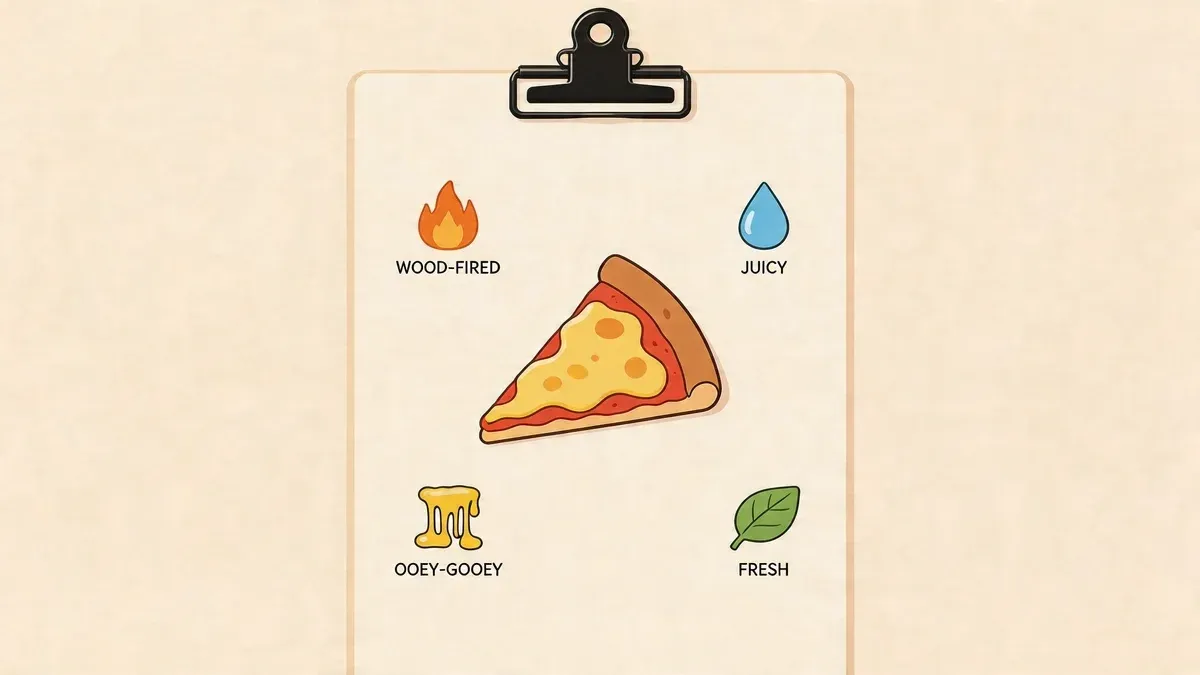
A customer opens Uber Eats on a Friday night. Your shop appears next to five other pizza places. One menu says “Pepperoni Pizza.” Another says “Artisanal pepperoni pizza with wood-fired crispy crust and fresh mozzarella.” Most owners already know which listing sounds stronger.
What gets missed is why the second one works. Better pizza description words don’t just make food sound good. They shape what customers expect, what they’re willing to pay, and how clearly your team can execute the order across in-house service, restaurant delivery, and POS integration. On a crowded marketplace, words become part of the product.
That matters because pizza is already one of the biggest categories in foodservice. The global pizza market reached US$128 billion in 2017, with the US at $44 billion across about 76,000 pizzerias. If you run a pizzeria, you’re not fighting for demand. You’re fighting for attention, clarity, and margin inside a huge existing market.
The practical problem is simple. Many restaurants still write menu copy like inventory labels. “Large veggie.” “Thin crust.” “Special pizza.” That kind of wording doesn’t help the buyer choose, and it doesn’t help staff interpret modifiers consistently in Clover, Square, Uber Eats, DoorDash, or Grubhub. Good pizza description words solve both problems. They increase perceived quality and make menu data more precise.
If you need a baseline for stronger menu writing, this guide on how to write a product description that sells is a useful companion. What follows is more specific to pizza. These are the words I’d prioritize first if the goal is higher conversion, fewer order errors, and cleaner menu sync across delivery apps and POS systems.
1. Crispy
“Crispy” is one of the safest high-performing pizza description words because it answers a delivery fear before the customer asks the question. Nobody wants a limp slice after a twenty-minute ride in a delivery bag. If your crust holds texture, say it clearly.
This word works best when it names where the texture happens. “Crispy crust” is decent. “Crispy edges,” “crispy bottom,” and “crispy thin crust” are better because they paint a more accurate picture. That extra clarity helps guests choose and helps staff understand what the item is supposed to be.
Why crispy sells in restaurant delivery
On delivery apps, texture words do heavy lifting. They replace the sensory cues customers lose when they can’t smell the oven or see the pie leave the pass. “Crispy” signals structure, heat retention, and quality control.
I’d also pair it with the cooking method whenever possible. “Wood-fired crispy crust” is stronger than “crispy crust” because it combines texture and technique in one line. If you post pizza content on social, the same wording often carries over well into promos and captions, especially if your team is already using ideas like these food captions for Instagram.
Practical rule: Don’t use “crispy” on every pizza. Use it only where the crust consistently arrives that way.
That’s the trade-off. If you label a soft New York-style slice as crispy, you create disappointment. If you label a pan pizza’s cheese edge or a thin-crust pie as crispy, you reinforce what the product already does well.
What works and what doesn’t
A few quick examples make this easier:
- Works well: “Brick-oven pizza with crispy edges and a chewy center”
- Works well: “Thin-crust pepperoni with crispy bottom”
- Doesn’t work: “Crispy” on heavily sauced pizzas that steam in the box
- Doesn’t work: “Extra crispy” if your kitchen line can’t produce it consistently during rushes
Operationally, crispy items also need good packaging and cleaner prep timing. If you integrate delivery orders into POS instead of retyping them, your kitchen can fire those pizzas faster and box them sooner. That matters because a late handoff turns “crispy” into “soggy” fast.
I also like using “crispy” in combo language. “Crispy outside, chewy inside” feels specific and credible. It’s stronger than vague praise like “delicious crust,” which says almost nothing.
2. Artisanal
Friday at 7:15 p.m., a guest is staring at two pizzas on a delivery app. One is a standard pepperoni. The other costs a few dollars more and says “artisanal.” That word has to answer the obvious question fast. Why is this one worth more?
“Artisanal” works as a margin word when the product gives you proof. It signals extra labor, tighter sourcing, or a longer process. Used well, it helps customers accept a higher price without feeling sold to. Used loosely, it reads like filler and makes the whole menu less credible.
Where artisanal earns its keep
I recommend “artisanal” only for pizzas with visible craft in the build or process. Hand-stretched dough, longer fermentation, house sauce, fresh-pulled mozzarella, or a more careful topping combination can justify it. Those details give the word weight and protect your price point.
The trade-off is simple. Premium language raises expectations. If the pizza is built for speed, heavy discounting, and exact uniformity, “artisanal” can create friction instead of demand. Customers expect a story behind that word, and staff need enough product knowledge to support it.
This descriptor also works well as a menu architecture tool. Put high-touch pies in a separate “Artisanal Pizzas” category on first-party ordering and third-party delivery platforms. That small labeling choice does two jobs. It makes premium items easier to find, and it gives your POS team a cleaner way to group recipes, modifiers, and reporting around higher-margin products.
How to make the word believable
Specific language does the heavy lifting:
- Process terms: “Hand-stretched dough,” “slow-fermented crust,” “small-batch tomato sauce”
- Ingredient terms: “Imported Italian tomatoes,” “artisan mozzarella,” “house-roasted garlic”
- Menu discipline: Reserve “artisanal” for signature pies and limited builds
Restraint matters here. If every pizza is artisanal, none of them are.
I also watch how this word flows into operations. If the front-end description promises a crafted pizza, the back-end setup should be just as clear. Item names, modifier groups, and prep notes need to match the sales language across your POS, online ordering, and delivery channels. That reduces manual interpretation, limits ticket errors, and keeps the premium item looking premium after the order leaves the screen and hits the line.
A good “artisanal” description does more than sound upscale. It supports higher average check, cleaner menu segmentation, and better execution.
3. Fresh
“Fresh” is one of the most overused words in restaurant marketing. It still works, but only when it’s attached to a real ingredient or action. “Fresh pizza” means nothing. “Fresh basil,” “fresh mozzarella,” and “made fresh to order” mean something.
This word matters because delivery customers worry about quality decline. They can’t inspect the pizza before they buy. “Fresh” reduces that uncertainty when you use it with precision.
Fresh works best when it names the ingredient
Think in nouns, not slogans. “Fresh basil daily” is useful. “Fresh local vegetables” is useful. “Freshly made dough” is useful. “Only the freshest ingredients” is filler.
That distinction matters in restaurant operations too. Specific menu wording reduces ambiguity for prep, substitution, and training. If your menu says “fresh mozzarella,” the prep team knows which cheese belongs on that item. If your menu just says “cheese,” mistakes become more likely during a busy Friday service.
Fresh is strongest when it answers a customer question and a line cook question at the same time.
Pizza remains an everyday habit for a huge audience. In the United States, 13% of people age two and older eat pizza on any given day. In a category with that much repeat ordering, clear language matters because customers compare options fast and reorder based on consistency.
Better uses of fresh in food tech menus
If I were rewriting a menu, I’d tighten “fresh” like this:
-
Weak: Fresh veggie pizza
-
Better: Thin-crust veggie pizza with fresh mushrooms, onions, and basil
-
Weak: Fresh margherita
-
Better: Margherita with fresh mozzarella, basil, and tomato sauce
-
Weak: Fresh ingredients
-
Better: Made fresh to order with hand-finished basil
The operational angle is simple. Faster order transmission helps “fresh” stay true. When delivery tickets move directly into your POS and kitchen workflow, staff spend less time re-entering app orders and more time producing food. That shortens the gap between purchase and oven, which supports the promise your menu made.
4. Authentic
“Authentic” is a trust word. Customers read it as a claim about heritage, method, or style. If you use it loosely, it backfires. If you use it carefully, it can separate your shop from a sea of generic listings.
The safest way to use it is to tie it to a recognizable style. “Authentic Neapolitan,” “authentic Detroit-style,” or “authentic New York-style” tells the buyer what tradition you’re referencing. The word works because it implies discipline. It says your pizza follows a known playbook, not just a random topping set.
Why authenticity needs proof
I tell operators to ask one question before adding “authentic” anywhere: authentic to what? If the answer isn’t obvious, the word probably shouldn’t be there.
Good support details include origin, method, and family or shop heritage. “Authentic Neapolitan pizza with traditional wood-fired technique” is stronger than “authentic Italian pizza.” “Authentic Detroit-style with caramelized cheese edge” is stronger than “authentic square pizza.”
Pizza’s history gives this word real weight. The term “pizza” first appeared in 997 AD in Gaeta, Italy. That long lineage is exactly why guests react strongly to claims of authenticity. They expect substance behind the word.
Where authentic helps restaurant operations
“Authentic” also works as a menu-organization tool. Grouping pizzas by style helps customers self-select faster on delivery apps. It also helps staff route production properly. A Detroit-style pie, a New York-style pie, and a Neapolitan-style pie don’t move through the kitchen the same way.
Here’s where many shops miss the operational benefit. They sell “authentic” on the front end but structure the backend menu by generic categories and vague abbreviations. That creates confusion on the make line and weakens the customer promise. If you say “authentic,” your item names, station prep, and modifier rules should reflect that style clearly in the POS.
Use “authentic” to narrow the customer’s expectation, not to widen your marketing language.
I also like “authentic” when educating newer delivery customers. A short description can carry a lot of value: “Authentic Detroit-style pizza baked in a deep pan with crisp cheese edges.” That tells people what they’re buying and why it’s priced the way it is.
5. Wood-Fired
“Wood-fired” is one of the strongest pizza description words because it does three jobs at once. It signals cooking method, flavor, and premium positioning. Customers immediately picture heat, char, and a more handcrafted result.
That’s useful online because method words cut through generic menu clutter. “Pepperoni pizza” is forgettable. “Wood-fired pepperoni with charred edges” feels deliberate.
Why wood-fired can command a higher ticket
This word often supports premium pricing because it implies a more specialized process and a tighter production window. Customers also associate it with better crust texture and a more distinct finish. If your pizza really does come out with blistering, char, or smoky depth, say so.
The phrasing matters. “Wood-fired” is stronger when paired with the result:
- Wood-fired crust with charred edges
- Wood-fired pizza with smoky depth
- Wood-fired margherita with blistered crust
The broader market context helps explain why these style words matter. A pizza market forecast projects the global category at USD 282.91 billion in 2025 and USD 340.91 billion by 2034. In a category that large, differentiation isn’t optional. Method-based words like “wood-fired” help a restaurant stand out without inventing a whole new product.
What operators need to watch
The trade-off is speed. Wood-fired pizzas usually punish operational sloppiness. They need tighter pacing from order acceptance to oven to handoff. If an Uber Eats or DoorDash order sits because someone has to manually re-enter it from a tablet, the product loses the very qualities the menu promised.
That’s why this word has to connect to restaurant delivery systems, not just marketing. Direct menu sync and order routing keep the oven flow cleaner. Your team doesn’t need to bounce between tablets and the POS while a fast-cooking pizza waits.
A short look at proper oven handling also helps customers understand the appeal:
I also like pairing “wood-fired” with a style descriptor if your brand supports it. Terms from other cuisines and high-tech menu writing often work the same way. This overview of teppanyaki take-out is a good reminder that method words often sell as hard as ingredient words.
6. Loaded
“Loaded” is a value word. It tells the customer they’re getting abundance. That matters when you want to boost perceived value without competing only on discounting.
Used well, “loaded” can increase average ticket because it makes specialty builds feel fuller and more satisfying. It’s especially effective for meat-heavy pies, veggie-heavy pies, and indulgent app-friendly combinations.
Loaded needs specifics
The mistake is stopping at the word itself. “Loaded pizza” is vague. “Loaded with three meats,” “loaded with fresh vegetables,” or “loaded with pepperoni, sausage, and onions” gives the customer something concrete.
North American pizza sales are closely tied to topping preference and menu segmentation. In one market outlook, pepperoni ranked highest among topping preferences, followed by sausage, mushrooms, extra cheese, and onions, while thin crust held a 40% share in that source’s segmentation. For operators, the lesson is simple. “Loaded” works best when the toppings listed match what customers already buy most often.
How loaded changes ordering behavior
There are two common ways I’d use this word:
- For indulgence: “Loaded meat pizza with pepperoni, sausage, and extra cheese”
- For value: “Loaded veggie pizza with mushrooms, onions, peppers, and olives”
What doesn’t work is using “loaded” on pizzas with sparse coverage. Customers notice that immediately, especially in delivery photos. If your food cost or prep process doesn’t support a visibly full build, choose another word.
Operator note: “Loaded” should show up in the box, not just on the screen.
This is also where clean POS configuration matters. Loaded pizzas often come with more modifiers and add-ons, which means more room for entry mistakes if your team is rekeying orders from multiple delivery apps. Consolidated order flow helps because topping-heavy builds are exactly where manual transcription tends to break down.
I’d also keep “loaded” away from premium minimalist styles. A burrata-and-basil pie probably wants “gourmet” or “artisanal,” not “loaded.” The word suggests generosity first, refinement second.
7. Specialty
“Specialty” is a differentiation word. It tells the customer this pizza isn’t the default build. It’s a signature, a house favorite, or a combination they probably won’t find everywhere else.
That’s valuable because standard pizzas compete on familiarity. Specialty pizzas compete on curiosity and margin. If your house creations are strong, “specialty” helps frame them as intentional choices rather than random topping piles.
Why specialty supports repeat business
A well-named specialty pizza gives customers a reason to come back. It also makes your menu more memorable on delivery apps. “Specialty pizza” isn’t enough by itself, though. The name and the ingredients have to do the main work.
I prefer formats like “The Brooklyn Special,” “House Specialty,” or “Chef’s Specialty Pie” followed by a clean ingredient list. Customers should understand the concept fast. Staff should know exactly what belongs on it.
One underserved opportunity in pizza menus is using richer description language to improve conversion. A recent angle highlighted the gap between basic menu wording and stronger sensory terms on delivery apps, noting that only a small share of pizzeria menus use advanced descriptors beyond basics like “extra cheese” or “thin crust” in that discussion of pizza vocabulary for pizza lovers. Even without leaning on every flourish, operators can do more with specialty naming than most currently do.
What strong specialty wording looks like
Try this structure:
- Distinctive name: “The Market Square”
- Style cue: “House specialty pizza”
- Ingredient clarity: “Roasted mushrooms, burrata, arugula, and chili oil”
If you want ideas on creating items people talk about, these examples of restaurant secret menus show why named, memorable menu items often outperform bland category labels.
The trade-off with specialty pizzas is operational complexity. Too many one-off builds slow the line, increase prep waste, and create modifier confusion. I usually recommend a focused specialty group with clean naming and strong photos, not a giant list of barely differentiated pies.
8. Gourmet
“Gourmet” is a premium filter. It tells the customer this pizza uses more refined ingredients, more selective sourcing, or a more elevated flavor profile. It’s the right word when you want to attract the guest who’s choosing between pizza and a higher-end dinner option.
It can work very well on delivery apps because it helps a pizza break out of the commodity category. Instead of competing against every pepperoni pie on the screen, you’re competing for a different decision. A more premium, treat-oriented order.
Gourmet needs ingredient proof
Like “artisanal,” this word can feel empty if you don’t back it up. “Gourmet pizza” is weak. “Gourmet burrata, truffle oil, and arugula” or “gourmet imported Italian ingredients” is stronger because the customer can see where the premium comes from.
That matters in a market where menu language is getting more refined. Forecasts for pizza trends emphasize terms such as customizable, vegan or gluten-free, and fusion-style in a category where US pizza restaurant revenue is described at $49.5B in that 2026-focused outlook. For operators, the lesson is straightforward. Premium buyers don’t just want better ingredients. They want better language around those ingredients.

Where gourmet works best in food tech menus
I like “gourmet” in a few situations:
- High-end signature pizzas
- Limited seasonal pies
- Date-night or wine-friendly menu sections
- Plant-based or fusion builds that need stronger framing
If you want that premium section to perform, support it with strong visuals and clean platform data. As a result, many teams lose sales. The menu copy says “gourmet,” but the image is weak, the modifier options are messy, and the same item appears differently in every ordering channel. Consistency matters.
For operators watching broader demand shifts, premium positioning also intersects with catering and group ordering trends. This roundup of catering food trends is worth reviewing if you’re building a gourmet pizza line for office lunches, events, or higher-value bundled orders.
I’d also use “gourmet” selectively. If every pizza is gourmet, none of them are. The word only works when it creates contrast inside the menu.
Comparison of 8 Pizza Descriptors
Descriptor Implementation Complexity 🔄 Resource Requirements ⚡ Expected Outcomes ⭐ Ideal Use Cases 💡 Key Advantages 📊 Crispy Low–Medium: simple technique changes; consistency through delivery can be hard Low: standard ovens; may need improved packaging ⭐ Moderate–High: enhanced mouthfeel and perceived quality Delivery-focused menus, crust-forward items 📊 Widely understood; boosts perceived value without price hike Artisanal Medium–High: requires hand techniques and longer processes Medium–High: skilled labor, time, specialty ingredients ⭐ High: premium perception and higher margins Upscale, small-batch offerings and premium delivery segments 📊 Differentiates from chains; creates emotional connection Fresh Medium: supply-chain and prep timing must be managed Medium: reliable ingredient sourcing and inventory turnover ⭐ Very High: builds trust and drives purchase decisions All styles; health-conscious and delivery-first menus 📊 Most persuasive descriptor; verifies food safety and quality Authentic High: requires demonstrated traditional methods and certifications High: specific ingredients, training, possible certifications ⭐ High: strong brand credibility and loyal customers Regional-style pizzerias, heritage-focused concepts 📊 Establishes authority; reduces price-based competition Wood-Fired High: specialized ovens and tight timing coordination High: capital investment and operational oversight ⭐ High: distinctive smoky flavor and premium positioning Premium dine-in concepts and curated delivery with quick timing 📊 Justifies significant price premium; memorable flavor profile Loaded Low: simple to implement but needs balance to avoid overload Medium: more toppings inventory and tracking ⭐ Moderate: perceived value and larger order sizes Value lines, upsells, appetite-driven combos 📊 Increases ticket size; clearly communicates abundance Specialty Medium–High: development and reproducibility are required Medium: unique ingredients and inventory management ⭐ High: drives interest, social shares, and higher margins Featured menu items, chef-signatures, seasonal rotations 📊 Highlights high-margin items; encourages repeat visits Gourmet High: refined techniques and consistent execution needed High: premium ingredients and skilled staff ⭐ Very High: prestige and willingness to pay premium prices Fine-dining, affluent-targeted delivery, curated pairings 📊 Enables substantial price premiums and brand elevation
Your Next Step Turn Powerful Words into Profit
Friday night, the rush hits, and the same pizza appears three different ways across your dining menu, POS, and delivery apps. One says “specialty.” Another says “loaded.” A third shortens the item so much that the guest cannot tell whether it includes sausage or prosciutto. That language problem quickly becomes an operations problem.
Good pizza description words do two jobs at once. They sell the pie, and they set a clear production standard for the team. If you call a pizza “wood-fired,” guests expect blistered crust and a light smoky note. If you call it “fresh mozzarella and basil,” the customer expects visible, identifiable ingredients, not generic shredded cheese and dried herbs. Specific language protects trust, reduces order disputes, and gives you a stronger reason for premium pricing.
It also affects speed.
Clear descriptions cut down on guest hesitation, fewer staff clarifications, and fewer remakes caused by mismatched expectations. That matters even more when orders flow in from your website, in-house POS, and third-party delivery channels at the same time. The stronger the wording, the easier it is to keep the front end and back end aligned.
The practical rule is simple. Every descriptor should earn its place on the menu. “Crispy” should point to a crust style or bake. “Authentic” should connect to a regional method or ingredient choice. “Gourmet” should be backed by a premium component customers can recognize. Empty praise wastes space. Precise words improve conversion.
Operators should treat menu copy as structured data, not just branding. Once a pizza name and description are set, that same wording should appear consistently in the POS, online ordering, and delivery listings. Consistency reduces manual edits, keeps modifiers cleaner, and lowers the risk of one platform selling a different product than the kitchen makes.
Start with an audit of your top sellers. Remove vague labels like “special pizza” or “veggie deluxe.” Replace them with one strong lead descriptor and one concrete proof point. For example, “Specialty Pizza” says almost nothing. “Wood-Fired Sausage Pizza with Fresh Mozzarella” gives the guest a reason to buy and gives the line a clearer reference point.
If your menu sync process is messy, fix that next. As noted earlier, Clover and Square users benefit when descriptions are managed once and pushed out consistently instead of being retyped across channels. OrderOut connects delivery apps with POS systems so operators can keep menu information aligned, reduce manual entry, and spend less time correcting preventable errors.
Here is the immediate move. Rewrite the descriptions for your ten highest-volume pizzas. Give each item one primary descriptor, one supporting detail, and wording that can hold up on a menu board, phone order, and delivery app screen without being rewritten.
Ready to sync your perfect menu descriptions everywhere, eliminate manual entry errors, and save time? Start onboarding with OrderOut for Free in a few clicks. Visit OrderOut Dashboard
If you want your pizza description words to drive more orders instead of creating more admin work, OrderOut gives restaurant owners a practical way to connect delivery apps with POS systems like Clover, Square, Pecan, and others. You can keep menu descriptions consistent, reduce manual re-entry, and make restaurant operations easier while your team focuses on food and service.