
Par Levels in Inventory: A Restaurant Operator's Guide
· Thibault Le Conte
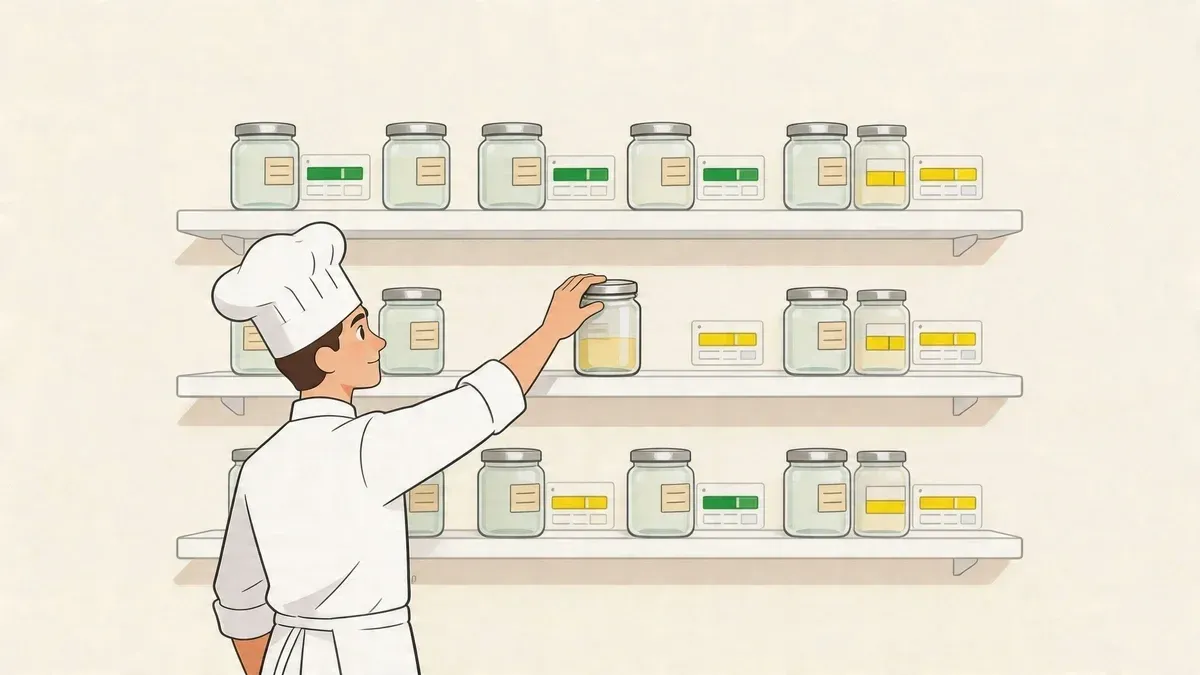
A busy Friday night exposes inventory mistakes fast. Your most popular delivery item is flying out through Uber Eats and DoorDash, the dining room is still active, and then someone in the kitchen says the words every manager hates: you’re out of a key ingredient.
That one miss creates a chain reaction. Orders get paused. Staff scramble for substitutes. Guests get refunds or a different dish they didn’t want. The back of house loses rhythm, and the front of house gets stuck explaining a problem that started in the storeroom.
The fix usually isn’t “order more.” It’s set better par levels in inventory, then connect those levels to real sales data so they reflect how your restaurant operates now, not how it operated six months ago. In a delivery-first environment, that difference matters. Your inventory system has to account for dine-in, pickup, and app orders together, or it’s working with a partial picture.
The Friday Night Inventory Nightmare
It usually starts with one item. Wings without enough fryer oil. Burgers without bacon. A pizza shop that burns through mozzarella faster than expected because delivery orders hit in a wave between 6 and 8.
The manager checks the shelf and sees the same thing that caused the problem last week. The count looked fine on paper, but the paper didn’t match reality. Someone forgot to adjust for a promo. Someone else counted loosely. Delivery sales came in faster than expected. By the time the kitchen caught it, the restaurant was already in damage-control mode.
What the rush exposes
Running out of product during service isn’t just an inventory problem. It’s an operations problem.
A stockout hits several parts of the business at once:
- Revenue takes the first hit. You can’t sell what you don’t have.
- Kitchen speed drops. Cooks stop producing and start improvising.
- Guests notice immediately. Delivery customers leave reviews when items are canceled.
- Managers lose time. Instead of leading service, they start chasing emergency fixes.
This is why experienced operators care so much about pars. They don’t see par levels as spreadsheet work. They see them as protection against chaos.
Why professionals use par levels
Par levels became prominent in restaurants by the 1980s, and they matter because they help operators control both shortages and excess stock. In modern restaurant operations, they also help address food waste, which accounts for 4-10% of purchases industry-wide, and optimized PAR can cut inventory carrying costs by 20-30% according to Unleashed’s overview of par levels.
That matters even more in delivery-heavy restaurants. App demand can arrive in bursts. If your team is still ordering from memory, or counting without tying inventory to actual sales, you’re inviting the same Friday night problem to repeat.
Good par levels don’t eliminate surprises. They reduce how often surprises turn into emergencies.
If your back-of-house process already feels reactive, it’s worth tightening the systems around it. Clear counting routines, prep communication, and inventory ownership all support stronger pars. A useful place to sharpen that operational discipline is this guide to what BOH means in a restaurant.
What Are Par Levels and Why They Are Critical for Restaurants
Par levels are simple in plain English. They’re the right amount of stock to keep on hand so you can get through normal demand until the next replenishment point without running out or overbuying.
Think of a car’s fuel tank. You don’t wait until the tank is empty on the highway. You refill when it reaches a level that keeps you safe based on how far you drive and how easy it is to stop for gas. Inventory works the same way.
The plain-language definition
A par level is the target quantity for an item. If stock drops below that level, the team knows it’s time to replenish.
For a restaurant, that target has to reflect how the item behaves in practice:
- Fast-moving perishables need tighter control because spoilage and stockouts both hurt.
- Shelf-stable products can often tolerate a different rhythm.
- Delivery-driven menu items need special attention because app demand can rise quickly.
The technical definition that matters in restaurant operations
In practice, par levels in inventory are built from usage, delivery rhythm, lead time, and a buffer for uncertainty. That’s why they work. They tie ordering to observed consumption instead of guesswork.
A new manager often makes one of two mistakes. They either set par too low because they want to avoid waste, or too high because they’re afraid to run out. Both choices cost money. Too low creates canceled orders and emergency purchases. Too high ties cash up in stock and increases spoilage risk.
Why restaurants can’t ignore pars
When par levels are right, four things improve fast.
- Stockouts become less common. That protects your best-selling dishes and your restaurant delivery reputation on apps like Uber Eats and DoorDash.
- Waste gets easier to control. You stop ordering by panic and start ordering by pattern.
- Cash flow improves. Less money sits on shelves in ingredients you won’t use in time.
- Staff work gets cleaner. The ordering process becomes faster and less dependent on one manager’s memory.
Practical rule: If your ordering system depends on one person “just knowing” what to buy, your par levels aren’t a system yet.
What pars solve that memory never will
Restaurants are noisy businesses. Deliveries come late. Staff rotate. Menu mix changes. Promotions hit. A manager who orders from instinct can still be a good operator, but instinct breaks down when the business becomes multi-channel.
That’s where par levels earn their value. They create a repeatable standard. New managers can follow it. Shift leads can support it. Owners can review it. And when something changes, the team has a baseline to adjust from instead of starting over from scratch.
The best operators I’ve seen don’t treat pars as accounting. They treat them as guardrails. They protect service, margins, and staff sanity all at once.
The Core Formula for Calculating Restaurant Par Levels
Most managers overcomplicate this at first. You don’t need a complicated system to start. You need a repeatable one.
The standard restaurant formula is straightforward.
PAR level = (Weekly Inventory Usage + Safety Stock) / Number of Deliveries per Week
Break the formula into parts
Each part matters for a different reason.
- Weekly inventory usage tells you what the restaurant consumes.
- Safety stock gives you a cushion for delays, spikes, or counting errors.
- Deliveries per week determines how often you get replenished.
Safety stock is typically 20-30% of usage, and that buffer is what keeps one rough service from turning into a stockout, as shown in Apicbase’s par level guide.
Worked example for a perishable item
Take bacon. It’s a useful example because it moves quickly, affects several menu items, and can create immediate service issues if you run out.
The numbers:
- Weekly bacon usage = 11.2 kg
- Safety stock at 25% = 2.8 kg
- Deliveries per week = 3
So the calculation is:
(11.2 + 2.8) / 3 = 4.7 kg
That gives you a PAR level of 4.7 kg.
Why this matters operationally: with a perishable item, you’re balancing two risks at the same time. Too little bacon means canceled dishes and substitutions. Too much means spoilage. The par gives your team a target that’s grounded in actual demand instead of “order a little extra just in case.”
Worked example for a non-perishable staple
Now look at a broader dry goods example.
The numbers:
- Weekly usage = 14 cases
- Safety stock at 20% = 3 cases
- Deliveries per week = 2
The calculation becomes:
(14 + 3) / 2 = 8.5 cases
This leads to a PAR level of 8.5 cases.
That’s a different ordering rhythm from bacon. Shelf-stable goods usually give you more flexibility. You still need discipline, but the cost of a slight overage is lower than it is with perishables.
A second formula that matters when lead time changes
Some restaurants also need to calculate pars based on daily usage and supplier lead time, especially when deliveries aren’t frequent or supplier reliability shifts.
A bakery-style example shows it clearly:
- Daily flour usage = 5 bags
- Lead time = 4 days
- Safety stock = 3 bags
The formula is:
PAR = (5 × 4) + 3 = 23 bags
This version is useful when your supplier schedule is the bigger issue. If your deliveries are steady, the weekly formula often works well. If lead time swings, the daily-usage approach becomes more practical.
One reason this matters financially is that inventory decisions directly affect margins. If you’re also reviewing menu profitability, this breakdown of how to calculate food cost percent pairs well with par-level work because both depend on accurate usage and ordering discipline.
Setting and Adjusting Par Levels for Modern Restaurant Operations
A par level that worked last season can fail this season. That’s the mistake many restaurants make. They calculate pars once, save them in a spreadsheet, and assume the job is done.
It isn’t.
Good par levels in inventory are living numbers. They need to move with demand, supplier performance, and menu changes. The restaurant changes every week, even when the menu board looks the same.
Start with a baseline from real sales
The first pass should come from historical sales data, not memory. Pull usage from your POS, compare it to actual depletion in the kitchen, and build a starting point item by item.
That baseline matters because different products behave differently:
- Produce often needs tighter review because it turns fast.
- Proteins usually deserve close attention because they’re expensive and central to core dishes.
- Dry goods can often tolerate a slower review cycle if demand is steady.
Lead time changes can wreck a good par
Supplier lead time is one of the fastest ways a healthy inventory system gets thrown off.
The relationship is direct: PAR level = (Average daily usage × Lead time) + Safety stock. A four-day lead time multiplies par requirements by 4x compared to daily delivery. In one example, using 5 bags of flour daily with a 4-day lead time and safety stock gives a par of 23 bags. If lead time extends to 6 days, the par rises to 33 bags, which is a 43% increase in tied-up capital, according to Fishbowl’s explanation of lead time and par levels.
That’s why a supplier issue isn’t just a purchasing problem. It becomes a cash and storage problem too.
The triggers that should force a review
Don’t wait for a scheduled count if the business has clearly changed. Certain events should trigger an immediate look at pars.
- Seasonality: Cold drinks, soups, fresh produce, and desserts often shift with weather and local traffic patterns.
- Menu changes: A new topping, combo, or limited-time item can change usage on several ingredients at once.
- Supplier changes: New vendor, new cut-off times, or less frequent deliveries all affect how much you need on hand.
- Promotions: A featured item on a delivery app can distort demand fast.
- Channel mix shifts: If delivery grows relative to dine-in, ingredient usage timing changes even if total weekly sales look similar.
If service patterns change, pars should change with them. Static pars in a changing restaurant are just delayed problems.
What works in practice
The most reliable approach is to review by priority, not just by schedule.
A practical operating pattern looks like this:
- Watch top sellers first. Core menu items deserve faster review than low-volume ingredients.
- Separate expensive items from minor items. A bad par on chicken or salmon hurts more than a bad par on salt packets.
- Review after events, not just on calendar dates. Promotions and supplier disruptions matter more than the month changing.
- Keep one owner for each category. If everyone owns inventory, no one owns inventory.
This is also where written process helps. Counting, ordering, receiving, and updating pars should be part of the same operating routine. If you need a cleaner process framework, these restaurant standard operating procedure examples are useful for tightening ownership and consistency.
What doesn’t work
A few habits cause repeated failures:
- Ordering from memory because “we’ve always done it this way”
- Using the same par for every location when traffic patterns differ
- Ignoring lead time changes until a stockout happens
- Treating delivery demand like a side channel instead of part of total demand
- Keeping pars too high to feel safe, then wondering why waste climbs
Managers often think inventory problems are caused by bad counts. Sometimes they are. But just as often, the count is fine and the par is wrong.
That distinction matters. A clean count on a bad target still produces a bad order.
Integrating Par Levels with POS and Food Tech for Automation
Manual inventory systems break in modern restaurants for one simple reason. They rely on delayed information.
A clipboard count done at the end of the night tells you what happened. It doesn’t help much when the lunch rush, pickup orders, and delivery apps are all pulling from the same ingredients in real time. That delay is exactly why so many operators feel like they’re always reacting instead of controlling.
The old way versus the usable way
The old method usually looks like this. A manager prints sales, does a rough walk-through, checks a spreadsheet, then places an order based partly on numbers and partly on habit.
The better method starts with integrated sales data. Every transaction that leaves the kitchen should inform inventory usage. That includes dine-in, pickup, and delivery. If one channel is missing, your pars are based on incomplete demand.
That’s a big issue in multi-channel restaurants. Traditional par formulas often fail in this environment because those restaurants can experience 30-40% more demand volatility than single-channel operators, and standard methods don’t account well for spikes from Uber Eats and DoorDash. That’s why integrated systems that consolidate orders are so important for accurate par setting.
Why POS integration matters to restaurant delivery
If you run on Clover or Square, your POS can already do more than ring up checks. It can become the system that helps translate sales activity into usable inventory decisions.
What matters is whether all channels land there cleanly.
If delivery tickets are manually entered, or live in a separate dashboard that managers review later, inventory visibility lags behind reality. The kitchen has already consumed product. The app has already sold it. But your inventory process hasn’t caught up yet.
What automation actually improves
Automation isn’t useful because it sounds modern. It’s useful because it removes repeated failure points.
Here’s where it helps most:
- Cleaner usage tracking: Sales feed ingredient depletion more consistently than hand-updated sheets.
- Faster reorder awareness: Teams can flag items approaching par before they become emergency orders.
- Less manager guesswork: Ordering becomes a review process instead of a reconstruction exercise.
- Lower entry error risk: Staff don’t have to retype delivery orders from one system into another.
A par system only works as well as the sales data feeding it. If delivery sales sit outside the main workflow, your inventory numbers will drift.
Where broader integration thinking helps
Restaurant operators can also learn from adjacent inventory workflows outside foodservice. For example, teams comparing connected operational systems often look at resources on integrating with Inventorylab to understand how automation reduces manual transfer work between tools. The exact software may differ, but the operational lesson is the same. When systems talk to each other, people spend less time reconciling data by hand.
A strong integrated POS system matters for the same reason. It gives operators one cleaner source of truth instead of scattered dashboards, emailed invoices, and handwritten ordering notes.
What an automated workflow should look like
The best setup is boring in the best possible way. Sales flow in. Inventory updates. Low-stock warnings appear before service suffers. Managers review exceptions instead of rebuilding the full picture from scratch.
This short video gives a useful visual of how restaurant tech can reduce manual order handling and tighten control across channels:
The practical goal isn’t to remove people from inventory. It’s to remove avoidable manual work so people can focus on judgment calls that software can’t make well, like supplier relationships, menu mix decisions, and prep planning.
Key Metrics to Monitor and Common Pitfalls to Avoid
Par levels don’t stay healthy on intention alone. You need a short list of numbers and patterns that tell you whether the system is working.
Most restaurants don’t need a giant dashboard. They need a few operating signals that are reviewed consistently and acted on quickly.
The metrics worth watching
Start with metrics your team can use.
- Inventory turnover rate: This helps you see whether stock is moving at the pace you expected.
- Food waste percentage: If waste climbs, pars may be too high, prep may be off, or purchasing may be too aggressive.
- Stockout frequency: If you keep running out of core ingredients, your pars, lead times, or ordering discipline need attention.
- Emergency orders: These usually signal weak forecasting, poor counting habits, or missed channel demand.
- Variance between recorded and actual stock: This tells you whether counting and depletion tracking are trustworthy.
For operators building more reporting discipline, it also helps to understand how broader data visibility supports decision-making. A retail-focused piece like Business Intelligence for Retail is useful context because the reporting habits transfer well to restaurant operations: cleaner inputs, faster exceptions, better decisions.
Review cadence should follow signals, not habit
A fixed weekly or monthly review can be too slow when demand moves quickly. One example from restaurants using real-time POS data is that a 20% sales spike tied to a delivery promotion may require immediate recalibration, and periodic reviews often miss that signal, as noted in Lavu’s discussion of dynamic par adjustments.
That’s the operational lesson. Scheduled reviews are fine for routine oversight. They aren’t enough on their own.
The best review cadence is stable for routine checks and flexible when demand clearly breaks pattern.
Common Par Level Mistakes and How to Fix Them
Common Pitfall Impact on Your Restaurant The Solution Setting pars once and never updating them Orders reflect old demand patterns, not current reality Revisit pars after promotions, menu changes, supplier shifts, and seasonal swings Ignoring safety stock One late truck or one busy service creates a stockout Build a buffer into every important item, especially high-volume and critical ingredients Using incomplete sales data Inventory counts look right on paper but fail in service Combine dine-in, pickup, and delivery demand before adjusting pars Treating every item the same Teams waste time on low-impact items and miss critical ones Prioritize top sellers, perishables, and expensive proteins first Letting too many people own ordering No one is accountable when counts or orders are wrong Assign clear ownership by category or ordering window Confusing a bad count with a bad par Managers fix the wrong problem and repeat the mistake Audit both the count process and the target quantity before changing orders
Your Next Step From Manual Counts to Automated Control
Par levels in inventory aren’t abstract. They decide whether your kitchen stays in rhythm, whether your team places clean orders, and whether your delivery menu stays available when demand hits.
The fastest practical move is simple. This week, calculate the par level for your top three best-selling menu items. Pick items that hurt when they run out. Use real usage data, add safety stock, and compare the result to what your team keeps on hand now.
Then look at the process behind the numbers. Are delivery sales included? Are supplier lead times current? Does one manager hold the whole system together by memory? If the answer is yes, the next improvement isn’t another spreadsheet. It’s a tighter operational workflow supported by better systems.
Restaurants that automate routine inventory work give managers time back. They also reduce the entry mistakes and blind spots that come from disconnected tools. If you’re tightening your systems more broadly, this guide on automation in restaurants is a good next read because inventory control works best when it’s part of a larger operational upgrade.
The goal isn’t perfection. The goal is fewer surprises, cleaner ordering, and a kitchen that doesn’t get ambushed on a Friday night.
If you want to connect delivery apps with your POS and make inventory control easier to manage, OrderOut is built for that workflow. It helps restaurants consolidate orders from platforms like Uber Eats, DoorDash, and Grubhub directly into systems such as Clover and Square, reducing manual entry and giving operators a cleaner view of demand. You can start onboarding in a few clicks through the OrderOut dashboard.