
On Demand Delivery for Restaurants: A Practical Guide for Growth
· Thibault Le Conte
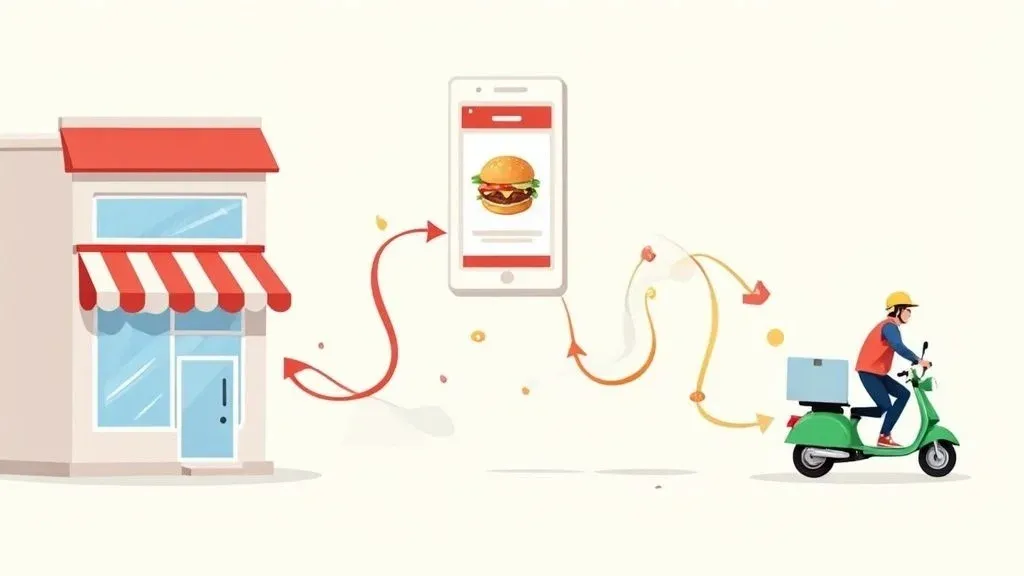
At its core, on-demand delivery is a service that connects your restaurant with local customers who want food delivered right now, all through third-party apps. Think of it as a digital bridge between your kitchen and a customer’s couch. This isn’t just about adding a delivery option; it’s about meeting modern customers where they are—on their phones.
For a restaurant owner, this technology gives you access to a massive fleet of delivery drivers without the headache and expense of hiring, training, or insuring them yourself. You’re plugging your business directly into a pre-existing network of hungry customers who might otherwise never have found you.
The New Reality of Restaurant Delivery and POS Integration

Today’s diners value convenience, and platforms like Uber Eats and DoorDash have become their go-to for a quick, easy meal. Getting your menu onto these apps provides instant visibility in a crowded marketplace where people are actively looking to place an order.
Why On-Demand Delivery Matters for Restaurant Operations
The impact on your daily operations can be immediate. Suddenly, your revenue is no longer limited by the number of seats in your dining room or customers who can physically visit. You can now serve a much wider area, creating a new revenue stream that keeps the kitchen busy, even during historically slow periods. This directly boosts your bottom line by increasing order volume.
However, without the right systems, this new stream of orders can quickly turn into a chaotic mess of tablets, ringing alerts, and manual data entry. This is where modern food tech becomes your most valuable tool. The secret to making on-demand delivery a true growth driver—and not just another operational headache—is smart POS integration.
The Why: By connecting delivery platforms directly to your point-of-sale (POS) system, you eliminate manual order entry. This simple action significantly reduces costly errors (like wrong items or modifiers), which saves money on food waste and refunds. It also frees up your staff to focus on what they do best—creating great food and serving in-house guests, which boosts staff productivity and improves the customer experience.
This seamless workflow is the key to making the on-demand model both profitable and manageable. To see how technology is reshaping the business, it’s worth exploring the latest hospitality technology trends that are helping restaurants get ahead.
The Takeaway: On-demand delivery is a strategic tool for growth and efficiency. This guide will provide practical steps to make it work for your restaurant.
How On-Demand Delivery is Reshaping Restaurant Operations
The way people decide what to eat has fundamentally changed. It’s no longer just about the food; it’s about how easily and quickly they can get it. For restaurants, on-demand delivery has shifted from a nice-to-have convenience to a core customer expectation.
This shift is the engine behind the delivery explosion. Simply put, platforms like DoorDash and Uber Eats have permanently rewired consumer behavior. They’ve created a new reality where a local restaurant can instantly reach customers miles away—people who might never have walked through the door. For a restaurant operator, this isn’t just a trend; it’s a massive, tangible growth opportunity.
The Scale of the Restaurant Delivery Opportunity
The numbers behind this trend are staggering. We’re not talking about a small bump in takeout orders; this is a global economic shift. Projections show the on-demand delivery market is on track to hit around $300 billion by 2025. That’s double the $150 billion it was worth in 2022. This rapid growth tells a clear story about where the industry is heading, and you can find more insights into on-demand delivery trends.
The Why: This explosive growth isn’t just an abstract number. It translates directly into real dollars for your restaurant. Every single order that comes through a third-party app is a sale you almost certainly wouldn’t have made otherwise, directly increasing your revenue.
Adapting isn’t just about keeping up. It’s about strategically tapping into a vital and ever-growing revenue stream that has become a new pillar of the food industry.
Turning Customer Expectation into Restaurant Revenue
The key is to view delivery not as a chore, but as a direct line to more sales. By listing your menu on these platforms, you put your food in front of hungry customers at the exact moment they’re ready to buy.
The challenge, of course, is handling all those new orders without turning your kitchen into a chaotic mess. This is where smart operators gain an edge—by leveraging food tech. A solid POS integration is the crucial link that makes this new sales channel a boost to your team’s efficiency, not a drain on their time and energy.
For example, a restaurant running a popular POS like Clover or Square can connect directly to delivery apps. This automates the entire process, eliminating manual order entry and slashing the risk of costly errors. This saves time, reduces food waste from incorrect orders, and frees up staff.
Practical Next Step: Think of on-demand delivery as your new digital storefront. With that in place, the next move is to ensure your back-of-house operations can handle the business smoothly with the right technology. To claim your piece of this growing market, you can start onboarding for free at the OrderOut dashboard.
Manual vs. Integrated Restaurant Delivery Workflows
When a new on-demand delivery order arrives, your restaurant has two options: handle it the old-school, manual way, or use a modern, integrated approach. This single choice dramatically impacts kitchen stress, your bottom line, and customer satisfaction.
The Old Way: Manual Entry and the “Tablet Farm”
Many restaurants start with the manual method, which involves a messy pile of tablets on a counter—one for each delivery service like DoorDash or Uber Eats. This is often called the “tablet farm.”
Every time an order comes in, a staff member has to stop what they’re doing, find the right tablet, and manually punch every detail into your POS system. This process is slow, disruptive, and a breeding ground for expensive mistakes. A single typo can lead to the wrong food being made, resulting in an angry customer, food waste, and a damaging one-star review. During a dinner rush, it’s a recipe for chaos and lost revenue.
The New Way: Seamless POS Integration for Restaurant Delivery
The alternative is a streamlined, integrated workflow powered by POS integration. This technology acts as the central hub for all your orders. Instead of a bunch of tablets demanding attention, every order from every app is automatically and instantly sent directly into your main point-of-sale system.
This eliminates manual entry, causing the risk of human error to plummet. Orders appear on your kitchen display screen (KDS) instantly, formatted just like your standard dine-in or takeout tickets. This creates a single, unified flow that your kitchen staff can easily manage.
The Why: An integrated workflow directly boosts efficiency and saves money. It gives your team back their most valuable resource—time. By eliminating 1-2 minutes of manual labor per order, you improve staff productivity. They can stop being data-entry clerks and get back to focusing on what matters: great food and happy in-house guests.
For restaurants using popular systems like Clover or Square, setting up this integration is straightforward. It transforms a major operational headache into a quiet, reliable part of your daily restaurant operations. To dig deeper into this unified approach, learn more about the advantages of multi-channel order management software.
Manual vs. Integrated: A Head-to-Head Comparison
The difference between these two workflows directly impacts your labor costs, operational speed, and customer satisfaction.
Operational Aspect Manual Workflow (Tablet Farm) Integrated Workflow (via POS) Order Entry Staff manually re-keys every order from a tablet into the POS. Orders are sent automatically and instantly to the POS. Error Rate High. Prone to typos, missed items, and incorrect modifiers. Extremely low. Accuracy is near 100%. Staff Focus Divided between tablets, customers, and other duties. Focused on guest service and core restaurant tasks. Kitchen Flow Disruptive. Staff often shout orders, leading to confusion. Seamless. Orders appear on the KDS just like any other ticket. Speed & Efficiency Slow. Adds 1-2 minutes of labor per order. Instant. No extra time needed, improving throughput. Reporting Fragmented. Sales data is scattered across different platforms. Centralized. All sales data is in one place for easy analysis.
The Takeaway: While the tablet farm might seem simple, it introduces hidden costs through wasted labor, order mistakes, and lost productivity. For any restaurant looking to make on-demand delivery a profitable, scalable part of the business, an integrated workflow is essential.
Ready to eliminate the chaos? Get started for free on the OrderOut dashboard.
How POS Integration Boosts Restaurant Profitability
Connecting your on-demand delivery apps to your point-of-sale (POS) system is more than a convenience—it’s a direct path to better profitability. This strategic move makes a real financial impact by cutting costs, saving time, and streamlining your entire operation.
Think about the actual cost of a single manual error. A staff member mis-types an order from a delivery tablet. That simple slip-up leads to wasted food, the cost of a remake, and potentially a full refund to an unhappy customer. These small errors add up, bleeding profits over time. A solid POS integration makes that problem practically disappear by ensuring every order is 100% accurate from the customer’s app straight to your kitchen.
This diagram illustrates the difference between a chaotic manual setup and a clean, integrated workflow.

The key takeaway is the shift from a multi-step manual process to a single, direct line of communication. That’s the foundation of any efficient delivery operation.
Unlocking Data for Smarter Restaurant Operations
Beyond eliminating errors, integration turns your POS into a powerful command center for all your sales data. No more trying to piece together reports from DoorDash, Uber Eats, and your in-house system. Every transaction—from a delivery app or a dining room table—flows into one place. This gives you a single, reliable source of truth for your business performance.
The Why: With unified sales data, you can finally get a clear picture of what’s selling, when it’s selling, and on which platform. This is the actionable insight you need to make smarter, data-driven decisions that increase profitability.
For instance, a restaurant using a Clover or Square POS with an integrated system can easily see which menu items are most popular for delivery. Armed with that knowledge, you can take action:
- Optimize Your Menu: Feature high-margin items that are popular on delivery apps.
- Refine Marketing: Run targeted promotions on the specific platforms where certain dishes perform best.
- Improve Staffing: Accurately predict delivery rushes and schedule your team accordingly to control labor costs.
This level of analysis is nearly impossible when your data is scattered across different platforms. To learn more about the technology that enables this, read about what to look for in POS integration software.
Boosting Staff Productivity and Service
Finally, consider the impact on staff productivity. Every minute your team spends juggling tablets is a minute they aren’t helping the guests in front of them. By automating the delivery workflow, you free up your front-of-house staff to provide better, faster service, leading to higher table turnover and happier customers. It turns a major distraction into a seamless background process.
Practical Next Step: Calculate how much time your team currently spends on manual order entry each day. That hidden labor cost is one of the biggest and most immediate savings you’ll see from integration. Reclaim that time and make your operation more efficient by getting started for free at the OrderOut dashboard.
Solving Common On-Demand Delivery Challenges
While on-demand delivery opens up a huge revenue stream, it also comes with challenges like high commission fees and the chaos of keeping menus in sync. With the right strategy and technology, you can turn these problems into a streamlined, profitable operation.
The key is to proactively manage your delivery business. By tackling these issues head-on, you can protect your margins, improve efficiency, and ensure every customer has a great experience with your brand.

Protecting Margins and Managing Menus with Food Tech
Hefty commission fees from third-party apps are a major concern for restaurant owners. A powerful strategy to combat this is smart menu engineering. This means strategically pricing your delivery menu to offset those fees. Focus on highlighting items that not only travel well but also have high profit margins.
Another significant headache is menu management. Manually updating prices, 86’ing an item, or changing a description across DoorDash, Uber Eats, and other platforms is time-consuming and prone to errors. This is where POS integration is a game-changer.
The Why: Instead of logging into multiple dashboards, you make one change in your POS system, and it instantly updates across all your delivery platforms. This saves hours of administrative work, prevents you from selling out-of-stock items (which leads to unhappy customers and refunds), and ensures pricing consistency. This directly impacts both staff productivity and revenue protection.
Ensuring Food Quality and Streamlining Restaurant Operations
Your delivery service is an extension of your brand. Ensuring your food arrives hot, fresh, and looking great is non-negotiable for customer satisfaction and repeat business.
Here are a few actionable tips:
- Optimize Packaging: Use vented containers for fried items to maintain crispiness and invest in quality insulated bags to hold temperature.
- Streamline Kitchen Workflows: Create a dedicated area for packing delivery orders. This simple step reduces mistakes and gets orders to drivers faster.
- Set Realistic Delivery Radii: Work with your delivery partners to define a delivery zone that ensures your food can arrive in excellent condition.
Beyond daily operations, adopting solid e-commerce fraud prevention best practices is crucial for security. For a more in-depth guide on managing these partnerships, check out our post on https://www.orderout.co/blog/third-party-delivery-service/.
Practical Next Step: Identify your single biggest delivery challenge right now. Is it menu updates, food quality, or commission costs? Focus on solving that one issue first to make an immediate, positive impact on your operations and bottom line.
Choosing the Right Delivery Integration Partner
Selecting the right technology partner is one of the most critical decisions for your on demand delivery strategy. This partner becomes a core part of your team, working to streamline your restaurant operations, reduce errors, and increase your profitability. A great partner tames the chaos; the wrong one creates more of it.
The most important factor is seamless POS integration. The tool you choose must work flawlessly with the system your staff uses every day. For restaurants on major platforms, a solid connection with Clover or a reliable integration for Square is non-negotiable. This ensures an order from DoorDash or Uber Eats flows directly to your kitchen without manual intervention, saving time and preventing costly mistakes.
Key Criteria for a Smart Decision
Once you confirm POS compatibility, here’s what to look for:
- Proven Reliability: You need a system that is dependable, especially during your busiest hours. Ask potential partners about their system’s uptime and performance under pressure.
- Simple Setup: Onboarding should be fast and straightforward, getting you live without complex technical hurdles.
- Responsive Support: When issues arise, you need a support team that understands the urgency of the restaurant business and can provide immediate assistance.
- Transparent Pricing: Look for a partner with a clear pricing model without hidden fees. The value from time savings, error reduction, and increased staff productivity should easily justify the cost.
The global online food delivery market is projected to reach $1.4 trillion by 2025, driven by investments in logistics and high customer demand. This massive volume means you need a partner whose technology can manage the flow without failing. You can read the full research about these market dynamics to understand the scale.
As you evaluate your options, a guide on choosing the right courier company can offer valuable insights. To dive deeper into the technical side, learn how to integrate Grubhub, DoorDash, and Uber Eats APIs with your POS system.
Practical Next Step: Vet potential partners against this list. The goal is to find a solution that simplifies your operations, freeing you to focus on what you do best: making fantastic food and serving customers. Ready to connect your systems? Start onboarding for free in just a few clicks at the OrderOut dashboard.
Common Questions About On-Demand Delivery
As a restaurant owner, you likely have practical questions about adding on-demand delivery. Let’s address the most common concerns—cost, kitchen workflow, and menu management—to help you move forward with confidence.
What’s the Real Cost of Integrating On-Demand Delivery?
The subscription fee is just one part of the equation. The real conversation is about your return on investment (ROI).
First, consider the hidden costs of manual order entry: staff hours spent typing in orders, food waste from human errors, and lost revenue when you have to turn off delivery apps during a rush because your team can’t keep up. POS integration pays for itself by eliminating these costs. By automating the process, you save on labor, reduce food waste, and can accept more orders, directly boosting your revenue.
Will This Slow Down My Kitchen?
No, it does the exact opposite. An integrated system brings order to the chaos of a busy service.
Instead of staff shouting orders from a jumble of tablets, all your delivery orders—from Uber Eats, DoorDash, and others—flow directly into your kitchen display system (KDS). They appear in a standardized format, just like an in-house ticket. This unified workflow makes your kitchen calmer, faster, and far more efficient, increasing throughput.
Can I Still Manage My Menus on Each App Separately?
You could, but integration offers a much more efficient way. The power of POS integration is having a single source of truth for your menu.
Instead of frantically logging into three different apps to 86 an item, you just mark it as “sold out” once in your POS, whether you use Clover or Square. The integration platform then automatically pushes that update to all your connected delivery apps instantly.
The Why: This is a massive time-saver that boosts staff productivity. More importantly, it prevents you from accidentally selling items you don’t have, which is critical for maintaining customer satisfaction and encouraging repeat business.
Ready to make on-demand delivery a profitable and stress-free part of your business? With OrderOut, you can connect all your delivery apps directly to your POS, eliminating manual entry and costly errors.