
What Off Premise Means for Your Restaurant's Delivery, Takeout, and Curbside Strategy
· Thibault Le Conte
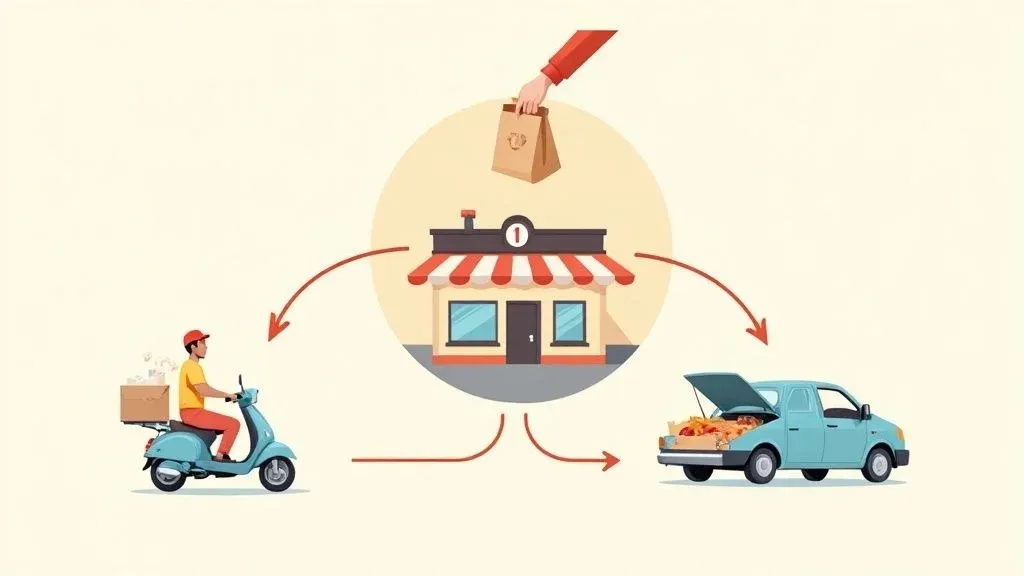
In the simplest terms, off-premise means any food ordered from your restaurant that is eaten somewhere else. Think of it as every meal that leaves your building: the lunch a customer grabs to eat at their desk, the Friday night pizza that arrives at their door, or the catered meal for a big family event. If it’s not enjoyed in your dining room, it’s an off-premise order.
This matters because off-premise channels—delivery, takeout, curbside, and catering—are no longer just a side business. For modern restaurants, they are a primary source of revenue and a critical way to improve overall efficiency.
Why Off-Premise Isn’t Just “Takeout” Anymore

While the term “off-premise” might sound technical, the concept is simple: it’s about expanding your restaurant’s reach without building new walls or adding tables. It’s a major shift from the traditional sit-down model, allowing you to meet customers wherever they are.
This isn’t just about offering delivery as an option. Today, off-premise channels are an engine for growth. What were once afterthoughts, like curbside pickup, have become central pillars of a modern restaurant’s strategy. Why? Because customer habits have changed for good, and convenience is now just as important as the quality of the food.
The Impact on Your Restaurant Operations and Food Tech
Getting your off-premise strategy right is no longer optional—it’s essential for staying competitive. A solid plan directly boosts your bottom line by increasing order volume and connecting you with customers who might never have walked through your doors. Your kitchen transforms from just serving a dining room into a production hub for a whole network of diners at home, at the office, or on the go.
This shift impacts every part of your restaurant operations:
- Kitchen Efficiency: Juggling a high volume of online, phone, and in-person orders demands a seriously organized workflow. This reduces errors and saves staff time.
- POS Integration: Your Point of Sale (POS) system needs to communicate seamlessly with your delivery apps. Without this connection, your staff is stuck manually entering orders, leading to mistakes, wasted food, and lost productivity.
- Profitability: Every channel has a different financial impact. A direct pickup order is high-margin, while an order from a third-party app like Uber Eats comes with commission fees you must account for.
The big idea is that off-premise separates your food from your physical location. Your restaurant becomes a brand that delivers a great experience, whether at one of your tables or on a customer’s couch. This increases efficiency and opens new revenue streams.
This evolution has even sparked new business models, like delivery-only brands that don’t have a storefront. You can dive deeper into these concepts in our guide explaining what ghost kitchens are and how they work.
Ultimately, a strong off-premise strategy helps you build a more resilient, adaptable, and profitable restaurant.
Choosing Your Off-Premise Revenue Channels for Restaurant Delivery
Deciding how to get your food to customers isn’t a one-size-fits-all decision. Each channel, from third-party apps to direct takeout, affects your kitchen workflow, staff duties, and profit margins differently.
The goal isn’t to be everywhere at once. That’s a quick recipe for operational chaos. The smart move is to choose channels that build sustainable growth without burning out your team or sacrificing food quality. Let’s break down the main options so you can build the right strategy.
Third-Party Delivery: The Marketplace Giants
Think of platforms like DoorDash or Uber Eats as massive digital food courts. In simple terms, they put your menu in front of thousands of potential new customers who might otherwise never find you. For a restaurant trying to expand its reach, that’s a powerful tool.
The technical side is that you are paying for customer acquisition and delivery logistics. These platforms charge commission fees on every order, which can range from 15% to over 30%. While these fees can seem high, they cover marketing to a huge audience and access to a pre-built fleet of drivers.
- Pros: Huge customer base, no need to manage your own delivery drivers, and built-in marketing.
- Cons: High commission fees that eat into margins, less control over the customer experience, and you’re listed right next to competitors.
Real-World Example: A local pizzeria signs up with DoorDash. They immediately see a 20% increase in orders from a neighborhood across town they previously couldn’t reach. While they pay a 25% commission, the new volume more than makes up for it, all without the headache of hiring and insuring their own drivers. This shows how delivery apps can be a powerful tool for growth.
For a deeper dive, check out our guide comparing DoorDash vs Uber Eats for restaurants.
First-Party Channels: Direct to Your Customer
First-party is just a clear way of saying the customer orders directly from you—through phone calls, an online ordering portal on your website, or your own branded app. The advantage here is simple and powerful: profitability and control.
When a customer orders direct, you keep 100% of the revenue. No commissions, no hidden fees. Just as importantly, you own the customer relationship. You get their information, you can market to them later, and you can build genuine loyalty. That direct connection is how you turn a single order into a regular.
By owning the transaction from start to finish, you control the branding, the pricing, and—most importantly—the direct line of communication with your customer. This is where long-term loyalty is built, boosting restaurant efficiency.
The trade-off? You’re responsible for everything. You have to market your own ordering system, manage the technology, and if you offer delivery, figure out the logistics yourself.
Curbside and In-Store Pickup
Often the easiest and most profitable off-premise channels are curbside and in-store pickup. They are a modern, streamlined version of classic takeout, built for pure convenience. Customers order ahead and can grab their food without even leaving their car.
This model is a huge win for restaurant operations:
- Efficiency: It keeps your entryway clear, freeing up staff to focus on dine-in guests. This directly improves staff productivity.
- Cost Savings: With no delivery or commission fees, it’s one of your highest-margin transaction types.
- Customer Convenience: For people on the go, it’s a fast, frictionless experience they’ll appreciate.
The key to making this work is integrating these orders directly into your POS system. For instance, with a POS like Clover or Square, an online order automatically prints a ticket in the kitchen—just like an in-person one. This eliminates manual entry, reduces errors, and keeps things moving, turning a simple pickup into a seamless brand experience.
Designing Your Off-Premise Operational Workflow
Great off-premise dining is about more than just great food—it’s about getting that food to your customer perfectly, every time. A solid operational workflow is the backbone of this process. It’s what ensures every delivery and takeout order lives up to the same standards you set for your dining room.
Without a well-oiled system, you’re inviting chaos. You’ll end up with costly mistakes, frustrated staff, and unhappy customers who won’t order again. The goal is to create a seamless, efficient path from your kitchen to their hands.

Each of these channels—delivery, in-store pickup, and curbside—needs its own playbook, but they all rely on one central, organized system to work.
Creating a Dedicated Handoff Zone
First, carve out a dedicated space just for order handoffs. This needs to be a purpose-built station designed to make pickups fast, smooth, and mistake-free.
An actionable handoff zone should have:
- Clear Signage: Nobody should have to guess where to go. Big, easy-to-read signs direct drivers and customers straight to the pickup area, keeping your main entrance uncluttered.
- Organized Shelving: Get a sturdy shelving unit and label it. “Uber Eats,” “DoorDash,” and “Customer Pickup” sections help drivers grab the right order and go. This simple step saves time and reduces errors.
- Order Verification: Train your team to double-check the name and order number on the ticket against the driver’s app. This one tiny step can practically eliminate those dreaded “missing item” calls and save you the cost of remaking orders.
Optimizing Your Menu and Packaging
Not everything on your dine-in menu will survive a 20-minute trip. French fries turn limp, and delicate sauces can break. It’s crucial to curate a menu specifically for off-premise. Focus on dishes that hold their temperature and texture.
Packaging is your final handshake with the customer. It protects the meal and represents your brand. Invest in quality containers—vented ones for fried foods to keep them crispy, and sturdy, leak-proof bowls for soups and pastas.
Think of your packaging as an extension of your restaurant’s hospitality. It communicates care and quality long after the food has left your kitchen, directly impacting whether a customer will order again and improving your restaurant’s efficiency.
Nailing these fundamentals—a dedicated handoff space, a travel-friendly menu, and smart packaging—creates a system that runs itself, protects your reputation, and boosts efficiency. This process is the first step toward implementing tools like restaurant order management software, which can help slash errors even further.
Why POS Integration is Your Off-Premise Superpower
If you’ve ever seen a counter buried under a pile of tablets, all beeping with orders, you know the chaos of modern off-premise dining. This is where technology stops being a hassle and becomes your most reliable employee.
In simple terms, POS integration connects all your different ordering channels—delivery apps, your website—into one smooth, manageable system.
Think of it this way: without integration, your team is manually typing orders from each tablet into your main POS system. This is slow, stressful, and a major source of mistakes. A good POS integration automates this entire process. Orders from apps like DoorDash flow directly into your kitchen printer, just like an order taken in the dining room. Your kitchen staff doesn’t even know the difference.
From Tablet Chaos to Automated Efficiency in Restaurant Operations
The magic of integration is automation. It funnels all incoming orders directly into your kitchen, eliminating the #1 source of errors: manual data entry.

This seamless flow of information separates a struggling off-premise operation from an efficient one. The impact is immediate. You get rid of mistyped orders and missed special requests. This directly cuts down on food waste, saves you the cost of remaking orders, and improves staff productivity. To get a deeper look at how this all works, check out our guide on POS software integration.
Leveraging Food Tech for Smarter Operations
When you connect your delivery channels to popular POS systems like Clover or Square, you create a single source of truth for your business. It’s about more than convenience; it’s about having clean data and a much more productive team.
Real-World Example: A busy cafe uses Square for Restaurants and integrates it with their online ordering platforms. Before integration, staff spent nearly an hour each day manually entering online orders, leading to about 5% of orders having errors. After integration, manual entry was eliminated. This saved over 5 hours of labor per week and dropped the error rate to near zero, saving hundreds of dollars in remakes and boosting customer satisfaction.
This streamlined thinking isn’t just for food. We’re seeing a huge rise in e-commerce for off-premise beverage sales. For example, direct-to-consumer online beer sales are expected to hit $42 billion by 2025. You can learn about key drivers for beverage alcohol sales and see how a solid digital setup is crucial.
Practical Takeaway: Take a hard look at your counter. Are you still juggling tablets? Exploring a POS integration solution is the single most impactful change you can make for your off-premise efficiency and profitability.
Tracking the Metrics That Actually Matter
Trying to run an off-premise business without tracking the right data is like flying blind. You might be busy, but are you actually making money? To find out if your delivery and takeout operations are helping or hurting your bottom line, you have to look beyond the top-line sales number.
The true health of your restaurant is hidden in a handful of key performance indicators (KPIs). These numbers tell the real story, pointing out everything from kitchen slowdowns to unhappy customers.
Key Off-Premise Metrics for Your Restaurant
Monitoring these core KPIs will give you a clear, actionable picture of your restaurant operations. You can pull most of this data straight from your POS system or delivery partner dashboards.
- Order Accuracy Rate: The percentage of orders that leave your kitchen with zero mistakes. A low number here is a red flag. It means you’re bleeding money on redos and refunds and losing customer trust. This directly impacts your profitability.
- Average Time to Fulfill: This measures the time from when an order is received to when it’s handed off. If this number creeps up, it’s a sign of a bottleneck somewhere in your workflow, hurting the customer experience and your restaurant’s efficiency.
- Cost Per Order: The ultimate profitability metric. Add up every cost tied to an order—food, packaging, labor, and commission fees—to see what you actually earn. This is crucial for understanding your delivery channel performance.
Tracking your Cost Per Order is non-negotiable. It answers the most critical question: “Are we really making money on this?” Without this insight, you could be losing profit on every single delivery that goes out the door.
Using Data to Boost Your Bottom Line
These metrics are your roadmap for improvement. A high error rate might lead you to create a final double-check station. Slow fulfillment times could show you it’s time to reorganize your prep line.
Getting into the weeds with your data is also key for managing your entire menu. For example, the U.S. off-premise wine market remained incredibly strong, hitting $12.7 billion in sales over 52 weeks. By tracking your own beverage sales, you can find ways to tap into this reliable revenue stream. Learn more about the strength of off-premise alcohol purchasing.
Ultimately, tracking these KPIs helps you build a smarter business. The insights are fundamental to building an accurate financial picture, which you can explore in our guide to the restaurant profit and loss statement.
Practical Next Step: Choose one of these metrics this week. Figure out where the data lives in your Clover or Square POS and start tracking it.
Your Action Plan for Off-Premise Growth
Alright, let’s put this all into practice. The final step is moving from understanding concepts to building a strategy that works for your restaurant. This journey starts with an honest look at your current process. How does your workflow hold up?
Start with Your Food Tech and POS Integration
The single biggest lever you can pull for off-premise success is adopting technology that ties your whole delivery operation together. Integrating your systems saves an incredible amount of time, cuts down on costly errors, and frees up your staff from tedious manual tasks. This is the foundation for efficient restaurant operations.
It’s also worth noting that the term “off-premise” isn’t just for food. In the beverage world, it refers to alcohol sold at places like liquor stores for people to drink at home. You can discover more insights about the global low and no alcohol market to see how that side of the industry operates.
Get the Word Out
Once your operations are running smoothly, tell people about it. A solid marketing plan is essential for keeping your off-premise service growing. Be sure to explore these proven tactics for restaurant advertising to get more orders coming in.
Clear Takeaway: The path to a profitable off-premise business is through efficiency. Start by automating your order flow with POS integration. This one step will reduce errors, save labor costs, and give you the breathing room to focus on growth.
Ready to build a more efficient future? You can get started right now—onboarding is free and only takes a few clicks at https://dashboard.orderout.co.
Your Top Off-Premise Questions, Answered
Jumping into the off-premise world can feel like learning a new business. Let’s tackle some of the most common questions restaurant owners ask when they’re trying to make it profitable.
How Can I Actually Make Money with Third-Party Delivery?
When commission fees are eating into your margin, it’s easy to wonder if delivery is worth it. The secret is to be smarter with your operations to claw back that profit.
First, create a menu specifically for delivery using data from your POS. Feature your higher-margin items that also travel well. Next, actively encourage customers to order directly from your website for pickup—your most profitable channel. A simple flyer in every delivery bag can work wonders.
Finally, the biggest lever is integrating delivery apps directly into your POS. This single move cuts out manual order entry and dramatically reduces costly mistakes, turning wasted labor and food costs back into pure profit.
What’s the One Piece of Food Tech I Absolutely Need?
If you have to pick one thing, make it a solid POS integration solution. This is the technology that acts as the central nervous system for your off-premise operations.
It’s the bridge that connects platforms like Uber Eats or DoorDash directly to your restaurant’s POS, whether you use Clover or Square.
This is what allows you to actually scale. It transforms a messy, multi-tablet headache into one streamlined, automated process. You simply can’t run a serious off-premise business without it. This food tech is key to restaurant efficiency.
This tool gets rid of the “tablet farm,” stops staff from having to punch in orders by hand, and practically eliminates the errors that come with it. It speeds up your whole kitchen and frees up your team to focus on food and guests.
Do I Really Need Different Packaging for Off-Premise Orders?
Yes, 100%. Your packaging is your last chance to make a good impression and a critical part of the customer’s experience.
The right containers ensure your food arrives looking and tasting the way you intended. Use vented containers to keep fried food crispy. Choose sturdy, leak-proof bowls for soups. Good packaging isn’t just a cost; it’s an investment in quality that tells customers you value their business and makes them want to order again.
Ready to stop juggling tablets and start running a smarter off-premise operation? With OrderOut, you can connect your delivery apps directly to your POS system, crush errors, and save valuable time. Start your free onboarding in just a few clicks.