
A Modern Marketing Plan for Restaurants That Actually Works
· Thibault Le Conte
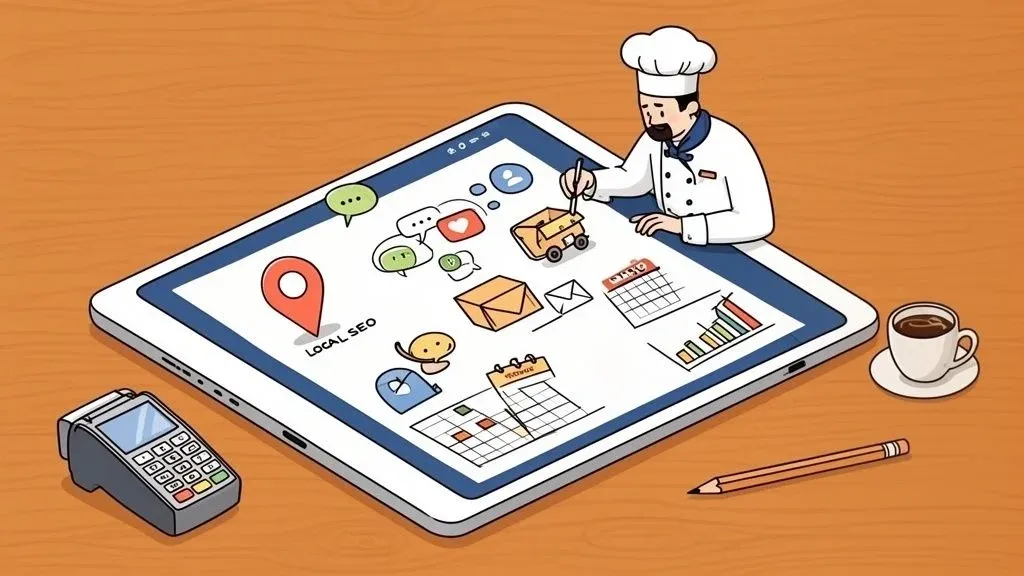
A winning marketing plan for restaurants isn’t about throwing money at ads and hoping for the best. It’s a strategic roadmap that starts with three simple questions: Who are you? Who are you serving? And what are you trying to achieve? Answering these questions first helps you spend your marketing dollars wisely.
This guide will show you how to build a practical marketing plan that connects directly to your daily operations, making every decision smarter, faster, and more profitable. We’ll focus on how your Point of Sale (POS) system and delivery integrations can transform your marketing from a cost into a growth engine.
Building Your Restaurant’s Marketing Foundation
Before you run a single promotion, you need a solid foundation. This means understanding what makes your restaurant unique, who your ideal customer is, and what specific goals you want to hit. Skipping this step is like trying to cook a new dish without a recipe—it’s messy and rarely works out.
What Makes You Different?
First, you need to know what makes your restaurant special. In marketing, this is called your Unique Selling Proposition (USP). It’s the simple, clear reason a customer should choose you over the competition. Maybe you’re the only spot in town with authentic, wood-fired Neapolitan pizza, or you offer the fastest late-night restaurant delivery service.
Your USP isn’t just about the food. It could be your amazing atmosphere, your lightning-fast service, or your commitment to local ingredients. Once you define this, all your marketing messages become clearer and more effective.
Who Are You Talking To?
Next, figure out exactly who you’re trying to reach. Don’t try to appeal to everyone; that’s a recipe for failure. Instead, create a target customer profile.
Think about your ideal diner. Are they busy professionals who need a quick lunch, or families looking for a fun weekend dinner? Knowing their habits and what they care about helps you create marketing that speaks directly to them.
This process is a sequence: your Identity (what makes you unique) helps you find your Target audience, which allows you to set meaningful Goals. Each step builds on the last, creating a solid strategy.
Setting Goals That Drive Restaurant Operations
Finally, set clear, measurable goals. A vague goal like “increase sales” isn’t helpful. A better goal is a SMART goal: Specific, Measurable, Achievable, Relevant, and Time-bound.
For example, a powerful goal is: “Increase weekday lunch delivery orders through DoorDash by 20% over the next 90 days.” This goal is specific and gives you a clear target to aim for.
Why it matters: Tying your goals to your POS data turns marketing from an expense into an investment. When a customer places an order from a delivery app like Uber Eats, a POS integration automatically sends that order to your kitchen. This saves your staff from manually punching in orders, which reduces errors and frees them up to help in-house guests. This simple piece of food tech boosts efficiency and directly impacts your bottom line.
Using data from your Square POS system, you can track progress toward your goal in real time. You’ll know exactly how your marketing efforts are impacting sales, profitability, and overall restaurant operations. To learn more, check out our guide on the benefits of an integrated POS system.
Core Components of a Winning Restaurant Marketing Plan
Here’s a quick summary of the foundational pillars for a successful marketing strategy.
Component Core Objective Actionable Example Brand Identity (USP) Clearly define what makes you unique and better than the competition. “We are the only farm-to-table cafe in the neighborhood using 100% organic, locally sourced ingredients.” Target Customer Profile Create a detailed picture of your ideal diner to focus marketing efforts. “Young professionals, age 25-35, who value healthy, convenient meal options and are active on Instagram.” SMART Goals Set specific, data-driven objectives to measure success and ROI. “Increase online catering inquiries through our website by 15% in the next quarter.”
With these pillars in place, you’re ready to build out the rest of your marketing strategy.
Mastering Local SEO for Better Restaurant Delivery
For most restaurants, the first impression happens on a customer’s phone. When someone searches “tacos near me,” you need to be at the top of that list. This is why a strong local search engine optimization (SEO) strategy is essential for any modern marketing plan for restaurants.
A key part of this is learning how to rank higher on Google Maps by optimizing your Google Business Profile. This makes it easy for hungry customers to find you, scan your menu, and place an order for delivery.
Optimize Your Google Business Profile for More Orders
Think of your Google Business Profile (GBP) as your digital storefront. It’s often the first thing a potential customer sees. Neglecting it is like leaving a “closed” sign on your door. Since 62% of diners use Google to choose a restaurant, a well-managed GBP is your most powerful free marketing tool.
Here’s how to make your GBP work for you:
- Fill Out Everything: Complete every field, from service options (dine-in, delivery) to hours and accessibility. The more information you provide, the more Google will show your profile to potential customers.
- Upload Great Photos: Show off your best dishes, your dining room, and your staff. Encourage customers to add their own photos, as this builds trust.
- Use the Q&A Feature: Proactively answer common questions like “Do you have vegan options?” or “Is there parking?” This removes friction for potential diners.
Your Website, Online Menu, and POS Integration
While your GBP gets you discovered, your website seals the deal. It must be mobile-friendly and fast. If your menu is a clunky PDF that’s hard to read on a phone, you’ll lose customers. A dedicated, web-based menu page is much better for user experience and helps with local search rankings. For a deeper dive, check out our guide on powerful restaurant SEO services.
Why it matters: A seamless online experience must connect to a seamless kitchen operation. When a customer finds you on Google and places a delivery order through an app like DoorDash, that order needs to get to your kitchen instantly and accurately. This is where food tech like POS integration is critical.
Without integration, a staff member has to stop what they’re doing to manually type that DoorDash order into your POS. This wastes time, increases the chance of errors, and slows down your whole kitchen.
For example, an integration tool can send an order from DoorDash directly to your Clover POS and kitchen printer. This simple automation:
- Saves Time: Frees up staff to focus on in-house guests.
- Reduces Errors: Eliminates manual entry mistakes, ensuring customers get the right food.
- Boosts Productivity: Gets orders to the kitchen faster, leading to quicker prep times and happier customers.
Connecting your local search presence to efficient restaurant operations creates a smooth experience that turns a one-time searcher into a loyal customer.
Choosing Digital Channels That Boost Restaurant Efficiency
Trying to market your restaurant on every social media platform is a fast way to waste your budget. A smart marketing plan for restaurants means choosing the channels where your customers actually are. It’s about being strategic, not just loud.
Match Your Marketing Channels to Your Brand
The best channels should feel like a natural fit for your restaurant. If you have a visually appealing product, like artisanal cakes or colorful cocktails, Instagram is perfect. Its visual format lets you make people hungry with a single photo or Reel.
If you’re a neighborhood pizza place, a community-focused approach on Facebook might be more effective. A targeted ad campaign aimed at local families, combined with an email newsletter, can build a loyal following. The key is to match the platform’s strengths to your restaurant’s appeal. For more ideas, read our guide on digital marketing for restaurants.
Use Email and SMS for Direct Customer Connection
Social media is for discovery, but email and SMS are for building loyalty. You own these channels, so you aren’t dependent on changing algorithms to reach your best customers. The key is to use your POS data to send personalized, relevant messages.
Why it matters: Generic promotions are easy to ignore. Automated, data-driven messages are far more powerful. For example, sending an automated “We Miss You” offer to a customer who hasn’t ordered in 60 days is much more effective than a random weekly promo. This type of targeted marketing, powered by your POS data, directly improves customer retention and drives sales without extra staff effort.
Your POS system allows you to create smart customer groups for targeted campaigns:
- VIPs: Offer your top spenders an exclusive preview of a new menu item.
- Lapsed Customers: Win back diners who haven’t visited in a while with a special offer.
- Delivery Fans: Encourage your delivery-only customers to dine in with a unique perk.
Connect Paid Ads to Efficient Kitchen Operations
Paid ads on platforms like Google or Facebook let you reach people who are ready to order now. A well-placed ad for “burger delivery near me” can put you at the top of their search results.
But a great ad is only half the battle. The experience after the click is what truly matters. This is why POS integration is essential for your advertising strategy.
Imagine running a successful ad campaign on Uber Eats for a lunch special. Without POS integration, each new order creates manual work. Your staff has to hear the tablet alert, stop what they’re doing, and punch the order into your Square POS. During a busy rush, this process is slow and prone to errors.
With a POS integration, that Uber Eats order flows directly into your POS and prints in the kitchen, just like an in-house ticket. This streamlines your restaurant operations, reduces staff workload, and ensures that the great experience promised by your ad is delivered every time.
Budgeting and Planning Your Promotions Calendar
A brilliant marketing plan is just a dream without a realistic budget and a clear schedule. You need to know how much you can spend and when to spend it to turn your ideas into profit.
A good starting point for an established restaurant is to budget 3-6% of your annual revenue for marketing. If you’re a new restaurant trying to build awareness, you might need to invest more, closer to 10-20%, to make a strong first impression.
Build a Promotional Calendar Based on Your Operations
Your promotional calendar is your marketing game plan for the year. It helps you plan ahead instead of reacting to slow days with last-minute discounts. Your calendar should align with your community and your kitchen’s capabilities.
Plan promotions around:
- Seasons: Launch a “Summer Patio Party” or a “Cozy Winter Eats” menu.
- Local Events: Create a pre-game special if you’re near a stadium or a post-show offer if you’re near a theater.
- Ingredient Availability: Feature a limited-time menu when local ingredients are at their peak.
The goal is to give customers a compelling reason to visit you now. For more inspiration, check out our list of unique restaurant promotion ideas.
Use POS Integration to Track Your Marketing ROI
This is where planning meets performance. Your POS system is the best tool for tracking the success of every promotion.
Why it matters: Let’s say you run a “Holiday Feast” delivery special in December. By creating a unique promo code in your Clover POS, you can track its exact performance. You’ll know precisely how much revenue it generated and how it impacted your bottom line. This eliminates guesswork and shows you the true return on your investment. This data-driven approach allows you to focus your budget on what works, improving cost savings and overall efficiency.
Allocate Your Budget for Maximum Impact
With the restaurant industry projected to hit $1.55 trillion in sales by 2026, smart budget allocation is critical. Since most customers now discover restaurants online, a large portion of your budget—around 60-70%—should be dedicated to digital marketing. For more insights, see RestoLabs’ guide to restaurant marketing.
This means you’re meeting customers where they are. For instance, running targeted ads on Uber Eats can drive immediate delivery orders. When those orders flow directly into your Square POS system via an integration tool, you create a seamless and efficient process from ad to kitchen. This boosts revenue while reducing the manual workload for your staff, directly improving your restaurant’s operational efficiency.
Practical Next Step: Start by planning your promotional calendar for the next quarter. Choose three key events—a holiday, a local event, or a seasonal theme—and build a simple campaign for each. Decide how you’ll track its success using your POS.
Ready to connect your delivery channels directly to your POS for seamless operations? You can start onboarding with OrderOut for Free in just a few clicks at https://dashboard.orderout.co.
Turning First-Time Guests into Loyal Regulars
Getting a new customer is hard work. Getting them to come back is where the real profit is. A successful marketing plan for restaurants must focus on retention, not just acquisition. Your POS system is full of valuable customer data that can help you build lasting loyalty.
Instead of a simple paper punch card, you can use technology to create personalized experiences. Imagine your system automatically identifies a customer who hasn’t ordered in 60 days and sends them a personalized “We Miss You” email with an offer. This is smart, data-driven marketing that turns one-time visitors into regulars. For more ideas, explore these restaurant marketing ideas and loyalty trends.
Leverage Your POS Data and Food Tech for Loyalty
Your POS is more than a cash register; it’s a customer intelligence hub. By analyzing that data, you can build loyalty programs that resonate with your guests.
Here’s how to start:
- Segment Your Guests: Use your sales data to group customers into segments like “High-Spenders,” “Lunch Crowd Regulars,” or “Lapsed Customers.”
- Automate Your Communication: Set up automated emails to welcome new customers or send exclusive offers to your regulars.
- Personalize Your Offers: Instead of a generic 10% off coupon, send a targeted offer like, “We noticed you love our spicy chicken sandwich—here’s a free side of fries with your next one.” This shows you’re paying attention.
Build Loyalty with Your Restaurant Delivery Customers
It’s easy for delivery customers to feel disconnected from your brand. When you integrate delivery platforms like DoorDash into your POS with a service like OrderOut, you gain valuable insight into who is ordering from you regularly.
Why it matters: Without POS integration, delivery orders are just faceless transactions. With integration, they become customer profiles. This data is crucial for building a relationship and encouraging them to order directly from you next time, which saves you from paying high commission fees. This directly impacts your profitability and gives you control over the customer relationship.
For example, if you see someone orders from Uber Eats three times a month, you can send them a targeted email: “Thanks for being a loyal customer! Order directly from our website next time and get 15% off.” This is a win-win: the customer saves money, and you increase your profit margin.
By connecting your tech, every order—dine-in, takeout, or delivery—becomes an opportunity to build loyalty. The data from a system like Square or Clover helps you make every guest feel valued.
Practical Next Step: Choose one customer segment, like customers who haven’t visited in 90 days. Create a simple “win-back” email offer and track the results. This small test is the first step toward building a powerful customer retention strategy.
Ready to get a clearer view of your delivery customers and streamline your operations? You can start onboarding with OrderOut for Free in just a few clicks.
Measuring Your Marketing Success with Real Data
You can’t improve what you don’t measure. A modern marketing plan for restaurants relies on data, not guesswork, to determine what’s working. Your POS system is the best tool for this, helping you understand the real impact of your marketing efforts. Did that “20% off appetizers” promotion actually increase your overall profit, or did it just give a discount to regulars? Your POS data has the answer.
Use POS Integration for Smarter Restaurant Operations
When you use a POS integration tool to consolidate your delivery app data, you get a single, clear view of your off-premise business. Instead of juggling separate reports from Uber Eats and DoorDash, you can see everything in one place.
This helps you identify which platforms are most profitable and where order errors are costing you time and money. To get the most out of your marketing, you need to know how to measure marketing performance with hard data.
Here are a few key metrics to track:
- Customer Acquisition Cost (CAC): How much does it cost to bring in one new customer?
- Online Order Volume by Platform: Which delivery app sends you the most orders?
- Average Order Value (AOV): Do customers from one platform spend more than others?
- Order Accuracy Rate: How many orders have errors, and what is the cost of those mistakes in both food and reputation?
Why it matters: Tracking these metrics creates a powerful feedback loop. It helps you refine your strategy, reduce wasteful spending, and invest more in the channels that deliver the best return. Integrating your delivery apps with a system like Clover or Square ties every marketing dollar to a measurable outcome, improving cost savings and staff productivity by highlighting operational issues before they become major problems.
Practical Next Step: Don’t get overwhelmed by data. Pick just 3-5 key metrics to review every Monday morning. This simple habit will provide the insights you need to make smarter, more profitable decisions for your restaurant.
Ready to connect your delivery channels directly to your POS for seamless operations? You can start onboarding with OrderOut for Free in just a few clicks at https://dashboard.orderout.co.
Restaurant Marketing FAQs
Here are answers to some of the most common marketing questions from restaurant owners, with a focus on practical, tech-driven advice.
How Much Should a Small Restaurant Budget for Marketing?
A good rule of thumb is to budget 3-6% of your monthly revenue for marketing. If you’re a new restaurant, you may want to increase that to 6-10% for the first few months to build momentum.
The key is to start with high-impact, low-cost actions. First, perfect your Google Business Profile—it’s free and powerful. Then, start collecting customer emails. Finally, use your POS data to see where your business is strongest (e.g., weekend delivery) and focus your marketing budget there for the biggest impact on your restaurant operations.
What Is the Most Important Part of a Marketing Plan for Restaurants?
The most critical element is your online presence, specifically your Google Business Profile and your online menu. This is your digital front door where most customers will form their first impression.
Before spending money on ads, ensure your basics are correct: address, hours, and an easy-to-read menu. Getting this right ensures customers can find you and that the entire ordering and delivery process is smooth from the start.
How Does POS Integration Help My Marketing Efforts?
POS integration connects your marketing directly to your kitchen operations. When you link delivery apps like Uber Eats to your Square or Clover POS system, you get a single, unified view of all your sales data.
Why it matters: This food tech provides clear data on which promotions are driving online orders and which delivery platforms are most profitable. From an operational standpoint, it eliminates manual order entry, which reduces errors, saves time, and lowers stress for your staff. This operational efficiency leads to a better customer experience—and happy, returning customers are the best marketing you can have.
Your restaurant’s success hinges on a marketing plan that’s as strategic as it is efficient. At OrderOut, we specialize in connecting your tech so you can streamline your operations and unlock the data you need to grow your business.
Ready to make your marketing smarter and your kitchen more productive? Start onboarding for Free in a few clicks.