
Interview Questions for a Restaurant Manager: Hire Leaders Who Drive Efficiency
· Thibault Le Conte
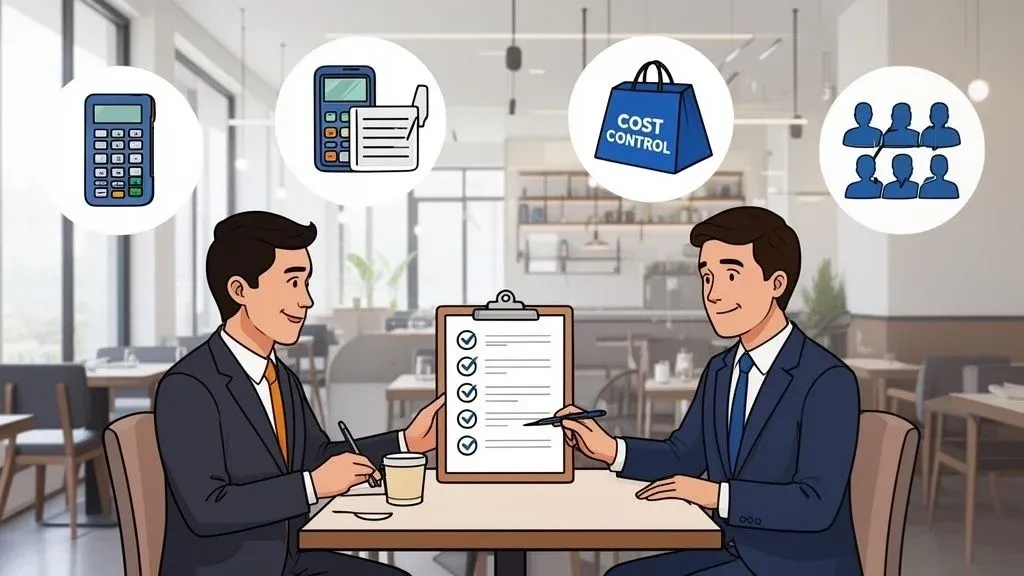
Hiring a great restaurant manager is one of the most critical decisions an owner can make. The right leader drives profitability, boosts restaurant efficiency, and builds a stellar team. A poor hire, however, can lead to lost revenue, high staff turnover, and operational chaos.
Today’s restaurant management goes far beyond just handling inventory and scheduling. A top-tier manager must be comfortable with technology, especially with Point of Sale (POS) systems and the complex world of third-party delivery. To ensure you’re asking effective questions and not settling for generic inquiries, it’s crucial to master general interviewing best practices.
This specific list of interview questions for a restaurant manager is designed to cut through the fluff. We will show you how to identify candidates who truly understand modern restaurant operations, from POS integration with systems like Square to optimizing delivery channels. Each question is built to reveal a candidate’s practical skills and their potential to use technology to grow your bottom line, reduce errors, and save valuable time.
Let’s dive into the questions that will help you find a manager who is ready to lead your restaurant into a more efficient and profitable future.
1. Tell me about your experience managing restaurant operations and POS systems.
This foundational interview question for a restaurant manager is designed to gauge a candidate’s comfort with the core technical and operational duties of the job. You’re not just asking about their leadership skills; you’re probing their direct experience with the restaurant’s central nervous system: the point-of-sale (POS) system and its connection to daily operations. A candidate’s answer reveals their ability to manage everything from order entry and payment processing to how these systems integrate with third-party delivery services.
Why This Question Matters for Restaurant Efficiency
A manager who understands how to connect delivery platforms directly with the restaurant’s POS can dramatically reduce operational friction. In simple terms, this means making orders from apps like DoorDash and Uber Eats appear automatically in your kitchen, without a staff member having to type them in by hand. This technical process is called POS integration. For example, integrating delivery apps with a system like Clover or Square eliminates manual re-entry. This automation saves time, reduces costly order mistakes, and frees up your team to focus on preparing food and serving customers, directly boosting staff productivity. To learn more about how these systems function, you can read this detailed guide on what a POS system is.
Key Insight: A manager’s technical proficiency is directly tied to your bottom line. An effective POS integration, guided by a knowledgeable manager, translates to lower labor costs, fewer food-related errors, and higher staff productivity.
What to Listen For
When asking this question, pay close attention to the specifics in their answer. Do they mention particular POS systems or integration challenges? A strong candidate will provide concrete examples.
- Strong Answer Example: “At my previous restaurant, we used Square and had three different tablets for Uber Eats, DoorDash, and Grubhub. I spearheaded the integration of OrderOut, which consolidated all incoming orders directly into our main POS. This cut our average order entry time from 90 seconds down to zero and reduced order mistakes by over 30% in the first quarter.”
- Weak Answer Example: “I’ve used a few POS systems before and am comfortable with technology. I’m a quick learner and can handle whatever system you have.”
The first answer demonstrates direct experience and a clear understanding of the financial and operational benefits of POS integration. The second is vague and lacks proof of their ability to solve real-world problems.
2. How have you managed multiple delivery platform orders (DoorDash, Uber Eats, Grubhub) simultaneously?
This is one of the most critical interview questions for a restaurant manager in today’s market. Your goal is to assess their hands-on experience with the operational chaos known as “tablet hell”—the overwhelming challenge of juggling multiple tablets, each with its own ringing alerts and order flow. Answering this question well reveals a candidate’s problem-solving skills, their attention to detail, and their approach to managing high-volume, high-stress situations that directly impact your restaurant efficiency and kitchen workflow.
Why This Question Matters for Restaurant Efficiency
A manager who has only ever dealt with a single delivery app or an already-integrated system may not fully grasp the challenges of juggling multiple order streams. Manually entering orders from DoorDash, Uber Eats, and Grubhub tablets into the POS is a major source of labor cost, human error, and kitchen bottlenecks. A candidate who has faced this problem head-on is better prepared to appreciate and implement solutions like POS integration. For a deeper look into how these platforms compare, you can explore this analysis of Uber Eats vs. DoorDash vs. Grubhub.
Key Insight: A candidate’s experience with manual order management is a direct indicator of their ability to identify and fix operational inefficiencies. Their past struggles are a strong predictor of their future success in creating a smoother, more profitable delivery operation for you.
What to Listen For
Probe for specifics on process and metrics. How did they ensure accuracy? How did they train staff to handle the rush? A top-tier candidate will provide data-driven examples of their management approach.
- Strong Answer Example: “At my last role, we were handling over 200 delivery orders daily across three platforms, all entered by hand. I implemented a strict cross-check system where one staff member confirmed orders on the tablets while another entered them into the POS. We also created a shared spreadsheet to track order status, which helped reduce our error rate from 8% to under 3%. It was a temporary fix, but it highlighted the need for automation, which I then presented to ownership.”
- Weak Answer Example: “Yeah, we had a few tablets for different delivery services. It could get busy, but we managed to keep up. My team was good at handling it.”
The first answer shows a proactive manager who measured a problem, created a process to mitigate it, and understood the ultimate need for a better system. The second answer is passive and demonstrates a lack of initiative or deep understanding of the operational costs involved.
3. Describe a time you had to implement a new technology or system. How did you handle staff adoption?
This behavioral interview question for a restaurant manager moves beyond technical knowledge and into leadership and change management. Implementing new systems, whether it’s a new POS or an order aggregation tool, is often met with staff resistance. A candidate’s answer reveals their ability to guide a team through change, provide effective training, and ensure new tools are adopted successfully rather than ignored.
Why This Question Matters for Restaurant Operations
New food tech is only effective if your team actually uses it. A manager who can successfully introduce and embed new systems is essential for realizing the benefits of restaurant efficiency. For example, when integrating multiple delivery platforms like DoorDash and Uber Eats into a central system, the goal is to eliminate manual order entry. If the staff reverts to old habits because they weren’t properly trained or convinced of the benefits, the investment in time and money is wasted. A manager’s ability to drive adoption is what makes technological improvements stick and deliver time savings and error reduction.
Key Insight: A manager’s change management skills are a direct predictor of your restaurant’s ability to adapt and improve. Poor adoption leads to wasted money and frustrated staff, while strong leadership ensures technology delivers on its promise of greater efficiency and lower costs.
What to Listen For
You want an answer that outlines a clear, empathetic process for managing change. Look for specific actions they took to train staff, address concerns, and measure success.
- Strong Answer Example: “In my last role, we switched to a tableside ordering system using iPads to speed up service. I knew some veteran servers were hesitant. I held a kickoff meeting to explain the ‘why’ - faster ticket times and higher tips. I then created a phased rollout, training a few ‘tech champions’ first who could then help their peers. We also had short, daily check-ins for the first two weeks to troubleshoot issues on the spot. Within a month, all front-of-house staff were using the system, and our table turn time improved by 15%.”
- Weak Answer Example: “I told the staff we were getting a new system and that they needed to learn it. I scheduled a training session, and most people picked it up pretty quickly. It’s just part of the job.”
The strong answer shows a strategic approach that considers the human element of technology adoption. The weak answer is dismissive and suggests a lack of leadership in overcoming inevitable challenges. To learn more about modernizing your operations, you can read this guide on automation in restaurants.
4. How do you prioritize and manage your time when handling competing demands (staff, customers, delivery orders, accounting)?
This is a critical interview question for a restaurant manager because it gets to the heart of their ability to perform under pressure. A restaurant is a dynamic environment where a customer complaint, a staffing emergency, and a flood of third-party delivery orders can all happen at once. You’re looking for a candidate who can triage tasks effectively, delegate intelligently, and maintain a calm, strategic presence instead of getting lost in the chaos.
Why This Question Matters for Restaurant Efficiency
A manager’s time management skills directly impact operational flow and profitability. If they are constantly putting out small fires, they have no time to focus on high-impact activities like staff training, cost analysis, or improving the customer experience. A manager who can systematize their day ensures that urgent tasks don’t derail important, long-term goals. For instance, they must balance supervising the floor, checking on kitchen ticket times, and ensuring that integrated delivery orders from DoorDash and Uber Eats are flowing smoothly through the POS system, all of which are vital for restaurant operations.
Key Insight: A manager who can’t prioritize will always be reactive, not proactive. Their inability to manage time leads to bottlenecks in service, higher staff turnover from a lack of support, and missed opportunities for operational improvement.
What to Listen For
A strong candidate won’t just say they are “good at multitasking.” They will provide a clear framework or system for how they organize their responsibilities. Pay attention to their philosophy on delegation and their use of tools.
- Strong Answer Example: “I use a version of the Eisenhower Matrix to start my day. I categorize tasks into four quadrants: urgent and important, important but not urgent, urgent but not important, and neither. This helps me focus on what truly drives the business forward, like staff development or analyzing sales data, while delegating tasks like inventory counts or scheduling. For example, I’d prioritize training a shift lead on our new OrderOut integration with Square over personally restocking the server station.”
- Weak Answer Example: “I’m used to being busy, so I just handle things as they come up. I make a to-do list in the morning and try to get through as much as I can. It’s all about multitasking and staying focused.”
The first answer demonstrates a concrete system and an understanding of delegation as a strategic tool. The second response is reactive and lacks a clear method for handling competing priorities, suggesting they might get overwhelmed during a real service rush.
5. How do you measure and track performance metrics? What KPIs do you monitor most closely?
This interview question for a restaurant manager assesses a candidate’s business acumen and data literacy. It’s designed to determine if they use concrete data to guide their decisions or simply manage by “gut feeling.” You want a manager who understands the key drivers of profitability, especially in the context of food delivery, where margins can be tight and operational efficiency is paramount. Their answer shows whether they can connect daily actions to high-level financial outcomes.
Why This Question Matters for POS Integration and Restaurant Delivery
A manager who actively tracks key performance indicators (KPIs) can identify and fix costly problems before they spiral out of control. For instance, by monitoring delivery order accuracy rates, a manager might discover an 8% error rate that costs the restaurant $2,000 per month in remakes and refunds. By integrating delivery platforms like DoorDash and Uber Eats with a Square or Clover POS system, they can directly improve this KPI by eliminating manual entry mistakes and reducing errors. You can dive deeper into the most important restaurant metrics by reading about the top KPIs for your restaurant.
Key Insight: A data-driven manager transforms operational information into actionable business intelligence. Tracking metrics like order entry time saved or reduced error rates provides clear proof of their impact on your profitability.
What to Listen For
When a candidate answers this question, listen for specific metrics and how they use them to drive improvements. A top-tier applicant will talk about KPIs related to cost, revenue, and efficiency, linking them to tangible outcomes.
- Strong Answer Example: “I monitor several KPIs on different schedules. Daily, I check labor cost percentage and ticket times, especially for delivery. Weekly, I analyze our cost of goods sold and track order accuracy, which was a big focus at my last job. I found we were spending nearly 2.5 hours a day on manual entry from delivery tablets, leading to a 10% error rate. By implementing an integration solution, we cut that time to zero and reduced errors to under 2%, saving us over $1,500 a month in comps.”
- Weak Answer Example: “I always keep an eye on sales and try to make sure our costs are low. If sales are down, I motivate the team to work harder. I think keeping customers happy is the most important thing.”
The first answer is specific, data-oriented, and solution-focused. The second answer is generic and lacks any evidence of a systematic approach to restaurant management.
6. Tell me about a time you identified an operational inefficiency and implemented a solution. What was the impact?
This behavioral question is one of the most powerful interview questions for a restaurant manager because it cuts straight to their problem-solving ability and business acumen. You’re asking for a story that demonstrates their initiative, analytical skills, and focus on tangible results. The answer reveals whether a candidate is a passive observer or an active leader who constantly seeks ways to improve processes, reduce costs, and make the restaurant run smoother.
Why This Question Matters for Restaurant Efficiency
A manager who can spot and fix inefficiencies is an invaluable asset. In a high-pressure restaurant environment, small bottlenecks can quickly escalate into major problems, hurting your profit margins and staff morale. For instance, a manager who notices the constant distraction and manual work of managing multiple delivery tablets from DoorDash and Uber Eats is more likely to appreciate and champion a solution like OrderOut, which automates the process by feeding orders directly into the kitchen. Their ability to connect a problem (manual entry errors, slow service) with a solution (process improvement, technology adoption) is critical for growth and shows they understand how to improve staff productivity.
Key Insight: A manager’s ability to identify and quantify operational improvements is a direct indicator of their potential to boost your restaurant’s profitability. Look for candidates who think in terms of measurable impact, not just daily tasks.
What to Listen For
A great answer will be structured like a mini case study: it will define the problem, explain the solution, and detail the results with specific metrics. When asking about performance metrics, it’s essential to understand a candidate’s grasp on what truly drives success. Further reading on choosing the right KPIs for your business can help refine your expectations.
- Strong Answer Example: “At my last job, I noticed our team spent nearly 15 minutes every hour consolidating delivery orders from three different tablets. I created a simplified tracking system and then pitched the integration of an order aggregator. After implementation, we eliminated that consolidation process entirely, saving about 90 minutes of labor per shift and cutting down our order errors from duplicate entries by 35%.”
- Weak Answer Example: “We had some issues with things being slow, so I talked to the team and we tried to work faster and be more organized. I think it helped make things better.”
The first answer provides a clear problem, a specific action, and a measurable impact. The second is generic and fails to demonstrate a proactive, data-driven approach to management.
7. How do you maintain service quality and accuracy when order volume spikes unexpectedly?
This is one of the most critical interview questions for a restaurant manager because it cuts straight to operational resilience. Unexpected rushes, especially from a flood of third-party delivery orders on a Friday night, can quickly lead to chaos, costly errors, and unhappy customers. You are asking candidates to demonstrate how they lead a team through high-pressure situations while protecting your restaurant’s standards and profitability. Their answer reveals their capacity for planning, delegation, and problem-solving under stress.
Why This Question Matters for Restaurant Delivery
A manager who only reacts to rushes instead of preparing for them will constantly be putting out fires. Proactive strategies are essential for handling volume spikes without sacrificing accuracy. For instance, a manager who cross-trains all staff to handle order assembly and communication can deploy team members dynamically as bottlenecks appear. This adaptability is key when a sudden influx of DoorDash orders arrives at the same time as a full dining room. An effective online order management system can also prevent the initial chaos by funneling all orders into one place, giving the manager a single, clear view of the demand and improving restaurant efficiency.
Key Insight: A manager’s ability to prepare for and manage peak volume directly impacts your error rates, food costs, and customer retention. A well-managed rush builds your reputation; a poorly managed one can damage it permanently.
What to Listen For
Look for answers that focus on proactive systems rather than reactive scrambling. A top-tier candidate will discuss specific, implemented processes and their measurable results. Ask follow-up questions about their prevention strategies versus just their recovery methods after a mistake has been made.
- Strong Answer Example: “During weekend rushes, we were drowning in delivery orders. I implemented a two-part system. First, we pre-staged common ingredients for our top delivery items, which cut assembly errors by 40% during the 6-9 PM window. Second, I created a simple order verification checklist for the expo station, which pushed our order accuracy to 98% even on our busiest nights.”
- Weak Answer Example: “It gets crazy, but I just jump in wherever I’m needed. I’ll help on the line, pack orders, and talk to drivers. We all just work hard and get through it together.”
The first response shows a methodical, data-driven approach to solving a recurring problem. The second answer, while well-intentioned, lacks any formal system and suggests the manager relies on sheer effort rather than smart operational design.
8. What is your experience with delivery platform economics and how do you optimize delivery channel profitability?
This is a high-level interview question for a restaurant manager that separates operational managers from true business leaders. You are testing their financial acumen and strategic thinking. An answer to this question shows whether a candidate understands that delivery isn’t just about fulfilling orders; it’s about managing a complex, and often expensive, sales channel with its own unique economic pressures like commission structures, promotional costs, and order value thresholds.
Why This Question Matters for Restaurant Delivery
A manager who only sees delivery as more orders is missing the bigger picture. The profitability of your delivery channels directly impacts your restaurant’s bottom line. A manager who can analyze delivery margins, understand the costs associated with platforms like Uber Eats and DoorDash, and implement strategies to improve profitability is a massive asset. For example, they might create delivery-only meal bundles to increase the average order value (AOV), offsetting the high commission fees. This strategic approach shows they understand how to manage food tech not just for volume, but for profit.
Key Insight: Profitability isn’t just about revenue; it’s about margin. A manager who can dissect delivery platform economics can turn a high-volume, low-profit channel into a significant contributor to your restaurant’s financial health.
What to Listen For
Look for answers that go beyond simply acknowledging that delivery platforms charge fees. A strong candidate will demonstrate a deep understanding of the numbers and provide clear examples of how they’ve used that knowledge to drive results.
- Strong Answer Example: “At my last role, I calculated that our 18% Uber Eats commission meant we needed an AOV of at least $35 to be profitable. I developed a bundling strategy that combined an entrée, side, and drink for $38, which we promoted heavily on the app. This strategy raised our channel profitability by 22% and reduced the number of low-margin, small orders.”
- Weak Answer Example: “Delivery fees are high, so we just tried to get as many orders as possible to make up for it. I made sure my staff was fast at getting the orders out the door.”
The first response shows a proactive, data-driven approach to managing delivery finances. The second answer is reactive and lacks the strategic depth needed to effectively manage this critical part of the business. A candidate who understands these economics will also recognize how tools that reduce errors, like OrderOut, directly improve margins by eliminating costly mistakes and comps.
9. Describe your approach to training and developing your team. How do you ensure consistent execution across shifts?
This is a critical interview question for a restaurant manager because it assesses their ability to build a reliable, high-performing team. A manager’s leadership and training methods directly impact everything from customer service quality to operational efficiency. You are looking for a candidate who doesn’t just hire staff but actively develops them into a cohesive unit that can execute tasks consistently, especially when adopting new technologies or procedures.
Why This Question Matters for POS Integration
A well-trained team is the foundation of a smoothly run restaurant. When a new system is introduced, such as an integration that funnels all DoorDash and Uber Eats orders into your central Square or Clover POS, consistent training is paramount. Without it, some shifts may revert to old, inefficient methods (like manually punching in orders), leading to errors, delays, and a chaotic kitchen. A manager with a strong training framework ensures that every employee, regardless of their shift, understands and follows the new, more efficient workflow, which increases staff productivity and reduces errors.
Key Insight: Consistent training is not just about service standards; it’s about operational integrity. A manager who builds strong training programs ensures that efficiency gains from technology are realized across the board, protecting your investment and your bottom line.
What to Listen For
When asking this question, probe for structure, documentation, and accountability in their training process. A candidate who can articulate a clear system for development is far more valuable than one who relies on informal, on-the-fly instruction.
- Strong Answer Example: “I believe in a structured, multi-stage training process. For new hires, it starts with documented standard operating procedures for every role. They shadow an experienced team member for their first five shifts, then work in a paired capacity for the next ten. We also hold daily pre-shift meetings to cover priorities and monthly refresher sessions to ensure standards don’t slip. When we implemented OrderOut, I created a one-page guide and ran a mandatory 30-minute training for every single employee to guarantee a smooth rollout.”
- Weak Answer Example: “I usually have my best server train the new people. I check in with them to make sure things are going okay. I’m a hands-on manager, so I’m always on the floor to correct mistakes as they happen.”
The first answer demonstrates a proactive, systematic approach to building a competent team and managing change. The second reveals a reactive style that can lead to inconsistent execution and an over-reliance on the manager’s constant presence.
10. What attracts you to OrderOut as a potential partner/solution, and how would you measure the success of implementing our integration?
This closing interview question for a restaurant manager is a direct test of their strategic thinking and problem-solving abilities. It shows whether the candidate has researched your business’s potential needs and can connect a solution like OrderOut to specific operational challenges. Their response reveals if they think in terms of measurable outcomes, such as reduced labor, fewer errors, or increased profitability, which are all hallmarks of an effective manager.
Why This Question Matters for Restaurant Efficiency
A manager who can articulate the value of an integration partner is one who already thinks about optimizing workflows. The ability to identify a pain point, like manual order entry from multiple delivery tablets, and then define what success looks like after fixing it, is critical. This foresight ensures that technology investments are not just made, but are also measured for a clear return on investment (ROI). It separates managers who simply oversee daily tasks from leaders who actively improve the business. For example, a great real-world example is how consolidating Uber Eats and DoorDash orders into a Clover POS system directly reduces labor costs and order entry errors.
Key Insight: A manager who can define success metrics for a technology solution is more likely to drive its successful adoption and ensure it delivers real financial benefits. They see technology not as a cost, but as an engine for profitability and efficiency.
What to Listen For
A strong answer will go beyond generic interest and connect OrderOut’s function directly to a quantifiable business improvement. Pay attention to the specific metrics they propose.
- Strong Answer Example: “I noticed you’re using DoorDash and Grubhub, and based on my experience, that can mean spending over 2.5 hours a day just re-keying orders. What attracts me to OrderOut is its ability to eliminate that manual work. I’d measure success by tracking two key metrics: first, reducing that manual entry time to under 20 minutes daily, and second, cutting our current 8% order error rate down to less than 1% within the first month.”
- Weak Answer Example: “It seems like a good tool. I think it would make things easier for the staff and help us get more orders out. We would know it’s working if things feel less chaotic during a rush.”
The first answer is powerful because it identifies a specific problem, proposes a clear solution, and establishes measurable goals (time saved, error reduction). The second answer is too vague, lacks any concrete data, and doesn’t demonstrate an ability to measure impact.
Top 10 Restaurant Manager Interview Questions Comparison
Question / Topic Implementation Complexity 🔄 Resource Requirements ⚡ Expected Outcomes ⭐📊 Ideal Use Cases Key Advantages / Tips 💡 Experience managing restaurant operations & POS systems Medium 🔄 Requires POS configuration and vendor integrations Technical familiarity, vendor access, setup time ⚡ High ⭐📊 Fewer entry errors, smoother order flow Multi-location or tech-forward restaurants using Square/Toast/Clover Reveals baseline competency; ask for specific platforms and measurable improvements 💡 Managing multiple delivery platform orders (DoorDash, Uber Eats, Grubhub) High 🔄 Complex without consolidation; duplicated workflows Multiple apps, significant staff time or integration tool ⚡ Very high ⭐📊 Reduced duplications, fewer missed orders, major time savings High delivery-volume restaurants on multiple apps Directly tied to OrderOut ROI; request order volumes and error metrics 💡 Implementing new technology and driving staff adoption Medium–High 🔄 Change management, training and support required Training programs, documentation, leader time and follow-up ⚡ High ⭐📊 Faster adoption, sustained usage, fewer disruptions Locations planning POS or delivery integration rollouts Assess training plans, timelines and resistance-handling strategies 💡 Prioritizing and managing time with competing demands Low–Medium 🔄 Process and delegation-focused, less tech complexity Organizational tools, delegation, routines and briefings ⚡ Medium ⭐📊 Better focus on high-impact tasks and operational stability Single-site managers juggling floor, delivery, and admin tasks Reveals prioritization frameworks; ask for recent concrete examples 💡 Measuring and tracking performance metrics (KPIs) Medium 🔄 Requires reporting access and analysis processes Reporting tools, time for analysis, accountability systems ⚡ High ⭐📊 Data-driven decisions, improved margins and error rates Managers focused on profitability and operational optimization Look for specific KPIs tracked and how metrics drive actions 💡 Identifying operational inefficiencies and implementing solutions Low–Medium 🔄 Often process changes or small tech fixes Analytical time, pilot resources, possible minor tech work ⚡ High ⭐📊 Time/cost savings, reduced errors, scalable gains Teams seeking quick ROI through process improvements Expect STAR examples with before/after metrics and rollout scope 💡 Maintaining service quality during unexpected volume spikes Medium 🔄 Staffing plans, processes and contingency playbooks needed Cross-training, prep time, checklists, temporary staffing ⚡ High ⭐📊 Maintained accuracy, higher customer satisfaction under pressure Restaurants with unpredictable peak delivery windows Probe prevention vs recovery tactics and peak error rates 💡 Experience with delivery platform economics and channel profitability Medium–High 🔄 Financial modeling and strategic channel management Margin analysis, reporting, promotional resources and experiments ⚡ High ⭐📊 Improved channel profitability and smarter promotions Restaurants optimizing multiple delivery channels for margin Ask about commission structures and total cost-per-order calculations 💡 Training and developing teams for consistent execution across shifts Medium 🔄 Ongoing program creation, documentation and coaching Training materials, mentors, time for shadowing and refreshers ⚡ High ⭐📊 Consistent standards, faster system adoption, lower errors Multi-shift or high-turnover locations Look for structured programs, measurable training outcomes and accountability 💡 Interest in OrderOut & measuring implementation success Low–Medium 🔄 Alignment and measurement setup; integration varies Baseline metrics, monitoring time, stakeholder buy-in ⚡ High ⭐📊 Clear ROI: time saved, reduced errors, better delivery margins Managers evaluating consolidation solutions for ROI Expect specific success metrics, timelines and reporting plans; probe realism 💡
Your Next Step: Hire a Manager Who Builds an Efficient Restaurant
The process of hiring a restaurant manager has fundamentally changed. It’s no longer enough to find someone who can manage schedules and placate unhappy customers. The right leader for a modern restaurant must be a strategic operator, a tech-savvy problem-solver, and a data-driven decision-maker. The comprehensive list of interview questions for a restaurant manager detailed in this article is your blueprint for identifying exactly that person. By moving beyond generic inquiries and focusing on specific competencies related to operations, technology, and profitability, you transform the interview from a simple conversation into a powerful diagnostic tool.
These questions are designed to reveal a candidate’s true capabilities. Can they handle the pressure of simultaneous orders from DoorDash and Uber Eats? Do they have a proven method for introducing new systems, like a delivery integration for your Clover POS, without causing staff chaos? A candidate’s answers to these targeted questions will show you whether they view technology as a burden or as a critical asset for building a more efficient and profitable restaurant. The goal is to find a manager who actively seeks out solutions to operational bottlenecks, rather than just managing the day-to-day fires.
Key Takeaways for Your Next Manager Interview
To ensure you hire a leader who will drive your business forward, concentrate on these three core areas during your interview process:
- Operational and Tech Fluency: A strong manager must speak the language of modern restaurant operations. Listen for specific examples of how they’ve used POS systems like Square to track performance or managed the complexities of third-party delivery services. Their ability to articulate past successes and failures in implementing food tech is a direct indicator of their future performance in your establishment.
- Data-Driven Mindset: The best managers don’t guess; they measure. Questions about KPIs, cost control, and profitability are essential. A top-tier candidate won’t just say they “try to reduce costs.” They will explain how they track food waste percentages, monitor labor costs against sales in real-time, and analyze delivery commission fees to optimize channel profitability.
- Problem-Solving and Adaptability: The restaurant environment is unpredictable. Your manager needs to be a master of adaptation. Inquire about how they handle sudden order spikes or resolve operational inefficiencies. Their response reveals their thought process, their ability to stay calm under pressure, and their capacity to create systems that prevent the same problems from happening again.
Crucial Insight: The single most important outcome of your interview process is finding a manager who understands that restaurant efficiency is not a background task; it is the engine of profitability. A leader who appreciates the time saved by eliminating manual order entry or the revenue captured by reducing order errors is a leader who will actively champion tools that make your restaurant stronger.
Ultimately, the right interview questions for a restaurant manager will help you find more than just an employee. You will find a partner in growth, someone who can take the operational reins and steer your restaurant toward greater efficiency and success. They will be the person on the ground who ensures your investment in food tech pays off, translating directly into a healthier bottom line, a happier team, and more satisfied customers. This strategic approach to hiring is your next crucial step in building a resilient and thriving restaurant business.
Hiring a manager who understands efficiency is the first step. The next is giving them the tools to succeed. See how OrderOut can eliminate manual order entry from all delivery platforms and send orders directly to your POS system.
Start your free onboarding with OrderOut in just a few clicks.