
How to Start a Food Cart: A Practical Guide
· Thibault Le Conte
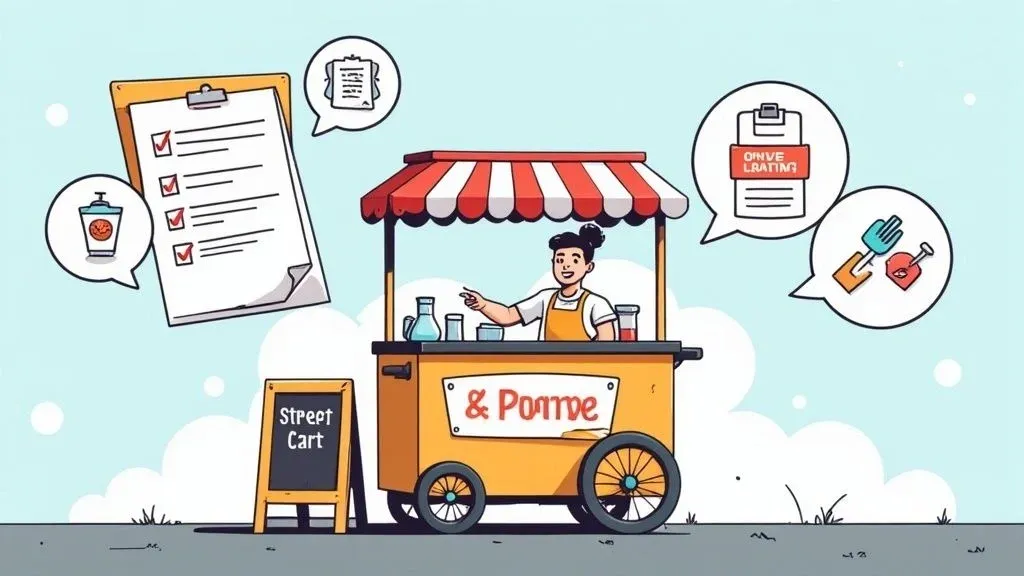
So, you’re thinking about starting a food cart. It’s an incredible way to get into the food business, but it’s easy to get bogged down in endless checklists. Let’s cut through the noise.
Launching a successful food cart really boils down to getting four things right: a killer concept, sorting out the legal stuff, crafting a smart menu, and picking the right tech to keep things running smoothly. Get these fundamentals locked in, and you’re not just starting a business—you’re building a brand.
Your Blueprint for a Profitable Food Cart
Jumping into the food cart scene is a smart move right now. The whole mobile food market is booming, valued at around USD 5.8 billion globally and expected to climb to USD 10.28 billion by 2033. People love the convenience and creativity that food carts bring to the table.
But here’s the thing experienced owners know: amazing food is only half the battle. Your success hinges on building an efficient, well-oiled machine from day one. Every single choice, from the type of onions you buy to the POS system you use, trickles down to your daily operations and, most importantly, your bank account.
Core Pillars of a Food Cart Business
Think of your launch plan as a set of dominoes. Each piece has to be lined up perfectly for the whole thing to work. If you jump ahead or miss a step, you’re setting yourself up for headaches and lost money down the road.
This is the path from a spark of an idea to slinging food on day one.
As you can see, you can’t just start with the fun stuff like menu tasting. Nailing your concept and getting all your permits in order has to happen first. It’s the only way to build a solid foundation.
To help you visualize the journey, here’s a quick roadmap of the major milestones you’ll hit.
Food Cart Startup Key Milestones
Phase Key Actions Why It Matters for Efficiency Concept & Legal Define your niche, write a business plan, and secure all necessary permits. Prevents costly legal fines and ensures your business idea is viable before you spend a dime on equipment. Menu & Sourcing Develop a focused menu, test recipes, and lock in reliable suppliers. A tight, well-costed menu is faster to prep, reduces waste, and makes inventory management a breeze. Cart & Equipment Design your layout, purchase equipment, and get your cart wrapped. An ergonomic layout means faster service, which translates directly to more sales during a busy lunch rush. Tech & Operations Set up your POS, integrate delivery apps, and create staff workflows. Smart tech automates tedious tasks, minimizes order errors, and gives you a clear view of your sales data.
Getting these phases right in order saves you a ton of time, stress, and money. It’s about working smarter, not harder.
Speaking of smarts, you absolutely have to know your numbers from the get-go. A solid grip on your finances influences every decision you make, from pricing your signature dish to deciding if you can afford that extra festival weekend. Getting your financial tracking in place is just as crucial as buying a good grill. For a crash course, take a look at our guide on how to create a restaurant profit and loss statement. It’ll help you build a business that’s not just tasty, but truly profitable.
Key Takeaway: A winning food cart isn’t just about culinary talent; it’s a game of strategy. By focusing on a unique concept, solid legal groundwork, an efficient menu, and smart technology, you build a resilient business that’s ready for anything.
Navigating Permits, Licenses, and Funding
Let’s tackle the two things that often feel the most intimidating for new food cart owners: the paperwork and the money. Getting these sorted out from day one isn’t just about following the rules; it’s about building a solid foundation for your business so it can handle surprise inspections and manage cash flow without breaking a sweat. A small slip-up here can mean big fines or frustrating delays, throwing your whole launch off track.
The world of food cart regulations is a hyper-local puzzle. The rules in one city can be wildly different from the town just a few miles away. That’s why your very first call should be to your local city and county health departments. They hold all the cards and will give you the definitive checklist of exactly what you need to operate legally.
Demystifying the Essential Paperwork
While the specifics change from place to place, there’s a core set of documents you’ll almost certainly need. Think of these as your non-negotiable tickets to get in the game. Getting them in order early on prevents costly shutdowns and lets you focus on what really matters: the food.
You’ll most likely need to track down the following:
- Business License: This is your basic permit to do business in your city or county. It’s usually the first one you’ll need to secure.
- Food Handler’s Permit: Anyone who touches the food in your cart—including you—needs this. It’s a certification showing you’ve passed a basic food safety course.
- Health Department Permit: This is the big one. An inspector will need to sign off on your cart’s design, your equipment, and your food safety plan to make sure you meet all the local health codes.
- Commissary Agreement: Most health departments won’t let you prep food or clean your cart at home. You’ll need a formal, signed agreement with a licensed commercial kitchen (a “commissary”) for food prep, water tank refills, and waste disposal.
This process might sound like a mountain of paperwork, but it’s much more manageable when you have a clear plan. For a deeper look at these steps, check out our guide on the essential checklist for opening a new restaurant, as many of the foundational legal steps are the same.
Budgeting and Securing Your Startup Funds
Once you’ve got a handle on the legal side, the next big question is always about money. The initial investment for a mobile food business can be pretty significant. A food truck, which is usually a bigger investment than a cart, typically runs between USD 50,000 to USD 200,000 to get started. The good news? Once they’re up and running, these businesses can be quite profitable, with average annual revenues hitting USD 346,000.
Your budget has to be grounded in reality, and it needs to cover more than just the cart itself.
Key Takeaway: Your startup budget has to account for way more than just the physical cart. The hidden costs—initial inventory, insurance, marketing materials, and a cash reserve for the first few months—are what trip people up. Under-budgeting is one of the top reasons new food businesses fail.
So, where does the money come from? Most new owners pull from a few different places.
- Personal Savings: This is the simplest route. Using your own cash means you have total control and no one to answer to.
- Small Business Loans: Banks and credit unions are an option, but you’ll need a rock-solid business plan and good personal credit to get approved.
- Grants: These are tougher to land, but the huge advantage is you don’t have to pay them back. For food-focused businesses, it’s definitely worth looking into programs like the USDA’s Local Food Promotion Grants.
Getting your funding right from the start is absolutely crucial. It means you can afford quality equipment, keep the business running smoothly with enough working capital, and reduce a whole lot of stress—setting you up for success in the long run.
Designing a Smart Menu and Efficient Kitchen

Your menu is so much more than a list of what you sell. It’s the heart of your brand and the single biggest driver of your profit. In the cramped quarters of a food cart, every item you offer has to earn its spot. The goal isn’t just to be delicious; it’s to be engineered for speed, minimal waste, and maximum profitability.
Think of yourself as a kitchen engineer. Your menu is the blueprint that dictates every other decision, from the equipment you buy to the physical layout of your cart and the exact steps your team will take during a chaotic lunch rush.
Crafting a High-Profit Menu
The most successful food cart menus are deceptively simple. They give customers exciting options while being ruthlessly efficient to execute behind the counter. The trick is to anchor your menu around a small, core group of items—think 3 to 6 main dishes—that can be easily customized.
This strategy immediately shrinks the amount of inventory you need to cram into a tiny space. It also makes training a breeze and cuts down on mistakes when the line is 20 people deep.
Here are a few tactics the pros use to build a menu that works:
- Cross-Utilize Everything: Design your menu around ingredients that can pull double or triple duty. That slow-cooked pork? It goes in the tacos, on the loaded fries, and into a rice bowl. This one move drastically reduces food waste and simplifies your entire ordering process.
- Price for Profit: You absolutely have to calculate the Cost of Goods Sold (COGS) for every single item on your menu. The industry standard is to aim for a food cost of around 28-35%. If you don’t nail this, you could be busy all day and still lose money.
- Engineer for Speed: Every dish needs to be designed for rapid assembly. Break down your workflow into stations: a grill station, a cold prep station, and a final assembly/packaging spot. An assembly-line mindset is how you crank out orders and keep the line moving.
Mastering these principles turns your menu from a simple list into a powerful business tool. If you want to go deeper, check out our guide on the essential menu elements every restaurant should master.
Optimizing Your Kitchen Layout and Restaurant Operations
Once your menu is locked in, you can finally design your kitchen. The layout of your food cart is a high-stakes game of Tetris where every inch counts. A smart layout minimizes the number of steps your staff has to take, which directly translates to faster service and more money in the bank.
It’s all about creating an efficient “work triangle.” Your most-used stations—like the griddle, the prep cooler, and the service window—should be just a pivot away from each other. The less your team moves, the more food they can push out the window.
Why it matters for restaurant efficiency: A well-designed kitchen can shave precious seconds off every single order. If an efficient layout helps you serve just 10 more customers an hour during a four-hour lunch rush, that could add up to hundreds of dollars in extra revenue every day. This boosts staff productivity and keeps your line moving, making for happier customers.
When it’s time to buy equipment, your menu is your shopping list. Tacos? A high-quality flat-top griddle is non-negotiable. Smoothies? You’ll need commercial-grade blenders that won’t burn out.
You’ll have to decide whether to buy new or used. Here’s a quick breakdown:
Equipment Type Pros Cons New Equipment Reliable, under warranty, energy-efficient. High upfront cost. Used Equipment Significant cost savings. No warranty, potential for repairs.
For most first-timers, a hybrid approach is the smartest path. Splurge on a new, reliable refrigerator (a food safety nightmare is the last thing you need), but save a bundle by picking up a used griddle or fryer.
Practical Next Step: Grab a piece of paper and sketch out your ideal cart layout. Label where every piece of equipment goes. Now, trace the physical path a staff member would take to make your most popular order. This simple exercise will instantly reveal any workflow bottlenecks before you spend a dime.
Improving Restaurant Operations with Food Tech

Not too long ago, a cash box and a spiral notebook were all you needed to run a food cart. Those days are gone. Today, getting your technology right isn’t just a nice-to-have—it’s the engine that keeps you from running out of steam during a lunch rush. Making smart tech choices from day one will save you from a world of operational headaches later.
The absolute heart of any modern food cart is its Point of Sale (POS) system. In simple terms, this is the system that takes orders and processes payments. Technically, a modern POS is your command center, handling every transaction and feeding you critical data that helps you run the business. A good POS lets you make smarter, faster decisions on the fly.
The Power of POS Integration for Your Food Cart
A modern POS system, like the ones from providers like Square or Clover, completely changes how you manage your day-to-day. Instead of just guessing which sandwich is the most popular or when your busiest hours are, the answers are right there on the screen. That’s pure gold when it comes to setting your hours, managing inventory, and making sure your staff isn’t overwhelmed.
Here’s a snapshot of what a good POS brings to the table:
- Real-Time Sales Tracking: See exactly what’s selling and what’s sitting. This data is your secret weapon for tweaking the menu, running promotions that actually work, and making sure you don’t sell out of your top item an hour into service.
- Smarter Inventory Management: Many systems can deduct ingredients from your inventory counts as you sell items. This is a game-changer for cutting down on food waste and getting alerts before you run out of something critical.
- Reporting Without the Spreadsheets: Forget spending your nights wrestling with Excel. A quality POS spits out daily sales reports, tracks your labor costs, and gives you a clear financial snapshot. It’s invaluable for planning your next move.
Deciding which system is the best fit can feel overwhelming. To get a clear comparison of the top players, check out our guide on the best POS systems for small restaurants.
Why It Matters: A smart POS automates all the tedious admin work that used to suck up an owner’s time. This frees you up to focus on what really matters: talking to customers, marketing your cart, and dreaming up your next killer menu item. This directly boosts staff productivity and reduces the time and cost associated with manual bookkeeping.
Optimizing Restaurant Delivery with POS Integration
Jumping on delivery apps like DoorDash and Uber Eats can open up a massive new revenue stream. But if you’re managing each one from a separate, beeping tablet at your service window, you’re creating a recipe for chaos. It’s a direct path to missed orders, typos, and a seriously stressed-out crew.
This is exactly where POS integration saves the day.
Simply put, integration means connecting your delivery apps directly to your main ordering system. Orders from Uber Eats or DoorDash automatically appear in your kitchen’s queue, just like a walk-up order.
The difference is immediate. This simple connection drastically reduces manual entry errors, which means fewer comped meals and happier customers. Your team is no longer juggling three different tablets and can focus on what they do best: making great food and getting it out the window fast. This time-saving automation boosts your team’s productivity and your profitability.
Manual vs Integrated Restaurant Delivery Management
Let’s break down the real-world difference between juggling tablets and having an integrated system.
Task Manual Process (Without Integration) Automated Process (With POS Integration) Order Entry Staff frantically re-types orders from multiple delivery app tablets into the POS. Orders from all apps flow directly into the POS kitchen queue. No typing needed. Error Rate High. Typos happen, leading to wrong orders, wasted food, and unhappy customers. Nearly zero. The system transfers order data perfectly, ensuring total accuracy. Staff Focus Split between taking in-person orders, watching for tablet alerts, and punching in tickets. Focused entirely on cooking and serving customers, both online and in-person. Speed of Service Slower. Manual entry creates a huge bottleneck, especially when it gets busy. Faster. The kitchen gets orders the second they come in, cutting ticket times way down.
The tech in the food world isn’t slowing down, either. We’re seeing more AI-powered tools, like voice ordering that boasts 83-88% accuracy and can cut labor costs by around 20%. As customers come to expect a smooth digital experience, keeping your tech up-to-date is how you stay competitive.
Practical Next Step: When you’re shopping for a POS, make delivery integration a non-negotiable. Ask them point-blank: “Can you connect with the major delivery apps in my city?” Getting a “yes” to that question future-proofs your cart and sets you up to grow without the growing pains.
Building Your Brand and Attracting Customers

Look, having incredible food and a killer kitchen setup is a great start, but it won’t magically create a line down the block. In the world of street food, your brand is what turns heads, and your marketing is what reels people in for that first bite. Building a loyal following starts way before you ever hand out your first order.
Think of your brand as the entire personality of your business, all wrapped up in a mobile package. It’s your logo, your colors, the design of your cart, and even the way you caption your photos on Instagram. A solid, cohesive brand makes you instantly recognizable and helps you stand out, whether you’re at a crowded food festival or parked on a busy street corner.
Crafting a Memorable Brand Identity
Your food cart is basically a moving billboard. Every single element needs to work together to tell the story of your food and what makes you special. You don’t need a massive budget to create something that sticks in people’s minds; you just need a clear vision.
Here’s what goes into a brand that people actually remember:
- A Unique Name and Logo: It needs to be catchy, easy to say, and give a hint about your food. Your logo has to be simple and bold—something people can recognize from across a park.
- A Striking Visual Design: This is where you get to have fun. Pick colors that match your food’s vibe. Bright and energetic for tacos? Earthy and natural for vegan bowls? Slap that design on your cart, your menus, and even your aprons.
- A Consistent Online Voice: How you “sound” online is a big deal. Are you fun and a little goofy, or are you all about premium, locally sourced ingredients? Whatever it is, keep that voice consistent everywhere you post.
Why It Matters: A strong brand isn’t just about looking good—it builds trust. When people recognize and trust your brand, they come back again and again. That creates a steady stream of revenue that makes everything from managing inventory to scheduling staff a whole lot easier.
Building Hype with Social Media
Social media is your absolute best friend when you’re launching a food cart, especially a visual platform like Instagram. The best part? You can start building an audience and getting people excited for free, long before you even open.
Start posting weeks, or even a couple of months, before you plan to launch. Show people the behind-the-scenes stuff—your logo design process, sneak peeks of menu items you’re testing, or photos of your cart getting its wrap. This makes potential customers feel like they’re on the journey with you, turning them into fans before they’ve even tried your food.
Finding Your Perfect Location
The old real estate mantra applies just as much to food carts: location, location, location. The beauty of being mobile is you can go where the people are, but that takes some smart scouting. You can’t just park anywhere; you have to find spots with heavy foot traffic that fit your ideal customer.
Think about prime spots like these:
- Downtown Business Districts: The weekday lunch rush is your bread and butter here.
- Local Farmers’ Markets: A perfect match if you’re reaching customers who care about fresh, local ingredients.
- Breweries and Bars: Partnering up with a local brewery can give you a built-in, hungry-and-thirsty crowd.
- Food Festivals and Community Events: These are gold mines for getting your brand in front of thousands of new faces.
Once you have a few spots in mind, you have to get permission. That usually means calling property managers, event organizers, or your city government to figure out the rules and book your spot. Keeping your cart busy is the name of the game, and this guide to generating leads for local business has some solid tips to keep the customers coming. You also need to show up in online searches when people are hungry, so be sure to check out our article on mastering local SEO for restaurants.
Practical Next Step: Go create a “Launch Week” social media calendar right now. Seriously. Plan out your posts for the 7 days leading up to your grand opening. Do a countdown, officially introduce your signature dish, and announce your very first location and hours. This simple plan is a pro move for building hype and ensuring you have a crowd on day one.
Operating and Growing in Your First 90 Days
https://www.youtube.com/embed/4pzpqxjmolo
The first three months are a blur. Forget perfection—this is all about adapting on the fly. You’re building your reputation, ironing out the kinks in your workflow, and proving your concept where it counts: on the street. Think of it as a live beta test for your business.
To keep the chaos at bay, you need a solid daily routine. This isn’t optional. Create non-negotiable checklists for morning prep, mid-shift restocking, and your end-of-day shutdown. You also have to be religious about inventory checks. Running out of your star ingredient during the lunch rush is more than just a lost sale; it’s a ding to your credibility right when you’re trying to build it.
Using Data and Feedback to Evolve
In these early days, your two best sources of intel are your customers and your POS system. Don’t be shy about asking people, “How was everything?” That direct feedback is pure gold. It tells you exactly what needs tweaking, whether it’s the heat in your hot sauce or how fast the line is moving.
At the same time, you need to be digging into the sales data from your point-of-sale. A system like Clover or Square is so much more than a cash register; it’s a treasure trove of insights. You can see which items are flying off the menu, pinpoint your busiest hours, and spot sales trends as they happen. This is how you make smart, data-driven decisions that boost restaurant efficiency, like adding a staff member for the lunch rush or getting rid of a slow-moving side.
Why It Matters: Gut feelings are great, but sales data doesn’t lie. Analyzing your reports takes the guesswork out of restaurant operations. You stop thinking you know what’s popular and you know. This cuts down on food waste and ensures you’re putting your inventory dollars where they’ll make you the most money.
Overcoming Early Challenges and Seizing Growth
Let’s be real: no launch goes off without a hitch. You’re going to have slow days with weak foot traffic or an equipment failure at the worst possible moment. The trick is to be proactive, not reactive. If one location is a dud, already have a backup spot in mind. Start building relationships with local businesses or office managers—securing a few regular lunch gigs can create a super reliable revenue stream.
Once you feel like you have a handle on the day-to-day grind, it’s time to hunt for those early growth opportunities. Offering to cater small local events or office parties can be incredibly profitable. Plus, it’s a fantastic way to get your food in front of a whole new crowd. These early wins are what build momentum and give you the cash flow to do more than just survive that crucial first quarter. You’ll be set up to thrive.
Ready to streamline your operations and connect with more customers? OrderOut integrates your delivery apps directly into your POS, eliminating manual entry and saving you valuable time. Start onboarding for Free in a few clicks.