
How to Improve Restaurant Sales: An Actionable Guide for Owners and Operators
· Thibault Le Conte
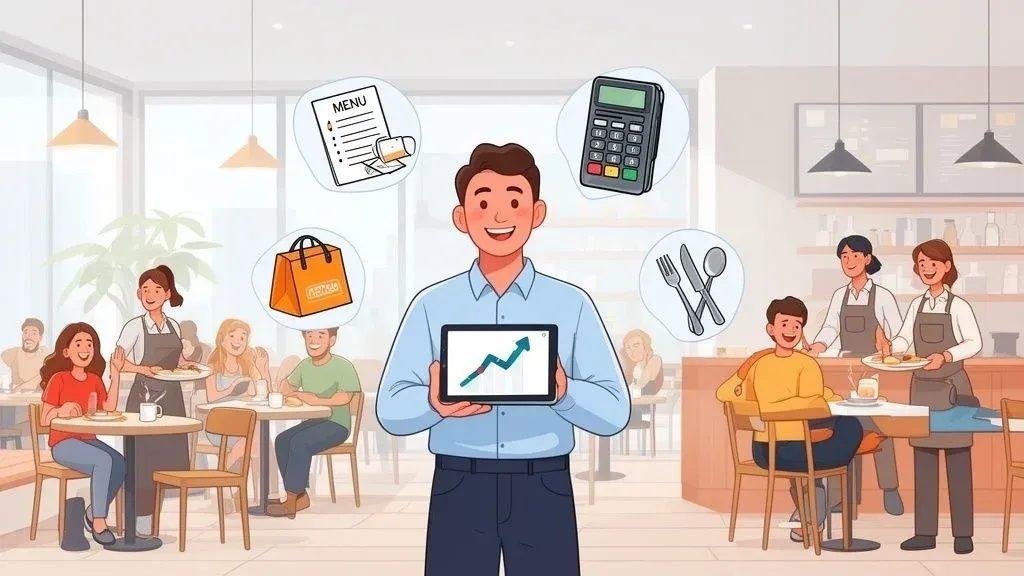
To truly improve restaurant sales, you need a two-part strategy: sharpen your operational efficiency and drive strategic growth. In simple terms, this means making your kitchen and delivery processes run flawlessly to cut costs and errors, while also using smart menu and promotion tactics to encourage customers to spend more and return often.
Think of it as strengthening your restaurant’s foundation. A smooth, efficient operation is the bedrock that allows for sustainable growth. Without it, even the best marketing can’t overcome a chaotic kitchen or inconsistent service.
Your Playbook for Increasing Restaurant Sales
Let’s get straight to what works. This guide is a practical playbook for restaurant owners looking for real, actionable strategies. We’ll walk through how to boost sales by connecting every part of your business—from back-of-house operations and your POS system to the menu you present to customers.
A crucial piece of this puzzle is technology. Specifically, integrating popular delivery services like Uber Eats and DoorDash directly into your restaurant POS system is no longer a “nice-to-have”—it’s an essential tool for increasing sales and efficiency. For a broader look at running a tight ship, our guide on effective food service management is a great resource.
The goal here isn’t just to work harder; it’s to work smarter. Every strategy we’ll cover is designed to produce measurable results that directly impact your bottom line:
- Why it matters: Drastically fewer order errors mean fewer refunds and less wasted food.
- Why it matters: Hours of time saved every week allow staff to focus on revenue-generating activities.
- Why it matters: A more productive and less-stressed team provides better service, leading to higher check averages and repeat business.
Of course, a smooth operation needs a steady stream of customers. To get more people in the door and ordering online, you’ll need a solid plan. You can find some great inspiration from these local restaurant marketing ideas to build buzz and drive traffic.
Consider this your roadmap to building a more profitable and resilient restaurant. Let’s get started.
Improve Restaurant Operations and Delivery Efficiency
A profitable restaurant runs like a well-oiled machine. When your kitchen and front-of-house teams are in sync, you create a seamless experience that serves more customers, slashes mistakes, and directly boosts your revenue. The key is to find and fix the operational bottlenecks that are quietly eating into your profits.
Simply put, every minute a staff member spends on a repetitive, manual task—like typing an order into the POS—is a minute they aren’t spending with guests, upselling a profitable special, or ensuring an order is perfect. Those minutes add up to real, tangible lost sales.

The Hidden Costs of Manual Order Entry
One of the biggest drains on efficiency in a modern restaurant is the manual handling of third-party delivery orders. We’ve all seen it: an order pings on an Uber Eats or DoorDash tablet, and a staff member has to stop everything, walk over, and punch every single item into the POS. This process is slow, tedious, and a breeding ground for expensive errors.
Why it matters: A single typo can lead to a wrong order, a bad review, and a full refund—plus the cost of wasted food and labor. This constant interruption pulls your best people away from tasks that actually make you money. For a deeper look at this, check out our complete guide to restaurants operations management.
The only real solution is to automate this repetitive task. That’s where modern food tech comes in.
Unlock Real Efficiency with POS Integration
The single most impactful change you can make to your restaurant delivery and operations is to connect your delivery apps directly to your Point of Sale (POS) system. This is called POS integration, and it’s a game-changer for your efficiency and your profits.
In simple terms, instead of an employee re-typing orders, the integration automatically sends every order from platforms like DoorDash and Grubhub straight to your kitchen printer and POS. It shows up just like an in-house ticket, with no manual work required.
Why it matters: This isn’t just about saving a few seconds. It’s a fundamental shift that transforms a chaotic, error-prone process into a smooth workflow. The impact on your bottom line is immediate. By eliminating manual entry, you achieve significant cost/time savings, drastically improve error reduction, and boost overall staff productivity.
When your team isn’t tied to tablets, they can focus on what actually matters:
- Ensuring Order Accuracy: They have time to double-check that every item is perfect before it heads out the door.
- Elevating the Guest Experience: They can spend more time with in-house diners, leading to higher satisfaction and bigger check averages.
- Managing the Rush: When that dinner surge hits, your team can handle a flood of delivery orders without breaking a sweat.
Real-world example: Imagine your restaurant uses a system like Square for Restaurants. With a POS integration, an order from DoorDash instantly appears on the kitchen display system. No one touches a tablet; the cooks just see the ticket and get to work. This eliminates the bottleneck at the counter, allowing your team to focus entirely on food quality and speed. You can see how this works with integrations available for Square.
The Real Financial Impact of Automation
Automating your delivery order flow translates directly into cost savings and revenue growth. The data is clear: fast-casual restaurants that embrace technology have kept labor margins consistent, while others have seen them slip. In a climate where 61% of operators are seeing less foot traffic, efficiency is your best defense. You can dig into more of these restaurant industry trends and their impact on profitability.
By automating a routine task like order entry, you empower your staff to serve more customers, faster and more accurately. That’s how you protect your margins.
For a restaurant on a system like Clover, integrating delivery orders can mean a single employee can effortlessly manage the entire takeout station, even during a crazy Friday night rush. This boost in staff productivity allows you to handle a higher volume of orders without piling on more labor costs. The error reduction alone can save you hundreds of dollars a month in comps, refunds, and wasted food.
Your Practical Next Step
Take an honest look at your current delivery order process. If your staff is still juggling tablets and manually punching in every order, you’ve found your single biggest opportunity for improvement.
Automating this process with a direct POS integration is the first, most critical step you can take toward building a more efficient and profitable operation. You can start automating your delivery orders for Free in just a few clicks by visiting https://dashboard.orderout.co.
Engineer Your Menu for Maximum Profitability with POS Integration
Your menu is your most powerful sales tool. It’s not just a list of food; it’s a strategic guide designed to nudge customers toward your most profitable dishes. When you treat it that way, you can dramatically improve restaurant sales with every single order. This practice is called menu engineering, and it’s essential for a healthy bottom line.
The core idea is simple: analyze every dish on two metrics: how often it sells (popularity) and how much money you make on it (profitability). This sorts every item into one of four categories, giving you a clear action plan.

Understanding the Menu Matrix
Effective menu engineering starts the moment you classify your dishes. When you know where each item falls, you can stop guessing and start making data-backed decisions that directly boost your revenue.
- Stars (High Profit, High Popularity): These are your winners. Customers already love them, and they make you great money. Your only job is to sell more of them.
- Plow-horses (Low Profit, High Popularity): These are crowd-pleasers. They sell like crazy, but the margins are thin. They’re crucial, but need strategic tweaks to improve profitability.
- Puzzles (High Profit, Low Popularity): These are hidden gems. The margins are fantastic, but they aren’t selling. The challenge is to get them in front of more people.
- Dogs (Low Profit, Low Popularity): These items are taking up space. They don’t sell well and don’t make you much money. It’s usually time to consider cutting them.
This framework gives you a powerful lens to view your sales through. But the analysis is only as good as the data you’re using.
The Power of Integrated Sales Data with Food Tech
To properly engineer your menu, you need the full picture of your sales—not just from your dining room, but from every single channel. This is where POS integration becomes a non-negotiable part of your food tech stack.
Trying to manually track sales from Grubhub, DoorDash, and others is a recipe for headaches and inaccurate data. But when all those third-party platforms feed directly into your Square or Clover POS, every online order is captured right alongside your dine-in sales.
Why it matters: This integration transforms your POS from a simple cash register into a business intelligence command center. It provides the unified data needed for smart decisions, saving you hours of manual spreadsheet work (cost/time savings) and ensuring your analysis is based on accurate, complete information (error reduction). You can finally see what’s a Star on DoorDash versus in your dining room, which lets you get incredibly targeted with your strategy.
This level of insight is what separates the pros from the amateurs. In an industry facing slower sales growth, menu engineering powered by real data has become one of the most effective ways to protect your margins. Consolidated order data gives you the intelligence to pinpoint high-margin items and forecast demand with precision. In fact, a data-driven menu strategy impacts profitability on NRN.com in ways many operators are just beginning to understand.
Turning Insights into Action
Okay, so you have clean, integrated data. Now you can take specific, profitable actions for each category.
For your Stars, make them impossible to ignore. Use callout boxes, put them at the top of a section, and train your servers to rave about them. For your Plow-horses, look for small ways to boost their profitability. Can you swap in a slightly less expensive ingredient or bump the price by fifty cents?
Your Puzzles need a marketing push. Give them an exciting name or a mouth-watering description. Feature one as a staff special for a week. As for the Dogs, it’s time for a tough call. Unless an item has sentimental value or is ridiculously cheap to make, it’s probably time to cut it loose. This simplifies things for your kitchen and makes room for a potential new Star. Designing a menu that sells is an art and a science; you can explore more of the essential menu elements that drive restaurant sales for a deeper dive.
Your Practical Next Step
Take a hard look at your menu, not as a chef, but as a strategist. Use your sales data—all of it—to classify every single item. This simple exercise will almost certainly reveal clear, immediate opportunities to increase profitability and streamline your restaurant operations.
The insights you gain will become the foundation of your sales growth strategy. To get the unified data you need for this analysis, you can start by automating your delivery orders for Free in just a few clicks by visiting https://dashboard.orderout.co.
Use Smart Promotions Driven by POS Integration
Today’s customers are always looking for value, but that doesn’t mean you have to slash prices and kill your margins. The secret to boosting sales with promotions is to be strategic, not just cheap. It’s about creating thoughtful offers that get people ordering and build loyalty, without giving away your profits.
The classics work for a reason. Tactics like daily specials, happy hours, and meal bundles are great places to start. But the real magic happens when you use your sales data to make these promotions much smarter.

Let Your Data Drive Your Deals
Stop guessing what your customers want and start using your POS data to find out. Every transaction holds a clue. Do your sales always dip between 2 PM and 4 PM? That’s the perfect window to launch a “late lunch” special or a half-priced appetizer deal to fill those empty seats.
Why it matters: Integrating your restaurant delivery channels becomes a massive advantage here. When orders from platforms like Uber Eats and DoorDash flow directly into your POS, you get a complete, unified picture of what’s selling, when, and where. This POS integration eliminates manual data consolidation (time savings) and gives you a single source of truth to plan your promotions effectively.
This consolidated data is a goldmine. You can finally answer crucial questions with real evidence. For instance, your sales reports might reveal that a “Free Delivery” offer on DoorDash brings in double the orders of a “15% Off” promotion on Uber Eats.
With that kind of insight, you can stop wasting money on deals that don’t perform and double down on what truly drives sales. Your promotional strategy transforms from a shot in the dark to a calculated, data-backed plan for growth.
Target Your Offers for Maximum Impact
This level of detail lets you get incredibly specific. Maybe you notice that your high-margin pasta dishes are a huge hit for dine-in but barely get ordered for delivery. That’s your cue to create a delivery-only “Pasta Night” bundle.
Real-world example: A pizzeria using Square for its POS integrates its delivery apps. The manager notices that while basic cheese pizzas are the top weekday seller, their specialty pizzas—with much better margins—are the star on weekends. They immediately create a weekend-only “Buy One Specialty Pizza, Get One 50% Off” deal on Uber Eats, driving up the average ticket size during their busiest hours.
Build Loyalty That Lasts
Smart promotions aren’t just about new faces; they’re about turning first-timers into regulars. This is where loyalty programs, powered by the same integrated sales data, really shine.
When your POS tracks customer purchases across every channel—dine-in, online, and third-party apps—you can create personalized rewards that actually mean something.
- Reward Repeat Business: Automatically send a “10% off your next order” coupon to a customer who has ordered three times in one month.
- Encourage Bigger Spends: Offer double loyalty points on any order over a certain dollar amount.
- Win Back Lapsed Customers: If a regular hasn’t ordered in 60 days, trigger an automated “We Miss You!” email with a free appetizer offer.
This shift toward offering real value is reshaping the industry. 70% of operators with loyalty programs say they helped increase customer traffic. For more creative ideas, our guide on effective restaurant promotion ideas is packed with actionable strategies.
Practical Next Steps
Move beyond generic, blanket discounts. Start using the rich data sitting inside your POS, especially once it’s unified with your delivery channels, to build a smarter promotional playbook. This data-driven approach ensures every promotion is a strategic investment designed to grow your sales.
Turn Your Staff Into a Powerful Sales Force
Your front-of-house team is one of your most valuable—and often overlooked—sales assets. With the right training and tools, they can shift from simply taking orders to becoming trusted advisors who genuinely improve the guest experience and drive up check averages.
This isn’t about being pushy. It’s about transforming them into confident experts. Once you’ve engineered your menu, they need to know which dishes are your “Stars”—those high-popularity, high-profit items. That knowledge turns a generic question like, “What’s good here?” into a powerful sales opportunity.
Empowering Staff Through Smoother Restaurant Operations
This is where your investment in restaurant operations really pays off. When your team isn’t constantly stressed out, running to a noisy tablet to manually punch in a restaurant delivery order, they have the mental bandwidth to actually engage with your in-house guests.
Why it matters: This freedom is the bedrock of effective upselling. A server who isn’t juggling three different delivery tablets can notice when a table is lingering over the drink menu and suggest a high-margin cocktail. Automating manual tasks through POS integration directly boosts staff productivity, giving them the time and focus needed for these valuable, revenue-generating interactions. The connection between operational smoothness and sales performance is direct and undeniable. After all, exceptional service is a cornerstone of keeping diners coming back, and you can explore more effective customer service retention strategies to empower your staff even further.
Real-world example: Think about a server at a busy Italian spot using a handheld POS like Clover. They can take an entire table’s order without ever leaving their side. That efficiency buys them precious time to build rapport and confidently recommend a premium appetizer they know is a “Star” item.
Key Takeaway: Staff productivity isn’t just about speed; it’s about creating the capacity for higher-value interactions. Automating low-level tasks like manual order entry directly fuels your team’s ability to sell more effectively.
From Order Taker to Sales Advisor
Training is where the magic happens. Don’t just tell your team to “upsell.” Give them the tools and the language to do it with confidence. The goal is to make suggestions that enhance the meal, not just pad the bill.
Here are a few practical ways to reframe the conversation:
-
Suggesting a Premium Appetizer:
- Instead of: “Can I get you an appetizer?”
- Try: “While you’re deciding on mains, our chef’s calamari with the spicy aioli is fantastic and perfect for sharing. Can I start one for the table?”
-
Recommending a High-Margin Pairing:
- Instead of: “Do you want wine with that?”
- Try: “That’s an excellent choice. The rich flavors in the short rib pair beautifully with our Malbec. It really brings out the best in the dish. Would you like a glass?”
-
Cross-Selling Sides and Add-Ons:
- Instead of: “Anything else?”
- Try: “Great choice on the burger! A lot of our guests love adding the truffle fries and bacon jam to take it to the next level. Can I add those on for you?”
A well-trained restaurant manager is crucial for this kind of coaching. You can learn more about the critical duties of a restaurant manager to make sure your team has the leadership it needs to succeed.
Motivating Your Team with Simple Incentives
Finally, don’t underestimate the power of a little friendly competition. Simple incentive programs can get your staff focused on sales goals.
- Daily Contest: Offer a small cash prize to the server who sells the most of a specific “Star” dessert each night.
- Team Goal: Set a weekly target for total appetizer sales. If the team hits it, everyone gets a shared reward, like a staff meal.
These simple programs channel your team’s energy and make selling a rewarding part of the job.
Your Practical Next Step
Stop viewing your staff as a labor cost and start seeing them as a revenue-generating force. Provide the operational support they need through POS integration and food tech, arm them with deep menu knowledge, and train them to make helpful, confident recommendations. When you do, you turn every table interaction into an opportunity to improve restaurant sales.
Ready to automate your operations so your team can focus on selling? Get started for Free in just a few clicks by visiting https://dashboard.orderout.co.
Your Next Steps to Driving Higher Restaurant Sales
We’ve covered how to fine-tune your operations and empower your team. Now let’s talk about the single most impactful change you can make to see a real difference in your sales, starting right now. It all comes down to unifying your restaurant’s technology.
If your counter is cluttered with a half-dozen tablets for different delivery apps, you know the chaos. Juggling those orders manually burns out your staff, creates costly mistakes, and slows everything down. Integrating all those delivery platforms directly into your POS is the linchpin for every other strategy we’ve discussed.
The Power of an Integrated System
When your systems talk to each other, everything changes. A direct POS integration gives you the clean, reliable sales data you need to actually engineer your menu for profit—not just guess what’s working.
It also frees your staff from the mind-numbing task of punching in orders. Suddenly, they have the bandwidth to focus on what truly matters: upselling, making personal connections with guests, and delivering top-notch service.
Why it matters: This isn’t just about making life easier; it’s about shifting your restaurant operations from reactive to proactive. A POS integration is a direct investment in cost/time savings, error reduction, and staff productivity. You’re not just saving time; you’re re-investing it into activities that directly boost your sales.
Think about it: an order from Uber Eats pops up and flows straight into your Square POS. Your kitchen gets the ticket instantly, and your FOH team doesn’t skip a beat. This seamless workflow means better error reduction and a big jump in staff productivity, which is exactly what you need to handle more delivery orders without the wheels coming off.
The art of upselling depends entirely on this efficiency. As you can see below, it requires your team to have the product knowledge and, crucially, the time to genuinely engage with customers.

A focused, un-flustered team is a team that can sell. And you only get that when your backend operations are running smoothly on autopilot.
Your Action Plan for Growth
So, where do you start? The path forward is clear.
First, get your order flow automated with a solid POS integration. Once that foundation is solid, use the clean, unified data you’re now collecting to analyze your menu. With that insight, you can train your staff on specific upselling tactics for your most profitable items and launch promotions that actually move the needle.
Each step builds on the one before it, creating a powerful engine for growth.
You can get started automating your delivery orders and finally unify your tech stack today. Get started for Free in just a few clicks.
Common Questions on Pumping Up Restaurant Sales
As a restaurant owner, you’re always on the hunt for that next edge. You’ve got questions about boosting sales, making sense of new technology, and figuring out where to put your time and money for the best possible return. Let’s dig into some of the most common questions we hear from operators in the trenches.
What’s the Absolute Fastest Way to Increase My Restaurant Sales?
Everyone loves a quick win. For an immediate, short-term bump in sales, the answer is usually an aggressive promotion. A well-marketed happy hour or a buy-one-get-one deal can definitely pack the house for a night or two.
But for a more lasting impact, the smarter play is to dial in your restaurant delivery operations. While a promotion gives you a temporary spike, streamlining your off-premise game increases your capacity and profitability every single day.
Why it matters: Automating how orders hit your kitchen through POS integration allows you to handle a much higher volume without burning out your team. This turns delivery into a consistent, powerful revenue engine that grows with you, providing sustainable sales growth rather than a one-time boost.
The Takeaway: Promotions are like a sugar rush—great for a quick burst of energy. But operational efficiency is what builds real, long-term financial health. Getting your delivery and takeout process right is a strategy that pays dividends for years.
How Can POS Integration Actually Save Me Money?
It’s obvious that POS integration makes your operation run smoother, but the cost savings are just as real. The money you save really comes from three places:
-
Slashing Labor Costs: Think about the time your staff spends manually punching in delivery orders. If it takes three minutes to enter one order and you’re doing 50 delivery orders a night, that’s 2.5 hours of paid labor spent on a mind-numbing task. Automation gives you those hours back. This is a direct cost/time saving.
-
Killing Costly Errors: One typo during manual entry can cause a wrong order, a refund, and wasted food. These mistakes add up. Direct POS integration makes those human errors a thing of the past (error reduction) and protects your bottom line.
-
Faster Service, More Orders: An efficient system means you’re pushing more orders out the door in less time. This speed is crucial during peak hours, letting you serve more customers and directly boosting your sales ceiling. An integration with a POS like Square, for example, can easily save a restaurant several hours of staff time every week while making sure every order is 100% accurate.
Is It a Huge Pain to Connect My Delivery Apps to My POS?
This is a common fear, but modern food tech has made this incredibly simple. The days of needing an IT guru are over. Today’s solutions are built to be “plug-and-play” for busy restaurant operators, not tech wizards.
In technical terms, these solutions use APIs (Application Programming Interfaces) to create a seamless connection between your delivery apps and your POS. But in simple terms, it means they are designed to connect easily without any complex setup on your end.
Real-world example: Getting Uber Eats and DoorDash talking to a POS system like Clover is surprisingly straightforward. The whole setup process is usually done online and takes just a few minutes. You don’t need any special hardware. It’s designed to be a simple, one-time setup that starts saving you time and money from day one.
Ready to see what a difference automation can make? Start onboarding for Free in just a few clicks.