
Top Pick: Grubhub vs Uber Eats for Modern Restaurants
· Thibault Le Conte
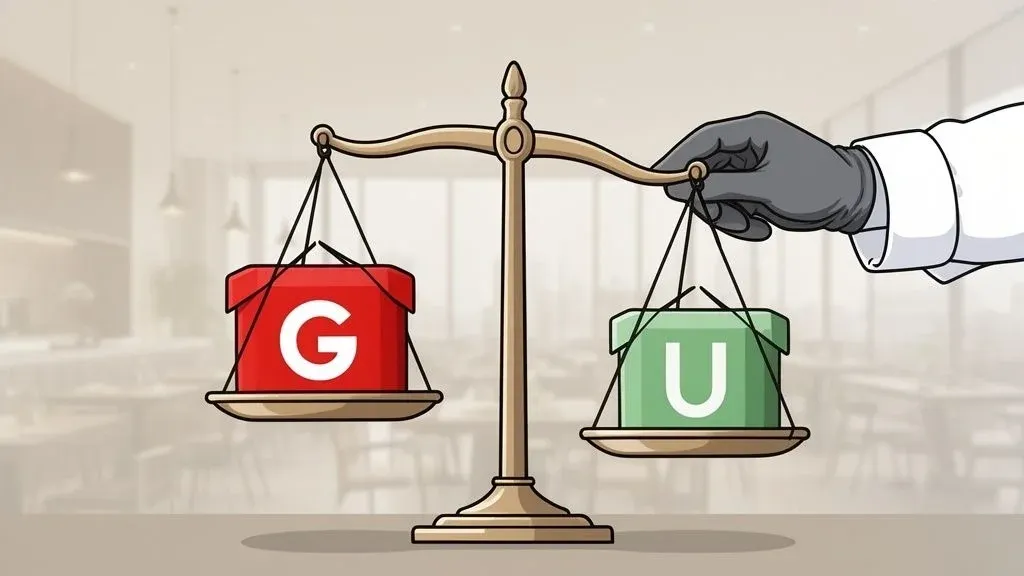
The decision between Grubhub and Uber Eats really comes down to a fundamental business strategy. Are you focused on building a loyal, local following, or do you need to cast the widest net possible to bring in new faces?
Grubhub shines when it comes to nurturing repeat business with its established network and powerful promotional tools. On the other hand, Uber Eats leverages its massive, tech-forward user base to get your menu in front of a huge audience, making it a powerhouse for customer acquisition in busy, competitive areas. Your best bet depends entirely on which of those goals is your top priority right now.
Choosing Your Delivery Partner: Grubhub vs Uber Eats
As any restaurant owner or operator knows, picking a third-party delivery service is a massive decision. It goes way beyond just getting food from your kitchen to a customer’s door. This choice hits your bottom line, your brand’s visibility, and even your kitchen’s workflow. The wrong partner can bleed you dry with high commissions, while the right one can open up a whole new revenue stream and introduce your food to thousands.
This decision is more critical than ever as the delivery landscape keeps changing. Getting to the heart of what makes Grubhub and Uber Eats different is key. Making a smart choice here is a lot like doing an ecommerce platform comparison—it’s all about weighing the features, the costs, and how well the platform aligns with your specific goals.
Core Strategic Differences
From a high-level view, the Grubhub vs. Uber Eats question is about market position and who they cater to. Grubhub has been in the game for a long time and tends to attract a more established, loyal customer base that responds well to direct promotions. In contrast, Uber Eats taps into the enormous user base of the Uber ride-sharing app, drawing in a younger, more mobile crowd that values convenience and discovering new places.
For a wider look at the market, our guide comparing Uber Eats, DoorDash, and Grubhub offers a really helpful, broader perspective.
But when it’s just these two head-to-head, it’s the subtle differences that matter most to your restaurant’s operations.
Grubhub vs Uber Eats Key Differences for Restaurants
This table gives a quick snapshot of their primary differences from a restaurant’s perspective.
Factor Grubhub Uber Eats Primary Audience Loyal, established local diners Broad, younger urban demographic Key Strength Strong promotional tools, established brand Massive user base, advanced logistics Marketing Focus Retaining existing customers Attracting new, discovery-focused users Integration with POS Varies by system; requires careful setup Strong integration with modern POS like Square Operational Impact Can drive steady, predictable order volume Often brings high volume, especially at peaks
These distinctions aren’t just academic—they directly affect your daily order flow and long-term profitability. Partnering with Uber Eats might swamp your kitchen with a rush of new tickets during peak hours, but is your staff ready to handle that surge? Siding with Grubhub could help you build a dedicated customer base, but will that translate into enough consistent volume?
This guide will walk you through these nuances to help you make the right call for your restaurant.
Analyzing Market Share and Customer Demographics
When you’re deciding between Grubhub and Uber Eats, looking at market share isn’t just an academic exercise. It’s about figuring out where your customers are actually ordering from. For a restaurant, more market share translates directly into more eyeballs on your menu and, ultimately, more orders coming into your kitchen.
This is where the battle lines are drawn, and the difference between the two platforms is stark. While DoorDash is the undisputed king of the hill, Uber Eats has carved out a solid second place, leaving Grubhub fighting for a much smaller piece of the pie.
Understanding the Current Market Landscape
Recent industry reports paint a very clear picture of the food delivery world in the U.S. DoorDash controls a massive 66% of the market. Uber Eats is the clear number two, holding steady with around 23-25%, while Grubhub has fallen to less than 10%.
It’s a dramatic shift for Grubhub, which used to be the dominant player with 60-70% of the market back in 2016-2017. For any restaurant owner trying to manage multiple apps, maybe through a POS integration with Clover or Square, this data is a wake-up call. It shows why you can’t just bet on one horse. You can dig deeper into how the market is changing in reports on delivery fee strategies.
The sheer size of Uber Eats is something you can’t ignore. With 88 million active users in 2023 and a presence in roughly 4,000 U.S. cities, its reach is enormous. This is especially true in big cities, where a high concentration of users means a constant stream of potential orders.
Tapping into the Uber Eats user base can dramatically increase your order volume, particularly during those crucial lunch and dinner rushes. The flip side is that you have to be ready for it. Your kitchen and front-of-house need to be able to handle those surges without getting overwhelmed and letting quality slip.
This kind of volume is a double-edged sword. It offers a huge opportunity for growth, but it also means your operations need to be buttoned up and ready to perform under pressure.
Tapping into Specific Customer Demographics
It’s not just about how many people use an app, but who those people are. The diners on Grubhub and Uber Eats aren’t identical, and understanding their habits can help you decide which platform is a better fit for your restaurant’s brand and menu.
-
Uber Eats Users: The Uber Eats crowd tends to be younger, tech-savvy, and already part of the broader Uber ecosystem. They’re often city-dwellers who prioritize convenience and speed above all else. They trust the app’s algorithm to help them discover new places, making them less loyal to one specific restaurant and more loyal to the platform that gets them their food fast.
-
Grubhub Users: Grubhub’s audience is often seen as more established and loyal. These might be slightly older customers who have been using the platform for years. They’re more likely to have their go-to local spots that they order from time and time again, often taking advantage of direct promotions from those restaurants.
So what does this mean for your restaurant? If you’re looking to acquire new customers quickly and your menu has broad, modern appeal, the massive user base on Uber Eats is a powerful tool. But if you’re more of a neighborhood institution focused on building a loyal base of repeat customers, Grubhub’s platform and promotional tools might align better with your goals. You can explore this further in our complete breakdown of the best delivery services for your restaurant.
The bottom line is to think about your own target customer. Does your ideal diner look more like the typical Uber Eats user or the Grubhub loyalist? Nailing down that answer is the first step toward choosing a partner that can truly help you grow.
Next Step: Now that you have a sense of each platform’s reach, it’s time to look at the numbers that hit your bottom line. Let’s break down the commission fees and pricing structures of Grubhub and Uber Eats.
A Deep Dive into Commission Fees and Profitability
For any restaurant owner, the conversation about Grubhub vs. Uber Eats always starts with one thing: commission fees. These percentages aren’t just numbers on an invoice; they’re a direct hit to your profitability on every single order that goes out the door. Getting a handle on how they work is fundamental to surviving in the delivery game.
Simply put, the commission is the cut the delivery platform takes from each order total in exchange for their services. That fee covers everything from getting your restaurant in front of their users to handling the credit card processing. But not all fee structures are built the same, and those differences can make or break your profit margins.
Unpacking Grubhub’s Fee Structure
Grubhub approaches its partnerships with a menu of plans, giving restaurants a bit of flexibility on commission rates. Typically, you’ll see fees ranging from 15% to over 30%, and what you pay really depends on the level of service you’re signing up for.
- Lower-Tier Plans: These come with lower commission rates but often just get you a listing on their marketplace. You’re on the hook for handling your own deliveries, which makes it a solid choice if you already have an in-house team of drivers.
- Higher-Tier Plans: If you’re willing to pay a higher commission, Grubhub brings its driver network to the table and gives you better placement in the app. It’s the full-service option, but it definitely eats into your margins.
The tradeoff with Grubhub is pretty clear: you pay for what you need. This can be a huge plus if you want to keep costs down by using your own drivers, but you have to be realistic about needing the pricier plans to get seen by more customers.
Deconstructing Uber Eats’ Commission Model
Uber Eats also presents a tiered model, but their packages are structured a little differently. They usually categorize their plans as Lite, Plus, and Premium, with commissions starting around 15% for pickup-only and climbing up to 30% for the full package of delivery and marketing tools.
What’s different about Uber Eats is that each tier is more of an all-inclusive bundle. For instance, their top-tier plan doesn’t just cover delivery; it might also include a promise to match your ad spending up to a certain limit and offers lower fees to customers who are part of their Uber One subscription. Tapping into that loyal subscriber base can be a major draw for getting repeat business.
For restaurant operators, the decision often boils down to control versus convenience. Grubhub’s à la carte model can offer more control at a lower fee, provided you have your own drivers. Uber Eats’ packages offer a more hands-off, integrated solution that connects you to their loyal subscribers—but you pay a premium for it.
The Real-World Impact on Your Menu
Let’s make this real. Say your best-selling item is a $15 burger. Your food cost is 30% ($4.50), and other overhead chews up another 40% ($6.00). Before any delivery fees, you’re looking at a $4.50 profit.
Now, let’s factor in a 30% delivery commission. On that $15 sale, the fee is $4.50.
- Your original profit: $4.50
- Delivery commission: -$4.50
- Your final profit: $0
In this all-too-common scenario, the commission just erased your entire profit. This is exactly why so many restaurants raise their online menu prices by 15-20%—they have to build that fee in. It’s a tightrope walk between protecting your margins and not pricing out your customers. To really get this right, you have to track your numbers meticulously, which you can learn more about by looking at a restaurant income statement example.
At the end of the day, when you really dig into the Grubhub vs. Uber Eats commission debate, the “cheaper” platform is whichever one best fits your specific restaurant’s operations and goals.
Streamlining Restaurant Delivery with POS Integration
We’ve all seen it: the dreaded “tablet farm” perched on a restaurant counter. It’s a chaotic mess of devices, each one chirping away with orders from a different delivery app. This setup isn’t just an eyesore; it’s a major drag on your kitchen’s efficiency.
Every time an order from Grubhub or Uber Eats comes in, someone has to drop what they’re doing, punch that order into your point-of-sale (POS) system, and pray they get it right. This manual entry is where costly mistakes happen. A single missed modifier or a mistyped item leads to a messed-up order, a frustrated customer, and a direct hit to your profits. It also chews up your staff’s time, pulling them away from cooking and serving your in-house guests, which is a killer during a dinner rush.
Why Seamless POS Integration Matters for Restaurant Operations
Simply put, POS integration is the bridge that lets apps like Uber Eats and Grubhub talk directly to your restaurant’s main system. When a customer places an order on their phone, it instantly appears in your POS and shoots right to the kitchen printer—just like an order taken at the counter.
From a technical standpoint, this happens through an API (Application Programming Interface) that syncs everything in real-time: menu items, prices, and all the order details. For your day-to-day operations, this connection is a game-changer. It gets rid of manual order entry, which is the number one source of errors in the entire delivery workflow.
This automation directly boosts your restaurant’s efficiency and profitability:
- Drastically Fewer Errors: When you take human re-entry out of the equation, you virtually eliminate mistakes. That means fewer comped meals, fewer refunds, and happier customers who order again.
- More Productive Staff: Your team is no longer wasting time juggling tablets. They can focus on what they’re actually there to do: prepare amazing food and provide great service.
- Faster Fulfillment: Orders hit the kitchen the second they’re placed. This cuts down ticket times, gets food out the door faster, and can even improve your visibility on the delivery apps.
How Grubhub and Uber Eats Handle Food Tech Integration
Both Grubhub and Uber Eats offer integrations with a wide range of POS systems, but the experience isn’t always the same. Uber Eats has earned a reputation for its solid, reliable integrations, especially with modern, cloud-based systems like Square. Their API tends to be more flexible, which makes it easier for tech partners to build smooth connections.
Grubhub also provides POS integrations, though historically, they could be a bit more complex to get running with certain older or less common systems. But no matter which platform you use, the goal is the same: to create one clean, unified flow of information from the customer’s phone to your kitchen.
This kind of centralization is what turns a high volume of delivery orders from an operational nightmare into a profitable part of your business. For a deeper look, check out our guide on the benefits of integrated POS systems.
The single most impactful thing a restaurant can do to save time and money on delivery is to integrate its POS system. It flips the script from a reactive, mistake-filled process to a proactive, efficient workflow that directly pads your bottom line.
But what if a direct integration isn’t available for your specific POS? That’s where a third-party aggregator becomes your best friend. A tool like OrderOut acts as a universal translator, connecting all your delivery apps—Grubhub, Uber Eats, and the rest—directly into your existing POS, whether it’s Clover, Square, or another system. This gives you all the benefits of automation without being locked into the native integrations of each platform.
Practical Next Step: Go audit your current order process. During your next rush, time how long it takes your team to manually enter five delivery orders. Then, count the number of order errors you find over a week. The data you gather will paint a very clear picture of the time and money you’re losing, building a rock-solid case for switching to an integrated solution.
You can transform this chaotic process by starting your onboarding for Free in a few clicks at https://dashboard.orderout.co.
How to Boost Your Visibility with Their Marketing Tools
Getting your restaurant seen on a packed delivery app is the real game. It’s not enough to just be listed; you have to stand out. Both Grubhub and Uber Eats have built-in marketing and promotional tools to help you do just that, but they approach it from very different angles.
Think of these tools as digital billboards inside the app. They give you a way to pay to put your restaurant in front of more eyes, whether that’s a sponsored spot at the top of a search or an eye-catching “free delivery” offer.
Under the hood, these promotions are driven by powerful algorithms. They’re designed to target specific customer behaviors, like someone searching for “pizza near me” or a diner who has ordered from you before. The whole point is to turn a casual browser into a paying customer by hitting them with a relevant, attractive offer right when they’re ready to buy.
Grubhub’s Playbook: Nurturing Your Regulars
Grubhub’s marketing suite is all about creating and rewarding loyalty. Their tools are built to encourage repeat business from diners who already know and love your food, making it a great fit for restaurants with a solid local following.
Here’s what they offer:
- Smart Promotions: This feature uses AI to suggest specific deals—like a percentage off or a free item—that are most likely to work in your area. It takes the guesswork out of crafting an offer that actually converts.
- Loyalty Programs: You can create your own loyalty program right in the app, rewarding your best customers with points or perks. It’s a direct line to building a stable, predictable customer base, which is gold for managing kitchen operations.
- In-App Marketing: This includes sponsored listings that push your restaurant higher in search results, giving you a serious visibility bump during peak mealtimes.
Uber Eats’ Strategy: Winning Over New Customers
While Grubhub bets on retention, Uber Eats is a powerhouse for customer acquisition. Their marketing tools are engineered to grab the attention of new diners, tapping into their massive user base and sophisticated search functions. This is perfect for restaurants trying to grow their reach and bring in a wider audience.
Uber Eats’ real strength is capturing users who know what they want to eat but don’t have a specific restaurant in mind. Their platform is incredibly good at turning general searches like ‘food near me’ into orders for their partners, making it a powerful engine for discovery.
This difference shows up in how they spend their own marketing money. Recent data revealed Grubhub running 4,451 separate paid search campaigns in a 90-day window, a clear sign they’re pushing hard to regain market share. Uber Eats, on the other hand, ran fewer campaigns but pulled in a massive 81.9% of its traffic from non-branded searches like “food delivery.”
For restaurants using a POS like Square or Clover to manage orders, this means Uber Eats often delivers a higher volume of brand-new, ready-to-buy customers. For more ideas on reaching local diners, check out these Local Restaurant Marketing Ideas.
So, which platform’s marketing is right for you? It boils down to your main goal. Are you trying to reward your existing fans or attract a flood of new ones? Answering that will tell you where to put your marketing budget for the best return. For a deeper dive, check out our guide on digital marketing for restaurants.
Practical Takeaway: Don’t go all in at once. Start with a small, defined marketing budget on one platform. Run a two-week promotion and track your return on ad spend (ROAS). If you need new customers, try a sponsored listing on Uber Eats. If you want more repeat business, launch a simple loyalty offer on Grubhub. The numbers will quickly tell you which platform’s tools work for your restaurant.
Making the Right Choice and Managing Multiple Platforms
The Grubhub vs. Uber Eats question doesn’t have a simple winner. The truth is, the “best” platform really depends on what you’re trying to achieve. Are you focused on attracting a wave of brand-new customers, or do you want to build deeper loyalty with the regulars who already love your food? How you answer that question changes everything.
For most restaurants I talk to, the answer isn’t picking one over the other—it’s using both. Listing on multiple platforms casts a wider net, making sure you show up no matter which app a hungry customer opens. But that strategy comes with its own headache: trying to manage orders from different tablets without turning the kitchen into a chaotic mess.
Match the Platform to Your Business Goals
Let’s get practical. A small, independent coffee shop in a busy downtown area would likely lean toward Uber Eats. Why? To get in front of the platform’s huge, discovery-driven user base. On the other hand, a long-standing local pizza place with a devoted following might get more mileage out of Grubhub’s promotional tools, which are great for encouraging repeat business.
The trick is to align the platform’s core strengths with what you need most right now. This chart breaks it down perfectly.
It’s a straightforward decision tree. If your main goal is growth and customer acquisition, Uber Eats is your workhorse. If you’re focused on nurturing your existing base and getting them to order again and again, Grubhub has the toolkit for that.
The real goal here is to transform the complexity of having multiple delivery partners into a smooth, profitable part of your business. That means moving past manual entry and embracing tech that simplifies everything.
Having your staff juggle two, three, or even more tablets during a dinner rush is a recipe for disaster. It’s inefficient, leads to costly mistakes, and stresses everyone out—all of which eats into your profits. The only sustainable solution is to bring all your delivery channels into one place.
The Clear Next Step: Unify and Conquer
To truly reap the rewards of being on both Grubhub and Uber Eats, you have to get rid of the operational chaos. This is where a POS integration solution becomes a non-negotiable tool for running a modern restaurant. It’s hands-down the most effective way to handle the order volume that a multi-platform strategy brings in.
Using an aggregator like OrderOut, you can funnel all your orders from Grubhub, Uber Eats, and any other platform directly into your point-of-sale system. This means no more manually punching in tickets, which instantly cuts down on errors and gives your staff their time back. It works right out of the box with major systems, sending orders straight to your Clover or Square POS.
This one move can take your delivery management from a frantic, time-sucking chore to an automated and profitable revenue stream. It lets you maximize your reach without losing control of your operations.
Ready to turn your delivery chaos into a profit center? You can start your free onboarding in just a few clicks at https://dashboard.orderout.co.
Frequently Asked Questions
When you’re trying to figure out the whole Grubhub vs. Uber Eats thing, a few key questions always seem to pop up. Here are some straightforward answers to help you make sense of it all for your own restaurant.
Which Is Cheaper for Restaurants: Grubhub or Uber Eats?
Honestly, there’s no simple answer here. One isn’t automatically “cheaper” than the other because the final cost is all about the plan you pick, your local market, and any special rates you might negotiate. Both have tiered commission plans that can start around 15% if you just want to be listed on their marketplace and handle your own deliveries.
That fee can climb past 30% if you go for a full-service plan that includes their driver network and top-tier marketing spots. The only way to know which is more cost-effective for your restaurant is to run the numbers. Look at your average order value and how many orders you expect, then compare that against each platform’s fee structure. A lower commission rate doesn’t mean much if it gets you fewer orders.
Can My Restaurant Use Both Grubhub and Uber Eats?
Absolutely. In fact, for most restaurants, this is exactly what you should do. Being on both platforms is the best way to get in front of the most potential customers. A lot of people are fiercely loyal to one app, so if you’re not on it, you’re invisible to them.
The big catch, of course, is that managing orders from multiple apps can get chaotic fast. This is where the right technology makes all the difference.
A solid POS integration is what makes a multi-app strategy manageable. It takes what could be a massive headache and turns it into a smooth, efficient way to bring in more revenue, cutting out the chaos of punching in orders by hand.
How Does POS Integration Help With Delivery Orders?
Think of a POS integration as a direct pipeline from apps like Grubhub and Uber Eats straight into the heart of your kitchen. When a customer places an order, it automatically shows up in your point-of-sale system and prints on your kitchen ticket. No one has to stop what they’re doing to manually type it in from a tablet.
The payoff is immediate and pretty significant:
- Saves Time: Your team isn’t chained to a tablet anymore. They can focus on cooking and taking care of the customers right in front of them.
- Reduces Errors: It gets rid of those inevitable typos and mistakes that happen when you’re re-keying orders, like wrong modifiers or missed items.
- Boosts Productivity: Getting orders to the kitchen faster means shorter ticket times, quicker service, and a more efficient team all around.
It basically makes your delivery business a well-oiled part of your overall operation instead of a clunky add-on.
Ready to stop juggling tablets and start streamlining your delivery operations? OrderOut syncs all your orders from Grubhub, Uber Eats, and more directly into your POS. Start your onboarding for Free in a few clicks at https://dashboard.orderout.co.