
A Modern Guide to the Ghost Kitchen Business Model
· Thibault Le Conte
Understanding The Ghost Kitchen Business Model
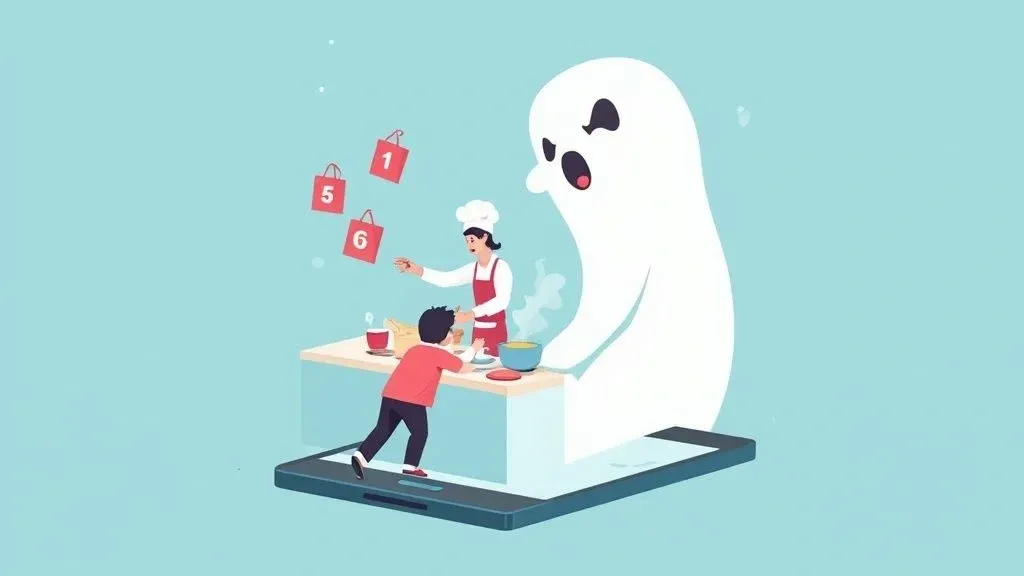
Imagine a professional kitchen focused entirely on preparing food for delivery. There’s no dining room, no tables to set, and no front-of-house staff. This is the core of the ghost kitchen business model: a restaurant built for the digital age, where the customer experience happens on an app, not in a physical space.
Your “storefront” exists on third-party delivery apps like DoorDash and Uber Eats. This is where customers discover your menu, place an order, and pay, all without ever seeing your physical location. By removing the traditional dining room, you dramatically cut costs and can focus every dollar on what matters most: food quality and delivery speed.
Why the Ghost Kitchen Business Model Works for Restaurant Operations
This model revolutionizes traditional restaurant operations by focusing on efficiency. Here’s how:
- Lower Startup Costs: You can launch a ghost kitchen for $10,000–$50,000, a fraction of the $200,000+ typically needed for a brick-and-mortar restaurant.
- Lean Overhead: Rent for a commercial kitchen in an industrial area is significantly cheaper than a prime retail spot. You also eliminate the costs of decor, furniture, and a full front-of-house team.
- Agile Menu Testing: You can introduce new dishes or even launch an entirely new virtual brand in a matter of days, not months. If a concept doesn’t work, you can pivot instantly without the cost of rebranding a physical location.
Navigating Food Tech and Restaurant Delivery Trends
A modern ghost kitchen is powered by smart technology. This is where the concept moves from a simple kitchen to an efficient, high-volume operation.
Why it matters: Technology is what connects your kitchen to the customer. Without it, you’re just cooking with no way to process orders efficiently. A POS system that integrates with delivery apps is the central nervous system of your business. It ensures that every order is processed quickly and accurately, which directly impacts customer satisfaction and your bottom line.
For example, a restaurant using a POS like Clover or Square can automatically pull orders from multiple delivery apps into one single, organized screen. This eliminates manual entry, reduces costly errors, and frees up staff to focus on food preparation. This level of automation is a key part of the food service industry trends shaping the future of restaurant delivery. You can learn more by checking out these 10 Food Service Industry Trends Shaping 2025 and Beyond.
Traditional Restaurant vs Ghost Kitchen Business Model Comparison
Below is a quick look at how both setups handle the essentials.
Aspect Traditional Restaurant Ghost Kitchen Physical Space Dining room, bar, waiting area Kitchen-only, optimized for prep and dispatch Overhead Costs High rent, décor, front-of-house salaries Lower rent, minimal fixtures and staff Startup Investment $200K+ for build-out, licensing, interior design $10K–$50K for equipment, fit-out, initial stock Staffing Chefs, servers, hosts, bussers Cooks, runners, delivery coordinators Menu Flexibility Slow menu changes; costly rebranding Rapid concept testing; multiple brands under one roof
This side-by-side highlights the trade-offs: traditional spots win on ambiance and foot traffic, while ghost kitchens excel at cost-efficiency and speed.
Key Takeaway: The ghost kitchen business model strips away dining-room expenses to lower your initial investment and ongoing costs. It provides a more agile, data-driven path to serving customers who prioritize the convenience of fast restaurant delivery. Ready to streamline your own operations? You can start onboarding for Free in a few clicks at OrderOut Dashboard.
What Goes Into a Winning Ghost Kitchen?
A successful ghost kitchen doesn’t just happen. It’s a carefully engineered operation built on four key pillars. Each one is critical for turning a great food concept into a profitable, delivery-first business. This isn’t just theory; it’s an actionable blueprint for building a lean, high-performing virtual restaurant that can compete in a crowded digital marketplace.
Pillar 1: The Optimized Kitchen Space for Restaurant Delivery
First, let’s talk about the physical kitchen. A ghost kitchen is built for one thing: speed. Every inch of the layout, from prep stations to the packing counter, must be optimized for a smooth, efficient workflow.
In simple terms, you’re building a food assembly line. Equipment is arranged to minimize steps for your cooks, and there’s a dedicated, organized hand-off zone for delivery drivers. We’ve seen many operators successfully launch by remodeling office space into a restaurant with this exact focus in mind. The goal is to get an order from the screen to the driver’s hand as fast as possible.
This infographic breaks down how the ghost kitchen business model works by stripping away traditional restaurant overhead.
As you can see, the entire operation is laser-focused on delivery, which is exactly how it keeps operational costs so low and efficiency high.
Pillar 2: A Tech-Powered Ordering System with POS Integration
Technology is the central nervous system of any ghost kitchen. Without a solid tech stack, you’re left with a counter full of ringing tablets from Uber Eats, DoorDash, and others—a recipe for chaos, missed orders, and a stressed-out team.
This is where POS integration is essential. A modern point-of-sale system acts as your command center, funneling every order from all your delivery apps into one clean, manageable dashboard.
Why It Matters: Automating order entry directly impacts your restaurant’s efficiency and profitability. It saves your team huge amounts of time and, more importantly, slashes the 5-10% error rate from manually punching in orders. Fewer mistakes mean less food waste and happier customers, which directly boosts your bottom line and improves staff productivity.
For example, a restaurant using a POS like Clover or Square can sync all their delivery channels into a single flow. This kind of consolidation is a cornerstone of effective restaurant operations management.
Pillar 3: A Streamlined Restaurant Delivery Network
Your kitchen is only as good as its ability to get food to the customer quickly and in great condition. This means perfecting your process for working with third-party delivery services. While you don’t control the drivers, you control the hand-off.
Actionable Insight: Set up a clear, designated pickup area for drivers that keeps them out of the kitchen workflow. A simple order status screen can keep them informed and ensures orders are bagged and ready the moment they arrive. Every minute saved here directly impacts your customer ratings and delivery times.
Pillar 4: A Strong Digital Brand Presence
Without a physical storefront, your digital presence is your restaurant. This includes your branding on delivery apps, your social media accounts, and customer reviews. High-quality food photography isn’t just a nice-to-have; it’s your only first impression.
A typical U.S. ghost kitchen can fulfill 200–400 orders a day. With no single company holding more than 5% of the market share, a memorable brand is what will make you stand out. Your online reputation is far more important than your physical address.
Practical Next Step: The single most impactful first step you can take is to centralize your orders. Integrating your delivery apps with your POS system solves the biggest operational headache for most ghost kitchens. You can start by connecting your existing systems for free right from the OrderOut Dashboard.
The Financial Upside: Saving Money Where It Counts
Restaurant margins are notoriously thin. The ghost kitchen business model directly addresses this by redesigning the traditional cost structure. It’s more than just cheaper rent; it’s a fundamental shift from a high-overhead, high-risk setup to a lean, efficient operation built for profitability.
The biggest financial wins come from eliminating the most expensive parts of a traditional restaurant. You don’t need a dining room, so you don’t need a prime storefront on a busy street. This alone can slash real estate costs by as much as 75%. On top of that, you can remove the entire front-of-house payroll—no hosts, servers, or bussers. This frees up cash to invest in what truly matters: quality ingredients, smart marketing, and efficient kitchen tech.
Slashing Startup and Day-to-Day Restaurant Operations Costs
Getting a ghost kitchen off the ground is dramatically cheaper. A full-scale restaurant build-out can easily cost over $200,000. By comparison, you can launch a ghost kitchen for as little as $10,000 to $30,000, which covers essential equipment and licenses. This low barrier to entry reduces risk and allows you to launch faster. The savings continue long after you open.
- Leaner Labor: With a kitchen-focused team, you run a much tighter ship. This reduces payroll and simplifies scheduling and management, boosting staff productivity.
- Lower Utility Bills: A smaller, kitchen-only space uses far less electricity, water, and gas than a large dining room requiring constant lighting, heating, and cooling.
- Zero Front-of-House Upkeep: Forget spending money on replacing tables, chairs, or updating dining room decor. Your investment stays in the heart of the business—the kitchen.
A Tale of Two Kitchens: A Cost Breakdown
To see the difference, let’s compare estimated monthly expenses for a small traditional restaurant and a ghost kitchen with similar revenue.
Expense Category Traditional Restaurant (Monthly Estimate) Ghost Kitchen (Monthly Estimate) The Bottom Line Rent (Commercial) $8,000 - $15,000 $2,000 - $5,000 No need for a prime location, slashing your biggest fixed cost. Staffing (FOH + BOH) $12,000 - $20,000 $5,000 - $8,000 Removing the front-of-house team can cut labor costs by more than half. Utilities & Insurance $2,000 - $3,500 $800 - $1,500 A smaller, optimized space is simply cheaper to run and insure. Marketing $1,500 (Print, Local Ads) $1,500 (Digital, App Ads) The budget is similar, but it’s spent on highly targeted, measurable online ads.
A ghost kitchen operator could easily save over $15,000 a month on core expenses. This is a direct boost to your profit margin on every single order. You can dig deeper into maximizing cost efficiency in restaurant operations with OrderOut in our complete guide.
Why It Matters: These cost savings create financial resilience. A ghost kitchen’s lower breakeven point provides a critical safety net during slow periods, helping you weather market fluctuations that could cripple a traditional restaurant.
For instance, restaurants already using a POS system like Square or Clover can amplify these savings even more. Integrating your delivery apps means kitchen staff no longer waste time manually entering orders, which reduces both labor costs and expensive mistakes.
Your Practical Next Step: Run the numbers for your own concept. Quickly research industrial kitchen rental rates in your city and estimate your savings on rent and front-of-house staff. This simple exercise will give you a clear, tangible picture of the financial viability of the ghost kitchen business model. Ready to start streamlining and saving? Get started for free at the OrderOut Dashboard.
What Are the Toughest Ghost Kitchen Challenges?
The ghost kitchen model offers significant potential for lower overhead and higher profit, but it comes with its own set of challenges. A smart operator anticipates these roadblocks and plans for them. Overcoming these hurdles is what separates the success stories from the ones that quickly fade away.
The three biggest challenges you’ll face are intense online competition, managing relationships with delivery apps, and ensuring food quality during transit.
Standing Out in a Sea of Digital Menus
Without a physical location, your brand lives and dies on a screen. You are a thumbnail image and a menu description, competing against hundreds of others on apps like DoorDash and Uber Eats. Excellent food isn’t enough if customers never click on your menu.
The ghost kitchen market has become incredibly crowded. In the U.S., the market is expected to level out around $2.9 billion in 2025. This means you have to be memorable to succeed. You can find more details in these ghost kitchens statistics and facts to see just how fierce the competition is.
Actionable Insights:
- Your Photos Are Your Front Door: Invest in professional photography. High-quality photos make your food look as good as it tastes and are your best tool for attracting clicks.
- Write Descriptions That Sell: Don’t just list ingredients. Use vivid, mouth-watering language to describe what makes each dish special.
- Build a Community on Social Media: Use platforms like Instagram to show off your food, run promotions, and engage with your customers. This helps build a loyal following that orders from you directly.
The Double-Edged Sword of Delivery Apps
Third-party delivery apps provide an instant audience, but they take a significant cut of your revenue, with commission fees ranging from 15% to 30% per order. Relying solely on them is a risky strategy.
Why it matters: Every order you can shift from a third-party app to your own direct ordering channel is an order where you keep the full profit. Shifting just 5% of your orders to a direct channel can significantly impact your monthly bottom line.
For example, if you use a POS like Square or Clover, you can easily add an online ordering page. A simple, actionable step is to include a flyer in every delivery bag with a discount code for their first direct order. It’s a highly effective way to build a more profitable customer base that you own.
Keeping Food Perfect from Kitchen to Couch
Your job isn’t finished when the order leaves the kitchen. If a meal arrives cold, soggy, or messy, the customer won’t return. Maintaining food quality during transit is a critical challenge in the ghost kitchen business model.
Actionable Insights:
- Build a Delivery-Proof Menu: Some dishes travel better than others. Focus on items that hold their heat and texture well. Before adding an item, test it: let it sit in a delivery bag for 30 minutes to see how it holds up.
- Invest in Quality Packaging: Don’t cut corners on packaging. Use vented containers for fried foods, sturdy containers that prevent leaks, and tamper-evident seals to give customers peace of mind.
Here’s Your Next Step: Run a “delivery stress test.” Cook your top five menu items, pack them as a customer would receive them, and let them sit for 30-40 minutes. Then, have your team taste them. This simple exercise will reveal potential issues before they cost you a customer. Ready to build a delivery operation that works? You can get started for free on the OrderOut Dashboard.
Using Food Tech for Peak Restaurant Efficiency
In a traditional restaurant, technology is helpful. In a ghost kitchen, it’s the engine. The entire operation is built on a smart, integrated tech stack. The right food tech tools transform your kitchen into a high-volume production hub designed for digital-first customers.
At the center of this is your Point of Sale (POS) system. It acts as the air traffic controller for your virtual restaurant, pulling in orders from every delivery app and funneling them into one unified, manageable workflow. This eliminates the chaos of juggling multiple tablets, all demanding attention at once.
The Power of Direct POS Integration for Food Tech
The real magic is POS integration, which connects third-party apps like DoorDash and Uber Eats directly to your POS. When an order comes in, it’s automatically sent to your kitchen printers or Kitchen Display System (KDS) without anyone needing to touch it.
This automation is a game-changer for restaurant operations. It eliminates the time-consuming and error-prone task of manually entering every order from every tablet into the main system.
Why It Matters: Manual order entry kills profits. It consumes staff time and, according to industry data, can lead to an error rate as high as 15%. Every mistake—a wrong item or a missed modification—results in a costly remake, an unhappy customer, and a negative review. POS integration directly reduces these errors, saving time and money while boosting staff productivity.
Streamlining Restaurant Delivery and Boosting Productivity
Automating your order flow unlocks significant efficiency gains. Your kitchen staff receives clear, standardized tickets instantly, allowing them to start cooking faster. Reducing “ticket time” is crucial for winning on delivery apps, where speed is paramount.
Imagine a ghost kitchen using a Square POS integrated with a platform like OrderOut. All orders from every app appear in one organized queue. The employee who once re-typed orders is now free to expedite, double-check bags, and improve workflow. The same applies to operators on a Clover POS; they can transform a chaotic process into a simple, automated one.
- Time Savings: Automating orders can save your team 30-60 minutes per shift—time now spent on quality control or faster dispatch.
- Error Reduction: Direct integration nearly eliminates order mistakes, leading to less food waste and happier customers.
- Improved Staff Focus: Free from administrative tasks, your team can focus on what they do best: cooking great food.
To understand how these connections are made, it’s worth learning more about the different kinds of point of sale integrations and how they can be tailored to your kitchen’s needs.
From Tech Investment to Tangible ROI
Investing in the right food tech isn’t just an expense; it’s a direct investment in your profitability. The savings from fewer errors, increased capacity from faster prep times, and improved staff morale all contribute to a healthier bottom line.
Practical Next Step: Connect your delivery apps to your POS. This single action solves the biggest operational headache for virtually all delivery-only kitchens. Start by evaluating your current POS and finding an integration partner that can sync everything seamlessly. Ready to ditch the tablet farm and build a more efficient kitchen? You can onboard for free and see how it all comes together at the OrderOut Dashboard.
Your Roadmap to Launching a Ghost Kitchen
Launching a ghost kitchen is simpler than opening a full-service restaurant, but it still requires a solid plan. The entire business model is built on efficiency, so every step should focus on cutting costs and protecting your profit margins.
Think of it as a three-part launch sequence.
Step 1: Define Your Brand and Menu. Start with a clear concept. What food will you sell, and who is your target customer? Design a menu specifically for delivery, choosing dishes that travel well. Your photos and menu descriptions are your most important sales tools.
Step 2: Find the Right Kitchen Space. Location is still important, but for different reasons. You need a space centrally located within your target delivery zone to ensure fast delivery times. The internal layout should be designed like an assembly line to get orders out the door with maximum efficiency.
Step 3: Build Your Tech Stack. This is the core of your operation. A ghost kitchen’s success depends on its technology. You need a system that funnels all orders from different delivery apps directly into your point-of-sale (POS). For instance, restaurants using a Clover integration or a Square integration can eliminate tablet chaos, slash order entry errors, and empower their staff to focus on food.
For a deeper dive into the nitty-gritty of permits and setup, our comprehensive opening restaurant checklist is a great resource to have on hand.
A unified dashboard, like the one from OrderOut pictured above, is a game-changer. It provides a single screen to monitor all your delivery orders. This real-time view lets you track order flow, see driver statuses, and analyze sales metrics in one place, improving your overall restaurant operations.
Launch Best Practices for Your Ghost Kitchen
Once you’re up and running, here are a few things experienced operators do to stay ahead:
- Test, Test, Test: Keep your menu agile. This lets you quickly test new concepts and focus on what sells. Don’t forget to run “delivery stress tests” to ensure food quality.
- Train Your Team: Ensure every staff member understands the POS integration. The goal is automatic ticket printing, eliminating manual order entry.
- Let Data Guide You: Use data from your delivery platforms to optimize everything from your kitchen layout to staffing schedules.
Practical Takeaway: Integrating your delivery apps directly into your POS is the most impactful step you can take for your restaurant’s efficiency. It can cut order errors by up to 15%, saving both time and money. Ready to see how it works? You can get onboarded in just a few minutes and try it out for free at the OrderOut Dashboard.
Got Questions? We’ve Got Answers
How Much Does It Really Cost to Start a Ghost Kitchen?
Getting a ghost kitchen off the ground is significantly cheaper than a traditional restaurant. You’re looking at an initial investment of around $10,000–$50,000, which covers essentials like kitchen equipment, permits, your first round of inventory, and a solid POS integration.
The real savings come from what you don’t need: dining room furniture, decor, a fancy storefront, or a lease in a high-foot-traffic area. This lean approach means you can launch faster, experiment with your menu, and start seeing a return on your investment much sooner as delivery orders roll in.
Can I Run More Than One Restaurant Brand from a Single Kitchen?
Absolutely. This is one of the biggest advantages of the model. You can operate several “virtual brands” all from the same kitchen space. To the customer, each brand looks like a completely separate restaurant on apps like Uber Eats or DoorDash.
This strategy lets you tap into different cravings and customer groups without paying a dime more in rent. You can test out a taco concept, a wing joint, and a salad bar all at the same time.
“We’ve seen operators run 3–5 brands from a single kitchen, boosting their overall revenue by as much as 50% without needing more space or staff.”
It all comes down to smart kitchen design and a POS system that can juggle orders from multiple menus. You share prep stations, cross-utilize ingredients, and streamline everything into one efficient workflow.
What’s the Upside of a Multi-Brand Strategy?
- More Revenue Streams: Different menus attract different customers, simple as that.
- Smarter Decisions: Use delivery app data to see which concepts are hitting and which are missing the mark.
- Less Waste: Share ingredients and staff across your brands to keep costs down and efficiency up.
- Lower Risk: Want to try out a wild new burger idea? Launch it as a virtual brand without a huge financial commitment.
How Do You Market a Restaurant People Can’t See?
When you don’t have a physical storefront, your digital presence is your storefront. Your “front window” is the customer’s phone screen, so you have to make a great first impression there.
Forget walk-in traffic; it’s all about online visibility. That means investing in professional food photography is non-negotiable. Seriously, great photos can boost your click-through rates on delivery apps by 20–30%. Pair those mouth-watering images with menu descriptions that make people hungry.
Beyond the apps, it’s crucial to build your own audience through email and social media. Offer promo codes to first-timers and create loyalty programs that keep people coming back. Running targeted online ads in your specific delivery zone is another great way to cut through the noise.
Quick Marketing Tips to Get You Started
- Master the Apps: Optimize your listings with the right keywords and tags so people searching for “spicy chicken sandwich” find you.
- Go Hyper-Local: Use geotargeted ads on Facebook and Instagram to reach potential customers right in your neighborhood.
- Create Urgency: Run limited-time offers to get new customers in the door (figuratively, of course).
- Own Your Audience: Collect customer emails so you can send them personalized deals and bypass the delivery app commission on repeat orders.
Which POS System Should I Use?
We see a lot of success with systems like Clover or Square, especially when they’re connected with an aggregator like OrderOut. The goal is to get all your orders from every single delivery app to show up on one screen. This cuts out the chaos of manual order entry and dramatically reduces mistakes.
Ready to simplify your delivery operations and maximize profits? Try OrderOut for free today.