
Franchise Fried Chicken: A 2026 Profitability Guide
· Thibault Le Conte
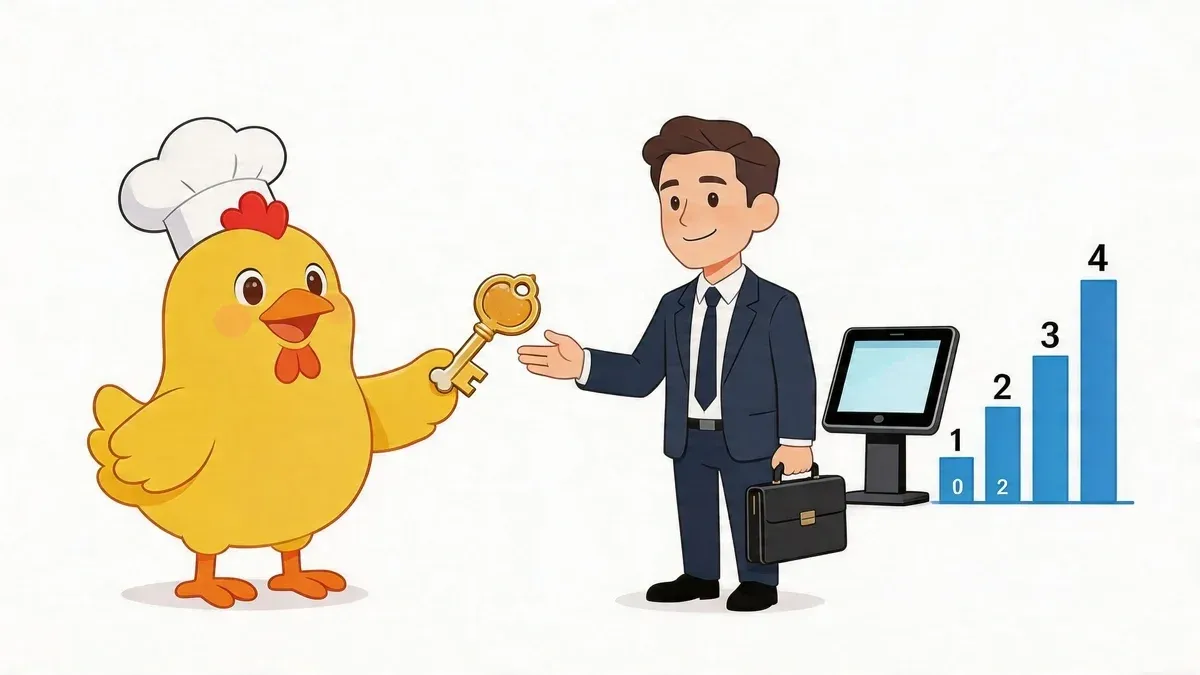
Most franchise fried chicken advice starts with menu, brand, and location. Those matter. But the real split between a smooth operation and a stressed one in 2026 is the system behind the counter.
The U.S. fast food chicken restaurant industry reached $63.7 billion in 2025, with 5.6% annualized revenue growth over the prior five years, according to IBISWorld’s fast food chicken restaurant industry data. That’s a large, proven market. It also means more operators are chasing the same customers, the same labor pool, and the same delivery demand.
A new entrepreneur can still win here. But the winning model isn’t just “serve good chicken.” It’s serve consistent food, move orders fast, keep labor focused, and make delivery work without breaking the kitchen. If you’re evaluating franchise fried chicken opportunities, that’s the lens to use.
The Fried Chicken Gold Rush Is Your Franchise Ready?
A large category attracts attention fast. Fried chicken has that effect. Strong demand brings in experienced multi-unit groups, first-time buyers, and independent operators testing the same customer base, which raises the standard for execution from day one.
That matters because franchise fried chicken looks simpler from the outside than it is on the inside. A franchise can give you a menu, operating standards, supplier access, and a recognizable brand. If you’re still learning the model, this guide to what quick service means in practice gives useful context for how these stores are expected to run.
Brand recognition helps with trial. It does not carry the store after opening week. Margin and repeat business come from order accuracy, ticket speed, food consistency, and how well the store handles dine-in, takeout, drive-thru, and third-party delivery at the same time.
Chicken is an unforgiving product to execute. You are managing fry times, hold times, breading consistency, batch cooking, labor deployment, and pickup timing in one of the busiest formats in QSR. Add delivery tablets, aggregator promos, and rush-hour channel spikes, and weak systems show up quickly.
The true test of the business happens in the kitchen and at the POS.
That is the part many new franchisees underestimate. In 2026, a fried chicken franchise is not just a food operation. It is a production line tied to a software stack. If the POS does not sync cleanly with delivery platforms, the kitchen gets hit with duplicate tickets, missing modifiers, delayed prep starts, and refund-heavy handoffs. If reporting is fragmented, owners miss where labor is drifting, which dayparts carry delivery profit, and which promo channels are creating volume without contribution.
Practical rule: In franchise fried chicken, the food earns the first visit. Operations and system design earn the next ten.
Operators who set up prep flow, staffing, POS controls, and delivery integration early usually protect margin better and recover faster during rushes. Operators who treat those decisions as back-office admin often pay for it in remakes, slower throughput, and crews that stay busy without staying productive.
Franchise vs Independent Two Paths to Fried Chicken Success
The easiest way to understand the choice is this. A franchise is like buying a Lego set with instructions, branded packaging, and a proven finished model. An independent concept is a table full of loose bricks. You can build anything. You also have to figure out everything.
Neither path is automatically better. The right choice depends on how much control you want, how much uncertainty you can handle, and whether you want to invent systems or operate them.
What franchising gives you
In franchise fried chicken, you’re buying more than a logo. You’re buying a playbook. That usually includes menu specs, training systems, store layout guidance, approved suppliers, operating procedures, and brand-level marketing support.
That model has staying power. MMCG Invest’s review of chicken chains notes that roughly 80% of KFC’s U.S. stores are run by independent franchisees. The same source also points to Popeyes’ 2019 Chicken Sandwich launch, which lifted same-store sales by 34% in Q4, showing how a strong brand can create immediate demand for franchise operators.
What independence gives you
An independent shop gives you freedom a franchise won’t. You can shape the menu, pricing, visual identity, hours, packaging, promotions, and vendor mix around your market.
That freedom is attractive. It’s also expensive in attention.
You have to answer questions a franchisor would have answered for you:
- Menu design: Which items travel well for restaurant delivery, and which ones die in the box?
- Kitchen flow: Where does breading happen, where does assembly happen, and who owns expo during the rush?
- Tech stack: Which POS fits your service style, and how will delivery orders enter the system?
- Brand standards: What does “done right” mean at 11:45 a.m. on a Friday?
The technology trade-off most buyers miss
Many first-time buyers think too narrowly when they compare franchise fee versus independence, but not decision load.
A franchise often narrows your choices. That can feel restrictive, but it can also save you from bad decisions. If the franchisor has already approved certain hardware, printers, kitchen display workflows, and support processes, you start with guardrails.
An independent operator has the opposite problem. You can choose anything. That means you can also choose a POS that doesn’t fit a high-volume chicken line, a delivery setup that creates duplicate entry, or a menu structure that slows the fry station.
Brand strength helps, but bad throughput can still sink a busy store.
How to decide honestly
Use a side-by-side filter:
Decision area Franchise fried chicken Independent fried chicken Brand awareness Built in Must be earned locally Menu flexibility Limited High SOPs and training Usually established Must be built Supplier standards Typically defined Owner-managed Tech choice Often guided or restricted Fully open Speed to launch Faster when systems are ready Slower but more flexible
If you want to operate inside a proven system and focus on execution, a franchise can be the cleaner fit. If you want creative control and you’re prepared to build systems from scratch, independence can work. Just be honest about your skill set. Many operators love inventing menus. Fewer love building repeatable restaurant operations.
Decoding the Financials Franchise Costs and Revenue Potential
The mistake I see most often is simple. Buyers fixate on the upfront franchise fee and treat everything else as secondary. That’s backwards.
The financial question is whether the full model works at unit level after labor, occupancy, food cost pressure, royalties, marketing obligations, repairs, software, and the daily friction that comes with modern restaurant delivery.
Don’t stop at the franchise fee
Your actual investment picture usually includes several layers of cost before the first order is sold. Some are obvious. Some hide in the build-out and operating ramp.
Here’s a practical framework to use when reviewing franchise fried chicken economics:
Cost Component Estimated Range (USD) What It Covers Franchise fee Varies by brand Right to operate under the franchisor’s name and system Build-out and equipment Varies by site and format Kitchen line, fryers, refrigeration, counters, signage, dining room, drive-thru elements if applicable Opening inventory Varies Food, packaging, smallwares, chemicals, uniforms Training and pre-opening labor Varies Manager training, crew onboarding, practice runs Technology stack Varies POS hardware, software subscriptions, printers, online ordering and delivery setup Royalties and brand fund contributions Varies by agreement Ongoing payments to the franchisor Working capital Varies Cash cushion for payroll, utilities, food purchases, and early operating volatility
The ranges vary too much by concept and real estate to state a universal number responsibly. What matters is that you model all of them, not just the entry fee.
AUV is useful, but it’s not profit
Many buyers lean hard on Average Unit Volume, or AUV. It’s a useful benchmark because it tells you how much revenue a typical store may generate. But revenue is not cash flow, and cash flow is not owner income.
AUV helps you compare potential. It does not tell you whether the kitchen is efficient, whether delivery orders are margin-friendly, or whether the labor model breaks at peak.
One reason this gets tricky is disclosure quality. Franzy’s review of chicken franchises points out a real gap in the market: Huey Magoo’s Chicken Tenders reports a $2.2 million AUV, while comparable unit-level economics for competitors such as Zaxby’s or bb.q Chicken are often not disclosed. That’s exactly why operators should stress-test labor assumptions, delivery mix, and operational efficiency before trusting a rosy top-line story.
What to pull from Item 19
If the franchisor provides financial performance representations in Item 19 of the FDD, read them with a pencil in hand. Don’t ask only, “How high can sales go?” Ask:
- What’s included: Gross sales only, or expense categories too?
- Store mix: Are these inline stores, drive-thru units, nontraditional locations, or a mix?
- Vintage: Are mature stores pulling up the average?
- Local reality: Does your proposed market support the same sales pattern?
- Operational dependency: How much of the model depends on fast delivery handling and labor discipline?
A smart buyer pairs Item 19 review with outside financial help. A restaurant-focused advisor or one of the experienced CPAs who understand unit economics can help you pressure-test assumptions before you sign a long contract.
Build a working P and L, not a fantasy deck
You need a practical store-level forecast. Not a hopeful one.
A solid draft should include projected sales by channel, staffing by daypart, food and packaging assumptions, occupancy, software, repairs, and delivery-related friction. If you need a cleaner handle on one of the biggest variables, this guide on how to calculate food cost percent helps ground that part of the model.
Operator note: If a franchise candidate can explain the menu but can’t explain ticket flow, labor deployment, and order mix, the underwriting isn’t finished.
The winners in franchise fried chicken usually aren’t the operators who fell in love with a brand story. They’re the ones who understood the numbers well enough to know where margin could leak, then built the store to stop those leaks early.
Understanding Your Franchise Agreement Without a Lawyer
Most franchise agreements are written in legal language, but the business impact is concrete. You don’t need to be an attorney to spot the clauses that shape your daily reality. You do need to read slowly and ask blunt questions.
Territory is your protection, or it isn’t
A territory clause decides whether the brand can place another operator close enough to cut into your trade area. In plain English, this is the “can someone open next to me later?” section.
Don’t assume “exclusive” means what you think it means. Some agreements protect only certain sales channels or physical boundaries. Others reserve broad rights for the franchisor, including alternate formats, captive venues, or digital channels.
Ask for practical examples, not legal summaries:
- If another unit opens nearby, what restrictions apply?
- Does your territory cover delivery demand?
- Can the franchisor sell through other channels into your zone?
- Are nontraditional sites treated differently?
Term and renewal decide how long you control the business
The term tells you how long your franchise rights last. Renewal tells you what happens at the end.
The trap here is assuming renewal is automatic. It usually isn’t. You may need to meet brand standards, update equipment, remodel the store, sign the then-current agreement, and clear any defaults. That matters because a profitable location can still require a major reinvestment to keep operating under the flag.
Supply chain rules affect cost and flexibility
Franchise fried chicken lives and dies on consistency. That’s why franchisors often require approved suppliers, product specs, and packaging standards. There’s logic behind that. The same breading, oil program, chicken specs, and branded packaging help keep the customer experience stable.
But there’s a trade-off. If local pricing changes, you may have limited ability to shop around.
Review supply chain sections with three questions in mind:
- How many inputs are mandatory? Core proteins and branded packaging usually are.
- What happens when approved supply is disrupted? Ask about substitutions and approval timing.
- Can local sourcing ever be approved? Sometimes yes, often with conditions.
Weak territory language can hurt a strong operator. Strong operations can’t fix a contract that lets the wrong unit open too close.
Defaults matter more than buyers think
Default clauses explain what counts as a breach and what cure period you get to fix it. This can cover late payments, operational noncompliance, reporting failures, insurance lapses, or brand standard issues.
Read this section with your operations hat on. If the brand requires certain technology, hours, audits, or vendor usage, those aren’t suggestions. They become enforceable obligations.
A practical approach is to write down each obligation in plain English. Then ask yourself whether your future management team can comply with it every week, not just during opening month. That’s how you turn a dense agreement into an operating reality.
The Engine Room Optimizing Restaurant Operations and Staffing
Good franchise fried chicken stores run on discipline, not adrenaline. A busy rush can look chaotic from the dining room, but the best kitchens don’t rely on heroics. They rely on repeatable systems.
SOPs are the foundation
A franchisor’s standard operating procedures are not paperwork for the office shelf. They’re the daily operating script. They define prep standards, fryer procedures, food safety routines, hold times, cleaning cycles, station responsibilities, and guest service expectations.
The mistake some new operators make is treating SOPs as training material instead of management material. Your managers should coach to them in real time. If the breading station improvises, the fryer station guesses, and the expo line develops its own shortcuts, your store starts serving several versions of the brand.
Inventory discipline protects more than food cost
Chicken concepts can get punished from both sides. Waste hurts margin, and stockouts hurt guest trust. You need enough inventory to survive spikes in traffic, but not so much that you lose control of freshness and prep rhythm.
A practical inventory routine usually includes:
- Daily pars: Set pars for chicken, breading ingredients, sauces, packaging, and beverages.
- Prep sheets tied to sales patterns: Don’t prep from instinct. Prep from actual demand by daypart.
- Manager count routines: Count critical items on a set cadence, not only when something runs low.
- Variance review: If usage doesn’t match sales, investigate quickly.
Delivery changes the game. Off-premise demand can arrive in waves that don’t look like front-counter traffic. If your forecast ignores that, your kitchen gets surprised.
Staffing for the rush means staffing for channels
A chicken store can’t schedule labor based only on dining room patterns anymore. You need to know when dine-in, pickup, drive-thru, and app orders overlap.
That changes how you assign people. You may need a stronger expo position, a dedicated packer during busy delivery windows, or a manager focused on order accuracy instead of jumping between stations. If you’re training new supervisors, this overview of back-of-house positions and responsibilities is a helpful way to clarify who owns what.
Training should look like the real shift
Some stores overtrain on procedures in quiet conditions and undertrain on execution under load. That’s backwards.
Run training in the conditions that break stores:
- Lunch with a line at the counter
- Dinner with stacked online orders
- Shift changes
- Late-night fatigue
- A fryer problem, a callout, or a delayed truck
The strongest teams don’t just know the recipe. They know who calls the next move when the volume changes.
Retention matters too. People stay longer in stores where stations are clear, workload feels fair, and tools work. If your team has to juggle tablets, rewrite tickets, chase missing modifiers, and solve preventable order mistakes, turnover gets worse. Operational simplicity is not just a systems issue. It’s a staffing strategy.
Future-Proof Your Kitchen with Smart POS and Delivery Integration
The fastest way to break a busy chicken kitchen is to layer modern delivery volume on top of manual order handling. In this scenario, many franchise fried chicken operators lose money without noticing it at first.
The dining room may look fine. Sales may even look healthy. Meanwhile, the kitchen is absorbing avoidable friction on every app order.
Tablet hell is a real operational problem
Here’s the plain-English version. Uber Eats sends an order to one tablet. DoorDash sends another to a second screen. Grubhub arrives on a third. A staff member hears the alert, reads the order, and manually re-enters it into the POS so the kitchen can make it.
That sounds manageable at low volume. It falls apart fast during a rush.
Manual entry creates familiar problems:
- Missed modifiers: Extra sauce, no pickles, combo swaps
- Duplicate work: Orders entered twice or handled twice
- Delay before the kitchen even sees the ticket
- A distracted front-line team that should be serving guests, packing orders, or managing quality
This isn’t just an annoyance. Data Bridge’s fried chicken franchise market report highlights the operational gap clearly: manual order entry from delivery apps can take 2 to 3 minutes per order, while automated integration can reduce that to under 10 seconds. In a growing market, that kind of time compression matters because it directly affects throughput, labor use, and error risk.
What good POS integration actually does
In simple terms, POS integration means your delivery orders flow straight into your point-of-sale system instead of being retyped by staff.
That changes the store in several useful ways:
-
One source of truth
Orders from third-party delivery platforms land in the same operating system your team already uses. That means fewer workarounds and less split attention.
-
Cleaner kitchen communication
Once the POS receives the order properly, it can route the ticket through your normal workflow. Kitchen printers or display systems get the same clean signal every time.
-
Better accuracy
Human re-entry is where modifiers get lost. Automation removes that failure point.
-
More usable reporting
If off-premise orders sit outside your main system, you can’t see the business clearly. Integrated order flow gives managers a better read on mix, peaks, and staffing needs.
If you want a broader primer on the mechanics, this guide to an integrated POS system in restaurant operations lays out the core logic.
The practical setup for 2026
For most operators, the goal is not adding more screens. It’s reducing them. Your POS should be the operational center, not one more destination to check.
That’s why restaurants using systems like Clover or Square usually benefit from thinking about delivery as a data-routing problem first. If orders enter cleanly, your kitchen can stay focused on production and handoff instead of transcription.
What works and what doesn’t
What works in a chicken concept is boring in the best way. Orders appear in the right place. The kitchen receives them fast. Packaging and expo stay organized. Managers can see where volume is coming from.
What doesn’t work is relying on “smart, hardworking staff” to patch a bad system. Good people can survive manual workflows for a while. They can’t make those workflows efficient.
Use this quick screen when evaluating a franchise or reopening a struggling store:
Workflow choice What usually happens Separate delivery tablets with manual POS entry Slower order flow, more distraction, more input mistakes POS-centered order flow with automated delivery intake Faster transmission, cleaner kitchen rhythm, better reporting Delivery treated as an add-on Staffing gets surprised by volume Delivery built into station design and labor planning Rushes become more manageable
If your kitchen sees delivery orders late, every other fix happens too late too.
The operators who protect profit in 2026 won’t necessarily be the ones with the most menu innovation. They’ll be the ones with the cleanest operational pipeline from app order to kitchen ticket to accurate handoff.
Beyond the Brand Local Marketing for Your Fried Chicken Franchise
National brand advertising helps. It doesn’t fill your dining room by itself. Each store still has to win its neighborhood.
The strongest franchise fried chicken operators treat local store marketing as part of restaurant operations, not a side hobby. If your marketing creates a rush your team can’t handle, it backfires. If your operations are solid but your neighborhood barely notices you, sales stay softer than they should.
Start with the local basics that drive intent
Your first job is making the store easy to find and easy to trust.
That usually means:
- Google Business Profile discipline: Accurate hours, current photos, menu links, and prompt review responses
- Location-based social content: Show the actual team, actual food, and actual service moments
- Delivery platform hygiene: Clean item names, accurate modifiers, and appetizing photos
- Consistent store information everywhere: Customers shouldn’t see conflicting hours or outdated promotions
If you want a broader list to build from, these restaurant marketing ideas for local growth are a solid starting point.
Local paid media works best when it stays narrow
A neighborhood chicken store doesn’t need broad awareness. It needs awareness in the trade area. That’s why geo-targeted campaigns usually outperform generic reach campaigns for franchisees.
For operators who want a practical starting point, this guide to Facebook Ads for Local Businesses is useful because it keeps the focus on local intent, not vanity reach.
A simple rule helps here. Promote the offer your kitchen can execute consistently. Don’t advertise a complicated bundle that slows the line unless the team is already handling that volume cleanly.
Community marketing still matters
Digital tools help customers discover you. Community presence helps them remember you.
Useful local tactics include:
- School and youth sports support: It keeps your store visible in family routines.
- Office and retail partnerships: Nearby businesses can become repeat lunch and catering customers.
- Sampling at the right moments: Grand openings, game days, and neighborhood events can build trial quickly.
- Fundraiser nights: They drive traffic and local goodwill at the same time.
Here’s a useful walkthrough on local promotion tactics and store-level visibility:
Match the marketing to the operation
A common mistake is pushing traffic without checking readiness. If the team is short-staffed, delivery packaging is inconsistent, or pickup flow is messy, more demand just creates more bad experiences.
The better approach is simple. Promote what your store already does well, then expand from there. If your dinner family meals travel well, push those. If your lunch combo line is fast, build around lunch. Good local marketing doesn’t create a different business. It amplifies the one your team can execute.
Your Final Checklist Before You Sign the Franchise Papers
Before you commit to any franchise fried chicken deal, slow the process down and run a final operator-style check.
Use this pre-signing filter
- Financial reality: Review Item 19 carefully. Build a store-level P and L that includes labor, food, occupancy, software, and delivery friction.
- Territory clarity: Confirm what your protected area covers, including delivery and alternate channels.
- Renewal terms: Understand what reinvestment, remodel, and compliance requirements apply at renewal.
- Supply chain rules: Know which items must come from approved vendors and what happens during shortages.
- Operational support: Ask how training works after opening, not just before launch.
- Kitchen design: Make sure the line can support dine-in, pickup, and restaurant delivery without cross-traffic.
- Technology readiness: Ask which POS systems are approved, how delivery orders enter the workflow, and whether staff will have to retype app orders.
- Local marketing expectations: Learn what the brand does nationally and what you’ll be responsible for in your own trade area.
The strongest franchise decision is rarely the most exciting one. It’s the one where the contract, the unit economics, the store workflow, and the tech stack all fit together.
If you want to make delivery and POS setup easier from day one, explore OrderOut and start onboarding free in a few clicks through the OrderOut dashboard.