
Food Truck Windows: A Guide to Speed & Profit
· Thibault Le Conte
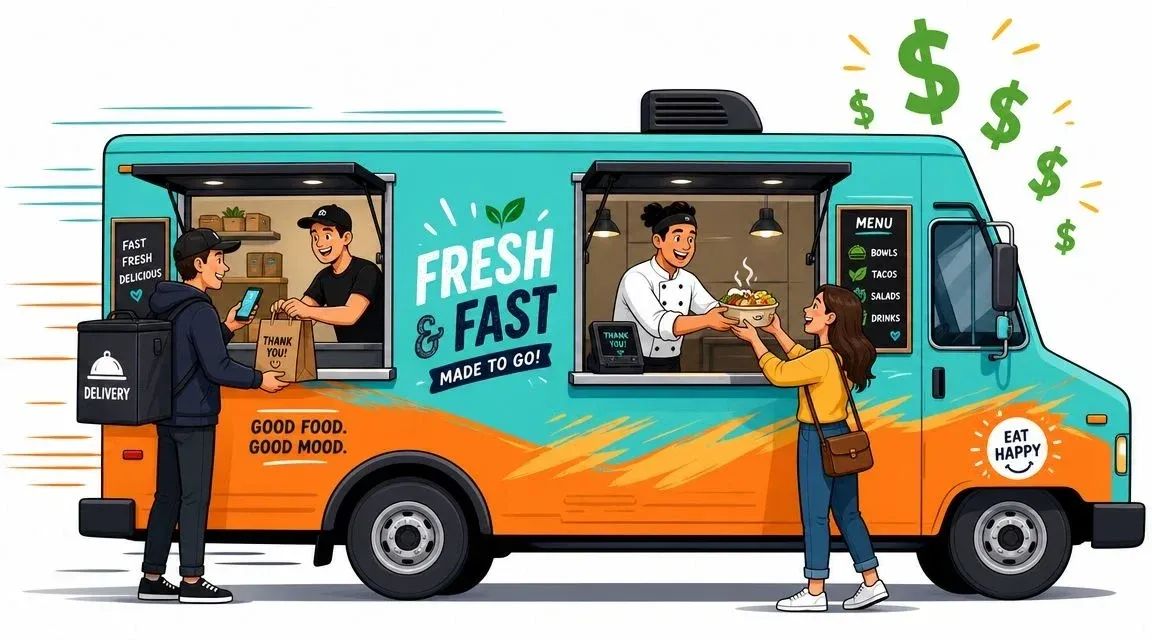
You’re probably looking at a floor plan, a menu, and a budget, and thinking the service window is the easy part. It isn’t. The wrong window turns a smooth lunch rush into a pileup. One customer is waiting to pay, another is waiting on pickup, a DoorDash driver is asking for three names at once, and your cook is trying to pass food through a small opening while reaching around a card reader.
That’s why experienced operators don’t treat food truck windows as cosmetic. They treat them as a production tool. The window controls handoff speed, customer communication, weather exposure, line management, and how well your truck can handle both walk-up traffic and restaurant delivery orders without chaos.
The business stakes are real. The U.S. food truck services market is projected to reach $3.56 billion by 2033, growing at a 7.5% CAGR, according to the U.S. Census Bureau story cited here. In a market that competitive, your window isn’t just an opening in the wall. It’s the point where revenue gets completed or delayed.
Why Your Food Truck Window Is Your Most Important Employee
A bad food truck window creates the kind of problems owners usually blame on staff.
Orders get called out twice because customers can’t hear. Bags stack up on the counter because there’s no clear pickup zone. Drivers from Uber Eats and DoorDash crowd the same opening as walk-up guests, so nobody knows who’s next. The team inside starts crossing paths, reaching over each other, and losing time on every handoff.
That’s not a people problem first. It’s a layout problem.
What the window actually does
Your window handles more jobs than most new operators expect:
- Customer communication: Can guests hear questions, specials, and order names clearly?
- Order handoff: Is there enough opening space to pass drinks, clamshells, and bags without awkward twisting?
- Payment flow: Can a card reader or cashier stand near the opening without blocking pickup?
- Queue control: Do walk-up customers and delivery drivers know where to stand?
- Weather protection: Can staff keep serving when wind or rain shows up?
When one opening has to do all of that, the details matter. Window height, open angle, screen design, latch position, and counter depth all affect speed.
Practical rule: If your team has to explain where to stand, where to pay, and where to pick up during every rush, the window setup is working against them.
Why it matters for profit
Food trucks run on limited space, limited labor, and short peak periods. You don’t have the luxury of wasting ten seconds on every handoff. During a lunch rush, those little delays stack up fast.
The operators who stay calm under pressure usually have one thing in common. Their service window matches their workflow. Orders move in one direction. Staff don’t reach around each other. Customers can see where the process starts and ends.
That’s the mindset to bring into every food truck window decision. Don’t ask, “What looks good on the truck?” Ask, “What lets my team serve fast with fewer mistakes?”
Exploring Food Truck Window Types and Materials
Most owners start by saying they need “a serving window.” That’s too broad. The right choice depends on how you sell, what you hand off, and whether your truck is built around walk-up service, restaurant delivery pickups, or both.
The main food truck window types
Awning-style concession window This is the commonly pictured format. The top panel opens upward and creates a canopy over the counter. It’s popular because it gives customers some shelter and keeps the service area more usable in sun or rain.
Modern concession windows often open to about 85 degrees, which helps maintain rain protection while keeping enough clearance for staff-customer interaction, as shown in concession window product details.
Sliding window
A sliding setup can work well when exterior clearance matters or when you want a compact opening. It’s simple and familiar. The downside is that sliding sections can limit the clear pass-through area, which matters when you’re handing out boxed meals, drink carriers, or large bags.
Full-service concession window
This is the better choice when the window is the center of the business. A larger concession unit creates a more open handoff area and better line-of-sight between staff and guests. It’s especially useful if your truck has a broader menu or you want one employee taking orders while another handles pickup from the same opening.
Materials that hold up in real service
The best frame material for most trucks is lightweight aluminum. It resists corrosion and keeps added vehicle mass down. Many manufacturers build concession windows around aluminum alloy frames for exactly that reason.
For screens, 304 stainless steel is common because it’s durable, corrosion-resistant, and easier to clean. That matters for sanitation and for day-to-day use when grease, dust, and moisture build up around the opening.
Here’s a practical comparison:
Material Pros Cons Best For Aluminum Lightweight, corrosion-resistant, common in concession frames Can feel less premium than heavier metals Most truck builds where weight matters Stainless steel Durable, hygienic, easy to clean Heavier, often more expensive in trim applications Screens, interior trim, sanitation-focused areas Acrylic or tempered glass Clear visibility, familiar look, available in many configurations Choice depends on weight, strength, and replacement concerns Service panels where visibility matters
Features worth paying attention to
A few features matter more than the brochure language:
- Open angle: An awning that opens high enough gives better headroom and rain protection.
- Locking hardware: Important for security when the truck is parked or stored.
- Screen design: Helps with sanitation and pest control.
- Assist mechanism: Pneumatic assist or drag hooks make repeated opening and closing easier on staff.
Before you choose a unit, check your local compliance requirements too. A design that looks fine online may still need changes once you compare it with food truck regulations by jurisdiction.
The best-looking window on the truck can still be the wrong one if it slows down the handoff.
Sizing and Placement for an Optimal Restaurant Workflow
A bigger opening isn’t always a better opening.
Large food truck windows improve visibility and can make service feel more open, but they also eat wall space and affect what fits underneath and beside them. Every extra inch in the opening changes where you place shelving, POS hardware, heat lamps, prep surfaces, and staff positions.
Start with the order path, not the cutout
The simplest way to size a window is to trace the path of one order.
A customer places an order. Staff enter it into the POS. The kitchen prepares it. Someone bags it. Someone hands it out. If those actions happen in different spots inside the truck, the window has to line up with that movement. If it doesn’t, your crew will keep pivoting, backtracking, and reaching across each other.
That’s why I tell owners to sketch three zones before they ever cut metal:
- Order-taking zone
- Expo and bagging zone
- Pickup and handoff zone
If all three zones collide at one small opening, service gets messy fast.
Single window versus dual-window setups
The idea of using more than one service side isn’t new. The dual-window concept goes back to 19th-century lunch wagons, including models Thomas H. Buckley produced in the 1880s, where one window could face the curb and another the street for more efficient service, as outlined in this food truck history overview.
That old idea still solves a modern problem.
Single large window works best when:
- your menu is simple
- one person can take payment and hand off orders
- delivery volume is light
- interior counter space is tight
Dual-window logic works best when:
- you handle both walk-up and app orders
- one line regularly blocks another
- you want order-taking separated from pickup
- you need a cleaner workflow during peak periods
A lot of operators don’t need two actual windows. They need two clearly defined functions. One opening can still work if the physical setup creates separate order and pickup positions.
Placement mistakes that hurt operations
Some mistakes show up only after opening day:
- Window too close to cooking equipment: Heat and steam make the handoff area uncomfortable.
- Window centered only for looks: It may look balanced outside but create dead space inside.
- Counter too shallow at the opening: Bags, receipts, and drinks fight for the same small landing spot.
- POS placed directly in the handoff lane: The cashier blocks the pickup exchange.
If you’re still building SOPs, map the window decision to your broader restaurant operating procedures. The best window placement supports repeatable movement, not just curb appeal.
Designing for Delivery and POS Integration
A food truck window used to serve one kind of guest. The person standing outside placed the order, paid, and waited. That’s no longer the default.
Now a truck may serve walk-up customers, scheduled pickups, and delivery drivers from Uber Eats and DoorDash in the same ten-minute stretch. If the service window doesn’t support that mix, the digital side of the business starts creating physical congestion.
The window is your physical API
In plain language, the service window is where your kitchen meets the outside world. Every digital order still becomes a physical handoff. That means the truck’s window has to support the same clarity your software should provide.
If your POS is taking walk-up orders while app orders are also firing into the kitchen, you need a handoff process that keeps those streams from colliding.
A strong setup usually includes:
- One visible pickup zone for completed orders
- A separate standing spot for customers placing new orders
- A shelf, ledge, or bag staging area near the window
- Clear labeling for pickup names and app orders
- POS hardware positioned off the handoff line
What works with Square and Clover
Actual restaurant operations meet food tech.
If you use Square or Clover, the physical layout should match how those systems are used inside the truck. A cashier taking in-person orders on one device shouldn’t have to step into the pickup lane every time a courier arrives. The bagging area should sit closer to the handoff point than the payment point.
That sounds obvious, but many trucks install the tablet where it’s easiest to mount, not where it helps workflow.
Put the POS where staff can take orders without blocking completed ones. That single decision prevents a lot of rush-hour confusion.
Delivery-first design choices
If delivery is becoming a larger share of your business, build for it early.
A few practical moves make a big difference:
- Use a pickup shelf inside the window line: Staff can stage sealed bags without balancing them in the payment area.
- Create a driver pickup side: Even a small designated section reduces crowding.
- Keep receipt printers and labelers near expo: Staff shouldn’t walk the length of the truck to identify an app order.
- Make order names visible: Drivers asking “Is this for Sarah?” at the main ordering position slows everyone down.
If you’re comparing POS ecosystems and how they fit into this process, review operational fit, not just features. Even a platform discussion like this one on POS setup considerations for restaurants is useful as a planning exercise because it forces you to think about where digital orders enter your workflow and where they leave it.
The key point is simple. Better software can reduce manual entry, but it can’t fix a bad handoff zone. Your food truck window still has to be designed for the way orders leave the kitchen.
Meeting Health Codes and ADA Regulations
This is the part many owners put off until permit review. That’s backward. Health code and accessibility requirements should shape the window decision before the build starts, not after.
A food truck can have a smart menu, a strong brand, and a clean layout, but if the window setup doesn’t satisfy local requirements, opening gets delayed and rework gets expensive.
Health code issues that commonly affect food truck windows
Health departments usually care less about style and more about whether the service opening supports safe operation.
In plain terms, they’ll look for materials and features that are easy to keep sanitary and that don’t create obvious contamination risks. That often means smooth, cleanable surfaces around the opening, service components that hold up under repeated cleaning, and screens or barriers where required by local rules.
Common trouble spots include:
- Hard-to-clean tracks and seams
- Damaged screen material
- Interior trim that traps grease or moisture
- Window hardware that loosens under vibration
- Poor seals that invite leaks and grime buildup
If your area requires permit review before operation, check those requirements before fabrication. It’s much easier to revise a plan on paper than after the wall has been cut. A permit planning guide like this overview of restaurant business permits is a useful starting point for organizing that work.
ADA matters at the service point
Accessibility isn’t a paperwork detail. It affects how real customers interact with your truck.
For service windows, the practical questions are straightforward. Can a customer comfortably reach the transaction point? Is there clear space outside the truck for someone using mobility equipment? Can staff communicate and complete the handoff without forcing awkward positioning?
You’ll need to verify exact local requirements with your city, county, or state authorities. The details vary. What doesn’t vary is the cost of fixing it late.
Check accessibility at the same time you review health code. Owners who split those steps usually end up revising the same area twice.
What to do before you cut
Before approving a window location, confirm:
- Your local health department requirements
- Any screening or service opening rules
- Material standards for cleanability
- Accessibility expectations for the service counter area
- Whether your jurisdiction wants plan review before modification
The best builders treat compliance as part of design, not an obstacle after the fact.
Budgeting for Installation and Long-Term Maintenance
The window itself gets most of the attention. The installation is where expensive mistakes happen.
A lot of owners shop for food truck windows as if they’re buying a simple accessory. In reality, you’re modifying a moving vehicle that flexes, vibrates, heats up, cools down, and deals with weather every day. That changes the standard.
Why installation quality matters more than people think
A proper installation needs reinforcement around the opening so the load transfers into the truck’s frame. As Lippert’s concession window guidance explains, cutting into the body skin alone isn’t enough. That can lead to structural flexing and water intrusion.
That’s the part DIY builds often underestimate.
When owners rush the job, the early warning signs are familiar:
- The wall flexes when the window opens
- Seals stop sitting flush
- Water finds its way in around corners
- The latch alignment shifts after road use
If you’ve ever priced adjacent vehicle glass work, even general resources on budgeting for RV window replacement help show why it’s smarter to prevent water damage and frame issues than to repair them later.
Think in ownership cost, not purchase price
The cheap option isn’t always the lower-cost option. A lower-grade unit or weak install can cost more in downtime, leak repair, trim replacement, and lost service days than a better-built setup would have.
What I tell owners to budget for is not just the purchase. Budget for:
- Reinforcement work around the opening
- Seal quality
- Hardware durability
- Future serviceability
- Time off the road if rework is needed
That broader planning becomes easier when you’re already pricing permits and startup costs. This guide to food truck license cost planning fits well into the same budgeting conversation.
Maintenance that protects uptime
Food truck windows live a hard life. They deal with vibration, grease, wind, rain, repeated opening cycles, and cleaning chemicals. Maintenance is simple, but it has to be regular.
A sensible routine includes:
- Cleaning tracks and corners so debris doesn’t grind into moving parts
- Inspecting seals before leak season starts
- Checking hardware and fasteners after heavy service periods
- Watching for frame movement after rough road travel
- Testing opening assists and latches before busy events
The right question isn’t “Can I install this myself?” It’s “Can I afford the downtime if this install fails in the middle of my season?”
Your Final Checklist for Choosing the Right Window
The best food truck windows don’t win on looks alone. They win because they support the way your business runs.
That’s where many buying guides fall short. They focus on dimensions, flap styles, or DIY steps. They rarely answer the harder business question: how does the window affect service speed, order accuracy, and revenue during peak periods? That gap is exactly why workflow analysis matters, as noted in this discussion of the ROI blind spot around concession windows.
A practical decision checklist
Use this before you buy, cut, or install anything.
- Workflow first: Can staff take orders, bag food, and hand off drinks and meals without crossing into each other’s space?
- Window size: Does the opening fit your menu and packaging, or does it sacrifice prep room you need more?
- Placement: Is the opening aligned with expo and pickup, not just centered for appearance?
- Weather protection: Does the design stay usable in sun, wind, and rain?
- Materials: Are the frame, screens, and interior finishes durable and easy to clean?
- Security: Will the locking setup hold up during transport and overnight storage?
- Delivery readiness: Can walk-up guests and app-order pickups coexist without crowding the same spot?
- POS integration: Is the card reader or tablet placed so payment doesn’t block handoff?
- Compliance: Have local health and accessibility requirements been checked before fabrication?
- Installation plan: Is the wall reinforcement part of the job from day one?
The final filter I’d use
If you’re stuck between two options, use this test.
Pick the one that makes rushes simpler. Pick the one that reduces unnecessary movement. Pick the one that leaves room for your digital workflow, not just today’s walk-up line. If you expect more online ordering, more delivery traffic, or more off-premise business, your service window has to support that future without a rebuild.
A food truck window is a customer-facing component, but it’s also an operations decision. Treat it like part of your kitchen line, your handoff station, and your food tech stack all at once.
Once your physical handoff is mapped out, the next step is cleaning up the digital side so delivery orders flow straight into your POS instead of creating more manual work. Restaurant owners can get started with OrderOut and begin onboarding free in a few clicks at OrderOut Dashboard.