
Food Truck License Cost: A 2026 Breakdown for Operators
· Thibault Le Conte
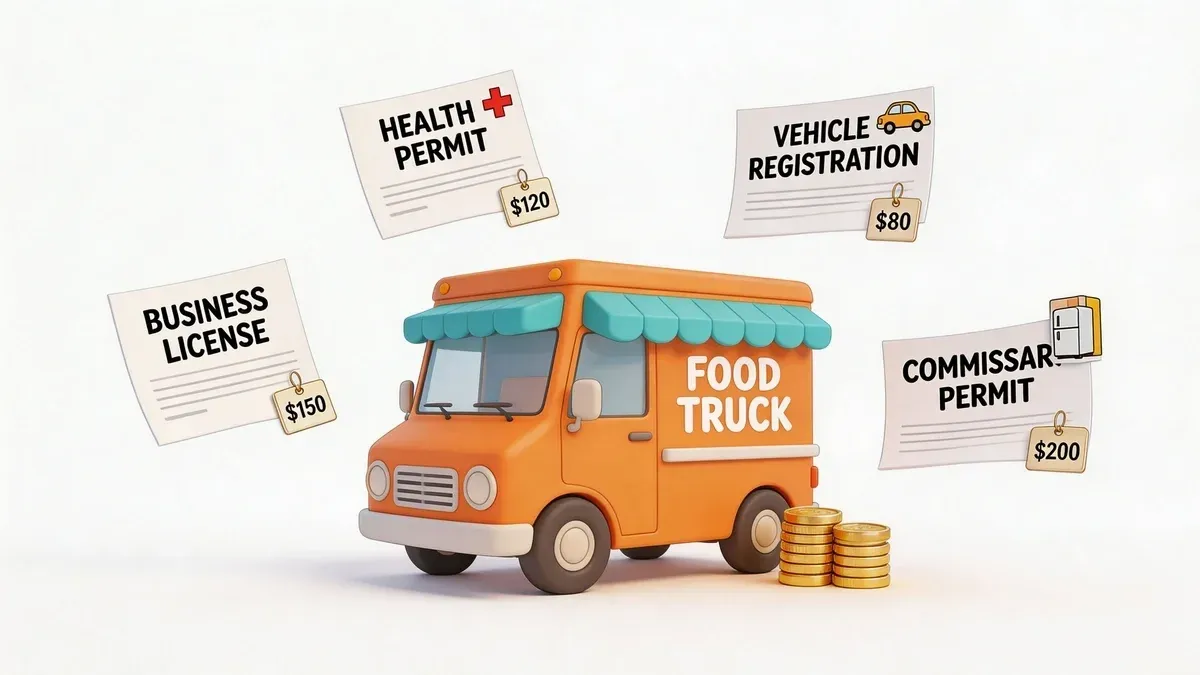
Most operators expect the truck to be the expensive part. The surprise is the paperwork.
Across major U.S. cities, first-year food truck regulatory expenses average $28,276 according to the U.S. Chamber of Commerce Foundation’s Food Truck Nation study, cited in Square’s breakdown of food truck costs: https://squareup.com/us/en/the-bottom-line/operating-your-business/food-truck-cost. That headline number is real, but it is also misleading if you use it as your budget.
Food truck license cost is not one fixed number. It is a stack of local decisions made by city halls, health departments, fire marshals, tax offices, and zoning boards. One operator can launch with a manageable compliance bill. Another can burn cash before selling a single meal.
That difference changes more than your startup plan. It affects your menu, where you park, whether you need a commissary, how much admin your team can absorb, and which restaurant operations tools make sense. If you are also running restaurant delivery through Uber Eats or DoorDash, the wrong setup turns regulatory complexity into daily friction.
The Shocking Reality of Food Truck Startup Costs
The biggest mistake I see is treating food truck license cost like a line item pulled from a blog post. It does not work that way.
A national average hides the core problem. Indianapolis sits at $590, while Boston reaches $17,066 in the same broad conversation about food truck regulatory costs, based on the same Square summary of the U.S. Chamber of Commerce Foundation data: https://squareup.com/us/en/the-bottom-line/operating-your-business/food-truck-cost. That spread is wide enough to change whether a concept is viable at all.
Why this catches operators off guard
Most first-time owners budget for the visible assets first. They price the truck, wrap, equipment, and opening inventory. Then the applications start.
A food truck usually needs approvals across several buckets. Business registration. Food safety. vehicle compliance. Fire review. Parking or zoning permission. Sometimes employment-related filings too. None of those feels huge in isolation. Together, they can reshape the launch budget.
Practical takeaway: If your budget has one cell labeled “permits,” it is too simple to protect you.
The operators who handle this well do one thing early. They build the business around the jurisdiction, not the other way around. That means choosing markets, service model, and technology based on local rules and recurring admin load.
A truck serving dessert in a festival-heavy route will face a different operating reality from a truck chasing lunch spots, brewery events, and restaurant delivery. If you want a useful example of how concept affects operations, this look at a dessert food truck shows why the model matters before you lock in costs.
Your Essential Food Truck License Checklist
Before you think about launch marketing or delivery menus, get the legal foundation right. The easiest way to think about it is like permitting a small kitchen that happens to move.
Start with the licenses that create the business
Your business license is the basic approval to operate legally. In the cost ranges summarized by Square, administrative licenses such as business registration fall around $75 to $150: https://squareup.com/us/en/the-bottom-line/operating-your-business/food-truck-cost.
That does not sound painful. The issue is that this is only the first form in a much longer chain.
You also need clean, organized records. If your formation documents, agreements, and renewals live across email threads and glove-box folders, renewals become harder than they need to be. For operators who want a more organized way to manage paperwork, these legal documents resources can help centralize the admin side.
Health, safety, and vehicle approvals
Your health permit confirms that the truck meets local food safety standards. Square’s food truck cost guide places health and food safety permits around $250 to $1,000 annually: https://squareup.com/us/en/the-bottom-line/operating-your-business/food-truck-cost.
Your vehicle and safety permits cover the truck as a commercial operating unit, not just a van with cooking equipment. Square notes vehicle requirements and safety permits in the range of $125 to $500 annually: https://squareup.com/us/en/the-bottom-line/operating-your-business/food-truck-cost.
Then there is the fire side. If you cook with equipment that triggers fire review, annual fire safety permits can add $125 to $150: https://squareup.com/us/en/the-bottom-line/operating-your-business/food-truck-cost.
What operators often forget
Some approvals are not headline permits, but they still control whether you can trade.
- Food safety certifications: Staff training and certification often sit outside the owner’s first draft budget.
- Zoning and parking permissions: You can be fully licensed and still unable to work the location you wanted.
- Sales tax registration: You need the structure to collect and remit correctly.
- Employment-related filings: If you hire, the paperwork expands.
A strong starting point is to keep a local compliance checklist tied to your launch timeline. This guide on regulations for a food truck is useful for turning the paperwork pile into a sequence you can manage.
Tip: Build a renewal calendar the day you receive your first approval. Operators often remember application dates. Inspectors care about expiration dates.
Why Food Truck License Costs Vary So Dramatically
The short answer is simple. Different governments charge differently and regulate differently.
The more useful answer is that food truck license cost changes because three forces combine at the local level: geography, inspection structure, and commissary rules.
Geography changes the stack
A city, county, and state can each touch the same operation. That means one truck may need one smooth path to approval, while another needs multiple approvals that do not line up neatly.
North Carolina is a good example of why “state cost” is not specific enough. In that state, health permits can range from $150 to $500 per year, business licenses vary from $50 to $150 in some local examples and up to $250 in Burgaw, and Raleigh adds a $150 vendor permit with property owner approval requirements, according to VendorLoop’s North Carolina guide: https://getvendorloop.com/guides/how-to-start-a-food-truck-in-north-carolina.
If you plan to cross city lines, the paperwork can multiply fast.
Inspection rules shape cost and workload
Two cities can charge similar fees and still create very different operating conditions. One may have a straightforward inspection process. Another may layer health review, vehicle review, and fire review in ways that slow opening and increase admin burden.
That matters for restaurant operations because inspection-heavy markets punish disorganization. Operators who keep permits, tax settings, sales records, and staff certifications tied to their POS and reporting process usually recover faster from compliance requests.
For many teams, it also helps to understand adjacent requirements such as food handler certification cost, because licensing rarely stops with the truck itself.
Commissary rules can turn startup cost into recurring cost
Once that happens, “license cost” stops being a startup question and becomes an operating model question. This scenario often breaks budgets.
Some jurisdictions push operators toward commissary-dependent workflows for prep, storage, cleaning, or overnight support.
CloudKitchens’ food truck cost analysis highlights that commissary kitchen rentals can run $400 to $1,200 monthly, or $4,800 to $14,400 annually, in the Michigan example, with additional recurring pressures from maintenance and insurance: https://cloudkitchens.com/blog/how-much-does-a-food-truck-cost.
Key point: The city with the cheaper application fee is not always the cheaper market to operate in.
Real-World Food Truck License Cost Examples
The most useful way to understand food truck license cost is to compare markets side by side.
One national number hides very different local realities
The U.S. Chamber of Commerce Foundation’s Food Truck Nation study, as cited in Square’s analysis, puts average first-year regulatory expenses at $28,276 across major U.S. cities. That same source shows Indianapolis at $590, Boston at $17,066, and notes that when Boston is removed as an outlier, the average across the top 19 food truck cities drops to about $1,864: https://squareup.com/us/en/the-bottom-line/operating-your-business/food-truck-cost.
That tells you two things right away.
First, food truck license cost is highly local. Second, broad averages can push operators into bad assumptions, especially if they are planning a regional concept and not a specific route.
California shows the problem inside one state
Operators often assume state-level planning is enough. California proves otherwise.
Square’s breakdown shows Los Angeles County food service permits ranging from $319 to $1,438, Contra Costa County from $700 to $2,000, San Diego from $790 to $1,981, and San Francisco from $900 to $1,400: https://squareup.com/us/en/the-bottom-line/operating-your-business/food-truck-cost.
That is a big spread without even leaving one state. Add parking or storage costs in California at $200 to $1,000 monthly, plus annual insurance and fire permit costs from the same source, and your route planning starts to matter as much as your menu.
A quick visual can help if you are comparing launch markets and trying to avoid the wrong benchmark.
North Carolina is a patchwork market
North Carolina is not extreme on every line item. It is complicated.
The issue is stacking. A health permit, business license, local vendor permit, and local zoning rules can all apply depending on where you operate. VendorLoop’s guide points out that operators moving between places such as Raleigh and Greensboro may need separate local approvals and property-specific permissions: https://getvendorloop.com/guides/how-to-start-a-food-truck-in-north-carolina.
For a mobile operator, that changes daily execution. A truck built for private-lot lunch service may need a different permit strategy from a truck built around events, breweries, or restaurant delivery. This is why real examples beat national averages every time.
How to Build Your Complete Food Truck Budget
A workable budget has to separate one-time launch costs from recurring operating costs. If you mix them together, you will either underestimate cash needs or overestimate how much room you have after opening week.
Build the budget in layers
Start with the visible capital expense. CloudKitchens lists food truck vehicle acquisition in a broad range of $50,000 to $175,000: https://cloudkitchens.com/blog/how-much-does-a-food-truck-cost.
Then add the recurring overhead that operators often push to the side. In the same Michigan example, annual vehicle maintenance runs $800 to $1,500, seasonal heating adds $500 to $1,000, commercial auto insurance runs $1,200 to $3,000 annually, recommended general liability insurance is $300 to $700 annually, and commissary rentals can total $4,800 to $14,400 annually: https://cloudkitchens.com/blog/how-much-does-a-food-truck-cost.
CloudKitchens also notes that total first-year operational overhead excluding food and labor reaches $8,400 to $20,100 in that example: https://cloudkitchens.com/blog/how-much-does-a-food-truck-cost.
Use a worksheet, not a rough estimate
This format works well because it forces you to assign every cost to a category and time frame.
Expense Category Cost Type Estimated Low Range Estimated High Range Your Estimate Truck purchase Startup $50,000 $175,000 Administrative licenses Startup $75 $150 Health and food safety permits Annual $250 $1,000 Vehicle requirements and safety permits Annual $125 $500 Fire safety permit Annual $125 $150 Commissary kitchen rental Monthly or annual $400 monthly / $4,800 annual $1,200 monthly / $14,400 annual Vehicle maintenance Annual $800 $1,500 Seasonal heating Annual $500 $1,000 Commercial auto insurance Annual $1,200 $3,000 General liability insurance Annual $300 $700 Parking or storage in California markets Monthly $200 $1,000
Keep margin planning tied to menu decisions
A budget is only useful if it connects to pricing and contribution margin. If your permit environment is heavy, your menu has less room for waste and underpricing.
That is why operators should pair the worksheet above with a clear approach to calculate food cost percent. The compliance bill does not sit outside your menu economics. It sits on top of them.
Budget rule: If a cost recurs, model it before launch. Do not wait to “see how things go.”
Smart Strategies to Reduce Your Licensing Expenses
You cannot negotiate every fee. You can control the structure around those fees.
Choose your operating geography carefully
The biggest savings usually come from smarter market selection, not from trying to shave a few dollars off a filing.
If your concept can succeed in more than one nearby municipality, compare the full compliance stack before signing anything. Look at permits, inspections, parking rules, and whether the area pushes you into commissary dependence. A lower-fee city with workable zoning can be more valuable than a busy district that traps you in constant admin.
Reduce recurring drag, not just startup fees
Some operators focus so hard on opening costs that they ignore the recurring pressure. That is where margin disappears.
Try these moves:
- Negotiate commissary terms: Ask for a plan that fits your prep and cleaning schedule instead of paying for access you rarely use.
- Bundle insurance coverage: A cleaner insurance package can simplify renewals and reduce admin overhead.
- Prepare for inspections early: Organized logs, posted permits, and a clean truck reduce the risk of avoidable rework.
- Limit jurisdiction sprawl: Serving too many nearby cities can create duplicate paperwork with little revenue upside.
A broader service-business mindset helps here too. These actionable strategies for cost reduction in service businesses are worth reviewing because the same logic applies to food trucks. Reduce friction, standardize repeatable tasks, and protect cash flow.
Treat admin efficiency as a cost-control tool
Operators often think of technology as a growth expense. In food trucks, it is often a compliance expense too.
Good systems help you track permits, renewal dates, tax settings, and sales records in one operating rhythm. Bad systems leave staff copying information between apps, chasing missing tickets, and fixing preventable mistakes during a lunch rush.
That matters because every wasted hour competes with mandatory costs you cannot avoid.
How Licensing Costs Drive Restaurant Tech Decisions
When recurring overhead is high, efficiency stops being optional.
CloudKitchens’ Michigan example shows why. Annual vehicle maintenance sits at $800 to $1,500, commissary kitchen rentals reach $4,800 to $14,400 annually, and mandatory insurance adds $1,200 to $3,000 annually before you even get into food and labor: https://cloudkitchens.com/blog/how-much-does-a-food-truck-cost.
Manual order entry becomes a hidden operating cost
If your team is entering Uber Eats and DoorDash orders by hand into the POS, the labor cost is only part of the issue. Errors creep in. Tickets slow down. Staff bounce between tablets instead of serving customers.
For a truck, that friction hurts more than it does in a larger restaurant. Space is tighter. Labor is leaner. Rush windows are shorter.
POS integration matters more in mobile restaurant operations
Restaurant delivery systems need to support the way a truck works. Orders should move directly into the POS and kitchen flow instead of being retyped during service.
For operators using Clover, the OrderOut integration is available here: https://www.clover.com/appmarket/apps/NWHCH32XVYV40. For operators using Square, the integration is here: https://squareup.com/us/en/app-marketplace/app/orderout.
If you are evaluating systems more broadly, this guide to an integrated POS system is useful background. The core idea is simple. When mandatory compliance costs are already heavy, your food tech stack should reduce labor waste, lower entry errors, and make reporting cleaner.
Bottom line: A good POS integration does not erase your permits. It helps your team operate well enough to afford them.
Your Next Step to a Profitable Food Truck
Treat food truck license cost as an operating system decision, not just a startup fee. Map every permit, price your real recurring overhead, and choose markets based on total compliance burden instead of headline demand alone.
Then tighten the back office. Use a checklist for approvals, a worksheet for recurring costs, and a delivery workflow that does not force staff to re-enter orders during a rush. That combination protects margin better than chasing shortcuts after launch.
If you want to simplify delivery operations and reduce manual order entry, OrderOut connects apps like Uber Eats, DoorDash, and Grubhub directly into POS systems such as Clover and Square. Restaurant owners can start onboarding for free in a few clicks at https://dashboard.orderout.co.