
A Modern Guide to Food Service Management
· Thibault Le Conte
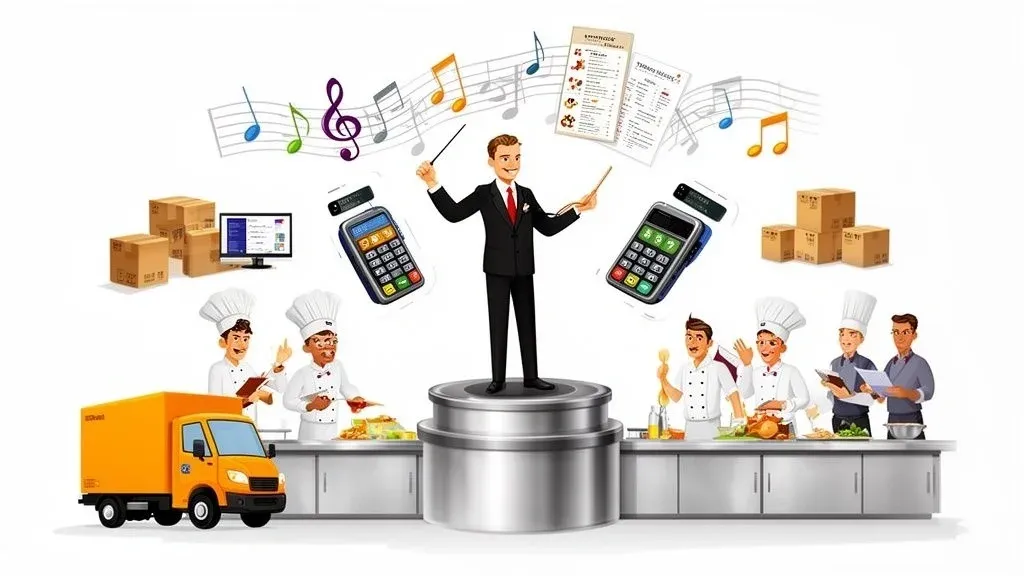
Food service management is the art and science of getting every moving part of a restaurant to work in perfect harmony. In simple terms, it’s about making sure the kitchen, front-of-house, finances, and customer experience all click together to run an efficient, profitable business.
Think of it like conducting an orchestra. Each section—from the line cooks managing delivery orders to the servers handling dine-in guests—needs to play its part flawlessly. When they do, you create a seamless experience that keeps customers coming back.
What Is Modern Food Service Management?

Not too long ago, running a restaurant meant juggling clipboards, drowning in spreadsheets, and relying on gut feelings. Today, modern food service management is a tech-powered command center built on four critical pillars that directly impact your restaurant’s efficiency and profitability.
- Operational Excellence: This is about fine-tuning your daily workflow, from smart inventory control to optimizing how orders move through the kitchen. The actionable goal is to reduce waste, speed up service, and ensure every dish is consistently perfect, whether it’s for dine-in or delivery.
- Financial Health: A sharp manager keeps a close eye on sales, wrangles costs (especially food and labor), and strategically designs the menu for maximum profit. This pillar ensures the business is actually making money, not just staying busy.
- Customer Experience: Great management is about creating an environment where guests feel valued, whether they’re sitting at a table or waiting for a delivery. This means quick service, spot-on orders, and a welcoming vibe, all of which drive repeat business.
- Team Leadership: At its core, this is about building a solid crew. It involves hiring the right people, training them well, and fostering a positive culture that makes them want to stick around. A happy, motivated team is your secret weapon for productivity.
The Shift to a Tech-Driven Approach
That orchestra conductor analogy is more accurate now than ever before. A modern manager uses technology—especially their Point of Sale (POS) system—as their baton. A POS is so much more than a cash register; it’s the brain of your restaurant operations, connecting every piece of the business.
Why it matters: When you integrate your POS with delivery platforms like DoorDash or Uber Eats, it automatically punches in orders. This simple connection slashes costly mistakes and frees up your staff to focus on the guests in front of them, directly boosting restaurant efficiency and staff productivity. This tech-first mindset isn’t just a trend; it’s the standard for modern food service management.
The global Food Service Management market is expected to balloon to $330,470 million by 2031, a clear sign that efficiency is the name of the game. In places with high labor costs, smart management tools are helping operators trim waste and get more out of every shift.
Why This Matters for Your Restaurant
Putting effective food service management into practice has a direct impact on your bottom line. When you connect your systems and embrace a modern approach, you cut down on tedious manual work, reduce errors, and see a real boost in both staff productivity and customer happiness.
This restaurant digital transformation is essential for staying competitive. For anyone just starting out, getting these principles right from day one is non-negotiable, a point reinforced in this comprehensive guide to starting a coffee shop. Ultimately, mastering modern management is how you build a restaurant that’s not just successful, but also resilient.
The Four Pillars of Restaurant Operations

Great food service management isn’t a single skill; it’s about mastering four key areas that work together to hold up your entire business. Think of them as the four legs of a table—if one is wobbly, the whole operation feels unstable. When you get these pillars right, you see real, tangible improvements in efficiency, lower costs, and a much healthier bottom line.
These aren’t just abstract ideas. They represent the daily grind and the strategic decisions that separate thriving restaurants from struggling ones. Let’s break down exactly what they are and how they directly impact your profitability.
Inventory and Supply Chain Management
At its core, this is about having what you need, right when you need it—without tying up cash in excess stock or, worse, running out of a key ingredient. Order too much, and you’re literally throwing profits in the bin. Order too little, and you’re 86ing a popular dish on a busy Friday night, disappointing customers.
Modern inventory management goes beyond just placing orders. Technically, it involves leveraging your POS sales data to forecast future needs. By tracking what sells and when, you can make surprisingly accurate predictions about what to order, reducing both waste and stockouts.
Why it matters for efficiency: When inventory is dialed in, waste plummets, food costs go down, and your menu stays consistent. The best POS systems track this at the ingredient level. So, every time a burger is sold, the system automatically deducts one bun, one patty, and two slices of cheese from your stock. This removes the guesswork and stops those last-minute panics that can throw both your kitchen and your restaurant delivery services into chaos.
Labor Management and Staff Productivity
Your team is easily your biggest asset, but they’re also one of your largest expenses. Smart labor management means scheduling just enough staff to give every customer a great experience without overstaffing during slow periods. It’s about building a team that’s trained, motivated, and has the right tools to do their job well.
Actionable Insight: Instead of just creating a schedule, use your POS data to identify your busiest hours for both dine-in and delivery. Staff up for those peaks and schedule leaner during the lulls. This simple, data-driven change can significantly reduce labor costs while improving service when it matters most, boosting staff productivity.
Menu Engineering and Cost Control
This is where the chef’s creativity meets the accountant’s spreadsheet. In simple terms, menu engineering is designing a menu that is not only delicious but also a powerful profit-generating tool.
Technically, it all comes down to analyzing the food cost percentage and contribution margin (the raw profit you make on a dish) for every single item you sell. By plotting items on a matrix, you can identify your “stars” (popular and high-profit) and your “puzzles” (popular but low-profit). This data allows you to make strategic moves, like subtly highlighting high-profit items or tweaking a recipe to make a popular dish more profitable. This directly impacts your bottom line.
Safety and Compliance
This last pillar is completely non-negotiable. Safety and compliance cover everything from following health codes for food handling to maintaining a safe work environment for your employees. A slip-up here can lead to crippling fines, a damaged reputation, or even having your doors shut for good.
Why it matters for restaurant operations: A strong safety culture builds trust with both customers and staff. It ensures your operation runs smoothly without the risk of costly interruptions. This foundation of trust is essential, especially as you integrate more [food tech] and delivery services where consistency is key.
Mastering these four pillars is the heart of successful restaurant operations. Each one plays a direct role in how well you can manage online orders, integrate new technology, and get the most out of your POS system to drive your business forward.
Using Key Metrics to Improve Restaurant Performance
You can’t improve what you don’t measure. In the restaurant world, this means shifting from gut feelings to data-driven decisions. Key Performance Indicators (KPIs) are your restaurant’s vital signs, telling you exactly where you’re succeeding and where you need to focus your attention.
Think of your KPIs as the dashboard in a car. You wouldn’t drive without knowing your speed or fuel level. The same goes for running a restaurant. Tracking these numbers is the only way to get a clear, honest look at your financial health, operational flow, and customer happiness.
To help you get started, we’ve broken down the essential KPIs that every food service manager should have on their radar.
KPI How to Calculate It Why It Matters for Your Restaurant Cost of Goods Sold (CoGS) (Beginning Inventory + Purchases) – Ending Inventory This is the direct cost of your ingredients. Tracking it keeps your food costs in check and protects your menu’s profitability. Prime Cost CoGS + Total Labor Cost This is your biggest expense category. Keeping it under 60% of total sales is the golden rule for staying profitable. Table Turnover Rate Number of Parties Seated / Number of Tables This shows how efficiently you’re serving guests. A higher rate means more sales per table during a shift. Average Order Value (AOV) Total Revenue / Number of Orders This metric reveals how much customers typically spend. Small increases here can dramatically boost your overall revenue. Customer Retention Rate ((Customers at End of Period - New Customers) / Customers at Start) x 100 This tells you how many customers are coming back. Since retaining a customer is far cheaper than acquiring a new one, this is key to long-term success.
Let’s dig a little deeper into what these numbers really mean for your day-to-day operations.
Understanding Your Financial Health
Your financial metrics are the foundation of your business. They show you exactly where your money is coming from and, more importantly, where it’s going. The two big ones to master are Cost of Goods Sold (CoGS) and Prime Cost.
-
Cost of Goods Sold (CoGS): In simple terms, this is what you paid for all the ingredients that went into the dishes you sold. It’s a direct measure of how well you’re managing food costs.
-
Prime Cost: This is the heavyweight champion of restaurant expenses. It’s your CoGS plus your total labor costs. For most restaurants, this number eats up the biggest chunk of revenue, so keeping it below 60% of your sales is absolutely critical.
Tracking these numbers helps you spot problems early, like a supplier’s prices creeping up or inefficient staff scheduling. A detailed restaurant profit and loss statement gives you the full picture you need to keep costs under control.
Measuring Operational Efficiency
Operational KPIs tell the story of how smoothly your restaurant is actually running. They shine a light on bottlenecks that slow you down and hurt both the customer experience and your bottom line.
Why it matters for restaurant delivery: A slow table turnover doesn’t just frustrate dine-in guests; it creates a backlog in the kitchen that delays your Uber Eats and DoorDash orders. Every minute of inefficiency has a ripple effect that impacts your entire revenue stream, highlighting the need for efficient POS integration.
Here are a few operational numbers you should be watching like a hawk:
-
Table Turnover Rate: This tracks how quickly you can seat a new party at a table after the previous one leaves. A low rate could signal slow service or a backed-up kitchen.
-
Average Order Value (AOV): This is your total sales divided by the number of orders. Pushing this number up with smart upselling is one of the fastest strategies to increase restaurant sales without needing more foot traffic.
-
Customer Retention Rate: This shows you how many of your customers are regulars. Happy customers come back, and it’s always cheaper to keep one than to find a new one.
Your POS system is the command center for all this data. Modern systems from providers like Square or Clover can track these KPIs automatically. When you integrate your POS with your delivery platforms, you get a complete, 360-degree view of your entire operation, empowering you to make decisions that actually move the needle.
Actionable Next Step: Don’t get overwhelmed. Just pick two or three of these KPIs to start tracking every week. Use the data to find one area for improvement, make a change, and measure the result.
How Food Tech Is Turning the Tables on Restaurant Management
Technology in a restaurant used to be a nice-to-have. Today, it’s the engine keeping the lights on. Modern food tech isn’t about flashy gadgets; it’s built to solve the industry’s oldest headaches, from the sting of inventory waste to the frustration of manual order errors. It’s how smart operators run leaner, faster, and more profitable businesses.
This shift isn’t just happening—it’s accelerating. Digital ordering is on track to make up a staggering 70% of sales in major markets by 2025. This isn’t a fluke; it’s a direct response to labor shortages and rising costs. In fact, 94% of managers now see AI-powered tools as a must-have to keep up.
Your POS System: The Brains of Your Restaurant Operations
Think of your Point of Sale (POS) system as your restaurant’s central nervous system. It’s so much more than a digital cash register. A modern POS is the command center that connects every moving part of your business—the dining room, the kitchen, and your delivery partners.
Why it matters: Every single transaction it processes is a goldmine of data. This data is the bedrock of solid food service management. A good POS gives you a real-time snapshot of your business health:
- Sales Data: It tells you what’s flying out of the kitchen and what’s not, so you can make smarter menu decisions.
- Customer Information: It helps you spot your regulars and understand their habits.
- Inventory Levels: Many systems can deduct ingredients from your stock with every order, giving you a live look at what you have.
Without this information, you’re just guessing. With it, you can spot the leaks in your operation and patch them up for good, improving overall restaurant efficiency.
Ending “Tablet Hell” with POS Integration
If you’ve ever worked a busy service, you know the nightmare of “tablet hell”—that chaotic symphony of beeps from a dozen different tablets for Uber Eats, DoorDash, and others. This setup is a recipe for disaster, forcing staff to stop what they’re doing and manually punch every single online order into the main POS. It’s slow, inefficient, and a breeding ground for mistakes.
Why it matters for restaurant delivery: Direct POS integration is the cure. When a customer orders through a delivery app, the ticket automatically flows into your POS and prints in the kitchen, just like an in-house order. No manual entry, no typos, no chaos.
For example, a restaurant using a POS like Clover or Square can pull all their delivery platforms into one central hub. This single change creates a massive ripple effect across your entire restaurant operations:
- Cost Savings: Fewer order errors mean less food waste and fewer refunds.
- Time Savings: Your team is freed from tedious data entry, giving them more time for what matters—serving customers.
- Boosts Staff Productivity: A calmer, more organized environment helps your team handle higher order volumes without getting burned out.
The right food tech isn’t about collecting tools; it’s about making smart investments that simplify your workflow. By embracing these solutions, you can explore other powerful hospitality technology trends that are reshaping the industry.
Your next step: Take an honest look at your current process. If your team is still juggling tablets and re-entering orders by hand, it’s time to look at POS integration. It’s one of the most impactful changes you can make for your efficiency and bottom line.
A Practical Guide to POS Integration for Delivery
Let’s get practical. POS integration is simply about making your different pieces of technology talk to each other automatically. Think of it as teaching your delivery apps like DoorDash and Uber Eats to speak the same language as your kitchen printer. The goal is to create one smooth, unbroken line from the customer’s phone to your cook line.
This isn’t about adding another gadget; it’s about building a smarter, more connected operation. A solid integration forms the backbone of modern food service management, getting rid of the manual steps that slow you down and lead to costly mistakes.
Unlocking Restaurant Efficiency with Automated Order Injection
The most immediate win from POS integration is automated order injection. In plain English, this means when a customer orders from a delivery app, the order flies directly into your POS system without anyone having to lift a finger. That manual sequence of hearing a tablet chime, stopping work, and re-typing the order disappears.
Why it matters:
- Error Reduction: Manually keying in orders is a recipe for disaster. One wrong button press means a wrong order, a wasted dish, and an unhappy customer. Automation eliminates that risk. What the customer orders is exactly what the kitchen sees.
- Time Savings: Every minute your staff spends juggling tablets is a minute they aren’t helping an in-house guest. Integrating your systems gives that time back, making your whole team more productive.
- Higher Throughput: When orders flow straight to the kitchen, you can process more of them, faster. This is critical for maximizing revenue during peak hours for restaurant delivery.
This visual perfectly captures the journey from the nightmare of “tablet hell” to a streamlined, efficient ordering process.

You can see how the POS acts as the central brain, taking all that complexity from different platforms and turning it into simple, actionable steps for your kitchen.
Beyond Orders: Menu Sync and Consolidated Reporting
But real POS integration goes way beyond just injecting orders. It also automates other critical—and often tedious—tasks that eat up a manager’s day.
- Real-Time Menu Updates: Just 86’d an item? Update it once in your POS, and that change is instantly pushed out to all your delivery platforms. No more angry phone calls from customers who ordered something you ran out of an hour ago. This is a huge time saver.
- Consolidated Reporting: Forget about exporting sales data from five different dashboards. All your revenue—whether from dine-in, pickup, or delivery—gets funnelled into one place. This gives you a crystal-clear picture of your finances without spending hours wrestling with spreadsheets.
Want to get into the nitty-gritty of how these systems connect? We’ve got you covered in our detailed guide on POS software integration.
The takeaway here is simple: if your team is still juggling a half-dozen tablets, you are leaving money on the table. The most practical next step is to see how a system like Square or Clover can sync up with your delivery partners. This isn’t just a minor upgrade; it’s a foundational move toward building a more efficient and profitable restaurant.
Putting It All Together: Your Tech-Forward Action Plan
Great food service management today is a blend of sharp leadership and even sharper technology. We’ve talked about how the right systems can bring order to the chaos, but now it’s time to build a real plan. This is where we go from ideas to action.
Thinking about technology isn’t just another expense. It’s a direct investment in making your restaurant run smoother, more accurately, and with a lot less stress, leading to significant cost savings and improved staff productivity.
If there’s one move that delivers the biggest bang for your buck, it’s integrating your POS system directly with your third-party delivery apps. This single step is a game-changer—it crushes order errors, gives you back countless labor hours, and directly pads your bottom line.
Action Plan for Implementing a Tech-Forward Strategy
Building a smarter, more efficient restaurant doesn’t happen overnight. The secret is taking small, smart steps that build on each other. This table breaks down a simple, practical checklist to get you started.
Step Action Item Key Benefit 1. Audit Your Current Tech Pinpoint the manual tasks that create bottlenecks. Are you still re-punching delivery orders into the POS? Updating menus one tablet at a time? This immediately shows you the biggest time-wasters and sources of error, helping you focus on what will give you the quickest win. 2. Prioritize POS Integration See how your POS, like Clover or Square, can plug directly into your delivery platforms. This is how you escape “tablet hell.” You can slash order mistakes by over 95% and let your staff get back to what they do best: serving guests. This is a direct boost to restaurant efficiency. 3. Train Your Team Walk your staff through the new, automated workflow. Show them how it makes their job easier and less frustrating, not more complicated. When your team is on board, the new system runs smoothly. It boosts productivity and builds a culture that’s excited about using better tools. 4. Measure the Impact Track your key numbers before and after you make the change. Keep a close eye on order accuracy, ticket times, and labor costs. This gives you hard data to prove the return on your investment and makes it much easier to justify adding more helpful tech down the road.
Practical Takeaway: The goal is to stop putting out fires and start preventing them. An integrated system gives you the power to manage inventory, schedule staff, and crush a dinner rush without breaking a sweat. This whole approach is the heart of effective restaurant operations, letting you run every single sales channel from one central hub.
Frequently Asked Questions
Taking your restaurant to the next level with new tech can feel overwhelming. Let’s break it down by answering some of the most common questions we hear from owners and managers trying to improve their food service management.
What Is the Biggest Challenge in Food Service Management Today?
The biggest challenge is getting squeezed by rising labor and food costs. It’s a constant battle to protect your margins. This is exactly where technology shifts from being an expense to a powerful tool for survival and growth.
Actionable Insight: Smart tech, like an integrated POS, goes right after these problems. When delivery orders from platforms like Uber Eats flow automatically into your kitchen, your front-of-house team isn’t stuck re-typing them. This allows you to run a leaner, more efficient crew without compromising on service, directly addressing high labor costs.
How Can I Improve My Restaurant Delivery Efficiency?
The secret to making your restaurant delivery process truly efficient is direct POS integration. If your team is still drowning in a sea of tablets, manually punching in every order from DoorDash or Uber Eats, you’re fighting a losing battle. That manual process is slow, full of potential for mistakes, and a huge time-suck for your staff.
Why it matters: True efficiency is about creating one seamless, automated path. When a customer orders online, that order should pop up on your kitchen display screen instantly, with zero manual input. This simple change eliminates typos, dramatically speeds up your kitchen, and delivers a better, more consistent experience for your customers every time, reducing errors and saving time.
Is Investing in Food Tech Too Expensive for My Restaurant?
This is a common concern, but it helps to flip the question around. Instead of asking, “What does it cost?” ask, “What is it costing me not to invest?” Every mistaken order that has to be remade, every minute a staff member spends re-entering an order—it all has a very real cost. The right food tech doesn’t just add an expense; it actively plugs these leaks, generating a real return on investment (ROI).
Here’s how this technology pays for itself:
- Labor Savings: When you automate repetitive tasks, your current team can get more done, which directly helps your bottom line.
- Waste Reduction: Accurate orders and smarter inventory insights mean you’re throwing away a lot less food, saving money.
- Increased Volume: A faster, more streamlined system means you can push more orders through the kitchen during your busiest hours, which means more revenue.
Many of today’s best solutions are designed to be incredibly accessible. For instance, you can integrate your existing POS from providers like Clover or Square with delivery solutions that offer free and easy onboarding. This gets rid of any scary upfront costs and lets you start seeing the benefits right away.
Practical Next Step: Escape tablet hell and build a more profitable restaurant. With OrderOut, you can connect all your delivery apps directly to your POS system, eliminating manual work and costly errors.
Start onboarding for Free in a few clicks.