
Your Guide to Food Influencer Marketing That Drives Real Orders
· Thibault Le Conte
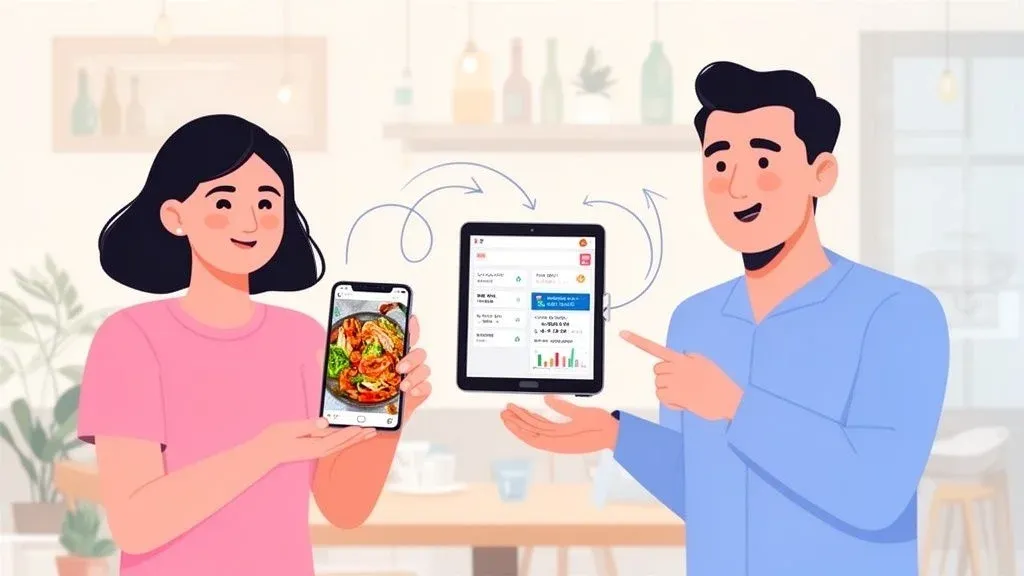
Let’s be honest, traditional restaurant ads are a shot in the dark. You’re spending money on flyers or radio spots hoping someone, somewhere, will notice. Food influencer marketing completely flips the script. In simple terms, it’s about partnering with trusted local creators whose followers actually listen to their recommendations. When done right, this drives real foot traffic and online orders.
Technically, this shifts your marketing from brand-led advertising to creator-led social proof, creating a direct line between authentic content and your bottom line. It’s no longer about you shouting about how great your food is; it’s about a respected foodie showing their audience why they love it.
Why Food Influencer Marketing Is Your New Growth Engine
At its heart, this approach is about authentic storytelling. People trust people, not ads. When a local food blogger shares a video of them digging into your signature pasta, it feels like a genuine recommendation from a friend.
This is a fundamental shift from brand-led advertising to creator-led social proof. And to make it work, you have to Unlock the Power of Influencer Marketing in a way that’s measurable. This isn’t about chasing vanity metrics like “likes”—it’s about building an efficient marketing channel that directly impacts your bottom line.
Connect Marketing Directly to Restaurant Operations and POS Integration
Here’s where the magic really happens: when you tie your influencer campaigns directly into your day-to-day restaurant operations.
Picture this: a local influencer with 10,000 followers posts a mouth-watering story about your brisket sandwich. They share a unique promo code for 15% off, good for orders on Uber Eats and DoorDash. Within minutes, your tablets start pinging with new orders.
Without the right setup, your front-of-house staff would be frantically punching each order into the POS by hand. On a busy Friday night? That’s a recipe for mistakes, chaos, and a direct hit to staff productivity.
This is exactly why POS integration is a non-negotiable. It’s a piece of food tech that automatically connects your delivery apps to your restaurant’s main computer (the Point of Sale). When synced, those influencer-driven orders flow straight to your kitchen printer without anyone lifting a finger, reducing errors and saving valuable time.
- No More Manual Entry: Orders from DoorDash or Uber Eats appear automatically in the POS.
- Fewer Mistakes: Automation gets rid of the typos and error reduction that come from re-keying orders. This saves you money on remakes.
- Happier Staff: Your team can focus on what they do best—making great food and serving customers—instead of wrestling with tablets, boosting staff productivity.
The Power of Authentic Engagement in Food Tech
The food and beverage world is one of the most effective spaces for influencer marketing, and the numbers back it up. Food content consistently hits an impressive 3% engagement rate, and research shows over 52% of consumers are likely to take action after seeing it.
For restaurants specifically, well-run campaigns with local creators can deliver an 8x return on investment and drive a 30% increase in reservations in as little as a week.
This high engagement becomes incredibly powerful when you can track it. For example, when a customer uses an influencer’s promo code on an order that syncs directly to your Clover or Square POS, you get clean, undeniable proof that your marketing dollars are working. You see exactly which post drove which sale, connecting your marketing spend directly to revenue.
Influencer Marketing vs. Traditional Ads for Restaurant Delivery
This table breaks down how influencer marketing stacks up against traditional ads, especially on the metrics that matter most to a restaurant’s success.
Benefit Food Influencer Marketing Traditional Advertising Credibility High (Authentic, peer-to-peer recommendation) Low (Brand-centric, often seen as biased) Targeting Hyper-local and interest-based Broad and untargeted (e.g., radio, print) Measurability Direct ROI tracking with promo codes & POS sync Difficult to measure direct sales impact Cost Flexible, can be as simple as a gifted meal High upfront costs, often with low returns Content User-generated content you can repurpose Static, one-time use assets
The contrast is clear. Influencer marketing gives you a targeted, credible, and measurable way to attract new customers.
Key Takeaway: Food influencer marketing isn’t just a one-off promotion. When integrated correctly with your POS, it becomes a core part of your restaurant operations, connecting marketing spend directly to sales and improving restaurant efficiency. By adopting these modern digital marketing strategies for restaurants, you stop guessing and start building a predictable revenue stream.
How To Find The Right Food Influencers for Your Restaurant
Let’s cut right to it. The biggest mistake restaurants make with food influencer marketing is getting star-struck by huge follower counts. Finding the right partner isn’t about chasing the biggest names; it’s about precision.
You need partners whose audience is full of your actual potential customers—the people living, working, and ordering takeout right in your delivery zone. The goal here is driving real foot traffic and online orders, not collecting empty “likes” from people thousands of miles away. The good news is that finding these hyper-local creators is simpler and more affordable than you might think.
Start Your Search with Location and Hashtags
Think of Instagram and TikTok as your own personal talent-scouting search engines. The trick is to get specific. Don’t just search for “foodie”; you need to combine location-based tags with keywords that match your menu.
Start by digging into your own city, neighborhood, or even well-known local landmarks. Then, tack on terms that scream “you.”
- Location-Based Searches: Try a mix of broad and specific tags, like
#[YourCity]Food,#[YourNeighborhood]Eats, or even#[FamousLocalLandmark]Foodie. - Cuisine-Specific Searches: Get even more targeted by combining your location with your food, like
#[YourCity]Pizza,#[YourNeighborhood]Tacos, or#[YourCity]Vegan. - Event-Based Searches: A great pro tip is to check out hashtags from recent food festivals or farmers’ markets. The people posting there are the active, engaged food lovers in your community.
This simple search strategy will quickly generate a solid list of potential collaborators who are already creating content in your backyard. As you refine your outreach, getting familiar with broader strategies for social media marketing for restaurants can give you an extra edge.
Vet Influencers for Quality, Not Just Follower Count
A huge follower count can be a vanity metric. What really moves the needle is audience trust and genuine engagement. You want a partner whose followers actually listen to them and act on their recommendations. This is where smaller, more niche creators really shine.
The data backs this up. Brands are moving away from mega-influencers because they’ve realized smaller creators often deliver a much better return. By 2026, it’s expected that 73% of brands will prefer working with micro and mid-tier influencers for exactly this reason. And with nano-influencers (under 10k followers) making up over 75% of all Instagram creators, their tight-knit communities give them the highest engagement rates in the game.
Actionable Tip: Don’t just look at the number of comments; read them. Are they generic junk like “Nice pic!” or are they real questions like, “Where is this place?!” or “OMG, I have to try that!”? That’s your sign of a real, engaged local audience.
Be on the lookout for red flags—a high follower count with barely any likes or comments is a major one. Authentic influencers foster real communities, and that’s who you want on your team. This focus on authenticity should be a core part of any solid marketing plan for your restaurant.
The Efficiency Payoff: How Local Partners Impact Restaurant Operations
Here’s where it all connects back to your bottom line and daily restaurant operations. When a local creator with a genuinely engaged audience promotes your special, the people seeing it are the ones who can actually place an order for restaurant delivery or walk through your door.
For example, imagine a local foodie with 5,000 real followers posts about your new brunch special using a unique promo code on Uber Eats. Because your delivery apps are synced with your food tech stack—say, a Clover or Square POS system—you’ll see those orders pop up instantly. No more manual entry errors for your staff, just clean data showing you exactly which partnerships are driving sales and a measurable time saving for your front-of-house team.
Your Next Step: Before you do anything else, open up Instagram and start a list of 5-10 local micro-influencers (under 20,000 followers) who are already posting about food in your area. This simple research is the foundation of a low-cost, high-impact food influencer marketing campaign that actually works.
How to Launch a Professional Food Influencer Campaign
You’ve done the research and have a solid list of potential influencers. Fantastic. Now comes the part where many restaurants stumble: turning that list into a real, order-driving campaign. This is where the rubber meets the road, but don’t worry. With a clear playbook, you can launch a professional collaboration that saves you headaches and protects your business.
Let’s get this campaign off the ground.
Making the First Move: How to Craft Your Outreach
Your first email or message sets the entire tone. A generic “Hey, wanna collab?” DM just won’t cut it. To stand out and be taken seriously, your outreach needs to be personal and professional.
Start by showing you’ve actually paid attention. Don’t just say, “I like your feed.” Get specific. Mentioning a recent post—“We loved your review of [Another Local Restaurant]” or “Your reel on the [Local Food Event] was fantastic”—proves you’ve done your homework and aren’t just blasting a template to a hundred people.
Here’s a simple, non-robotic template you can adapt:
Subject: Collaboration Idea: [Your Restaurant Name] x @[Influencer’s Handle]
Hi [Influencer’s Name],
My name is [Your Name], and I’m the owner of [Your Restaurant Name] over in [Your Neighborhood]. I’ve been following your page for a while and was seriously impressed with your post about [mention a specific post you genuinely liked].
We’re about to launch a new [dish/menu/special], and I immediately thought your audience would love it. We’d like to invite you in for a complimentary meal for yourself and a guest to try it out and share your honest thoughts with your followers.
If this sounds like something you’d be interested in, just let me know, and we can chat through the details.
Best,
[Your Name] [Your Restaurant Name] [Link to your website or Instagram]
This approach is direct, respectful, and opens the door for a real conversation about expectations and compensation. For more creative ways to get noticed, you can always explore other restaurant marketing ideas.
Setting Clear Expectations with a Campaign Brief
Once they say yes, the next step is crucial: the campaign brief. Think of this as your single source of truth for the entire project. It’s not a stuffy legal document; it’s a simple outline that ensures everyone is on the same page and prevents those “I thought you meant…” moments later on. A clear, one-page guide is all you need.
Before you start writing, think through every detail. The table below covers the essential elements you should include in every brief. Using this as a checklist will help you avoid misunderstandings and set your campaign up for success right from the start.
Essential Elements of an Influencer Campaign Brief
Use this checklist to ensure you cover every important detail when briefing an influencer, setting your campaign up for success from the start.
Category Key Details to Include Campaign Goal Are you promoting a new menu item, driving restaurant delivery orders, or increasing foot traffic for brunch? Be specific. Deliverables How many posts? (e.g., 1 Instagram Reel, 3 Stories). What format? (e.g., video, carousel). Key Messages Mention the new dish name, a special offer, or your unique story. Mandatory Elements Your Instagram handle (@YourRestaurant), location tag, and any specific hashtags. Compensation Is it a complimentary meal, a flat fee, or both? Be upfront. Timeline When should they visit? When should the content be posted?
Having a solid brief like this isn’t just good practice; it’s how pros operate. The global market is projected to hit a staggering $32.55 billion in 2026. With 80% of brands either maintaining or increasing their spend, the days of casual, unstructured collaborations are fading fast. A brief ensures your campaign is professional from the start.
Navigating Contracts and FTC Guidelines
Don’t let the word “contract” scare you. For most gifted meal collaborations, a simple, one-page agreement is plenty. It just formalizes what you both agreed to in the campaign brief—the deliverables, timeline, and compensation. It’s your safety net.
What’s completely non-negotiable, however, are the FTC guidelines. Any post that results from a paid or gifted partnership must be disclosed as an ad. This is a legal requirement that protects you, the influencer, and the audience.
- Required Disclosures: The influencer has to make it obvious that the post is an advertisement. The easiest ways are with hashtags like #ad, #sponsored, or a tag like #[YourBrand]Partner.
- Placement Matters: The disclosure can’t be buried. On Instagram, it needs to be “above the fold”—visible in the first few lines of the caption without the user having to click “see more.”
Following these rules isn’t just about avoiding legal trouble. It’s about being transparent, which builds trust with potential customers and strengthens your restaurant’s reputation.
Your Next Step: Take that outreach template and send it to one of the local influencers on your list. The goal right now is simply to start a conversation and turn all this planning into action. Go for it.
How to Measure Real ROI with POS Integration
A successful food influencer campaign doesn’t stop once the post goes live. Honestly, that’s just the starting line. The real challenge is turning those gorgeous food photos and engaging videos into actual profit. It’s time to look past vanity metrics like ‘likes’ and ‘views’ and dial in on what really matters: your return on investment (ROI).
This is where your restaurant’s tech stack becomes your most valuable marketing tool. By creating a smart link between your promotions and your POS integration, you can see exactly which partnerships are driving sales. It’s all about closing the loop from a social media post to a paid order.
Each part of this—from your first outreach message to the final contract—lays the groundwork for a professional, measurable collaboration. When you follow a structured approach like this, you aren’t just crossing your fingers and hoping for results; you’re building a system to create them.
Promo Codes: The Simplest Way to Track ROI
The single most powerful tool for measuring an influencer’s impact is a unique promo code. It’s a simple idea with huge payoffs. You give each influencer a distinct code—say, “FOODIE15” for one and “EATS20” for another—to share with their followers. This lets you trace every single sale back to the person who drove it.
Let’s walk through a real-world example. Imagine you’re partnering with a local food blogger to push your new happy hour menu on DoorDash and Uber Eats. You create a code just for them: “TASTYHOUR10”. When their followers use that code at checkout, you know without a doubt that the order came from that specific campaign.
This simple action changes your marketing from a guessing game into a data-driven strategy. You’re no longer wondering if a post “worked.” You’re seeing precisely how many orders it generated. This is the first step toward building a truly integrated POS system that does the heavy lifting for you.
Why POS Integration Is the Engine of Your Restaurant Operations
Creating the codes is only half the job. The real magic happens with POS integration. Without it, your team is stuck manually punching in codes and trying to track sales on paper. That’s a recipe for mistakes and wasted time, especially during a busy service.
But when your delivery apps are connected directly to your POS, the whole process runs on autopilot.
- An order using the “TASTYHOUR10” code comes in from Uber Eats.
- It flows straight into your Square or Clover POS.
- The sale is automatically recorded and tagged to that influencer’s campaign.
This automated workflow gives you a clean, accurate, real-time picture of how your campaigns are performing. No more clipboards, messy spreadsheets, or asking customers, “So, how did you hear about us?” The data is right there in your sales report, offering huge cost and time savings.
Key Takeaway: Integrating your delivery apps with your POS does more than just clean up your kitchen workflow. It transforms your POS into a powerful marketing analytics machine, bridging the gap between what you spend on marketing and the revenue you see each day, directly boosting restaurant efficiency.
Calculating ROI and Boosting Staff Productivity
With this data right at your fingertips, figuring out the ROI from your food influencer marketing becomes simple math. The basic formula is:
(Revenue from Influencer Code - Campaign Cost) / Campaign Cost
Let’s break it down with our happy hour example:
- Revenue from Influencer Code: Your POS report shows that the “TASTYHOUR10” code brought in $1,500 in sales.
- Campaign Cost: This includes the influencer’s fee and the cost of their meal. If you paid them $200 and the gifted meal cost you $50, your total investment is $250.
Now, run the numbers: ($1,500 - $250) / $250 = 5.
That means for every $1 you spent on this campaign, you made $5 back. That’s a 500% ROI.
This kind of clarity is a game-changer. It gives you the confidence to double down on partnerships that work and cut ties with those that don’t. On top of that, the efficiency boost is massive. By automating order entry and tracking, you reduce costly errors and give your staff their time back. Instead of juggling tablets, they can focus on what matters: great customer service and getting orders right, which directly improves staff productivity.
To learn more about how to set up a seamlessly connected restaurant, check out our detailed guide on the benefits of an integrated POS system.
Optimizing Future Campaigns With POS Integration
So, you ran the campaign, the promo codes went live, and you saw a nice bump in orders. What comes next? This is where most restaurants drop the ball, but it’s also where the real money is made. The secret to a killer food influencer marketing program isn’t just running a single campaign; it’s turning the data you just collected into a smarter plan for the next one.
When your sales data syncs directly with your POS, the guessing games are over. You have cold, hard numbers telling you exactly which influencer partnerships are actually putting money in your pocket. This is that “aha!” moment where your investment in food tech stops feeling like an expense and starts acting like a predictable growth engine.
Use POS Data to Find Your Most Valuable Influencers (MVIs)
Think of your POS sales report as your new marketing playbook. Forget trying to gauge success by scrolling through Instagram to count likes. Now, you can just pull up a report and see precisely how much revenue each influencer’s unique promo code generated. The numbers don’t lie, and they’ll point you straight to your top performers.
For instance, your report might show that Influencer A’s code drove $1,200 in sales, while Influencer B—who you might have thought was a sure thing—only brought in $300. The path forward is crystal clear. Influencer A has an audience that’s not just looking, they’re buying. That insight is gold, letting you focus your budget where you’ll see the biggest return and improve the financial health of your restaurant operations.
Look for clues in the data:
- Sales Volume: Which codes were used the most? This shows you reach.
- Average Order Value (AOV): Did one influencer’s followers spend more per order? This shows you the quality of the customer.
- Peak Order Times: Did a post drive a rush during a typically slow Tuesday afternoon? That’s a huge win for smoothing out your sales week.
This is what it looks like when an integration tool like OrderOut connects all your delivery apps to a central POS like Square.
With this kind of setup, every single sale from an influencer campaign is automatically captured. You get clean, actionable data without lifting a finger, saving time and preventing manual tracking errors.
Double Down on Your Winners for Long-Term Growth
Once you’ve identified your star players, it’s time to build a real relationship. A one-off post is great, but a long-term partnership with a proven influencer creates the kind of steady buzz that keeps your restaurant top-of-mind with their audience for months.
Actionable Tip: Don’t just send a thank-you note to a high-performing influencer. Re-engage them immediately. Offer a multi-month collaboration or make them an official brand ambassador. You’re turning a one-time win into a reliable marketing channel.
Look at what made the first campaign work and do more of it. If a reel of your epic cheesy pizza went viral, collaborate with that same influencer on a “behind the scenes” look at how you make it. If a giveaway contest generated tons of comments, plan a bigger one for next quarter. Using data from your POS integration takes the guesswork out of these decisions. To get a better handle on the tech itself, you can learn more about how POS integration software works across your entire business.
This data-driven focus also tells you what didn’t work, which is just as valuable. If an influencer’s campaign brought in zero code redemptions, you now know not to invest there again. It saves you money and helps you sharpen your criteria for who you partner with next. This continuous cycle—test, measure, optimize—is how you truly master food influencer marketing and stop wasting your budget.
Your Practical Next Step: Log into your POS system right now and pull the sales data from your last influencer promo code. Find your top performer and draft an email proposing a three-month partnership to promote your upcoming seasonal menu.
Your Next Step: From Buzz to Bottom Line
Alright, let’s put a bow on this. After all the planning and outreach, what really separates a successful food influencer marketing campaign from one that just generates a few nice photos? It boils down to one thing: connecting the dots between a social media post and your cash register.
The real game-changer isn’t just finding great local partners; it’s being able to track their impact directly through your POS system. This is where the magic happens, turning “buzz” into actual, measurable revenue.
The key is embracing the food tech that closes that loop. Your very next move should be integrating your marketing efforts with your daily operations. For example, finding an integration app on the Clover app market is as simple as adding any other tool to your workflow.
This isn’t just about better marketing reports. This kind of POS integration fundamentally improves your restaurant’s efficiency. You stop guessing which campaigns are working and start making decisions based on hard data.
When you build a smarter marketing engine for your restaurant, you’re not just selling more food. You’re saving time, cutting down on mistakes, and freeing yourself up to focus on what you love—crafting an incredible dining experience. It’s about creating a predictable, profitable system for growth.
Why wait? You can start onboarding for Free in a few clicks at https://dashboard.orderout.co.
Common Questions About Food Influencer Marketing
Getting into food influencer marketing for the first time? It’s natural to have questions. Let’s walk through some of the most common ones I hear from restaurant owners, so you can get started with confidence.
How Much Do I Really Need to Budget for My First Campaign?
Honestly, you don’t need a huge budget to get started. The smartest way to dip your toes in the water is with a micro-influencer campaign, which can be incredibly cost-effective.
Instead of thinking about big upfront payments, your initial investment can be as simple as a complimentary meal for the influencer and a plus-one. This is a low-risk way to test the waters, see how the process works, and start building those crucial relationships. Once you see a positive return, you can then make an informed decision to scale up to paid collaborations.
What Kind of Results Can I Expect From a Single Post?
While there’s no magic number, a single, well-crafted post from a good local micro-influencer can definitely move the needle. You’ll often see a tangible bump in online orders or foot traffic, especially if you give them a unique promo code to share for your restaurant delivery platforms like Uber Eats or DoorDash.
Here’s what really matters: The goal of that first post isn’t just a quick sales spike. It’s about setting a benchmark. Track the immediate social media buzz, but more importantly, watch those promo code redemptions in your POS. This gives you a clear performance baseline to measure all future campaigns against, turning your marketing from a guessing game into a predictable growth engine.
Do I Always Have to Pay Influencers a Fee?
Not at all, especially when you’re working with smaller creators. Many local micro-influencers are genuinely excited to partner with restaurants in exchange for a great dining experience. This is often called a “contra” or “in-kind” collaboration.
However, as you move toward working with more established influencers or have bigger asks—like a multi-post campaign or a professionally shot video—a fee becomes standard. Sometimes it’s a flat fee, other times it’s a hybrid model (meal plus a smaller fee). The key is to be transparent and lock in all the compensation details before anything goes live. This simple step builds a professional, lasting partnership and keeps your restaurant operations running smoothly.
Ready to build a smarter, data-driven marketing engine for your restaurant? You can start onboarding for Free in just a few clicks at https://dashboard.orderout.co.