
What Is the True Food Handler Certification Cost in 2026?
· Thibault Le Conte
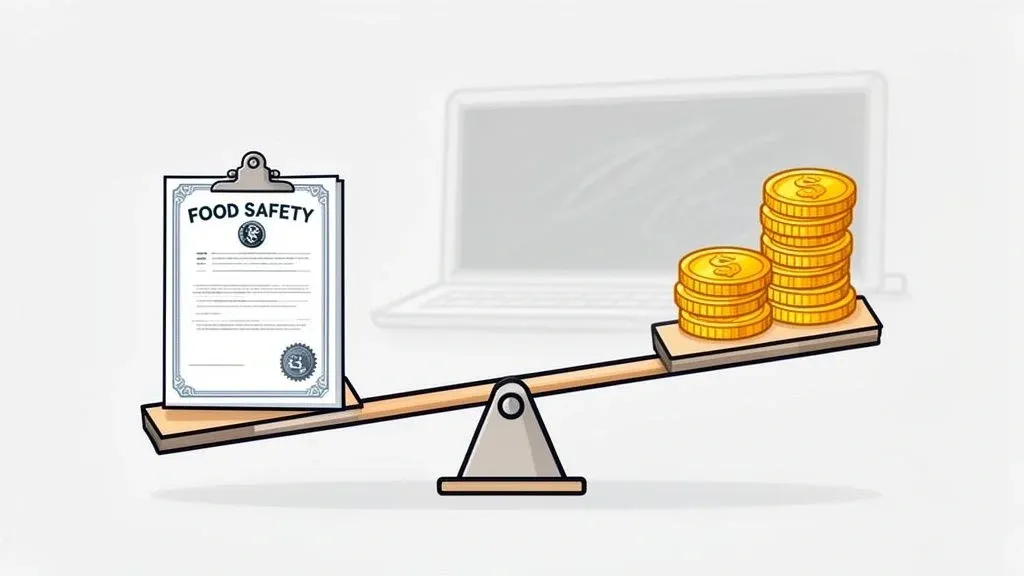
When you’re running a restaurant, every dollar counts. You budget for ingredients, labor, and marketing, but what about the food handler certification cost? This isn’t just a minor administrative fee; it’s a critical investment in your restaurant’s safety and efficiency. In simple terms, this is the price you pay for legally required food safety training. The technical cost can range from $10 for a basic online course to over $200 for a manager-level exam.
Why it matters for your restaurant: A well-trained team is your first line of defense against foodborne illness, customer complaints, and costly food waste. For restaurant owners and managers, this isn’t just about compliance; it’s about protecting your profits. A single food handling mistake during a busy dinner rush—whether for an in-house guest or a delivery order from an app like Uber Eats—can lead to negative reviews, health code violations, and lost revenue. Integrating proper training with your restaurant’s technology, like your POS system, ensures that efficiency doesn’t come at the expense of safety.
Comparing Certification Levels and Costs
The price you’ll pay for certification isn’t one-size-fits-all. It depends on who on your team is getting certified. A frontline cook needs different training than the kitchen manager overseeing your entire food safety program.
Here’s a simple breakdown of the common tiers:
- Food Handler Card: This is the basic certification for any employee who handles food. It covers essentials like personal hygiene, time and temperature control, and preventing cross-contamination. These courses are typically affordable and easy to find online.
- Food Protection Manager Certification: This is a more advanced certification for supervisors, chefs, and managers. The training is more in-depth, covering technical topics like Hazard Analysis Critical Control Point (HACCP) principles, risk management, and how to train your own staff. The cost is higher to reflect this greater responsibility.
- Facility Audits: Beyond individual certifications, you can opt for comprehensive facility-wide assessments. These are deep dives into your entire operation, from receiving to serving, ensuring your processes meet high safety standards.
This chart gives you a clearer picture of how these costs stack up.
As you can see, the investment grows significantly with the level of responsibility. This is why budgeting ahead is so important for your restaurant’s financial health. To see how these expenses fit into your overall budget, it’s a good practice to review a detailed restaurant income statement example.
H2: Why Certification Is Your Secret Weapon for Restaurant Efficiency
Food safety certification is much more than a piece of paper for the health inspector. For a modern restaurant owner, it’s a tool for operational excellence. In simple terms, a trained team makes fewer mistakes. The technical result is a reduction in food waste, fewer order errors, and stronger customer trust—all of which directly impact your profitability. Viewing the food handler certification cost as an investment rather than an expense is a mindset shift that can give your restaurant a genuine competitive advantage.
H3: Tying Compliance to Restaurant Operations and POS Integration
In a busy kitchen, every detail matters. A certified employee doesn’t just memorize rules; they understand why those rules exist. They know that proper holding temperatures aren’t just arbitrary numbers—they are the critical barrier protecting a customer from getting sick. This proactive mindset is essential when juggling a high volume of orders, especially from delivery platforms.
Here’s a real-world example: A complex order comes in from DoorDash and is instantly sent to your kitchen via an integration with your Square POS. A certified food handler ensures every component is prepped, held, and packaged correctly, preserving both food safety and quality. This reduces the chance of errors that lead to food waste or customer complaints, protecting the revenue from that order. This focus on error reduction and staff productivity is a cornerstone of a well-run operation.
H3: Protecting Profits with Training and Food Tech
Modern restaurants thrive on the synergy between trained staff and smart technology. While a Clover or Square POS integrated with delivery apps boosts efficiency, that tech is only as good as the people operating it. A competent, certified staff ensures that the speed gained from technology isn’t lost fixing preventable mistakes.
A well-trained team is the human interface for your restaurant’s technology. They guarantee that the speed you gain from POS integration isn’t wasted on fixing mistakes, throwing out food, or redoing orders.
This partnership between people and tech creates a powerful cycle for growth:
- Error Reduction: Certified staff make fewer mistakes, directly reducing food waste costs.
- Staff Productivity: When your team isn’t constantly putting out fires, they can handle more orders, increasing throughput during peak hours.
- Cost & Time Savings: Fewer remakes and complaints save both ingredients and labor time, directly benefiting your bottom line.
The market for food certification is projected to grow from USD 12.2 billion in 2025 to USD 32.8 billion by 2035, a clear sign that the industry is prioritizing safety. You can discover more insights about food certification market growth to understand the trend.
Actionable Takeaway: See your food handler certification cost as a direct investment in operational excellence. A well-trained team, combined with efficient food tech like POS integration, builds a culture that protects your brand, reduces waste, and boosts profitability. This solid foundation is what allows you to get the most out of your investments in restaurant delivery and technology. For a deeper look, check out our guide on restaurant operating procedures.
H2: Understanding Certification Types for Better Restaurant Operations
To control your food handler certification cost, you have to know what you’re paying for. In simple terms, there are different levels of certification for different roles in your kitchen. Understanding these distinctions is key to creating a training plan that’s both compliant and cost-effective, preventing you from overspending.
The Basic Credential: Food Handler Cards
The most common certification is the basic Food Handler Card. This is for all frontline employees—cooks, servers, and bussers who directly touch food. The training covers the essentials: proper handwashing, avoiding cross-contamination, and basic time and temperature safety. These courses are designed to be fast and affordable, with most online options costing between $10 and $25.
The Leadership Credential: Food Protection Manager Certification
A step up is the Food Protection Manager Certification. This is for your leaders: managers, supervisors, and head chefs. In most jurisdictions, you’re legally required to have at least one person with this certification on-site. The technical training is much deeper, covering the development of a Hazard Analysis and Critical Control Points (HACCP) plan, food allergen management, and staff training protocols. The cost reflects this, usually running between $150 and $200, and includes a proctored exam.
Advanced and System-Wide Certifications
Beyond individual credentials are more specialized, facility-wide certifications like HACCP certification. This certifies your entire operational process, not just one person. It involves a deep analysis of your workflow to identify and control potential food safety hazards. While not always mandatory, it’s a best practice that signals a serious commitment to safety. For a wider view on compliance, this small business compliance checklist for 2026 is an excellent resource.
Why This Matters for Your Restaurant: Understanding these tiers helps you spend smarter. Your cashier likely only needs a basic food handler card, but the chef overseeing a flood of orders from your Square POS absolutely needs manager-level certification. By matching the right training to the right role, you prevent overspending and equip your team with the knowledge they need. This targeted approach turns a required expense into an investment in quality and safety. For more, see our guide on effective food service management.
H2: What Drives Your Food Handler Certification Cost?
The advertised price of a food handler course is rarely the full story. In simple terms, several factors can change the final price. Understanding these variables allows you to budget more effectively and make smart investments that free up cash for other critical parts of your business, like improving your restaurant delivery services.
Your Biggest Cost Factor: Geography
The number one factor affecting your cost is your location. Food handler training rules vary wildly between states, counties, and even cities. One county might accept a $10 online course, while the one next door could require a $50 in-person class.
Actionable Insight: Your first step should always be to call your local health department. They are the final authority on requirements and approved providers. This simple call saves you from wasting money on a non-compliant certification and is a crucial step for smooth restaurant operations.
Online vs. In-Person Training: A Trade-Off
Next, decide on the training format. Online courses are almost always the cheapest and most flexible option, minimizing disruption to your staff’s schedule. In-person classes cost more but offer hands-on learning and direct access to an expert, which can be valuable for new managers. Weigh the cost savings of online training against the practical benefits for your team.
The Real Game-Changer: Bulk Discounts
The most powerful tip for any restaurant manager looking to control their food handler certification cost is to buy in bulk. Most providers offer significant discounts when you purchase certifications for your whole team at once, often reducing the per-employee cost by 30% or more.
Buying in bulk shifts certification from a reactive expense to a planned, cost-effective investment. You get the same accredited training for a fraction of the price.
Real-World Example: Imagine your busy cafe uses a Square or Clover POS. Instead of paying $15 each for 20 employees ($300 total), a bulk deal might drop the price to $10 per person. That’s an instant $100 in savings—a direct cost saving that you can reinvest into marketing or new food tech. This strategy is especially effective for managing staff productivity and turnover, as you can onboard new hires quickly and compliantly. This financial tactic pairs well with other cost-control measures, like learning how to calculate food cost percent to maximize margins.
H2: Cut Certification Costs & Invest in Restaurant Efficiency and POS Integration
Paying for food handler certifications can feel like a chore. But what if you could turn this mandatory expense into an opportunity? By being smart about how you manage this cost, you can free up real money to invest in technology that makes your restaurant run smoother and more profitably. The goal is to transform a line item on your expense sheet into a strategic advantage that enhances restaurant efficiency.
Find Low-Cost and State-Approved Online Providers
The quickest win is online training. Reputable online providers offer the same state-approved and ANSI-accredited certifications as in-person classes for a fraction of the price, often $10 to $15 per employee.
Actionable Insight: Before purchasing, verify that the provider is approved by your specific local health department. A quick check on their website prevents you from buying a useless certificate.
Use Bulk Discounts to Train Your Entire Staff
Instead of paying for certifications one by one, buy them in bulk. Most online providers offer discounts of 20-30% or more for block purchases. This creates a “bank” of certifications, making onboarding new hires faster and turning an unpredictable expense into a manageable part of your budget, boosting staff productivity.
Create a Simple System for Tracking Renewals
An expired certification can lead to heavy fines. A simple spreadsheet is all you need to track employee names, certification dates, and expiration dates. Set a reminder for 60 days before expiration. This simple organizational tool is a massive risk-management win, similar to the logic behind automation in restaurants, where simple systems eliminate manual errors.
H3: Reinvest Savings into Food Tech and POS Integration
Here’s where it all comes together. The savings from smart certification management—which can be hundreds or even thousands of dollars a year—can be funneled directly into technology that delivers a real return. Industry research shows that certified kitchens see 15-20% higher customer retention on delivery apps. The full research on food safety audit services paints a clear picture.
The hundreds of dollars saved by choosing a cost-effective certification plan could fund a full year of a service that automates order entry from Uber Eats and DoorDash.
Real-World Example: Imagine a chaotic Friday night. Instead of an employee manually punching a delivery order into your Clover or Square POS, an integration tool does it instantly with zero errors. This is a direct time saving and error reduction. The money saved on certification fees can directly fund the food tech that makes this happen. This creates a powerful growth loop: compliance savings fund POS integration, which boosts profitability, making future operational costs easier to handle.
Practical Next Step: Ready to take the next step in optimizing your restaurant? You can start onboarding for Free in a few clicks and connect your delivery platforms to your POS.
Your Next Steps to Maximize Certification ROI
Let’s shift from theory to action. It’s time to stop looking at your food handler certification cost as just another expense and start treating it as a strategic investment in your restaurant operations.
Actionable Insight: Your first move is to audit your team’s current certifications. Create a simple spreadsheet listing each employee, their certification type, and its expiration date. This gives you a clear picture of where you stand and allows you to get ahead of renewals by researching bulk pricing from accredited providers. This simple step prevents last-minute scrambles and ensures you’re not overpaying.
The goal is to create a cycle where compliance savings fund efficiency tools, and those tools boost profitability, making future operational costs easier to manage. This is how you build a more resilient and competitive business.
Connecting Compliance Costs to Food Tech ROI
Here’s a perfect, real-world example of this in action. Imagine taking the money you saved on bulk training and investing it in POS integration technology that links your delivery apps directly with your point-of-sale system. Instead of a staff member manually punching every order from Uber Eats into your Clover or Square POS, automation takes over.
The result is a direct impact on your restaurant’s efficiency. You see immediate time savings for your staff, a sharp reduction in costly order entry errors, and improved staff productivity. The savings on certification fees can directly fund the food tech that drives this efficiency, improving both morale and your profit margins.
Clear Takeaway: By managing certification costs strategically, you can fund technology that directly improves your restaurant’s delivery efficiency and profitability. You can get started right now when you start onboarding for Free in a few clicks.
Frequently Asked Questions
Here are quick, straightforward answers to common questions from restaurant owners about food handler certification costs.
How Often Do Food Handler Certifications Need Renewal?
Generally, a basic food handler card is valid for two to three years. In contrast, a Food Protection Manager certification typically lasts five years. However, these are just general rules; you should always confirm the specifics with your local health department.
Actionable Insight: Use a simple spreadsheet to track expiration dates for your team. Set a calendar reminder 60 days out. This prevents fines and disruptions to your restaurant operations.
Should My Restaurant Pay for Employee Certifications?
Yes. While some states allow employees to pay, smart owners cover the cost. Paying for training shows you are invested in your team and in safety.
Why it matters for your restaurant: Covering the cost gives you control and access to bulk discounts, which lowers your total food handler certification cost. This is a simple way to achieve cost savings and improve staff productivity by streamlining the certification process.
Are Online Food Handler Courses Valid?
Yes, they are valid, but with one critical condition: the course must be accredited. The gold standard for accreditation in the U.S. is the ANAB (ANSI National Accreditation Board).
Actionable Insight: Before purchasing, double-check that your local health department approves the specific online provider. A legitimate online course offers the same certification as an in-person class but with more flexibility and a lower cost—a big win for any busy restaurant.
What Is the Difference Between a Food Handler and a Food Manager?
In simple terms, think of it as the difference between a player and a coach. A Food Handler Card is for frontline crew (cooks, servers) and covers day-to-day safety rules. A Food Manager Certification is for your leaders (supervisors, chefs) and is much more in-depth. The technical training for managers covers creating safety systems (like HACCP), staff training, and crisis management. Most health codes require a certified manager on-site, and the higher cost reflects that responsibility. Getting this distinction right is key for both compliance and budgeting.
At OrderOut, we believe smart, simple operations are the foundation of a profitable restaurant. It all starts with streamlining your delivery process and getting rid of manual order entry for good.