
Food Delivery Management Software: A Guide to Restaurant Efficiency
· Thibault Le Conte
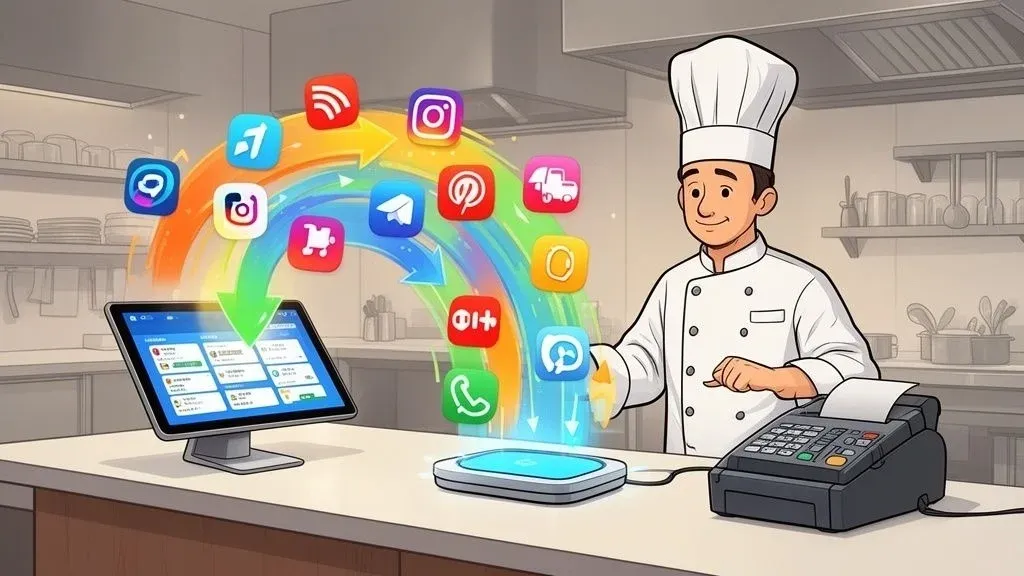
Let’s be honest, managing food delivery can feel like controlled chaos. You know you need to be on apps like DoorDash and Uber Eats, but juggling them all is a different story. In simple terms, food delivery management software is a tool that gathers all your online orders from different platforms and funnels them into one place: your restaurant’s Point of Sale (POS) system.
Why it matters: This technology eliminates the need for your staff to manually re-enter every order from a dozen different tablets. This one change saves time, cuts down on costly order mistakes, and lets your team focus on cooking great food and serving customers, directly improving your restaurant’s efficiency and profitability.
Taming the Chaos of Modern Restaurant Delivery
If you’ve ever seen a counter cluttered with tablets, each one chirping with a unique alert for a new order, you know the “tablet farm.” It’s a scene straight out of a restaurant operator’s nightmare.
This setup forces your team into a frantic scramble. They have to stop serving dine-in customers or packing orders to become data-entry clerks. They manually re-type every single delivery order into the POS, and every keystroke is a chance for a mistake. For example, a simple typo can turn a “no cheese” request into an extra-cheese burger, leading to wasted food and an unhappy customer who probably won’t order again. This directly impacts your bottom line through food costs and lost repeat business.
The Real Cost of a Fragmented Restaurant Delivery System
This isn’t just a minor annoyance; it’s a constant drag on your restaurant’s health. The “tablet farm” quietly drains your resources and creates problems that ripple through your entire operation:
- Order Errors Pile Up: When you’re manually re-entering orders, mistakes are inevitable. A missed modifier or the wrong side dish can torpedo a customer’s experience, leading to costly remakes and negative reviews.
- Staff Productivity Plummets: Every moment your team spends wrestling with tablets is a moment they’re not focused on your food and your guests. During a dinner rush, this inefficiency can bring your service to a crawl, affecting both dine-in and delivery customers.
- Kitchen Tickets Get Delayed: The lag time between an order hitting a tablet and actually reaching the kitchen printer adds precious minutes to prep time. This means longer waits for drivers and, ultimately, lukewarm food for your customers.
This operational bottleneck isn’t just a headache—it’s a direct threat to your profitability. The accumulated cost of errors, wasted food, and lost staff productivity chips away at the already thin margins of restaurant delivery.
How POS Integration Boosts Restaurant Operations
This is exactly where food delivery management software steps in. Think of it as the ultimate peacemaker for your delivery channels. Instead of juggling multiple tablets, this software acts as a central hub that connects directly to your restaurant’s POS system.
Technically, it uses APIs (Application Programming Interfaces) to create a direct line of communication between delivery platforms like Grubhub and your POS. When an order comes in, it doesn’t just ping a tablet; it flows automatically into your POS and shoots right to the kitchen printer, just like an order from a server on the floor. This automated workflow builds a more organized system of delivery. Your team can finally stop playing whack-a-mole with tablets and get back to running the restaurant, turning a chaotic mess into a smooth, efficient, and much more profitable operation.
Ready to stop juggling tablets and start managing your delivery operations efficiently? Get started for free on our dashboard in just a few clicks.
How Food Delivery Management Software Works with Your POS
At its heart, food delivery management software is the central hub connecting all the spokes of your delivery operation. In non-technical terms, it acts as a bridge between the separate islands of your delivery partners—like DoorDash, Uber Eats, and Grubhub—and the mainland of your restaurant: your Point of Sale (POS) system.
Imagine it’s a universal translator for your orders. Without it, a staff member has to listen to the “DoorDash language” from one tablet, then manually translate and punch it into your POS. This software does that work automatically and instantly, converting every order into a language your POS understands and shooting it straight to the kitchen. No more manual entry.
Why it matters: This one simple change solves one of the biggest headaches in a modern restaurant. It frees your staff from being chained to a counter cluttered with tablets, reducing errors and saving significant labor time, which can then be reinvested into improving the guest experience.
Say Goodbye to the Tablet Farm and Boost Staff Productivity
The most immediate thing you’ll notice is the consolidation of orders. Instead of having five different tablets dinging, chirping, and demanding attention, all your orders flow into a single, organized stream within your POS.
This means your team can finally manage every single delivery service through one screen. The “tablet farm” is gone. That frees up precious counter space, but more importantly, it gives you back your staff’s time and focus, boosting productivity.
With a single flow of information, nothing slips through the cracks. An order from Uber Eats gets the same priority and accuracy as an order from a customer at your counter because it follows the exact same path to your kitchen. A real-world example is when a restaurant using a Square POS integrates with management software. An Uber Eats order appears on the Square terminal just like an in-house order, eliminating any special or manual steps for staff.
Keep Your Menus in Sync with Smart Food Tech
Manually updating menus across a half-dozen delivery apps is a recipe for disaster. If you 86 an item, you have to scramble to log into each platform to pull it before a hungry customer orders something you can’t make. This is where menu synchronization becomes a total game-changer.
With the right food tech, you only have to make a change once in your central system.
- Update an Item: Tweak the price of your signature burger.
- Remove an Item: Mark the daily fish special as sold out for the night.
- Add a Special: Roll out a new limited-time dessert for the weekend.
Technically, the software pushes these updates via API to all your connected delivery partners simultaneously. This guarantees customers always see the right menu, which dramatically cuts down on order errors, cancellations, and staff frustration. As you dig deeper into how to handle a change order integration, you’ll realize just how crucial this unified control really is for efficient restaurant operations.
This isn’t just a nice-to-have anymore; it’s a necessity. Recent research shows that 95% of restaurants are using digital ordering platforms, and those orders now make up 25% of their total revenue. It’s a trend pushing the Food Service Distribution Software market toward a projected $10.02 billion by 2034. You can read the full market forecast to see just how fast this part of the industry is growing.
Ready to take control of your restaurant delivery operations? You can get started for free on our dashboard in just a few clicks.
Core Features That Drive Restaurant Efficiency
Knowing what food delivery management software is supposed to do is one thing. Seeing how its features actually create a calmer, more profitable restaurant is another. These platforms are built with actionable features designed to solve the biggest headaches in modern restaurant operations.
Let’s break down the capabilities that will make the most significant difference to your bottom line and your team’s sanity.
Automated POS Integration for Flawless Restaurant Delivery
If there’s one feature that’s an absolute must-have, it’s automated POS integration. In simple terms, it’s the bridge that connects your delivery apps directly to your kitchen.
Without it, your staff is stuck manually typing every single order from a delivery tablet into your Point of Sale (POS) system. It’s tedious, slow, and a recipe for costly mistakes. With automation, an order from DoorDash or Uber Eats flows straight into your POS and fires to the kitchen, exactly like an in-house order. For instance, with an integration for a Clover POS, an online order appears on the Clover screen and prints to the kitchen automatically, eliminating manual entry.
Why it matters: This automation gives your team precious time back to focus on food quality and customer service, while simultaneously eliminating errors that lead to food waste and lost revenue.
Manual Entry vs Automated POS Integration
Operational Task Manual Process Without Software Automated Process With Software Order Entry Staff manually types each order from a tablet into the POS, one by one. Orders from all apps automatically appear in the POS and print in the kitchen. Error Handling High risk of typos, missed modifiers, and incorrect items, leading to remakes. 100% order accuracy. What the customer orders is what the kitchen sees. Reconciliation At the end of the day, someone has to manually match delivery app sales to POS reports. All sales are auto-reconciled within the POS, giving you a single, accurate report. Menu Changes Staff must log into each app individually to 86 an item or change a price. Update once in the central dashboard, and it syncs across all connected apps instantly.
As the table shows, automation doesn’t just save a few minutes; it fundamentally streamlines your workflow, freeing up staff and eliminating costly friction points.
Centralized Order Management and Restaurant Operations
Next up is the centralized order management dashboard. This is the feature that finally kills the infamous “tablet farm” cluttering your counter. Instead of juggling a half-dozen devices, all your orders are funneled into one clean, organized screen within your POS.
From this single command center, your team can see and manage everything:
- New incoming orders from every single delivery partner.
- The real-time status of active orders, from acceptance to driver pickup.
- A complete history of past orders for easy look-up.
This unified dashboard acts like an air traffic control tower for your restaurant’s delivery operations. It gives you a crystal-clear overview, helping your team work more efficiently with far less stress. For a deeper look at how this works, check out our guide on order status software.
This flowchart shows just how simple the journey becomes when an order moves from the customer’s app to your kitchen through an integrated system.
It’s a clean, automated handoff that ensures both speed and accuracy.
Menu Synchronization for Accurate Online Menus
Menu synchronization is another game-changer. How much time does your team waste logging into four different platforms just to 86 an item? This feature lets you manage all your online menus from one place.
When you run out of brisket, you can mark it as “unavailable” once, and the software instantly pushes that update to all your delivery profiles. This stops customers from ordering something you can’t make, saving you from canceling orders and fielding unhappy calls.
Why it matters: This capability gives you total control over your online brand and ensures menus are always consistent, which reduces order errors and saves significant administrative time for your managers.
Analytics and Reporting for Smarter Food Tech Decisions
Finally, great software comes with powerful analytics and reporting tools that turn your sales data into actionable insights. By pulling information from every delivery partner into one place, the software gives you a complete, unbiased picture of your performance.
You can easily track key metrics like top-selling items, busiest order times, and which delivery service brings you the most profit. This is the insight you need to make informed choices about your menu, marketing, and daily operations, turning your POS data into a tool for growth.
The Real-World Benefits for Your Bottom Line
Bringing new food tech into your restaurant isn’t just about looking modern. It’s a hard-nosed business decision that should directly boost your profitability. While features like POS integration and menu syncing sound impressive, their real worth is measured in time and cost savings.
Let’s cut through the jargon and talk about how this software solves the everyday headaches that cost you money.
Drastically Reduced Errors and Food Waste
We’ve all been there. That sinking feeling when a customer calls because their burger had onions when they asked for none. A single mistake sets off a chain reaction of costs: the wasted food, the staff time to remake it, and often, the expense of redelivery.
Why it matters: Automated POS integration plugs that constant revenue leak. By eliminating manual order entry, food delivery management software guarantees that the order a customer places online is exactly what your kitchen sees. This 100% order accuracy immediately slashes food waste and protects your margins. This is a key part of reducing food waste in restaurants.
Significant Time and Labor Savings
Picture your best front-of-house employee on a slammed Friday night. How much of their shift is spent just swiveling between tablets, frantically punching orders into the POS?
Why it matters: An integrated system gives that precious time back to your team. Instead of playing tablet jockey, your staff can focus on engaging with dine-in guests or ensuring every takeout bag is perfect. This shift makes your operation smoother and directly improves staff productivity and morale.
Increased Order Throughput and Revenue
During your busiest hours, speed is everything. A system that instantly fires orders to the kitchen lets your team handle a much higher volume without getting buried.
Think of a pizza shop during the dinner rush. With food delivery management software, an order from DoorDash or Uber Eats hits the kitchen line in seconds. The cooks get started immediately, which means more pizzas out the door per hour.
The ability to process more orders faster during peak times is a direct path to higher revenue. When your system is efficient, you’re not just surviving the rush—you’re capitalizing on it.
Enhanced Customer Satisfaction and Loyalty
At the end of the day, this business is about one thing: happy customers who keep coming back. For delivery, that comes down to getting the right food, fast.
When a customer’s order arrives quickly and is exactly what they craved, they’re far more likely to order again and leave a glowing review. This creates a powerful cycle: great reviews boost your ranking on delivery apps, which leads to more visibility and more orders. Smart food tech builds long-term loyalty and sustainable growth. Every corrected mistake and every minute saved has a direct impact on your bottom line; learning how to calculate food cost percentage can help you see just how much these efficiencies add up.
How to Choose the Right Food Tech Partner for Your Restaurant
Picking the right food delivery management software is a strategic business move that directly affects your kitchen’s rhythm, your staff’s sanity, and your bottom line. With so many options, asking the right questions is the only way to find a partner who understands the chaos and speed of running a restaurant.
Does It Integrate With My Current POS System?
This is the single most important question. If a system doesn’t seamlessly connect with your existing Point of Sale (POS), it’s not a solution—it’s just another headache. The whole point is to eliminate manual order entry.
You need a provider with a rock-solid history of stable integrations. For example, if your restaurant runs on a Clover POS or you’re using a Square POS for restaurants, the software must offer a true plug-and-play connection. A clean integration means orders fire directly to your kitchen printers without anyone lifting a finger, saving time and preventing costly mistakes. Diving into the different restaurant technology companies and their integration libraries is a great place to start.
How Reliable Is the Connection?
Picture this: It’s 7 PM on a Saturday. The dining room is packed, and delivery alerts are blowing up. This is the absolute worst time for your integration to crash, forcing your staff to punch in orders by hand.
A reliable connection is non-negotiable. Before signing a contract, ask potential partners for their uptime stats and what their plan is for outages. A system this central to your restaurant operations has to be bulletproof.
What Is the Pricing Model?
You have to get a clear handle on the cost to see if the investment will pay off. Most pricing models fall into a few buckets, depending on your order volume.
- Flat Monthly Subscription: You pay one fixed fee, no matter how many orders you process. This is perfect for high-volume restaurants because the costs are predictable.
- Per-Order Fee: The provider takes a small fee from every order. This can be a great, low-risk way for smaller restaurants to get started.
- Tiered Plans: Many companies offer different packages based on order counts or locations, letting you scale up as your delivery business grows.
Actionable Insight: Run your average monthly delivery orders through each model to see which one makes the most financial sense for your operation and delivers the best ROI.
Is Customer Support Responsive?
When things go wrong, you need help now, not in 24 hours. A responsive support team is your lifeline. Before you commit, test them. Do they offer 24/7 support? Can you get a human on the phone, or are you stuck with emails?
In a competitive market where DoorDash owns a whopping 56% market share, every single order counts. Integrated software can boost profitability, but only if it’s backed by support you can count on. You can discover more about these market share insights to better understand the landscape.
Your Next Step to a Saner, More Profitable Kitchen
Let’s be blunt: if you’re still juggling tablets and manually entering delivery orders, you’re leaving money on the table. The constant tablet tango, expensive order mistakes, and frazzled staff are all symptoms of a broken system that can’t keep up with modern customer demands.
The good news is there’s a clear path to higher profits, a less chaotic kitchen, and real control over your delivery operations. It runs straight through adopting the right food tech.
Choosing food delivery management software is a fundamental business strategy. It’s about getting out of reactive mode—constantly putting out fires—and into a proactive state where your systems do the heavy lifting for you.
Taking Back Control of Your Restaurant Operations
This software hands the reins back to you. Instead of letting a “tablet farm” dictate your kitchen’s pace, you’re the one in command.
The advantages are straightforward and you’ll feel them almost immediately:
- Massive Time Savings: Redirect hours your staff spends on manual entry to fantastic customer service.
- Fewer Costly Mistakes: Automation virtually eliminates preventable errors that hurt your margins and waste food.
- Handle More Orders: A smooth process means your kitchen can take on more volume during peak hours, which means more revenue.
This is a strategic choice for growth. It’s the difference between letting delivery apps run your business and making them a profitable part of your brand. The whole point is to make delivery work for you.
Ultimately, you have a choice: stick with the fragmented, resource-draining status quo, or move toward a unified, efficient future. The right tools are non-negotiable for building a resilient, profitable business.
Practical Next Step: Ready to make the switch to a smoother, more profitable operation? Start by exploring a solution that integrates with your POS. You can start your free onboarding in just a few clicks at https://dashboard.orderout.co and take the first step toward taking back control.