
A Guide to Mastering Your Food Cost Percentage
· Thibault Le Conte
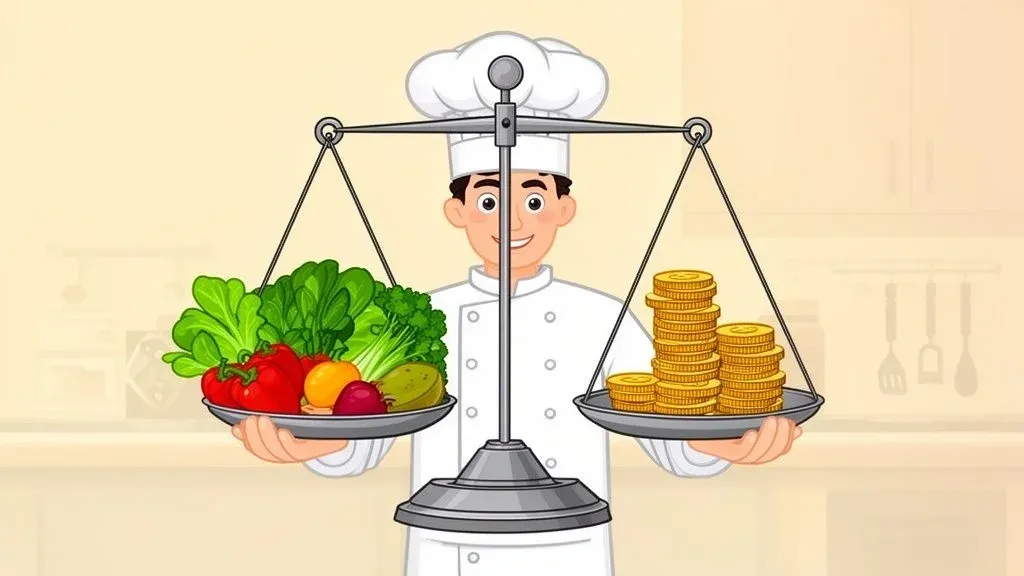
Your food cost percentage isn’t just another number on a spreadsheet—it’s one of the most important health metrics for your restaurant. In simple terms, it tells you exactly how much you spend on ingredients compared to how much you earn from selling the finished dish.
Think of it this way: if you run a bakery, you need to know precisely how much the flour, sugar, and butter cost for every single cake that goes out the door. Mastering that number is the key to knowing if you’re actually making a profit. This guide will show you how to calculate, understand, and lower this crucial metric to boost your restaurant’s efficiency and profitability.
Why Your Food Cost Percentage Is Everything
At its heart, food cost percentage is a simple concept that shows you how much you’re spending on ingredients for every dollar of revenue you bring in.
Let’s say your food cost percentage is 30%. That means for every $100 you make in sales, you spent $30 on the raw materials to make that food. Flying blind on this metric is like trying to drive across the country without a map or a gas gauge. You’re almost certainly losing money somewhere—whether it’s from waste, bad purchasing habits, or poorly priced menu items—and you won’t even see it happening.
This one number is the bedrock of your restaurant’s financial health. It dictates your menu prices, guides your purchasing strategy, and ultimately determines how much money you take home. A high food cost percentage will eat away at your profits, especially when you factor in third-party delivery commissions and the ever-rising cost of ingredients. Keeping a tight grip on this metric lets you spot trouble long before it becomes a crisis.
Connecting Costs to Your Bottom Line
Getting a handle on your food cost percentage is what allows you to build a resilient, profitable business. It shifts you from guessing to knowing, completely changing how you look at every dish on your menu.
For most well-run restaurants, the sweet spot for food cost percentage hovers between 28% and 35%. Hitting this benchmark is non-negotiable for staying profitable, especially with the surge in delivery orders from platforms like Uber Eats and DoorDash.
This metric is a powerful tool for making smart decisions. It helps you finally answer the tough questions:
- Are my menu prices actually high enough to cover my costs and leave a healthy profit margin?
- Which dishes are my profit powerhouses, and which ones are secretly draining my bank account?
- Am I throwing money in the trash through food waste or inconsistent portion sizes?
- Are my suppliers giving me the best deal, or is it time to pick up the phone and renegotiate?
The Impact on Restaurant Operations and Delivery
In today’s world, where platforms like Uber Eats and DoorDash are a necessary part of the business, managing your costs is more critical than ever. Those commission fees can take a huge bite out of your already thin margins, making a lean food cost percentage your best line of defense. This is where the right restaurant technology can make all the difference.
When you connect your delivery apps to a POS system like Clover or Square, you take manual order entry out of the equation. This one change eliminates the kind of human errors that lead to wasted food and messy sales data—two things that drive your food cost percentage through the roof. Clean data is the foundation of solid cost control, boosting staff productivity and reducing errors. Check out our guide on the restaurant income statement to see how all these numbers fit into the bigger financial picture.
At the end of the day, mastering your food cost percentage is the first and most vital step toward building a restaurant that lasts. It gives you the clarity you need to fine-tune your menu, slash waste, and protect your profits.
How to Calculate Your Food Cost Percentage
You don’t need to be an accountant to figure out your food cost percentage. The calculation is simple: you’re just comparing what you spend on ingredients to the money you make selling the finished dishes.
Think of it as your kitchen’s weekly report card. It’s a straightforward process that gives you an honest look at your restaurant’s financial health. Nailing this number is the first step toward smarter menu pricing, better purchasing, and, ultimately, higher profits.
The Standard Food Cost Percentage Formula
To get your food cost percentage for a specific period—say, a week or a month—you just need four numbers: your starting inventory, what you purchased, your ending inventory, and your total food sales. The formula itself is pretty logical.
First, you need to figure out your Cost of Goods Sold (COGS). This is a technical term for the value of the ingredients you actually used, not just what you bought.
Cost of Goods Sold = (Beginning Inventory + Purchases) – Ending Inventory
Once you have your COGS, you can pop it into the main formula.
Food Cost Percentage = (Cost of Goods Sold / Total Food Sales) x 100
This calculation shows you exactly how many cents of every dollar you earn go right back into buying ingredients. It’s a critical health metric for any restaurant.
This visual flow shows how managing your ingredients is the first link in the chain to boosting revenue and profitability.

The takeaway here is simple: get a handle on your input costs, and you’ll create a more profitable output.
A Practical Step-by-Step Example
Let’s walk through this with a real-world scenario. Let’s say you run a bustling cafe and want to figure out your food cost for the first week of the month.
- Beginning Inventory: On Monday morning, you take stock of everything. You’ve got $10,000 worth of coffee beans, milk, flour, and other supplies.
- Purchases: Over the week, your suppliers drop off orders totaling $3,000.
- Ending Inventory: The next Monday, you do another count. This time, you have $9,000 worth of ingredients left.
- Total Food Sales: You pull up your POS report and see your food sales for the week hit $14,000.
Now, let’s crunch the numbers.
- Cost of Goods Sold = ($10,000 + $3,000) – $9,000 = $4,000
- Food Cost Percentage = ($4,000 / $14,000) x 100 = 28.57%
Your cafe’s food cost for the week is 28.6%—a pretty solid number that falls right in the ideal industry range. Knowing this empowers you to make smarter decisions about everything from your menu to your operations.
Total Cost vs. Individual Plate Cost
While your overall food cost percentage gives you the big-picture view, you also need to get granular and understand the cost of each individual item on your menu. This is often called “plate cost” or “recipe cost.”
- Overall Food Cost helps you monitor your entire kitchen’s efficiency and see if you’re trending in the right direction over time.
- Individual Plate Cost tells you exactly how profitable a single dish is, like your signature burger or that fancy latte.
Calculating plate cost means you have to account for every single ingredient in a recipe—right down to that pinch of salt and the sprig of parsley for garnish. It’s a tedious but essential task for menu engineering. It’s how you find your hidden profit-drivers and spot the dishes that are secretly draining your bank account. If you want to dive deeper into restaurant finance, check out our guide on how to calculate average revenue to better understand customer spending.
The best approach is to use both calculations. Keep an eye on your overall percentage weekly to make sure things are on track, and re-calculate your plate costs anytime a supplier’s prices go up.
What a Good Food Cost Percentage Looks Like
So you’ve crunched the numbers and have your food cost percentage. Great. But a number on its own is just… a number. Is it good? Bad? Somewhere in the middle?
The truth is, it completely depends on your restaurant. Think of it like this: you wouldn’t expect a high-performance sports car to have the same MPG as a delivery van. They’re built for different purposes. In the same way, a fine-dining steakhouse and a fast-casual pizza joint are playing two totally different games.
Understanding where you fit in is the first step to setting goals that actually make sense for your business and drive real profit.
Industry Benchmarks by Restaurant Type
The “perfect” food cost percentage simply doesn’t exist. A high-end spot working with A5 Wagyu and fresh truffles will naturally have a higher food cost than a pizzeria whose main ingredients are flour and tomatoes. Neither one is wrong; they just have different business models.
To give you a general idea of where things land, here’s a quick breakdown of typical food cost percentages across different types of restaurants.
Typical Food Cost Percentage by Restaurant Type
This table gives you a solid starting point for benchmarking your own operation against industry standards. Use it to see how you stack up.
Restaurant Type Average Food Cost Percentage Range Quick-Service (QSR) 25% - 30% Fast-Casual 28% - 32% Full-Service Casual Dining 30% - 35% Pizzerias 20% - 25% Fine Dining 32% - 38% Catering 30% - 40%
Remember, this is a guide, not gospel. Your ideal number is shaped by your unique menu, your local suppliers, and how smoothly your kitchen runs. For a closer look at getting your back-of-house in order, our guide on restaurant management and operations is a great next read.
Why Your Restaurant Is Unique
While those industry averages are a helpful measuring stick, they aren’t the final word. Several factors can push your target food cost up or down, and being aware of them is what separates the pros from the amateurs.
Your menu is the single biggest driver. A restaurant slinging pasta and bread will always have a lower food cost than one specializing in fresh-caught seafood. The goal isn’t to blindly chase a generic number—it’s to figure out what’s profitable for your specific concept.
Keep these variables in mind when you set your own targets:
- Menu Mix: Are your top sellers high-margin items like fries and fountain drinks? Or do customers flock to your lower-margin steak dinners? That balance has a massive impact on your overall percentage.
- Supplier Relationships: A solid, long-term relationship with your vendors can mean better pricing, bulk discounts, and more predictable costs. That stability is huge for keeping food costs in check.
- Service Style: Fine dining restaurants often accept a higher food cost because they can make up for it with higher menu prices and killer beverage programs. Alcohol, after all, typically has a much lower cost percentage (around 15-20%).
The Role of Delivery and POS Integration
In today’s world, you can’t talk about profitability without talking about delivery. Every time an order from DoorDash gets punched into your Square POS incorrectly, what happens? You have to remake the dish. That mistake instantly doubles your food cost for that sale, with zero extra revenue to show for it.
It’s a direct, painful hit to your bottom line.
This is exactly why a seamless POS integration is no longer a “nice-to-have.” When you automate how orders flow from delivery apps straight to your kitchen, you kill the manual errors that slowly bleed your profits. Clean data and efficient systems are the bedrock of good cost control, saving time and money while increasing staff productivity.
Ultimately, your job is to find that sweet spot between quality ingredients, fair prices, and a profit margin that keeps the lights on. Use these benchmarks as a compass, not a map, to define what success really looks like for your restaurant.
Ready to take control of your restaurant’s profitability? Start by optimizing your operations. You can start onboarding for Free in a few clicks.
Practical Ways to Lower Your Food Costs
Knowing your food cost percentage is one thing. Actually wrestling that number down is where the real money is made. Getting your costs in line isn’t about cheaping out on ingredients or shrinking portions until customers complain. It’s about being smarter, more strategic, and plugging the tiny, invisible leaks where your profits are draining away.
This is where the rubber meets the road. These aren’t theoretical ideas; they’re battle-tested strategies you can put into action today to improve your restaurant’s financial health. By zeroing in on your menu, portions, suppliers, and waste, you can systematically drive down that food cost percentage and build a much tougher, more resilient business.

Engineer Your Menu for Maximum Profit
Your menu is more than just a list of what’s for sale—it’s the most powerful sales tool you own. Menu engineering is the process of analyzing what sells and what makes you the most money, then using that data to nudge customers toward your most profitable dishes.
Let’s imagine a burger joint. The fancy signature burger with imported cheese is a hit, but its food cost is a steep 40%. On the other hand, the loaded fries—made with cheap potatoes and a few toppings—have a fantastic food cost of just 22%. By giving those loaded fries a better spot on the menu, maybe with a mouth-watering photo, you can boost their sales and bring your overall food cost down. This simple change is a powerful, actionable insight for any operator.
Master the Art of Portion Control
Nothing kills your margins faster than inconsistent portioning. An extra ounce of steak here, a bigger handful of fries there… it feels like nothing in the moment. But over the course of a year, those little slip-ups add up to thousands of dollars walking right out the door.
The fix is surprisingly simple, but it demands consistency. You have to standardize everything.
- Use Portioning Tools: Get your kitchen crew using food scales, measured scoops, and specific ladles for every sauce and topping. No more guesswork.
- Create Visual Guides: Tape photos to the wall at each station showing exactly what a finished plate is supposed to look like.
- Train, Train, Train: Make perfect portioning a core part of your kitchen’s culture. It’s not about being stingy; it’s about being consistent.
I know a pizzeria owner who saved a fortune just by creating a rule for the exact number of pepperoni slices on each pizza. No more “eyeballing it.” Every single pizza now has a predictable cost and, just as importantly, gives every customer the same great experience. This leads to immediate cost savings and error reduction.
Negotiate Smarter with Your Suppliers
Think of your suppliers as partners. And like any good partnership, it thrives on communication. Don’t just passively accept the prices on the invoice. When inflation peaked in 2022, pushing industry food costs to a brutal 35-40%, the operators who survived were the ones who got on the phone with their vendors.
Pick up the phone and talk to them. Ask about potential discounts for buying in bulk, paying your invoices early, or signing a longer-term contract. Shaving even 5% off a high-volume item like chicken or cooking oil can make a massive difference to your bottom line.
Don’t ever be afraid to shop around. Getting quotes from a few different suppliers keeps everybody honest and ensures you’re getting a fair price without compromising the quality your regulars expect.
Declare War on Food Waste
Every potato peel, bread crust, or bit of wilted lettuce that hits the trash can is cash you’re throwing away. Slashing your food waste is one of the fastest and most effective ways to lower your food cost. It means looking at everything, from the moment an order arrives to when a plate hits the table. There are tons of smart strategies for reducing food waste that can make an immediate impact.
Start with a simple waste log next to the bin. Have your team track everything that gets tossed. You’ll quickly see patterns—is produce spoiling before it’s used? Is one particular dish coming back to the kitchen half-eaten? Find creative ways to use every part of an ingredient, like turning vegetable scraps into a rich stock or day-old bread into house-made croutons. We’ve got even more ideas in our guide to reducing food waste in restaurants.
By weaving these four strategies together, you’re not just cutting costs—you’re building a system. You’re moving from being reactive to proactive, giving yourself the power to protect your margins no matter what the market throws at you. The best way to start? Pick one area, like portion control, and make one small, measurable change this week.
Using Food Tech for Smarter Cost Control
In a modern restaurant, technology isn’t some shiny new toy; it’s your secret weapon against razor-thin margins and rising expenses. While your team is focused on crafting incredible dishes, outdated manual processes can be silently bleeding you dry. The biggest culprit is often hiding in plain sight: the daily chaos of juggling online delivery orders.
Having staff manually punch in orders from a sea of tablets is a recipe for disaster. Every typo, every misheard modifier, every rushed entry is a costly mistake waiting to happen. An incorrect dish has to be remade, and just like that, you’ve doubled the food cost on that order for zero extra revenue. It’s a direct hit to your bottom line, every single time.
The Power of POS Integration for Restaurant Delivery
The solution is to get those orders flowing automatically from platforms like DoorDash and Uber Eats straight into your POS system. This is where POS integration completely changes the game. It acts as a perfect translator, creating a seamless bridge between what the customer taps on their app and what prints out in your kitchen.
This one simple change accomplishes two massive goals for getting your food cost under control:
- It kills manual errors. No more remakes because a frazzled host typed “no onions” when the ticket clearly said “extra onions.” This instantly cuts down on food waste and protects the profit margin on every single order coming in.
- It ensures your data is rock-solid. Every sale is captured perfectly inside your POS. This clean, reliable data is the bedrock of an accurate food cost calculation. After all, you can’t manage what you can’t measure.
Connecting your delivery apps to a system like Square or Clover transforms a high-risk, time-sucking task into a flawless, automated workflow. The time saved is just a bonus; the real win is the reduction in costly errors and the improvement in staff productivity.
From Raw Data to Actionable Insights
Once your sales data is clean and consolidated, you unlock a whole new level of control over your purchasing and inventory. A unified dashboard gives you a crystal-clear, real-time view of what’s actually selling versus what you think is selling.
This is what it looks like when your delivery orders stop being a headache and start becoming a source of powerful business intelligence.

With this kind of clarity, you can finally make smart, data-driven decisions that directly push your food cost percentage down.
You can suddenly see which menu items are flying out the door on Uber Eats on a Tuesday, or which sides are most popular during the weekend dinner rush on DoorDash. This kind of insight lets you fine-tune your inventory, ordering only what you truly need and avoiding costly overstocking of ingredients that just sit on the shelf. To really drill down, specialized tools like inventory analytics for food businesses can provide even deeper insights into managing ingredient costs and waste.
Key Takeaway: Investing in the right food tech isn’t an expense—it’s one of the most powerful strategies you have for protecting your profit margins. Automation gives you the clean data you need for precise food cost calculations and smarter inventory management.
Ultimately, technology is what shifts your restaurant from being reactive to proactive. It gives you the tools to not only measure your food cost percentage with precision but to actively wrestle it down. For a deeper look at the tools out there, check out our complete guide to restaurant technology solutions. By embracing automation, you build a more efficient, resilient, and profitable restaurant that’s ready for anything.
Taking the Next Step Toward a More Profitable Restaurant
Getting a handle on your food cost percentage isn’t a one-and-done job. It’s a constant, active process that directly impacts the financial health of your restaurant.
Think of it this way: you now have the blueprint. You know how to calculate the numbers accurately, how you stack up against the competition, and what practical steps you can take to trim waste and boost efficiency. The rest is about putting that knowledge into action.
Start with Data and Efficiency
So, where do you begin? The single most effective first step is to clean up your data and your daily operations. Every other tactic, from brilliant menu engineering to tough supplier negotiations, falls apart without a foundation of reliable numbers.
Manual processes are the enemy of accuracy, especially when you’re juggling delivery orders. They open the door to costly mistakes that quietly inflate your food costs.
By automating how orders from apps like Uber Eats and DoorDash flow directly into your Clover or Square POS, you shut down the biggest source of food waste and bad data. This isn’t just a time-saver; it’s about creating a rock-solid financial foundation you can actually trust.
Take a look today at how you can integrate your delivery platforms with your POS system. It’s a powerful move that frees up your staff, slashes expensive order errors, and gives you the clean data you need to finally get your food cost percentage under control. True profitability starts with automation.
Ready to build a more efficient and profitable restaurant? You can explore our solutions and start onboarding for Free in a few clicks.
Frequently Asked Questions
Digging into food cost can bring up a lot of questions. Let’s walk through some of the most common ones we hear from restaurant operators, with clear answers to help you get a handle on your numbers.
How Often Should I Calculate My Food Cost Percentage?
Ideally, you should be calculating your food cost weekly. This is the sweet spot for most restaurants.
Running this number every week lets you catch problems before they spiral out of control. You’ll spot supplier price hikes, catch unusual waste, and see trends taking shape while you still have time to react. Think of it as a weekly financial health check for your kitchen. A monthly calculation is okay for a big-picture view, but it’s too slow for the day-to-day realities of a busy restaurant. You also need to recalculate the cost of individual dishes whenever a key ingredient price jumps.
Do Delivery App Commissions Affect My Food Cost Percentage?
Technically, no. Commissions from apps like DoorDash and Uber Eats don’t get plugged directly into your food cost formula. Those fees are usually considered an operating or marketing expense, not part of your Cost of Goods Sold (COGS).
But they have a huge indirect impact on your bottom line. Those high commission fees—often 15-30%—put the squeeze on your overall profit margin. That pressure makes it absolutely critical to keep your food costs on a tight leash. If your food cost is creeping up and you’re also losing a big chunk to commissions, the profit on your delivery orders can vanish completely. This is exactly why every bit of efficiency you can find matters.
Why It Matters: High delivery commissions make a low food cost percentage non-negotiable. If a 30% commission eats into your revenue, a high food cost will leave you with no profit. Automating your delivery orders into a Clover POS or Square POS reduces costly food waste from errors, protecting the already thin margins on every sale.
What Is the First Step to Lowering a High Food Cost Percentage?
Before you do anything else, make sure your numbers are 100% accurate. You can’t fix what you can’t measure correctly.
Don’t jump into changing recipes or renegotiating with suppliers until you can trust your data. That means making sure your team is doing precise weekly inventory counts and that every single sale, including all your third-party app orders, is tracked perfectly.
An excellent first step is to automate your order entry. It’s a simple change that gets rid of manual mistakes that throw off your sales data and lead to food waste from incorrect orders. For example, integrating DoorDash with your Square POS eliminates the need for staff to re-enter orders, saving time and preventing costly errors. Once you have that solid data foundation, the next tactical step is to start tracking your waste. Set up a simple waste log in the kitchen and have your team record every item that gets spoiled, dropped, or made wrong. You’ll be surprised how quickly this shows you where your profits are leaking.
Ready to build a more efficient, data-driven, and profitable restaurant? At OrderOut, we help you automate your operations by integrating all your delivery orders directly into your POS system, eliminating errors and giving you back control.