
DoorDash vs Uber Eats: A Restaurant's Guide to Smarter Delivery
· Thibault Le Conte
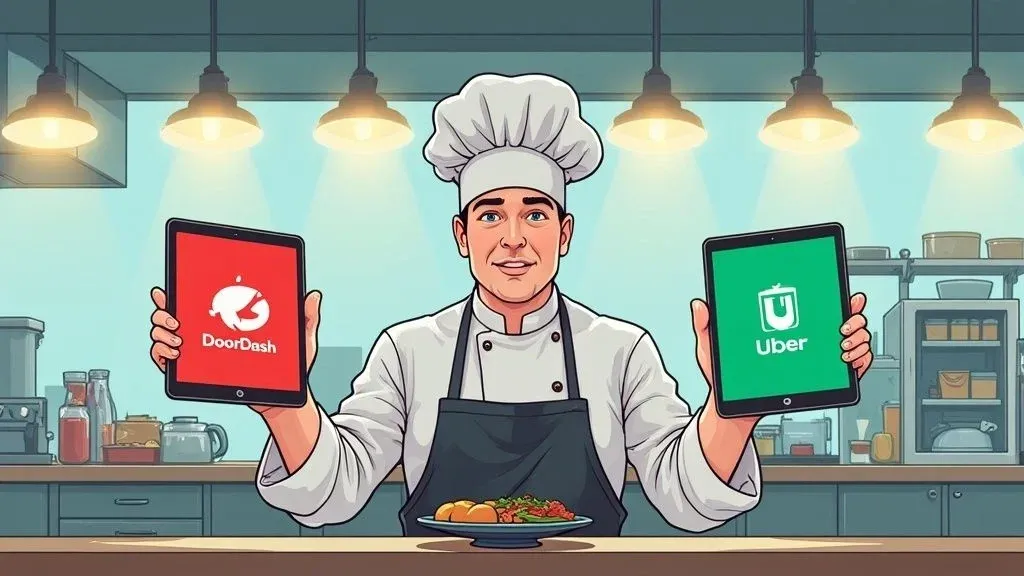
When you’re choosing between DoorDash and Uber Eats, it boils down to a simple question: Do you want sheer volume or a more targeted, urban audience? In simple terms, think of it like this: DoorDash is the undisputed king of U.S. market share, with a sprawling reach that extends deep into the suburbs. On the other hand, Uber Eats shines in dense city centers, tapping into a loyal customer base that’s already using its global ride-sharing app. Your best bet depends entirely on who you’re trying to reach.
Why it matters: Making the right choice directly impacts your restaurant’s efficiency and profitability. The right platform means more orders, smoother kitchen operations, and less wasted time for your staff.
Comparing the Food Delivery Giants
Picking the right third-party food delivery services is one of the most critical decisions you’ll make for your restaurant. It directly impacts your sales, how your kitchen runs, and, ultimately, your profitability. While DoorDash and Uber Eats are the top dogs, they play in different sandboxes and have very different strengths.
Let’s break down what actually matters from an operator’s point of view—the stuff that affects your daily operations and your bank account.

Key Operational Differences in Restaurant Delivery
The biggest, most unavoidable factor in the DoorDash vs. Uber Eats debate is pure market share. For 2024-2025, DoorDash has a massive lead, pulling in somewhere between 56% and 67% of all U.S. food delivery sales. Uber Eats is a distant second, with about 23% to 25%.
What does that gap actually mean for you? It means more potential customers see your menu, which translates to more orders, especially if you’re located outside a major downtown core. For a busy restaurant, that market dominance is huge. A bigger pool of potential customers means more consistent order flow, which keeps your kitchen humming and your staff productive.
The decision isn’t just about commission fees. It’s about finding the right fit for your brand. DoorDash brings the masses, while Uber Eats can connect you with a loyal, city-dwelling crowd that prioritizes convenience.
To make things a little clearer, here’s a quick side-by-side look at the two platforms.
Quick Comparison: DoorDash vs Uber Eats
This table breaks down the fundamental differences that will likely shape your experience as a restaurant partner.
Feature DoorDash Uber Eats Primary Strength Dominant U.S. market share and extensive suburban reach. Strong global presence with deep penetration in urban markets. Typical Customer Broader demographic, including families in residential areas. Younger, urban professionals; often existing Uber app users. Commission Model Tiered plans (Basic, Plus, Premier) with varying fees. Similarly tiered plans with options for marketing add-ons. Key Advantage Higher potential order volume due to larger customer base. Access to premium Uber One subscribers and a global brand.
At the end of the day, understanding these core differences helps you build a smarter delivery strategy. While one platform might promise a higher quantity of orders, the other could deliver customers with a higher average ticket. It’s all about analyzing which ecosystem aligns with your restaurant’s location, menu, and long-term goals.
Comparing Commission Fees and Restaurant Operations
Let’s get right to it: your restaurant’s profitability. When you’re weighing DoorDash vs. Uber Eats, nothing hits your bottom line harder than the commission fees. Both platforms have thankfully moved past the old one-size-fits-all model, now offering tiered plans that let you decide how much you want to spend in exchange for visibility and features. Getting this choice right is fundamental to protecting your margins.
The basic idea is simple: pay a higher commission, and you get more marketing firepower and a better spot in the app. But a bigger fee doesn’t automatically equal bigger profits. The real goal is to find that sweet spot—a plan that matches what you can handle operationally and what makes sense for your bank account.

Breaking Down the Commission Tiers
Both DoorDash and Uber Eats have pretty similar partnership structures, usually with three main tiers. While the names and exact percentages can shift depending on your city and what you negotiate, the general setup is the same.
Here’s how they typically stack up:
- The Basic Tier (~15% Commission): This is your no-frills option. You get the lowest commission rate, but you’re on the hook for handling your own deliveries. It’s a solid choice for restaurants that already have drivers and just want to tap into the apps for a bit more online visibility.
- The Plus Tier (~20-25% Commission): This is where most restaurants land. It gives you full access to their driver network, a listing in the main marketplace, and—critically—inclusion in their subscription programs (DashPass for DoorDash and Uber One for Uber Eats). This connects you directly with their most loyal, highest-frequency customers.
- The Premier Tier (~30% Commission): This is the all-in plan. You pay the highest commission for all the Plus benefits plus a significant marketing boost, prime placement in the app, and sometimes even a guarantee on order volume. This tier is built for operators ready to go all-in on growth and exposure.
Remember, these headline numbers aren’t the whole story. They almost never include payment processing fees, which tack on another 2.5-3%. Always, always ask for a complete fee breakdown before you sign anything. For a deeper dive, check out our guide on how to negotiate better third-party delivery fees.
Payout Schedules and Your Restaurant Operations
Beyond the fees, how quickly you get your money is a massive deal for cash flow. A few days’ delay can be the difference between paying your staff on time and scrambling for funds.
Both DoorDash and Uber Eats are pretty aligned here:
- DoorDash: Offers standard weekly payouts via direct deposit, landing in your account in 2-3 business days. They also have a Fast Pay option that lets you cash out daily for a small fee.
- Uber Eats: Also runs on a weekly payout schedule. If you need cash faster, they offer instant payouts for a fee, which can be a lifesaver after a monster weekend.
Why It Matters: Think about a small, independent coffee shop. Waiting a full week for the revenue from a slammed Saturday and Sunday can put a serious strain on cash flow. Having an option for daily payouts, even with a small fee, provides the flexibility to buy fresh produce for the week without missing a beat. This directly impacts your operational stability.
A Practical Cost Example
Let’s put some real numbers to this. Say your restaurant gets a $50 order. Here’s a rough sketch of how your profit changes across the tiers, factoring in a 3% payment processing fee.
Platform Tier Commission Rate Commission Fee Processing Fee Your Take-Home Basic Plan 15% $7.50 $1.50 $41.00 Plus Plan 25% $12.50 $1.50 $36.00 Premier Plan 30% $15.00 $1.50 $33.50
That table says it all. The jump from Basic to Premier means you’re leaving $7.50 on the table from a single order. Now, multiply that by hundreds of orders a month. The financial impact is huge. Picking the right plan isn’t just about pinching pennies—it’s about building a delivery business that actually lasts.
DoorDash vs. Uber Eats: Reaching the Right Customers
When you’re weighing DoorDash vs. Uber Eats, it’s about more than just commission fees. You have to ask: who are you actually trying to reach? Your restaurant’s location and your ideal customer will make a huge difference here. These two platforms own different territories, both geographically and demographically, so one could be a goldmine while the other is just a trickle.
Think of it this way: market share isn’t just a number. It’s your potential customer base. If a platform has more users in your neighborhood, that translates directly to more orders hitting your kitchen. A one-size-fits-all approach to delivery just doesn’t cut it; you have to align your brand with the right audience.
DoorDash and Uber Eats Market Dominance
The sheer scale of each platform’s user base has a real impact on your day-to-day operations. A bigger local market share means a more predictable flow of orders, which makes everything from inventory planning to staff scheduling a whole lot easier.
In the U.S. food delivery game, DoorDash has a massive lead. The latest numbers show DoorDash controls about 67% of the total market, with its app downloaded nearly 19 million times in early 2024. That’s a big jump from Uber Eats’ 12 million. While DoorDash is almost entirely focused on U.S. growth, Uber Eats is playing a global game across 45 countries.
This rivalry plays out differently from city to city. For instance, DoorDash can pull in up to 74% of sales in a market like San Francisco, but Uber Eats sometimes comes out on top in cities like Miami with 55%. When a platform dominates your area, it’s basically a free marketing engine, putting your menu in front of thousands of hungry customers you’d never reach on your own.
Customer Demographics and Ordering Habits
Beyond the raw numbers, you need to look at the type of customer each app brings in. DoorDash and Uber Eats attract slightly different crowds, and if you understand that nuance, you can tailor your menu and promos to make a bigger impact.
DoorDash’s Suburban Stronghold:
DoorDash absolutely owns the suburban and family market. Its user base is full of households placing larger, multi-person orders.
- Ideal Restaurant Type: Family-style spots, pizzerias, and places with kid-friendly menus do incredibly well here. If you’re located in a residential community, DoorDash is almost certainly your best bet for reaching local families.
- Operational Impact: You’ll likely see larger average ticket sizes, but that also means you need a rock-solid process for bagging and double-checking big orders. Getting it right the first time saves you from costly remakes and frustrated customers, directly reducing errors and saving money.
Uber Eats’ Urban Core:
Uber Eats really shines in dense urban areas, attracting a younger, tech-savvy crowd—think Gen Z and Millennials. These are often single professionals or couples who are already using the main Uber app for rides.
- Ideal Restaurant Type: Trendy fast-casual concepts, ghost kitchens, and restaurants with unique or niche food tend to thrive. If you run a cafe near a university or a lunch spot downtown, you’ll find a built-in audience on Uber Eats.
- Operational Impact: Orders tend to be smaller and more frequent, mostly individual meals. This means your kitchen needs to be dialed in for speed and efficiency. Nailing your single-order packaging is key to keeping those convenience-focused customers happy and coming back. For a closer look at these regional differences, check out our guide to the top delivery partners on the US West Coast.
Real-World Example: A family-owned Italian place in a Dallas suburb will likely see more success on DoorDash due to its family-oriented audience. Conversely, a modern poke bowl shop in downtown Chicago will probably get way more traction from the younger, urban professional base on Uber Eats. Choosing the right platform is a strategic marketing move that boosts efficiency.
Managing these different order patterns is where connecting your delivery channels to a POS like Clover or Square becomes a game-changer. Automation means that whether it’s a huge family meal from DoorDash or a quick solo lunch from Uber Eats, the order zips straight to your kitchen without anyone having to punch it in manually. That frees up your staff to focus on the food, increasing productivity and reducing error rates.
Improving Operations with Restaurant POS Integration
Let’s get real for a moment. Beyond the commissions and market share debates, how do DoorDash and Uber Eats actually feel inside your four walls? The daily grind of managing a flood of delivery orders can either be a smooth, profitable hum or a chaotic mess that tanks your kitchen’s efficiency.
If you’re juggling multiple tablets, each one screaming for attention during a dinner rush, you know the chaos I’m talking about. Every order requires someone to stop what they’re doing and manually punch it into the POS. This isn’t just inefficient; it’s a magnet for mistakes. One wrong modifier, one missed item—that’s a frustrated customer and a direct hit to your profits.

The Power of Direct Restaurant POS Integration
This is exactly where restaurant POS integration changes the game. Put simply, integration connects your delivery apps directly to your point-of-sale system. Orders stop being stranded on separate tablets and instead flow automatically into your central hub, appearing on your kitchen printer or KDS just like an order taken at the counter.
Technically, this works through an API (Application Programming Interface) that acts as a translator between, say, DoorDash and your POS. It takes the order data and formats it perfectly for your system, no human hands required. For a deeper dive into the tech, check out our guide on POS integration software.
Why It Matters: This is about more than just saving a few seconds. By automating order entry, you eliminate the single biggest point of failure in the delivery workflow—human error. This directly cuts costs from remakes, saves staff time, and lets your team focus on what they do best: cooking amazing food and taking care of the guests right in front of them.
Comparing Operational Impact: Manual vs. Integrated Systems
The difference between wrestling with tablets and running an integrated system isn’t just incremental; it’s a night-and-day transformation. Let’s break down what that actually means for your time, costs, and sanity.
Operational Task Manual Tablet Management Integrated POS System Impact on Restaurant Order Entry Staff manually re-keys every order from the tablet into the POS. Orders from DoorDash & Uber Eats appear automatically in the POS. Saves 30-60 seconds per order, reducing labor costs and increasing staff productivity. Error Rate High potential for typos, missed modifiers, and incorrect items. Eliminates manual entry errors, ensuring order accuracy is over 99%. Cuts food waste & remake costs significantly, boosting profit margins. Staff Focus Front-of-house staff are distracted by constant tablet alerts. Staff can focus entirely on customer service and in-house tasks. Improves guest experience and staff morale. Menu Updates Must update menus manually on each platform, one by one. Update your menu once in the POS to sync across all platforms. Saves hours of administrative time each month.
Real-World Example: Clover and Square Integrations
Picture a busy pizzeria on a Friday night. Without integration, one of your best front-of-house people is stuck at the tablet station, frantically re-keying orders from DoorDash and Uber Eats into their Square POS. They inevitably miss a “no onions” note on one order. The result? An angry customer, a remade pizza, and money straight down the drain.
Now, imagine that same pizzeria with an integrated system. Orders from both apps zap directly into the kitchen’s Clover KDS, with every modifier perfectly intact. The front-of-house team can actually manage the dining room, while the kitchen crew works from a single, unified queue. This one change can easily cut order entry errors dramatically, boosting staff productivity and saving critical minutes off every single delivery.
Practical Next Step: Streamline Your Food Tech
Whether you lean toward DoorDash for its massive reach or Uber Eats for its loyal urban following, the operational headache is the same. The single most powerful way to manage either—or both—is to eliminate manual work with POS integration. This one move transforms delivery from a chaotic necessity into a streamlined, profitable, and scalable part of your business.
Using Marketing Tools and Food Tech for Restaurant Growth
Let’s be real—simply getting your restaurant listed on DoorDash and Uber Eats isn’t enough. In a sea of options, you have to fight to be seen, and that’s where their in-app marketing tools come into play. These tools can either be a money pit or a powerful engine for growth, and the difference comes down to strategy.
From an operator’s perspective, promotions are all about driving specific outcomes: pulling in first-time customers, getting regulars to order again, or bumping up that average order value. The goal isn’t just to run a promotion; it’s to run a profitable one. You have to be smart about it, picking the right offer that aligns with your goals—whether that’s clearing out inventory with a BOGO or finally making Tuesdays feel like Fridays.
Comparing Promotional Features
DoorDash and Uber Eats offer a nearly identical marketing toolkit, but how they perform can differ based on who’s using the app. Your choice of promotion shouldn’t be a shot in the dark. To get the best results, you might even consider specialized digital marketing for restaurants to guide your in-app strategy.
Here’s a quick rundown of the heavy hitters and how they work:
- Percentage-Off Discounts: Think 20% off orders over $30. This is your go-to for driving up ticket sizes. It’s the perfect nudge to get customers to add that extra appetizer or dessert to hit the minimum.
- Fixed-Amount Discounts: Like $5 off orders over $25. This works just like a percentage-off deal but can feel more tangible to customers. Sometimes, seeing that concrete $5 savings is a more powerful motivator.
- Free or Discounted Delivery: This one is a magnet for new customers. The delivery fee is often the biggest hurdle for someone on the fence about trying a new place. Wiping it out makes saying “yes” a whole lot easier.
- Buy One, Get One (BOGO): Perfect for pushing a new menu item or moving extra inventory before it goes to waste. Just make sure you run it on a high-margin item so you’re still protecting your bottom line.
Remember, every one of these promotions costs you money. The trick is to obsessively track your return on investment (ROI). If that “20% off” campaign doubles your orders on a dead-slow night, the cost was absolutely worth it.
Reaching High-Value Customers with Subscription Services
Now for the real game-changer: the subscription members. We’re talking about DashPass on DoorDash and Uber One on Uber Eats. These are the holy grail customers you want to reach. They order more often, they spend more money, and they don’t sweat the delivery fees because their membership covers it.
Why It Matters: Opting into these programs is basically non-negotiable for serious growth. Subscribers actively filter their search results to only see participating restaurants. If you’re not in DashPass or Uber One, you’re completely invisible to the most valuable diners on these platforms. This directly impacts your order volume and restaurant efficiency.
DoorDash has been especially savvy here, expanding into convenience and grocery to make its DashPass subscription an indispensable part of a user’s life. That strategy creates a sticky ecosystem of loyal, high-frequency customers. By joining, you get direct access to this ready-made audience.
Using Data and Analytics for Smarter Decisions
Both platforms give you an analytics dashboard, but its real value is in how you use it. Don’t just glance at your total sales—dig in. This dashboard is a treasure trove of operational intel.
You can use it to:
- Identify your bestsellers: See what’s flying out the door and feature it in your next promotion.
- Spot sales trends: Notice a spike in dessert orders after 8 PM? Time to launch a late-night sweet special.
- Understand your customers: Analyze order frequency and average spend to fine-tune your marketing offers.
When you let data drive your decisions, your marketing spend stops being an expense and starts becoming an investment. If you want to go deeper, our guide on building a marketing plan for your restaurant can help you tie it all together.
How to Choose the Right Delivery Partner
Picking between DoorDash and Uber Eats isn’t just about comparing commission rates. It’s a strategic move that needs to line up with your restaurant’s specific situation—where you’re located, who you’re trying to reach, and what your kitchen can handle. Get it right, and a delivery partner feels like a true extension of your business. Get it wrong, and you’re stuck with operational headaches and money down the drain.
The first question you have to ask is: what’s my main goal here? Are you trying to blast your menu out to as many people as physically possible? Or are you aiming for a more specific, high-value customer in a packed city market?
A Simple Framework for Your Decision
Honestly, your restaurant’s physical address is the single biggest clue as to which platform will work better for you. Market share isn’t just some abstract number; it directly translates into how many orders you’re going to get.
- Choose DoorDash if: Your restaurant is in a suburban or residential area. DoorDash absolutely dominates the U.S. market, and its strength is reaching families and customers outside of busy downtowns.
- Prioritize Uber Eats if: You’re set up in a dense, urban core. Uber Eats smartly leverages its massive ride-sharing customer base, which is packed with younger, tech-forward professionals who live and work in the city and prioritize speed and convenience.
This simple breakdown is often the deciding factor in the whole DoorDash vs. Uber Eats debate.

The takeaway here is pretty clear: line up your delivery strategy with the platform that already owns your neighborhood. It’s the fastest way to see real results and a solid return on your investment.
Why Not Choose Both?
For a lot of restaurants, the smartest—and most profitable—move isn’t picking one over the other. It’s using both. By listing on DoorDash and Uber Eats, you cover all your bases, reaching that suburban family on a Tuesday and the downtown professional on a Friday. But this is where the operational nightmare begins.
Managing multiple platforms usually means juggling multiple tablets. That chaos leads to manual entry mistakes, slows down your kitchen, and pulls your staff’s attention away from your dine-in customers. When you’re looking at these platforms, you absolutely have to factor their commission fees and the operational strain into your numbers, right alongside understanding your restaurant’s startup costs. It’s easy for the extra labor and mistakes to completely wipe out the profits from those extra orders.
The ultimate goal is to leverage the strengths of both platforms without creating operational chaos. The modern solution is to eliminate the manual work that makes multi-platform management so difficult.
This is where integrating your delivery channels straight into your POS system becomes a game-changer. By connecting DoorDash and Uber Eats to a system like Square or Clover, you can pull in orders from every app without ever touching a tablet. This kind of food tech approach completely removes the biggest obstacle to running a multi-platform strategy, boosting your restaurant’s efficiency and reducing errors.
Final Takeaway: Your Actionable Next Step
So, what’s next? Do some recon in your specific market. Ask other non-competing restaurants in your area which platform sends them the most business. Then, look at your own customer data. Are you serving more families or young professionals? The answer will point you straight to the platform—or platforms—that will bring the most value to your bottom line.
Whether you choose DoorDash, Uber Eats, or both, the key to success lies in streamlining your operations. The single most powerful way to manage your delivery channels is to eliminate the manual work with POS integration. This transforms delivery from a chaotic necessity into a streamlined, profitable, and scalable part of your business.
Ready to stop juggling tablets and streamline your delivery operations? OrderOut connects DoorDash, Uber Eats, and all your delivery channels directly into your POS system. Start onboarding for Free in a few clicks at https://dashboard.orderout.co.