
Digital Marketing for Restaurant: Boost Orders, Profits, and Loyalty
· Thibault Le Conte
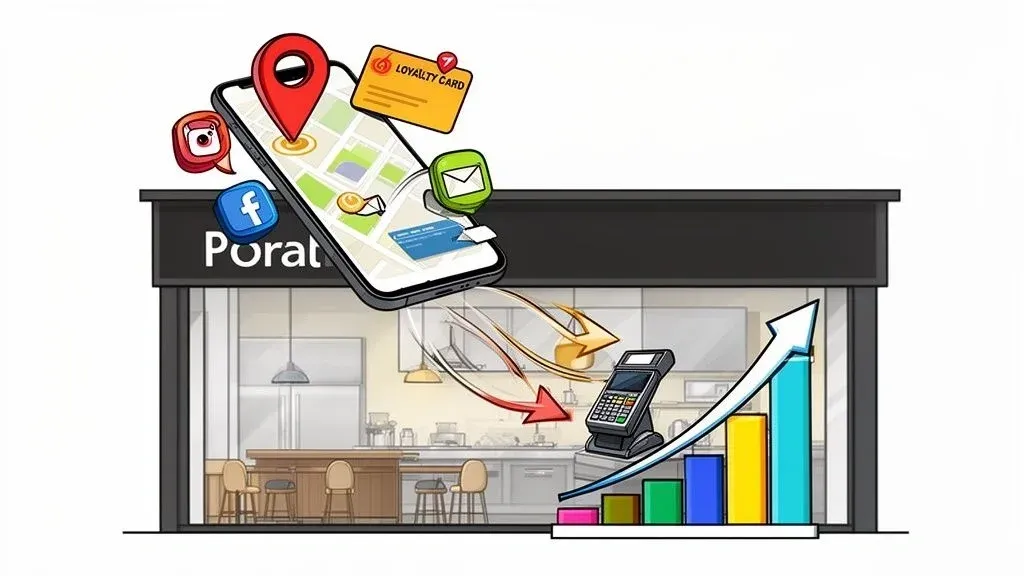
Digital marketing for restaurants isn’t about just being online; it’s about using the right online channels to bring in new customers, keep them coming back, and drive more orders. In simple terms, it starts with making sure hungry people can find you the second they search on Google. From there, it’s about connecting with them on social media and, ultimately, turning those online clicks into real, profitable orders that land directly in your kitchen. This guide will show you how to connect your marketing directly to your restaurant operations to save time, reduce errors, and increase sales.
1. Building Your Digital Storefront with Local SEO
Your restaurant’s marketing kicks off the moment someone types “food near me” or “best tacos in Brooklyn” into their phone. That search result is your new storefront, and the most important piece of real estate you own there is your Google Business Profile (GBP).
Think of your GBP as more than just a business listing. It’s your most valuable online billboard—it’s free, it’s where everyone is looking, and it’s the starting point for nearly every customer who finds you online. Nailing local Search Engine Optimization (SEO) is the technical term for getting your restaurant to the top of those search results, which means more foot traffic and more online orders. To really show up when it matters, you need to understand the five factors that could affect your Local SEO rankings. Spending a little time optimizing your profile is one of the highest-impact things you can do for your business, and it costs you nothing but time.

Why Local SEO Is a Game-Changer for Restaurant Operations
A well-kept Google Business Profile doesn’t just attract customers; it makes your restaurant run better. When your hours, address, and menu are all accurate and easy to find online, you dramatically cut down on phone calls asking for basic info. This one simple thing frees up your host or cashier to focus on the guests standing right in front of them, improving staff productivity. Every minute your team isn’t on the phone answering a question Google could have answered is a minute they can spend taking an order or delivering food, making for a much smoother shift and boosting restaurant efficiency.
The Power of POS Integration for Your GBP and Restaurant Delivery
But here’s where local SEO becomes truly powerful: when you connect it directly to your kitchen. By adding “Order” buttons to your GBP—linking to your own website, Uber Eats, or DoorDash—you create a seamless journey from discovery to dinner. The technical side involves ensuring these ordering links are properly tracked and integrated with your backend systems.
A fully optimized Google Business Profile acts as an automated front-of-house employee. It answers common questions, showcases your best dishes, and takes orders 24/7, all without adding to your payroll.
Imagine this: a hungry customer finds your restaurant on Google Maps. They scroll through your food photos, read great reviews, and tap the “Order” button for delivery through Uber Eats. That order instantly and automatically appears on your kitchen’s POS system, whether it’s a Clover or Square terminal. No one has to stop what they’re doing to manually punch in the order from a tablet. This POS integration eliminates typos, saves precious time during a rush, and is the key to running modern, efficient restaurant operations.
Essential Google Business Profile Optimization Checklist
To get started, work through this checklist. It covers the absolute must-haves for making your restaurant stand out on Google.
Optimization Area Actionable Step Why It Matters for Your Restaurant Basic Information (NAP) Verify your Name, Address, and Phone number are 100% accurate. Inconsistency confuses both Google and customers. This is the foundation of local SEO. Business Category Choose “Restaurant” as your primary category and add specific secondary categories like “Pizza Restaurant” or “Mexican Restaurant.” Helps Google show your business for relevant searches (e.g., “pizza near me”). Service Options Accurately list your services: Dine-in, Takeout, Delivery, Curbside Pickup. Tells customers exactly how they can order from you, which is crucial for their decision-making. High-Quality Photos Upload at least 10-15 vibrant photos of your food, interior, exterior, and team. People eat with their eyes first. Great photos are your best sales tool. Menu Add your full menu directly to your profile, either manually or via a URL link. Makes it easy for customers to see what you offer without leaving Google. Customer Reviews Actively encourage happy customers to leave reviews and respond to every single one (good and bad). Builds trust and social proof. Google rewards businesses that engage with their customers. Google Posts Regularly create Posts to announce specials, events, or new menu items. Keeps your profile fresh and active, signaling to Google that your business is current. Q&A Section Proactively add and answer frequently asked questions (e.g., “Do you have gluten-free options?”). Saves your staff time and provides immediate answers to potential customers. Ordering Links Add direct links to your first-party ordering page and third-party delivery apps. Turns searchers into customers with a single click, capturing impulse buys.
Completing this checklist puts you leagues ahead of competitors who just “set it and forget it.” A well-managed profile is a customer-generating machine.
3. Your Website and Integrated Online Ordering System
While your Google profile gets customers to the door, your website is the digital property you actually own. It’s your command center where you control the customer experience—and keep every penny from a sale. When you rely solely on third-party apps, you’re handing over a huge chunk of your profits, sometimes as much as 30% per order, in commission fees.
Think of your website as your hardest-working employee. It’s open 24/7, never calls in sick, and is designed for one primary mission: turning curious browsers into loyal, paying customers. This is where your marketing efforts really hit the bottom line.
Turning Your Website From a Brochure Into a Sales Machine
A great restaurant website isn’t about flashy design. It’s a tool built to do one thing exceptionally well: make it incredibly easy for people to give you money.
Get these three things right, and you’re golden:
- Mouth-Watering Photos: People eat with their eyes first. Professional photos of your food aren’t a luxury; they are your most powerful sales tool.
- A Simple, Readable Menu: Ditch the clunky PDF. Your menu needs to be clean, mobile-friendly (responsive design), and easy to navigate, or you’ll lose people before they decide what they want.
- A Big, Obvious ‘Order Now’ Button: This call to action should be impossible to miss. Place it right at the top of your homepage and use a bold, contrasting color that screams, “Click me!”
Don’t underestimate how critical every detail is. Industry benchmarks show that the average conversion rate for restaurant display ads is a painfully low 0.59%. That means for every 1,000 people who see your ad and click, only about six will actually place an order. Your website has to be perfectly tuned to capture every single one of those opportunities.
The Magic of POS Integration for Food Tech
This is where your website goes from being a simple ordering portal to a core part of your restaurant operations. An integrated system connects your online orders directly to your kitchen.
The real goal of your website isn’t just to take an order—it’s to get that order fired in your kitchen, instantly and accurately, without a single staff member having to touch it.
This means you can say goodbye to the chaos of juggling multiple tablets for DoorDash, Grubhub, and your own website orders. Everything flows into one place. This consolidation isn’t just a convenience; it’s a game-changer for your restaurant efficiency.

How POS Integration Improves Restaurant Operations
Let’s get into the nuts and bolts. When a customer orders from your site, the order data is sent through an API (an Application Programming Interface, which is just a way for different software to talk to each other) to a platform like OrderOut. This platform acts as a universal translator, converting the order into a format your Point of Sale (POS) system understands. From there, it’s sent directly to the kitchen printer.
This seamless connection delivers massive wins for your restaurant efficiency:
- No More Manual Entry: Your staff can stop wasting time punching online orders from a tablet into the POS. This simple change boosts staff productivity and saves hundreds of hours a year.
- Kills Costly Mistakes: Automation guarantees 100% accuracy by eliminating manual re-typing, which means less food waste from error reduction and fewer unhappy customers.
- Dramatically Speeds Up Service: Orders hit the kitchen the second they’re placed online. This shaves precious minutes off ticket times, gets food out the door faster, and improves your restaurant delivery speed. Our guide on how to choose a restaurant order management system dives deeper into how this food tech can revolutionize your workflow.
Imagine a customer places an order on your website. Before they can even close the browser tab, the ticket is already printing in your kitchen and the sale is logged in your Square POS system. No one had to lift a finger. That’s the power of true integration. It makes your website an efficient, profitable, and error-proof extension of your restaurant.
Driving Demand with Social Media Marketing
Think of social media as your direct line to building a community of loyal fans who not only visit but order again and again. It’s about sparking conversations that translate directly into sales. All you really need is your smartphone to create powerful content.
But the real magic happens when you connect your social media activity directly to your kitchen. Building that bridge between a customer’s discovery on Instagram and an order hitting your POS is what turns a casual scroll into a profitable sale. When you get this right, social media becomes a measurable engine for growth.

From Likes to Orders: The ROI of Social Food Tech
Platforms like Instagram, TikTok, and Facebook are your restaurant’s digital dining room. It’s where you show off your personality and build a real community. Often, it’s the simple, authentic content that performs best.
Here are a few actionable ideas you can start with today:
- Behind-the-Scenes Action: Film your chefs plating a bestseller. This kind of content feels exclusive and showcases the craft that goes into every order.
- User-Generated Content (UGC): Your customers are already taking amazing photos of your food. Share their best shots on your feed (with permission!). This gives you free content and acts as powerful social proof.
- Interactive Polls and Questions: Use Instagram Stories to let your followers vote on a new menu special. It’s a simple way to get customers invested in your brand.
By creating content people engage with, you’re building relationships that lead directly to sales. For even more inspiration, check out our guide on restaurant promotion ideas.
Closing the Loop with POS Integration for Restaurant Delivery
Making great content is only half the battle. The other half is making it ridiculously easy for an inspired follower to place an order. This is where the connection between your social media, third-party delivery apps, and your POS system becomes critical.
Picture this workflow: you run an Instagram poll for a new “Spicy Chicken Sandwich” special. It’s a huge hit. You create a post announcing its launch, and in that post, you include a direct link for customers to order it immediately through DoorDash. A customer taps the link, places their order, and that’s where the tech takes over.
With a POS integration tool, that DoorDash order zips straight to your kitchen’s printer without anyone on your team lifting a finger. No tablet to watch, no manual order entry, and zero chance of a costly mistake.
This completely frictionless journey—from a customer seeing your post to a ticket printing in the kitchen—is how you prove the tangible return on your marketing efforts and streamline your restaurant delivery operations.
The Financial Impact of an Integrated Social Strategy
A well-executed social media strategy doesn’t just create buzz; it directly pumps up your bottom line. The data shows a clear link between social media activity and revenue.
In 2025, restaurants that are truly leaning into social media are seeing an average 9.9% increase in B2C revenue directly from their efforts. For brands that are “social-first,” that number jumps to a massive 14.1% revenue boost. You can discover more insights on these benchmarks and see the numbers for yourself. When you integrate social media with your operational food tech, you’re not just marketing—you’re building a predictable and highly profitable sales channel.
Your Practical Next Step
Pick one content idea—like a behind-the-scenes video—and shoot it on your smartphone this week. Post it on your most active social channel with a clear call-to-action in the caption, like “Order tonight through the link in our bio!” This simple action starts the engine. To make sure those orders flow seamlessly into your kitchen, look into integrating your delivery apps with your POS. You can start onboarding for free in just a few clicks at https://dashboard.orderout.co.
Using Paid Ads to Target Local Customers
Think of organic marketing, like SEO and social media posts, as patiently fishing with a single line. Paid advertising is the opposite. It’s like using a high-tech fish finder to locate a massive school of fish and casting a giant net exactly where you know they’re biting.
With platforms like Google, Facebook, and Instagram, you can jump the line and put your food directly in front of people who are hungry right now. The technical side involves setting up campaigns with specific targeting parameters, but the concept is simple: find your ideal customer and show them an ad.
The Power of Geo-Targeting for Restaurant Delivery
The single most powerful tool in your advertising arsenal is geo-targeting. Simply put, it’s drawing a virtual fence around your restaurant and only showing your ads to people inside it. You can set a 1-mile, 3-mile, or 5-mile radius, making sure every single ad dollar is spent on someone who can actually become a customer.
This is a complete game-changer for restaurant efficiency. Imagine it’s a slow Tuesday evening. Instead of just hoping things pick up, you can launch a quick Instagram ad for a “2-for-1 Burger Night” special. You target it to everyone within a 2-mile radius. Suddenly, you’re not just advertising—you’re creating immediate demand precisely when you need it most, leading to significant cost savings on your marketing spend.
From Ad Click to Kitchen Ticket: A Seamless Food Tech Workflow
The magic of paid ads really happens when they connect straight to your kitchen. A good ad isn’t just a pretty picture; it’s the first step in a smooth ordering process that makes you money without creating chaos for your team.
An effective paid ad doesn’t just get a customer’s attention; it gets their order to the kitchen without a single manual step. This is where modern food tech transforms marketing from an expense into a profit center.
Let’s walk through a real-world example. A local pizza shop wants to get more restaurant delivery orders during the week. They run an Instagram Story ad featuring their most popular pizza.
- The Ad: It’s geo-targeted to people within a 2-mile radius and only runs from 5 PM to 8 PM. A big, clear “Order Now” button is impossible to miss.
- The Click: A hungry customer sees the ad, taps the button, and lands directly on the pizzeria’s online ordering page on DoorDash.
- The POS Integration: The customer places their order. Thanks to an integration tool, that DoorDash order is instantly sent to the restaurant’s Square POS system, and the ticket prints right in the kitchen.
The whole process is automated. The staff isn’t glued to a tablet or manually punching in orders, which reduces errors and saves precious time. This seamless flow turns a small ad budget into a reliable stream of profit, all while improving restaurant operations. To see how this fits into a bigger strategy, explore our complete guide to building a restaurant marketing plan.
Your Practical Next Step
Ready to try it? Set aside a modest budget—even $10-$15 per day—and create a simple ad on Facebook or Instagram. Target people within a 3-mile radius of your restaurant and run the ad just during your dinner rush for three days. Make sure the ad’s link goes directly to your online ordering page. This small experiment will prove just how powerful and efficient paid advertising can be.
Building Loyalty with Email and SMS Marketing
Finding a new customer costs money; keeping an existing one is where you make real profit. While ads are great for getting discovered, email and SMS are your best tools for building loyalty. Why? Because you own that contact list. Social media algorithms can change, but your email and text list gives you a direct, reliable line to your best customers. It’s your VIP pass to talk directly to the people who already love your food.
Turning POS Data into Repeat Orders with Food Tech
The easiest way to start building your customer list is to make it a natural part of your checkout process. A simple offer, like 10% off their next meal for signing up, can pay for itself almost instantly.
The real magic happens when you automate this through your POS system. Modern platforms like Clover or Square can automatically ask for contact info right at the point of sale. The system does all the heavy lifting, turning every transaction into a marketing opportunity with zero extra work for your staff. This POS integration is fundamental to modern restaurant operations.
Think of it like this: by connecting your marketing directly to your POS, you create a powerful, self-sustaining loop. You grab a customer’s info during a sale, use that info to send a targeted offer, and that offer brings them back for another sale. It all happens with almost zero manual effort.
This seamless data collection is the first step toward building a machine that drives repeat business on autopilot, boosting restaurant efficiency.
Actionable Campaigns That Drive Sales
Once you have that list, you can launch simple, automated campaigns. You don’t need a marketing degree to see results.
Here are a few high-impact ideas:
- The Automated Welcome Email: The moment a customer signs up, an email hits their inbox with a special offer for their next order.
- The “We Miss You” Campaign: If someone hasn’t ordered in 30 days, your system can automatically send them an email or text with an offer like, “Enjoy a free appetizer on us,” to bring them back.
- Birthday and Anniversary Offers: Collecting a customer’s birthdate lets you send a personalized offer for a free dessert or drink, creating a memorable experience that builds loyalty.
For restaurants, email is one of the most cost-effective tools you have. Industry benchmarks show that open rates are typically between 18.5% and 20.2%—proof that your customers actually want to hear from their favorite spots. Unlike the gamble of social media, email gives you a direct way to drive repeat orders. While you can discover more insights about these social media strategies to compare, email often wins for direct ROI.
Our complete guide offers even more great tips on how to master email marketing for your restaurant.
Your Practical Next Step
Start building your list this week. Create a simple sign-up sheet by your register or just enable the customer contact feature in your Square POS system. Give people a compelling reason to join, like 10% off their next purchase. This simple habit is the foundation for a powerful loyalty program that will pay you back for years to come.
Bringing It All Together: Your Integrated Restaurant Marketing Plan
Great restaurant marketing isn’t about throwing different tactics at the wall. It’s about creating a smart, connected system where every piece—from your Google profile to your delivery apps—works together. The goal is a seamless experience for your customers and a more profitable, efficient operation for you.
Your “food tech stack” is the engine that drives this. This is the collection of software—your POS, delivery apps, and marketing tools—that, when properly integrated, turns individual marketing efforts into an automated growth machine.
To see what this looks like, let’s trace a customer’s journey. Imagine someone sees your Facebook ad for a new lunch special. They click over to your site and decide to order delivery through Uber Eats.
From Ad Click To Kitchen Ticket: The Power of POS Integration
Here’s where the magic of POS integration happens. Without it, your team is stuck watching a tablet, waiting for orders, then manually punching them into the POS—a recipe for mistakes and delays that hurts restaurant efficiency.
But with an integrated system, that Uber Eats order—powered by a tool like OrderOut—instantly prints out on your kitchen’s Square POS ticket printer. No manual entry required.
This single connection solves three huge problems:
- It saves a ton of time, boosting staff productivity, especially when you’re slammed.
- It gets rid of expensive manual entry mistakes, leading to significant error reduction.
- It gets the order to the kitchen faster, improving restaurant delivery times and customer satisfaction.
But the journey doesn’t stop there. As part of that online checkout, the customer’s contact info is automatically saved to your marketing list. A week later, an automated email goes out thanking them for their order and including a small offer to entice them back. This simple loop—collect, send, and get another order—is the core of building a loyal customer base.

This automated cycle is the secret to sustainable growth. By layering in other proven local business marketing strategies, you can keep your restaurant top-of-mind and your tables (and delivery bags) full.
The big idea is this: an integrated tech stack is the backbone of modern restaurant marketing. It connects your marketing spend directly to revenue while making your day-to-day operations run smoother.
Your Practical Next Steps
Feeling overwhelmed? Don’t be. You don’t have to tackle everything at once. Focus on the two things that will give you the biggest bang for your buck right away:
- Own your Google Business Profile. It’s 100% free and the single most powerful tool for helping new, local customers find you. Keep it updated religiously.
- Integrate your online ordering platforms with your POS. This one move will save you more time, money, and headaches than almost anything else you can do by improving restaurant efficiency, reducing errors, and speeding up restaurant delivery.
Once you have these two fundamentals locked down, you’ll have a solid foundation to build the rest of your marketing on. You can get started building this integrated system for free right now at https://dashboard.orderout.co.
Frequently Asked Questions About Restaurant Digital Marketing
Jumping into digital marketing for your restaurant can feel like learning a whole new language. Here are straightforward answers to the questions we hear most often, focusing on what really matters: your budget, your time, and your bottom line.
How Much Should I Budget for Digital Marketing?
A solid rule of thumb is to set aside 3-6% of your total revenue for marketing. But you don’t have to spend a fortune to get started.
Begin with the free, high-impact stuff first. Fully optimizing your Google Business Profile, for instance, costs you nothing but a bit of time and can make a massive difference. Once that’s humming, you can dip your toes into paid strategies. A geo-targeted social media ad campaign can start bringing in locals for as little as $15 a day.
The trick is to track everything. The technical part involves using tracking pixels and UTM codes to monitor performance. But the simple part is that when your systems are integrated, you can see exactly which ads are ringing up orders on your Clover or Square POS. That way, you know you’re putting your money where the profit is, a huge cost saving for your restaurant operations.
What’s the Single Most Important Task If I’m Short on Time?
If you only have time to do one thing, make it your Google Business Profile (GBP). It’s your restaurant’s digital front door and the single biggest factor in new customers finding you. Make sure it’s packed with great photos, your hours are current, and you’re getting a steady stream of recent, positive reviews.
Once that’s handled, the next biggest time-saver is connecting your online ordering apps directly to your POS system. This POS integration eliminates more daily headaches and order-entry errors than almost anything else, freeing up staff productivity and letting you actually run your restaurant.
How Do I Know If My Digital Marketing Is Actually Working?
You have to measure what matters: orders and profit. Likes and followers are nice, but they don’t pay the bills.
Look at your website’s online ordering conversion rate. Check the click-through rates on your email campaigns. Most importantly, calculate your Cost Per Order from any paid ads you’re running. This is a key marketing metric.
The easiest way to get these numbers is with an integrated POS system. When your delivery apps are all talking to your central hub, you can clearly see which channels—Uber Eats, DoorDash, or your own website—are bringing in the most money. This isn’t guesswork; it’s data you can use to make smarter decisions and improve restaurant efficiency.
Do I Really Need a Website If I’m on Delivery Apps?
Yes. One hundred percent, yes. Think of it this way: third-party apps like Uber Eats or DoorDash are like renting a stall in a giant, noisy market. You’re surrounded by competitors and you’re paying them a hefty commission for every sale.
Your website, on the other hand, is your own space. It’s your restaurant, where you control the experience and keep 100% of the profit on every direct order.
Use the apps to get in front of new customers, absolutely. But your goal should always be to bring them back to your own website for their next meal. An integration tool lets you manage both worlds without the operational chaos, giving you the marketing reach of the big apps without killing your profit margins—a key part of efficient restaurant operations.
Ready to stop juggling tablets and start making your marketing work for you? With OrderOut, you can connect all your delivery apps directly to your POS system, which means no more manual order entry and no more costly mistakes.
Start onboarding for free in just a few clicks.