
Your Guide to a Profitable Dessert Food Truck
· Thibault Le Conte
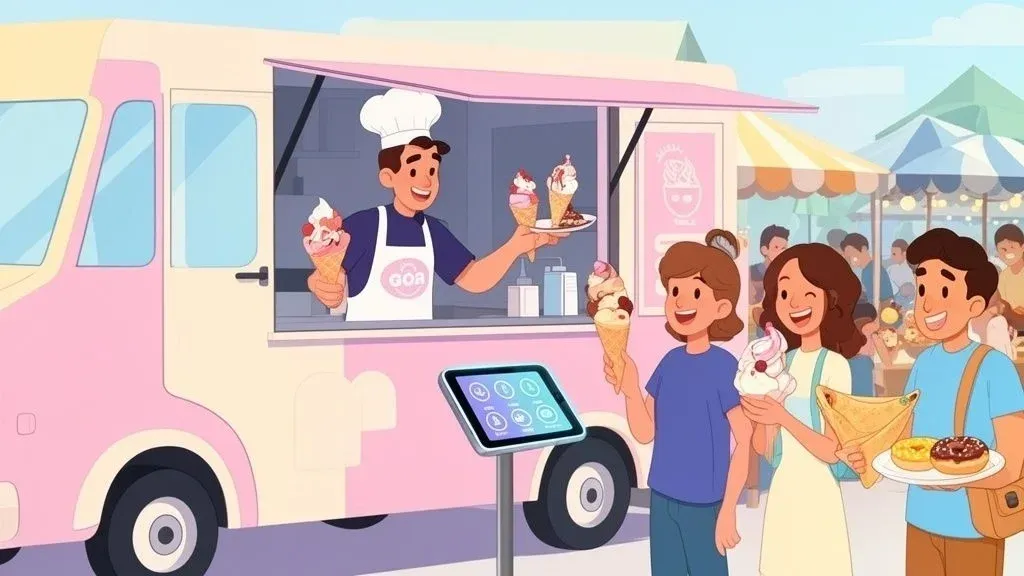
Thinking about getting into the food truck business? Let’s talk about one of the smartest plays in the mobile food world: the dessert food truck. While many people jump straight to tacos or burgers, the real money is often in the sweet stuff. A well-run dessert truck can easily outperform traditional food trucks, thanks to its high-margin items and surprisingly low startup costs.
The Sweet Opportunity in Mobile Desserts
The beauty of a dessert-focused truck is its simplicity and serious profit potential. Unlike a full-service truck that has to manage complex, often low-margin entrees, a dessert concept lets you focus on items with fantastic returns.
Think about it in simple terms: the ingredients for gourmet cookies, fancy ice cream sundaes, or fresh crepes are relatively cheap. But the final product? You can sell those for a premium. That massive gap between your costs and your sale price is where you make your money. For example, a gourmet brownie might only cost you $0.50 in flour, sugar, and chocolate, but you can sell it for $4.00. This creates a healthy profit margin that’s tough to match with savory dishes.
Why it matters: High margins mean you make more money on every sale, which is critical for a business with limited space and service hours like a food truck. This profitability directly impacts your ability to grow and invest back into your operations. If you really want to see the numbers behind this, it’s worth learning how to calculate your food cost percentage—it will open your eyes to just how profitable sweets can be.
Why Restaurant Operations Benefit from Mobile Desserts
For existing restaurant owners, adding a dessert truck to the mix is a game-changer. It gives you an agility that a brick-and-mortar location just can’t offer. Instead of waiting for customers to find you, you can take your best treats directly to them.
Here’s how a mobile dessert unit can boost your restaurant operations:
- Go Where the Crowds Are: Park your truck at busy farmers’ markets, summer festivals, corporate lunch parks, or even book private parties. You’re no longer limited to your neighborhood foot traffic.
- Keep Your Costs Down: A food truck comes with much lower startup and running costs than another physical location. Say goodbye to long-term leases, huge utility bills, and the need for a large service staff, immediately improving your bottom line.
- Test Your Next Big Hit: Want to try out a new lavender-honey ice cream or a line of vegan donuts? Your truck is the perfect, low-risk lab. See what sells and get real-time feedback before you even think about adding it to your main restaurant menu.
Your truck isn’t just a vehicle; it’s a magnet for modern consumers. People are always hunting for new experiences and Instagram-worthy treats, and a beautifully branded dessert truck delivers on both fronts.
Connecting Mobility to Restaurant Efficiency
A dessert truck doesn’t have to operate on an island. You can weave it directly into your existing restaurant’s workflow to make everything run smoother. In simple terms, your main kitchen can prepare large batches of cookie dough, sauces, or cake bases during slow periods.
Why it matters: This shared prep work keeps your kitchen staff productive, lowering labor costs per item. It also guarantees your quality and recipes stay consistent, whether a customer is at your restaurant or your truck. This operational efficiency means you can produce more with the same staff, directly boosting profitability. A dessert truck is more than just a fun side project—it’s a powerful marketing tool, a revenue booster, and a smart way to grow your brand.
Crafting Your Unforgettable Dessert Concept
Before you even think about the truck itself, you need to nail down your core idea. What are you selling, and why should people line up for it? This is your concept, and it’s more than just a menu—it’s the entire story and vibe of your brand. Getting this right from the start makes every other decision, from the design on your truck to the toppings you stock, so much easier.
Your first move is to find a niche. Don’t try to be everything to everyone. Are you going to be the spot for over-the-top, artisanal donuts? Or maybe you’re all about decadent, plant-based gelato? You could even lean into nostalgia with gourmet waffles that taste like a childhood memory. Pick a lane and own it.
The timing couldn’t be better. The food truck world is absolutely booming, with projections showing the market will hit USD 4.17 billion by 2034. The desserts and sweets category is a huge piece of that pie, expected to grow at a healthy 5.6% CAGR. People are actively looking for those special, indulgent treats, and they love the experience of getting them from a food truck. A focused dessert concept is a very smart play right now.
Balancing Creativity with Operational Reality
I’ve seen too many new owners get tripped up here. They dream up a wildly creative menu that looks amazing on Instagram but is a nightmare to execute in a tiny kitchen during a dinner rush. Your menu has to be practical. Every single item needs to be designed for speed and consistency.
For example, a “build-your-own” sundae bar sounds fun, but it can grind your line to a halt. A much smarter approach is to perfect three to five signature sundaes. You can pre-portion the toppings, control your costs, and serve people way faster, all while delivering a consistently awesome product. This simple change reduces wait times, increases how many customers you can serve per hour, and boosts staff productivity.
Here’s how to think about building a truck-friendly menu:
- Prep, Prep, Prep: Focus on items you can get 90% ready ahead of time. Think cookie dough, brownie batter, sauces, or pastry creams made in a commissary kitchen.
- Keep Assembly Simple: Your on-the-spot work should be quick. We’re talking scooping ice cream, drizzling a sauce, or warming up a pre-baked good. Seconds matter.
- Limit Your Ingredients: Build your menu around a small set of high-quality core ingredients. Using the same chocolate in your brownies, hot fudge, and cookies simplifies ordering, reduces waste, and saves precious shelf space.
This kind of strategic thinking is called menu engineering, and it’s not just for big restaurants. If you want to go deeper, our guide on crafting a high-performance menu has some fantastic tips that are just as relevant for a kitchen on wheels.
Why Your Concept Influences Restaurant Operations
A focused concept isn’t just about branding; it has a massive impact on your day-to-day operations. A tight menu means you need less equipment. That saves you thousands of dollars upfront and, just as importantly, frees up counter space you simply don’t have to spare. It also makes training your team a breeze because they only have to master a few key recipes.
Why it matters: A clear concept streamlines everything. It dictates your equipment purchases, simplifies your supply chain, and makes marketing easier because you know exactly who you’re talking to and what makes you special.
This clarity is the foundation for using technology effectively. If your concept is pre-boxed cookie assortments, your point-of-sale (POS) system needs a rock-solid inventory management feature. If you specialize in made-to-order crepes, a kitchen display system (KDS) becomes your best friend for keeping orders straight.
Getting your concept dialed in from the beginning sets the stage for a smoother, more profitable business. With that sorted, the next practical step is to dive into the world of permits and start planning the actual truck build-out.
Getting Legal and Building Your Dream Truck
You’ve got your killer dessert concept ready to go. Now comes the part that trips up a lot of new owners: turning that idea into a real, legal, and functioning business. This means diving headfirst into the world of permits and then, the main event—building out your mobile kitchen.
Getting these two things right from the start saves you a world of headaches and money down the road. You can’t sell a single cupcake without the right licenses. The rules can be wildly different from one city to the next, so what flies in one town might be a major violation just a few miles away. Doing your local homework is absolutely non-negotiable.
You’ll generally need a folder full of permits that looks something like this:
- Business License: The standard permit for operating any kind of company in your city.
- Health Department Permit: This is a big one. An inspector will go over your truck with a fine-tooth comb to make sure you meet all food safety and sanitation codes.
- Mobile Vending License: The specific permit that allows you to legally operate a food truck.
- Food Handler’s Permit: You and every person on your team will need to pass a food safety course to get certified.
We cover this in much more detail in our guide on food truck regulations, which is a great resource for navigating the specifics.
Designing a Mobile Kitchen That Works for Restaurant Operations
With the legal stuff in motion, you can turn your attention to the fun part: the truck itself. You can either buy a brand-new, custom-built truck or a used one. A new truck is reliable and you can design the layout perfectly, but it costs a premium. A used truck is cheaper upfront but may need a costly overhaul.
For a dessert truck, your kitchen layout is everything. It needs to be designed around your menu to make your workflow as smooth as possible, especially when a line starts forming. Think of it like a choreographed dance. If you’re selling elaborate ice cream sundaes, your station needs a logical flow: freezer, to scoops, to the topping bar, and straight to the payment terminal. This assembly-line style is what lets your crew fly through orders.
Why It Matters: A bad layout is a profit killer. If your staff is constantly bumping into each other or walking from one end of the truck to the other for a single order, your service grinds to a halt. This increases ticket times, makes customers impatient, and costs you sales. A smart layout directly boosts staff productivity and revenue.
Powering Your Truck and Food Tech
Finally, you need the right gear and the power to run it. A dessert truck might need heavy-duty commercial freezers, a soft-serve machine, or convection ovens. Every one of these is an energy hog, so you absolutely need a powerful generator or a guaranteed spot to plug into shore power.
This is also where your food tech stack comes into play. Your Point of Sale (POS) system is the command center of your entire operation. It’s the tool you use to take payments and track sales. When you’re looking at systems like Square or Clover, think about how quickly you can punch in an order and whether it plays nicely with other tools for restaurant delivery. By planning your tech while you’re planning your truck build, you’re setting yourself up for speed, accuracy, and a healthier bottom line from the moment you open for business.
Optimizing Restaurant Operations with the Right Food Tech
In a dessert food truck, space is tight and time is money. While a reliable generator keeps the lights on and the freezers cold, it’s the right technology that will truly power your growth. To keep your truck from descending into chaos during a rush, you have to work smart.
The heart of your mobile operation is your Point of Sale (POS) system. This is so much more than a cash register; it’s the central hub that connects your sales, your kitchen, and your customers. Trying to juggle in-person sales and a flood of online orders without a solid POS is a recipe for disaster.
How POS Integration Boosts Restaurant Delivery Efficiency
Picture this: you’ve landed a great spot at a local festival. The line at your window is 10 people deep, but at the same time, your tablets are dinging with new orders from Uber Eats and DoorDash. In a typical setup, a staff member has to stop serving customers, read the order on the tablet, and manually type it into your main POS system.
This constant back-and-forth is a massive bottleneck. It’s slow, it’s frustrating, and it’s incredibly prone to human error. Every second spent on data entry is a second not spent serving the next customer.
This is exactly where POS integration comes in. In simple terms, it’s a digital bridge that automatically sends every order from every delivery app straight into your POS and kitchen printer. No manual re-entry needed.
Why it matters: This shift from manual to automated order entry is the single biggest efficiency gain you can make. It frees up your team to focus on what actually makes you money: preparing amazing desserts and serving customers. This reduces labor costs and dramatically cuts down on order errors.
As you can see, building the truck is a process. Integrating your technology workflow should be a core part of that process, not an afterthought.
How Smart POS Integration Drives Profitability
The right food tech doesn’t just make your life easier; it directly protects your profit margins. The global food truck market is set to explode, growing from USD 2.4 billion in 2024 to an estimated USD 3.6 billion by 2030. A huge driver of this is the adoption of digital tools that let trucks serve more people, faster. You can dig into the full research on food truck market growth to see the trends for yourself.
Let’s look at a real-world example. Say your truck uses a Square POS. With an integration tool like OrderOut, an order for a dozen cookies placed on DoorDash instantly appears in your POS and prints from your kitchen printer, just as if the customer ordered at your window. Your staff just grabs the ticket and starts prepping.
To see the difference in staff productivity and error reduction, here’s a breakdown of the two workflows.
Manual Entry vs. Integrated POS Workflow for Restaurant Delivery
Operational Task Manual Workflow (Without Integration) Integrated Workflow (With OrderOut) New Delivery Order Tablet alarm sounds. Staff must stop their task. Order automatically prints in the kitchen. Order Entry Staff member manually types the order into the POS. No manual entry needed. The system does it instantly. Error Potential High. Typos (e.g., 2 sundaes vs. 12) are common. Zero. The order is transmitted exactly as placed. Staff Focus Divided between service and tablet monitoring. Focused entirely on food prep and customers. Speed of Service Slower. Each manual entry adds 30-60 seconds. Faster. Orders hit the kitchen line immediately. Sales Reporting Fragmented. App sales must be manually reconciled. Centralized. All sales are in one system for easy analysis.
This direct connection brings a few powerful advantages for your bottom line:
- Fewer Mistakes: Automated entry eliminates costly typos. This means less food waste and happier customers, saving you money and protecting your reputation.
- Higher Throughput: You can handle more orders per hour. During a two-hour lunch rush, this can dramatically increase your total sales and profit.
- Unified Reporting: All your sales data lives in one place. You can instantly see your best-sellers, track inventory, and make smarter purchasing decisions without having to patch together reports.
The same concepts that help large restaurants become more efficient are now accessible for food trucks. To see a deeper dive, check out our guide on building an integrated POS system for your restaurant. Your next move should be choosing a POS known for its strong integration capabilities, like the popular Clover platform, and connecting it with a service that handles the delivery automation for you.
Getting the Word Out: Marketing and Finding Your Sweet Spots
So you’ve perfected your recipes and your truck looks amazing. Great. But none of that matters if hungry customers can’t find you. Your marketing isn’t just a side task; it’s the daily hustle that brings people to your window and keeps the sales rolling in. This is what separates a food truck that’s just getting by from one that’s a local legend.
The opportunity is huge. The U.S. food truck scene is booming, expected to hit $1.02 billion by 2025. Desserts are a hot ticket within that market, especially since 60% of millennials eat at food trucks every year. With nearly half of all customers discovering trucks at festivals and events, your marketing has to be just as mobile as your kitchen.
Master Your Digital Megaphone
For a dessert truck, your social media accounts are your best friends. Instagram and TikTok aren’t just for posting drool-worthy photos; they’re your live, direct line to your fans. It’s how you tell them who you are, what’s on the menu, and—most importantly—where you’re parked today.
- Make Your Feed Irresistible: Your desserts are your stars. Get up close with high-quality photos and short, satisfying videos. Show off that perfect swirl of frosting, the gooey cheese pull of a dessert panini, or the smiling faces of happy customers.
- Broadcast Your Location. Always. Every single day you’re open, your location and hours need to be front and center. Put it in your bio, make a dedicated post, and blast it on your stories.
- Build Your Tribe: Don’t just post and ghost. Jump into the comments, ask your followers where they want to see you next, and repost photos from customers who tag you. This is how you turn casual buyers into loyal fans.
Beyond social media, get your Google Business Profile (GBP) set up immediately. As a mobile business, this is a game-changer. When someone nearby searches “ice cream truck near me” on their phone, a well-managed profile helps you show up on Google Maps, guiding them right to your window.
Why it matters for efficiency: A strong digital game turns online “likes” into actual sales. When people know where you are, they show up. This keeps your staff busy filling a steady stream of orders instead of waiting around, maximizing staff productivity and revenue per hour.
Securing the Most Profitable Vending Spots
Your parking spot can make or break your day. While you’ll catch some spontaneous walkers, the most successful trucks don’t leave it to chance. They lock down spots that have a built-in audience, and that takes a bit of research and networking.
Your marketing and location hunting should feed each other. A big, engaged social media following makes you a much more appealing vendor to event organizers. To really nail this down, it helps to map out a complete strategy, something we cover in our guide on creating a restaurant marketing plan.
- Public Hotspots: Scout high-traffic areas like downtown business districts at lunchtime, busy public parks on weekends, or the local farmers’ market.
- Private Gigs: These are your bread and butter for guaranteed revenue. Actively pitch your truck for weddings, corporate lunches, and birthday parties. You get a set fee and introduce your brand to a whole new crowd.
- Build Real Relationships: Make friends with event coordinators, office park managers, and other local business owners. A friendly chat can turn into a recurring Saturday gig or a prime spot at the next town festival.
When you pair a killer digital presence with a smart location strategy, you’re not just hoping for customers—you’re creating a reliable system to bring them in. This keeps your truck humming and ensures your incredible desserts are constantly finding new fans.
Answering Your Dessert Food Truck Questions
As you get closer to launch day, a million little questions probably start popping up. It’s completely normal. Let’s run through some of the most common ones I hear from new dessert truck owners and get you some solid, no-nonsense answers.
What’s the Real Cost to Start a Dessert Food Truck?
There’s no single price tag, but you should realistically plan for a budget somewhere between $40,000 and $150,000. The biggest variable is the truck itself. You might find a dependable used truck for $25,000 to $60,000, but a brand-new, fully customized rig can easily push past $100,000.
Don’t forget all the other costs that add up quickly. You’ll need to set aside funds for:
- Kitchen Equipment: Think commercial freezers, ovens, maybe a specialty soft-serve machine.
- Opening Inventory: All your initial ingredients, from staples like flour and sugar to the fancy chocolate that will define your brand.
- Licenses and Permits: These fees vary wildly by city and state, so do your homework early.
- POS System & Marketing: You need a modern POS to take payments and a budget to create some initial buzz.
Actionable Insight: Start with a tightly focused menu. This lets you get by with less specialized equipment right out of the gate and helps keep those initial costs in check, saving you significant time and money.
What Desserts Actually Make the Most Money?
Profitability in a food truck comes down to a simple formula: low food cost + high customer demand + fast prep time. The sweet spot is finding items you can prep in large batches, which is a massive win for productivity and lowers your cost per item.
Gourmet cookies, decadent brownies, and pre-scooped ice cream are classic money-makers. Don’t sleep on specialty drinks, either—things like loaded hot chocolates or unique coffees often have the best profit margins on your entire menu. If you have the right setup and a quick hand, freshly made items like beignets or crêpes can be incredibly profitable.
Why it matters: Fast-moving, high-margin items are the lifeblood of your truck. They increase your average order value and let you serve more people per hour, which is how you make real money during those short service windows. Higher throughput directly translates to higher revenue.
How Can I Run This Thing Efficiently with a Tiny Staff?
When it’s just you and maybe one other person, efficiency isn’t just a goal—it’s your survival guide. Your menu has to be designed for speed, and your truck layout needs to be a logical, step-by-step workflow from order to hand-off.
Beyond that, automate everything you possibly can. This is where a POS integration for restaurant delivery makes a night-and-day difference. Instead of having someone glued to tablets, manually typing orders from DoorDash or Uber Eats into your register, a direct integration does it for you. This one piece of tech frees up your team from mind-numbing data entry, slashes order errors, and lets you handle a much higher volume of sales without having to hire another person, directly boosting staff productivity and your bottom line.
What’s the Best Way to Handle Payments and Marketing?
First things first: get a modern, tablet-based POS system. It’s non-negotiable. Systems from platforms like Square or Clover are perfect for trucks because they take every kind of payment (cards, Apple Pay, Google Pay) and can operate on cellular data. “Cash-only” is a sales killer.
When it comes to marketing, your truck itself is your biggest billboard. Eye-catching and professional food truck signage is what grabs someone’s attention from across a crowded festival. A bold logo and a clear, easy-to-read menu will do more to pull customers in than almost anything else.
Your Next Step: You have the blueprint for a profitable dessert food truck. The key is to blend a great concept with smart, efficient operations powered by the right technology.
Ready to boost your dessert food truck’s efficiency and profitability? With OrderOut, you can connect all your delivery apps directly to your POS system, eliminating manual entry and streamlining your operations. Start onboarding for Free in a few clicks.