
How a Prep Cook Can Transform Your Restaurant Operations
· Thibault Le Conte
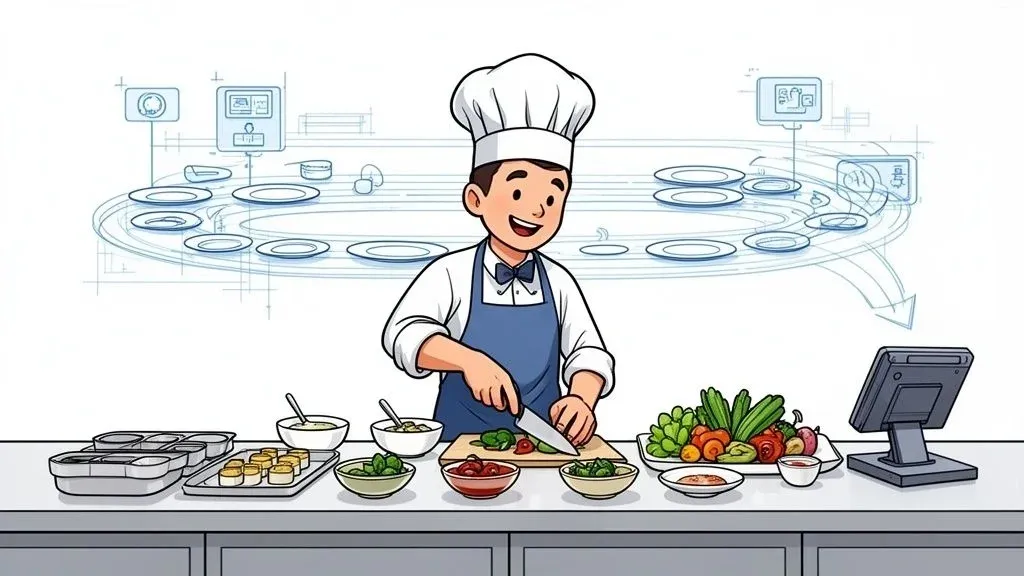
In simple terms, a prep cook is the essential behind-the-scenes force in a professional kitchen. They handle all the foundational food preparation—like chopping vegetables, portioning meats, and mixing sauces—long before your line cooks start firing orders. Their work ensures your kitchen can assemble dishes with the speed and consistency your customers, both in-house and online, demand. For a restaurant owner, understanding and optimizing this role is a direct path to greater efficiency and profitability.
What is a Prep Cook and Why Does It Matter for Restaurant Efficiency?
Think of a prep cook as the person who organizes all the tools and materials for a construction project before the builders arrive. Without them, your highly skilled line cooks would waste precious time on basic tasks, causing delays and chaos, especially when a sudden rush of delivery orders hits. An efficient prep cook is the foundation of a smooth service.
Why it matters: When your prep work is solid, the entire kitchen operates faster. This translates directly to lower ticket times, reduced staff stress during peak hours, and a more streamlined operational flow. It’s a strategic role that boosts staff productivity and is a vital part of your back of the house team.
Core Responsibilities of a Prep Cook
A prep cook’s job description revolves around preparation and organization. These tasks are designed to set the line cooks up for success.
Task Category Specific Duties Why It Matters for Operations Ingredient Preparation Chopping vegetables, mincing herbs, peeling produce Ensures consistency and saves line cooks time during service. Protein Handling Butchering meats, portioning fish, preparing poultry Controls costs through precise portioning and reduces cook times. Component Assembly Mixing sauces, preparing dressings, making marinades Guarantees every dish has the same flavor profile, protecting brand quality. Station Organization Stocking stations, labeling and dating ingredients (FIFO) Minimizes food waste and ensures a smooth, fast workflow for line cooks. Inventory & Cleaning Assisting with inventory counts, maintaining a clean workspace Supports accurate ordering and maintains food safety standards.
These duties ensure that when service starts, every component is ready, minimizing delays and maximizing your kitchen’s output.
How Prep Cooks Boost Restaurant Delivery and POS Integration
The prep cook’s role is even more critical now that restaurants manage dine-in guests alongside a constant flow of online orders from platforms like Uber Eats and DoorDash. While the U.S. Bureau of Labor Statistics notes a potential slight decline in overall food preparation roles, it still projects around 148,000 openings annually due to staff turnover, highlighting the ongoing need for skilled prep cooks. You can find more details in the BLS data on food preparation workers.
At its core, the prep cook’s job is about a culinary philosophy known as mise en place—ensuring everything is in its place before service. This level of organization is the secret to handling high order volumes, especially those flowing from your POS integration with services like Clover or Square.
By mastering this system, a prep cook provides line cooks with everything needed to execute orders with speed and precision. This organized approach is what allows a modern kitchen to absorb a sudden delivery rush without sacrificing quality. To learn more, see what does mise en place mean in cooking.
Prep Cook vs. Line Cook: Optimizing Your Restaurant Operations
To optimize your kitchen, you must understand how each role contributes to the overall workflow. Simply put: the prep cook prepares ingredients in bulk before service, while the line cook uses those ingredients to assemble individual dishes during service.
The fundamental difference is timing and focus. A prep cook is proactive, working hours before the rush to prepare ingredients in large, consistent batches. A line cook is reactive, thriving in the heat of service by grabbing those prepped ingredients to build dishes as tickets appear on the screen. This handoff is the backbone of an efficient kitchen.
The Impact on Restaurant Delivery and Ticket Times
What happens if you don’t have this clear division? Imagine a line cook stopping to chop vegetables for every single salad order. The entire line would grind to a halt, creating a bottleneck that kills ticket times for both dine-in guests and the delivery orders flooding in from DoorDash. This directly impacts revenue and customer satisfaction.
Why it matters: The prep cook sets the pace for the entire shift. Their efficiency directly impacts how quickly a line cook can turn a digital ticket from your POS into a finished plate. A well-prepped station is a direct investment in faster service and higher staff productivity.
This systematic workflow is a cornerstone of effective restaurant operating procedures.
Prep Cook vs. Line Cook: A Role Comparison
Aspect Prep Cook Line Cook Timing Before service (bulk preparation) During service (à la minute cooking) Primary Focus Consistency and efficiency across batches Speed and execution for individual orders Core Skill Organization, portion control, knife skills Multitasking, heat management, speed Impact Reduces food waste, ensures consistency Fulfills orders quickly, drives revenue
A prep cook’s job is about proactive preparation—setting the kitchen up for success. A line cook’s job is about reactive execution—masterfully using that prep work to deliver in the moment. This partnership is what allows a modern kitchen to handle high order volumes without missing a beat.
How Prep Cooks Drive Profit with POS and Delivery Integration
A great prep cook isn’t a cost center; they are an engine for profitability, especially when you integrate delivery platforms like Uber Eats and DoorDash with your point-of-sale (POS) system.
Connecting your delivery apps directly to a POS like Clover or Square opens the door to a massive stream of digital orders. This is great for revenue, but it can easily overwhelm an unprepared kitchen.
Why it matters: A well-organized prep station is your defense against chaos. With solid prep work, your kitchen can absorb a 25-30% increase in order volume without needing more staff. This allows you to maximize the return on your food tech investments, turning higher order volume directly into higher profit.
Maximizing Kitchen Output with Smart Food Tech
Imagine a Friday night where 20 delivery orders hit your kitchen at once. Without good prep, you have chaos and costly errors. But when your prep cook has already portioned sauces, chopped vegetables, and prepared proteins, your line cooks can simply fire, assemble, and fulfill orders.
This reduces ticket times, eliminates mistakes, and ensures every customer receives a high-quality meal.
The handoff from prep cook to line cook is where efficiency is won or lost. Technology amplifies this. For example, integrating DoorDash with a POS like Clover eliminates manual order entry, freeing up staff and giving prep cooks a real-time view of demand.
This allows your team to stay ahead of a 30% higher order volume while keeping errors low. An efficient prep station supported by an integrated POS system can also reduce food waste by 15-20%, a significant cost saving, especially as the prepared meals market grows. For more on this, explore the market trends on Fortune Business Insights.
Actionable Takeaway: A well-supported prep cook unlocks the full potential of your delivery business and tech stack. They ensure your kitchen can handle the speed and volume of modern restaurant operations, directly boosting staff productivity and your bottom line.
Essential Duties for Modern Restaurant Operations
In a busy kitchen, a prep cook does more than just chop vegetables. They lay the groundwork for a smooth service, ensure consistency, and control costs—quietly protecting your profit margins every day. Their work is all about methodical preparation: washing produce, precisely weighing ingredients for perfect recipes, mixing large batches of signature sauces, and stocking every station (mise en place).
Why it matters: When a prep cook perfectly portions ingredients, they are actively preventing food waste and controlling your costs. By having every component ready, they slash cooking times, which means your kitchen can push out more orders and generate more revenue without adding staff. When your POS is firing off tickets, this organization prevents bottlenecks and ensures every dish goes out exactly as it should, protecting your brand’s reputation.
The Prep Cook’s Role in Food Tech and Scalability
With the boom in delivery and takeout, the prep cook has become indispensable. They enable your kitchen to handle the dine-in rush and a flood of online orders simultaneously. According to the Occupational Outlook Handbook, there will be about 2.6 million openings for food preparation jobs each year as people change careers, highlighting the constant need for these skilled workers. You can read more about these food service employment trends on BLS.gov.
This demand is tied to modern dining habits. The ready-to-cook food market, which relies on efficient prep work, was valued at USD 120 billion in 2023 and is still growing. A well-run prep station, supported by POS integration from platforms like Square, is what allows a restaurant to scale and meet this demand.
Actionable Takeaway: Investing in a great prep cook isn’t just about food prep. It’s about setting up your entire operation for higher volume, better efficiency, and greater profitability. Their work is what makes your investment in modern food tech and POS integration truly pay off.
Hiring and Training an Elite Prep Cook for Modern Restaurant Operations
Finding a great prep cook is less about their resume and more about their personal traits. Look for candidates who are naturally organized, detail-oriented, and move with a sense of purpose. A calm demeanor under pressure is a huge plus, as these traits are harder to teach than knife skills.
In the interview, use real-world scenarios. Ask how they would handle a large prep list on a tight deadline or what they’d do if a produce delivery arrived unexpectedly. Their answers reveal their problem-solving ability—a critical skill in a fast-paced kitchen. You can adapt situational questions from these interview questions for a restaurant manager for this role.
Building Repeatable Training Systems for Higher Staff Productivity
Once hired, your training must focus on standardized, repeatable systems. This creates a prep station that runs like clockwork, ensuring every dish is consistent, whether for a dine-in guest or a DoorDash driver.
Your training must include:
- Visual Prep Lists: Use photos alongside text to show exactly what “diced onions” should look like. This eliminates ambiguity.
- Clear Recipe Cards: Document every recipe with precise weights and measurements to remove guesswork and ensure consistency.
- Rigorous FIFO Implementation: “First-in, first-out” is your best defense against spoilage and is critical for controlling food costs.
Why it matters: The goal is a team that produces identical quality every time. This consistency is what allows your kitchen to absorb the pressure of high order volume from POS integrations like Clover and Square without sacrificing quality or speed. This directly leads to higher staff productivity and reduced error rates.
Using talent acquisition software platforms can also help you find candidates who fit your kitchen’s culture. By investing in smart hiring and systematic training, you establish the prep cook as the foundation of your kitchen’s efficiency and profitability.
Your Next Step: A More Efficient and Profitable Kitchen
Ultimately, a great prep cook is more than an entry-level position—they are the key to a smooth, efficient, and profitable kitchen. By investing in this role and equipping them with the right tools, you set your entire team up for success.
When delivery orders from platforms like Uber Eats flow directly into your POS system, you eliminate the manual entry that causes bottlenecks and errors. This simple tech upgrade allows you to reduce ticket times, prevent costly mistakes, and handle a higher volume of orders without burning out your staff. This means more revenue and happier employees.
Actionable Takeaway: Stop letting manual order entry create chaos. Empower your kitchen team to focus on what they do best: cooking great food. Integrating your delivery apps with your POS is the first practical step.
If you’re looking for more ways to optimize your digital operations, our guide on choosing an online order management system is a great place to start.
Ready to see the difference for yourself? You can start onboarding for Free in a few clicks.
Clearing Up Common Questions About Prep Cooks
Here are straightforward answers to common questions restaurant managers have about this crucial role.
What Are The Most Important Skills For A Prep Cook?
Beyond basic knife skills, the most valuable traits are organization, speed, and obsessive attention to detail. A great prep cook anticipates what line cooks will need before they ask. They can multitask efficiently, maintain a spotless station, and follow every recipe precisely.
Why it matters: This isn’t just about neatness; it’s about consistency. Their work ensures a dish a customer loves on Tuesday tastes identical the following Friday, protecting your brand. Their real value is in creating a seamless workflow that boosts staff productivity.
How Can I Measure The Efficiency Of My Prep Cook?
You will feel the efficiency in the kitchen’s smooth operation, but you can measure it with data that impacts your bottom line. An efficient prep cook’s impact shows up on your reports.
- Food Waste Percentages: A drop in this weekly number indicates effective portioning and stock rotation (FIFO). This is a direct cost saving.
- Kitchen Ticket Times: Shorter ticket times during peak hours mean line cooks aren’t scrambling for ingredients. This translates to faster service and more sales.
- Line Cook Stress Levels: A calm, well-stocked line during a rush is a clear sign your prep system is working, leading to better staff retention.
Can A Small Restaurant Afford A Dedicated Prep Cook?
The better question is: can you afford not to? Even for a few hours a day, a dedicated prep cook prevents your entire operation from collapsing when orders flood in.
Why it matters: The cost of a prep cook is often quickly offset by reduced food waste (cost savings), faster service (higher revenue), and improved consistency (customer retention). This is an investment with a clear ROI. A solid prep foundation allows your kitchen to handle more business from both dine-in and delivery orders coming through a POS like Clover or Square.
Ready to streamline your restaurant operations and boost profitability by integrating your delivery apps directly with your POS? OrderOut can help. Get started for Free in a few clicks.