
Cloud Kitchen Meaning and How It Impacts Restaurant Operations
· Thibault Le Conte
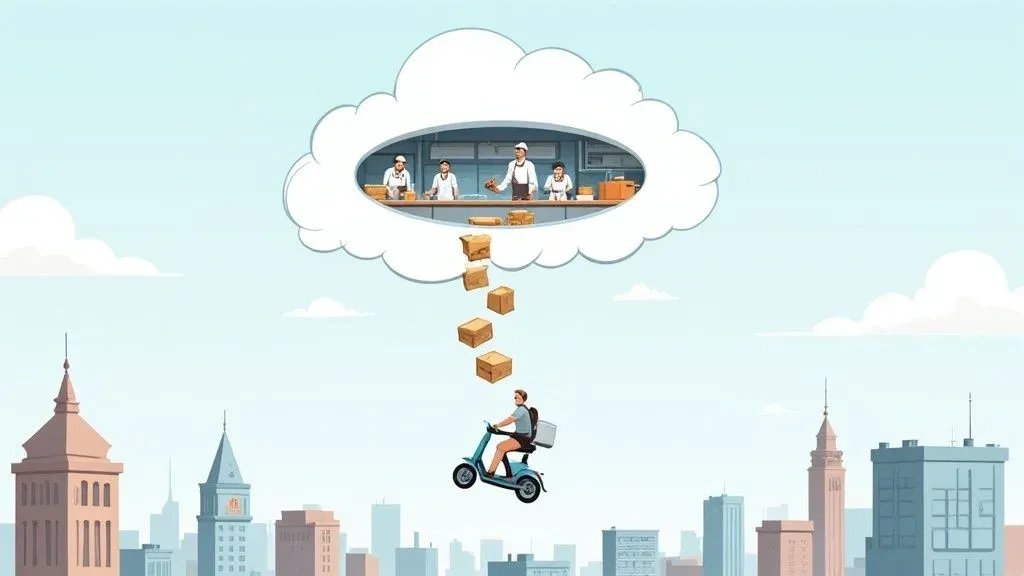
Imagine your restaurant’s kitchen, but without the dining room, the tables, or the walk-in customers. That, in simple terms, is the cloud kitchen meaning. It’s a professional commercial kitchen designed exclusively for one purpose: fulfilling delivery orders.
What Does “Cloud Kitchen” Really Mean for Restaurants?
Think of it this way: a traditional restaurant is a physical retail store where customers browse and buy in person. A cloud kitchen is the e-commerce warehouse for food—a production and shipping center. This shift from a public-facing storefront to a private, delivery-focused hub is what defines the model and unlocks massive benefits for restaurant efficiency.
By removing the front-of-house, you eliminate some of your biggest operational costs: expensive rent in high-traffic areas, waitstaff salaries, and interior decor. This frees up capital and focus for what matters most in a delivery world: creating high-quality food, fast. For restaurant owners and operators, this model is a low-risk way to launch a new brand, test a menu in a new neighborhood, or expand delivery reach without the huge upfront cost of a traditional restaurant. It’s the industry’s direct answer to the explosion in online ordering.
Why This Model Matters for Restaurant Operations and Delivery
The core advantage of cloud kitchens—also known as ghost kitchens or virtual restaurants—is the significant reduction in operating costs, which directly improves restaurant efficiency. Without a dining room, you can protect profit margins while remaining competitive. This is a powerful edge in a crowded market.
The market data supports this shift. The global cloud kitchen market was already valued at around USD 73.18 billion in 2024 and is expected to rocket to USD 141.08 billion by 2030. It’s not a temporary trend; it’s a fundamental change in food delivery. You can explore the data in this report on the cloud kitchen market.
This operational pivot directly impacts your business:
- Slashed Overhead: Eliminating the dining room means no more prime location rent, lower utility bills, and zero front-of-house labor costs. This reduction in fixed costs can save a restaurant from going under.
- Supercharged Efficiency: A kitchen designed purely for delivery can be optimized for speed. Every station is streamlined to get orders prepped and handed off to drivers from platforms like DoorDash and Uber Eats as quickly as possible. This means shorter ticket times, higher order volume, and increased staff productivity.
- Unmatched Flexibility: Cloud kitchens are the perfect testing ground. You can launch a new concept with minimal financial risk. If a virtual brand doesn’t perform well, you can pivot to a new idea without a costly remodel.
The key takeaway for any restaurant owner is that the cloud kitchen model separates food production from the dine-in experience. Unbundling these two unlocks incredible cost savings and operational freedom, allowing you to focus purely on efficient food delivery.
To make the differences crystal clear, let’s break them down side-by-side.
Traditional Restaurant vs. Cloud Kitchen At A Glance
This table quickly highlights the fundamental operational and financial distinctions between the two models. It’s a great way to see exactly where the cloud kitchen value proposition lies.
Aspect Traditional Restaurant Cloud Kitchen Primary Focus Dine-in experience, ambiance, service Delivery speed, food quality, efficiency Customer Interaction Face-to-face, in-person Digital-only (via apps and websites) Location Critical; requires high foot traffic Secondary; needs delivery driver access Startup Costs Very high (decor, furniture, FOH staff) Significantly lower (kitchen equipment only) Overhead High (rent, FOH labor, utilities) Low (kitchen rent, minimal staff) Menu Flexibility Difficult and costly to change Easy to test and pivot concepts Marketing Local advertising, signage, reviews Digital marketing, app presence, social media
As you can see, the cloud kitchen strips the restaurant business down to its operational core: making and selling food.
The Critical Role of Food Tech and POS Integration
Here’s the catch: in a cloud kitchen, your technology is your business. Without a physical storefront, your digital presence and order management systems must be flawless to maintain restaurant efficiency.
A common nightmare for operators is the “tablet farm”—a counter cluttered with iPads from different delivery apps, all beeping at once. This manual process is a direct path to chaos, missed orders, and costly data entry errors that hurt your bottom line.
This is why direct POS integration is essential. When you connect all your delivery apps directly to your Point of Sale system, such as Clover or Square, every order flows into one central hub. This automation eliminates manual entry, reducing errors and saving your staff valuable time. That directly translates to improved staff productivity and a healthier profit margin.
Tired of juggling tablets? You can integrate your POS system by getting started at OrderOut.
Exploring Different Cloud Kitchen Business Models
The term “cloud kitchen” isn’t a one-size-fits-all concept; it covers several different operational strategies. Understanding these models is the first step in deciding which approach aligns with your brand, budget, and business goals.
Picking the wrong model can be a costly mistake. An independent gourmet brand might struggle in a shared space, while a startup could be crushed by the overhead of a private kitchen. Aligning your business plan with the right operational model is crucial for success and long-term restaurant efficiency.

The Independent Model: Full Control
In simple terms, the Independent Model is a private kitchen dedicated to a single brand, but with no dining room. This setup offers complete control over your menu, workflow, and quality—perfect for established restaurants that need a custom layout to optimize delivery or protect proprietary recipes. The trade-off is higher cost, as you are responsible for the lease and all equipment.
The Multi-Brand Model: Maximum Efficiency
The Multi-Brand Model is where one company operates multiple virtual brands from a single kitchen. For example, using a shared inventory of ingredients like chicken, cheese, and tortillas, a single kitchen could power a taco brand, a quesadilla brand, and a burrito brand on delivery apps like DoorDash or Uber Eats.
This strategy is a masterclass in restaurant efficiency. It maximizes ingredient use, reduces food waste, and captures a wider customer base, significantly boosting potential revenue. The key to making it work is a powerful POS integration that can manage orders from multiple digital storefronts without creating chaos, preventing errors and saving staff time.
This model demands tight operations and the right food tech. For a deeper look, you can learn more about the ghost kitchen business model.
The Shared Kitchen Model: Low-Risk Entry
The Shared Kitchen Model, also called a commissary kitchen, offers the lowest barrier to entry. Instead of leasing a private space, you rent a station in a large, fully-equipped commercial kitchen alongside other food businesses. This is ideal for startups or food trucks wanting to test a concept without a major financial commitment. The cost savings are significant, but it means sacrificing some control. Even in this model, integrating with a POS system like Clover or Square from day one is an actionable step to ensure your operations are efficient and scalable.
The Core Benefits for Your Restaurant Operations
So, what does this all mean for your actual restaurant? When you peel back the layers, the cloud kitchen model offers some pretty powerful perks that hit your bottom line and make day-to-day life easier. Let’s get practical and talk about the real-world impact on your costs, speed, and ability to adapt.
The most obvious win is the massive cost savings. Right off the bat, you’re ditching the need for a dining room, front-of-house staff, and all that expensive decor. This means you can hunt for smaller, cheaper real estate in places where foot traffic doesn’t matter, slashing your monthly overhead. All that saved cash can be poured back into things that actually grow the business—like marketing, better ingredients, or smarter tech.
Boosting Operational Efficiency and Restaurant Delivery Speed
When your kitchen is built for one thing and one thing only—delivery—it becomes a finely tuned machine. You can design every station and every workflow to get orders out the door as fast as humanly possible. This singular focus naturally shortens prep times, cuts down on mistakes, and makes your team incredibly productive.
Think about it: no dine-in customers to distract the crew. Your kitchen staff can focus 100% on banging out orders from apps like Uber Eats and DoorDash. This is a total game-changer for efficiency. The entire cloud kitchen boom is built on meeting the modern customer’s need for convenience and speed. According to the IMARC Group’s market analysis, a huge part of the appeal is being able to run multiple “restaurants” from one location, which really pushes your operational capacity to the max.
The core operational advantage is simple: a delivery-only kitchen minimizes distractions and maximizes output. This leads directly to shorter ticket times, higher order volume, and increased revenue per square foot.
Gaining Unmatched Market Flexibility
This might just be the most exciting benefit of all: incredible market flexibility. What if you could launch a new taco concept in a totally different part of town for a tiny fraction of what it costs to open a full restaurant? That’s the power a cloud kitchen gives ambitious owners.
This model lets you experiment with new menus, brands, and neighborhoods using real customer data instead of just a gut feeling. You can pivot on a dime, jumping on new food trends without the crushing financial risk tied to a brick-and-mortar spot. This kind of agility is what fuels rapid growth and makes your business far more resilient. To pull this off, you absolutely need the right restaurant technology solutions that can juggle multiple brands and menus without breaking a sweat.
- Test New Concepts: Throw a virtual brand out there with almost no risk. If customers love it, great. If not, you haven’t lost your shirt.
- Enter New Markets: Instantly expand your delivery reach into new zip codes without having to scout for a physical storefront.
- Adapt to Trends: See a new food craze taking off? You can add it to a menu in days, not months.
By leaning into these core advantages, you can build a more profitable and scalable food business. The next piece of the puzzle is getting the right tech in place to manage it all.
Essential Food Tech and POS Integration for Success
In a cloud kitchen, technology isn’t just helpful—it’s the foundation of your entire operation. With no physical storefront, your customer experience is entirely digital. The biggest threat to that experience, and your restaurant efficiency, is the chaotic “tablet farm.”
You know the scene: a cluttered counter with tablets from Uber Eats, DoorDash, and other delivery apps, all beeping for attention. Staff must manually re-enter every single order into your main system, a process that is slow, frustrating, and prone to errors.
The High Cost of Manual Order Entry
Manually keying in orders is a direct drain on your resources. One typo can lead to a wrong order, an unhappy customer, and a negative review that damages your online-only brand. This process also pulls your cooks away from cooking, slowing down your entire kitchen and reducing staff productivity.
For a business built on speed, these manual errors and delays are more than just an annoyance—they are a direct hit to your profit. Every mistake costs money in wasted food and refunds. Every minute spent on data entry is a minute not spent preparing the next order. This is why mastering your digital workflow through food tech is non-negotiable.
This infographic lays out how the benefits of a cloud kitchen—cost savings, speed, and flexibility—all come from operational excellence.

As you can see, these advantages aren’t automatic. You have to build the right systems to actually see those benefits in your bank account.
POS Integration: The Engine of Restaurant Delivery
The solution is a fully integrated system where all your third-party delivery apps feed directly into your Point of Sale (POS), creating a single, automated channel for every order.
By eliminating manual data entry, POS integration fixes the single biggest bottleneck in a cloud kitchen. This automation gives staff back up to 3 minutes per order, slashes costly mistakes, and allows your kitchen to handle significantly more volume without chaos. This is a clear example of how food tech directly translates to cost savings and increased staff productivity.
This is exactly what tools like OrderOut are built for. We act as the bridge, seamlessly pulling orders from every delivery platform into top POS systems like Clover and Square. Your team never has to touch another tablet. Orders appear instantly on the kitchen printer or KDS. For a deeper dive, our guide on POS integration software for restaurants explains how this technology is the core engine that drives profit and restaurant efficiency.
Navigating the Challenges of the Cloud Kitchen Model
As appealing as the cloud kitchen model is, it’s not without its own unique set of hurdles. Let’s be honest—jumping into this space requires a clear-eyed view of the challenges and a rock-solid plan to tackle them, especially now that everyone seems to be getting in on the action.
The biggest obstacle right out of the gate is building brand visibility. Think about it: without a physical storefront, you have zero foot traffic. No one is going to just wander by and discover you. Your restaurant is a ghost, existing only online. This means you have to build your brand, customer base, and reputation from the ground up in a very noisy digital world.
Mastering the Digital Marketplace
To make a name for yourself, you’ve got to master the art of online appeal. That starts with incredible food photography—your pictures on apps like DoorDash have to be so good they make people’s stomachs rumble. A strong, active social media presence isn’t optional, either; it’s where you build a community and talk directly to your customers. Your digital marketing is your storefront.
Another major hurdle is the deep reliance on third-party delivery platforms. These apps are a double-edged sword. They give you instant access to a massive audience, but they take a hefty cut for the service—commission fees can slice anywhere from 15% to 30% right off the top of your revenue. Juggling these platforms is a constant balancing act. If you want to dive deeper, our guide on third-party delivery service breaks down how to manage these partnerships effectively.
The explosive growth of this sector means you’re not just competing with the pizza place down the street. You’re up against a tidal wave of new, digital-first brands, making operational excellence and a killer online presence more critical than ever.
The market is set to absolutely explode. One report projects the global cloud kitchen industry could hit USD 225.76 billion by 2034. That number represents a massive opportunity, but it also flashes a warning sign: competition is going to be fierce. Only the leanest, most efficient operations will survive.
Of course, the operational challenges don’t stop there. Food safety is paramount, especially in a multi-brand kitchen, making it crucial to implement effective ways to prevent cross-contamination.
When it comes down to it, winning in the cloud kitchen space means getting a few key things right. You have to price your menu smart to absorb those commission fees, run your kitchen like a well-oiled machine to protect your margins, and roll out a flawless digital marketing plan to build a brand that people not only trust but crave.
How to Launch Your Cloud Kitchen Successfully
https://www.youtube.com/embed/S9qO1Rt2_-A
Thinking about making the leap? A cloud kitchen can be a fantastic way to grow your brand with lower risk and incredible efficiency, but your success really boils down to getting the operations and technology right from the start. The absolute first thing you need to nail down is how you’re going to manage your orders.
Trust me, you don’t want your team buried under an avalanche of delivery tablets. The cornerstone of any successful delivery-only operation is a smooth, automated workflow. That means getting all those different delivery platforms to talk directly to your POS system, creating one central hub for every single order that comes in.
Build for Scale from Day One
Getting this integration right isn’t just a “nice-to-have” for efficiency’s sake; it’s about setting yourself up to scale from the get-go. When you take manual order entry out of the equation, you slash the kind of costly mistakes that eat into your profits and you free up your kitchen staff to do what they do best: cook amazing food, fast.
On top of the tech, remember the physical space. Making sure you meet all commercial kitchen ventilation requirements is non-negotiable for safety, legal compliance, and creating a workspace where your team can actually thrive.
A streamlined, automated order flow is the central nervous system of a profitable cloud kitchen. It saves time, reduces waste, and allows you to handle higher order volumes without the chaos.
For a complete rundown of everything you’ll need to get started, our checklist for opening a new restaurant is a great resource. It walks you through the entire process, from licenses to launch.
The clear next step is to solve the tablet problem for good. You can start by connecting your delivery apps to your POS by signing up at https://dashboard.orderout.co.
Got Questions? Here Are the Answers on Cloud Kitchens
If you’re a restaurant owner trying to get your head around cloud kitchens and how they actually work, you’re not alone. A few questions pop up time and time again. Let’s break them down with some straight-to-the-point answers.
How Much Does It Really Cost to Start a Cloud Kitchen?
Here’s the good news: the startup cost is worlds away from what you’d spend on a traditional restaurant. Forget the hundreds of thousands of dollars for a full-service spot; a simple cloud kitchen can get off the ground for a tiny fraction of that.
Of course, the final number depends on your approach. Renting a spot in a shared commissary kitchen is usually the cheapest route. Your main costs will be kitchen equipment, licenses, your first food order, and the software subscriptions for your POS and order management. The biggest win? You completely sidestep the massive expense of a dining room, furniture, and front-of-house staff, which dramatically lowers your startup cost.
Can I Just Run a Cloud Kitchen Out of My Current Restaurant?
Absolutely. In fact, this is one of the smartest and most efficient ways to start. This hybrid model means you’re creating a new, delivery-only “virtual brand” that operates from the kitchen you already have. It’s a fantastic strategy for adding a new revenue stream using the team, equipment, and space you already pay for, boosting staff productivity during slow periods.
The key to success is ensuring your kitchen can handle the extra order volume without negatively impacting your dine-in service. This is where a robust POS integration for delivery is non-negotiable. For example, manually managing a rush of Uber Eats orders while serving a full dining room is a recipe for chaos. Automatically funneling those orders into your POS, whether it’s Clover or Square, is essential for maintaining efficiency and order accuracy.
How Do You Market a Restaurant That People Can’t Visit?
When you don’t have a physical storefront, your marketing has to be 100% digital. Think of the delivery apps as your new storefronts. That means your menu needs to shine with incredible photos and descriptions that make people hungry just reading them. But you can’t stop there. A strong, engaging social media presence is crucial for building a brand and connecting with your audience.
What else works?
- Targeted digital ads on platforms like Instagram and Facebook.
- Partnering with local food influencers to get the word out.
- Building a simple website to capture commission-free direct orders.
Since nobody can walk by and see your bustling restaurant, your online reviews become your reputation. This puts immense pressure on making sure your food and restaurant delivery experience are top-notch, every single time.
The most practical first step to improve your restaurant delivery operations is to eliminate manual order entry. OrderOut syncs all your delivery apps directly into your POS system, saving your staff time, reducing costly errors, and calming the chaos of delivery. Start onboarding for Free in a few clicks.