
BOH Meaning Restaurant: A Guide to Back of House Operations
· Thibault Le Conte
So, what exactly is the “BOH” everyone in the restaurant industry talks about? In simple terms, it’s everything your customers don’t see. The acronym stands for Back of House, and it’s the high-octane command center of your entire establishment: the kitchen, the prep areas, the walk-in coolers, and the dish pit.
What BOH Really Means for Restaurant Operations
Think of it this way: if your restaurant is a Broadway show, the Front of House (FOH) is the stage where servers and hosts perform for the audience—your guests. The Back of House (BOH) is the entire backstage operation where the crew of chefs, cooks, and dishwashers works tirelessly to make sure the performance goes off without a hitch.
Why it matters: While the dining room gets all the attention, any veteran restaurateur will tell you that the BOH is where a restaurant’s profitability and reputation are truly forged. A smooth-running BOH is your secret weapon for five-star reviews and a healthy bottom line, ensuring every single order, whether for dine-in or delivery, is accurate, fast, and meets your quality standards. This directly impacts staff productivity and reduces costly errors.
Core BOH Functions at a Glance
The BOH is responsible for the entire production side of your menu. To break it down, here are the main activities happening behind the scenes and why they are critical for efficiency.
BOH Function Key Responsibilities Why It Matters for Efficiency & Cost Food Preparation Chopping vegetables, butchering meats, mixing sauces, and portioning ingredients before service. Actionable Insight: Consistent prep ensures every dish is the same, speeding up cook times during busy rushes and controlling food costs. Cooking & Plating Executing recipes on the line, cooking food to order, and artfully arranging it on the plate. Actionable Insight: This is the final product. Speed and accuracy here define your food quality and directly impact guest satisfaction and delivery times. Inventory & Receiving Ordering supplies, accepting and inspecting deliveries, and organizing all food storage areas. Actionable Insight: Proper inventory management directly controls food costs, prevents shortages, and maintains ingredient freshness, reducing waste. Sanitation & Dishwashing Washing all dishes and cookware, cleaning equipment, and maintaining a spotless, health-code-compliant kitchen. Actionable Insight: A clean kitchen prevents cross-contamination and operational bottlenecks. A backed-up dish pit brings the entire production line to a halt.
Ultimately, a well-oiled BOH is the engine of your profitability. A disorganized kitchen leads to long ticket times, frustrating customers waiting on a DoorDash order who then leave a bad review. On the flip side, a kitchen where orders flow seamlessly from a POS integration to the prep line gets food out the door perfectly every time, cutting down on food waste and boosting morale.
The Unsung Heroes: Your Back of House Team
The BOH is a physical space, but its soul is the team that works there. A great back of house runs on a special kind of organized chaos where a dedicated crew transforms raw ingredients into the dishes your customers love.
Technically, the kitchen operates within a clear hierarchy, but in practice, it’s about speed and consistency. Every person has a distinct role that feeds into the next, ensuring that final plate gets to the customer—whether they’re sitting in your dining room or waiting for a delivery at home. Understanding these roles is the first step to running a tighter, more efficient operation.
The Core BOH Roles and Why They Matter for Your Bottom Line
A well-oiled team is the backbone of any successful restaurant. If you want to dig deeper, we’ve put together a complete guide to back-of-the-house positions. But for now, let’s meet the key players.
- Executive Chef: The big-picture leader. They’re the creative force behind the menu, but they also keep a close eye on food costs, staffing, and the kitchen’s overall contribution to the restaurant’s financial health.
- Sous Chef: The second-in-command and the hands-on floor general during service. When the tickets start flying, the Sous Chef is on the line, directing traffic, ensuring quality, and making sure every dish goes out perfect and on time.
- Line & Prep Cooks: The absolute engine room of the kitchen. Prep cooks are the masters of “mise en place,” doing all the chopping, portioning, and organizing before service even begins. The line cooks then take over, firing and finishing dishes to order.
- Dishwashers: The foundation of a clean, safe, and efficient kitchen. Without clean pans, plates, and tools, the entire line grinds to a halt, preventing bottlenecks and keeping health standards high.
Actionable Insight: Every single role is tied directly to your profitability. If a prep cook portions inconsistently, your food costs will creep up with every serving. If the dish pit gets buried in dirty pans, cooks can’t plate, ticket times skyrocket, and your delivery ratings suffer. A supported, well-organized team can absorb high order volume without breaking a sweat, reducing mistakes and protecting your bottom line.
BOH and FOH: A Guide to Restaurant Efficiency
A restaurant’s success is built on the partnership between the Back of House (BOH) and Front of House (FOH). In simple terms, when they’re in sync, it’s a perfectly choreographed dance. When they’re not, the whole operation can grind to a halt, costing you time and money.
Think of it like a relay race. The FOH team grabs the baton—the customer’s order—and has to pass it cleanly to the BOH. The BOH then runs their leg of the race, cooking the meal with precision, before handing it back to FOH for delivery to the guest. If that handoff is fumbled, you’re looking at incorrect dishes, wasted food, and unhappy customers.
From Ticket to Table: The Critical POS Integration Workflow
The journey of an order ticket is the perfect illustration of this relationship. Here’s how a seamless workflow, powered by modern food tech, boosts restaurant efficiency.
- Order Placement (FOH): It starts with a server taking an order, catching any special requests or allergies, and punching it into the POS system.
- Ticket Transmission (The Digital Handshake): Instantly, the POS sends that order straight to the kitchen’s printer or Kitchen Display System (KDS). This is that first crucial handoff where technology eliminates human error.
- Order Execution (BOH): The kitchen crew sees the clear, accurate ticket and fires the order. They can trust the information, from steak temperatures to allergy warnings.
- Quality Control & Handoff (BOH to FOH): Before any dish leaves the kitchen, the expediter gives it a final check against the ticket, then calls for a food runner or server.
Why it matters for restaurant operations: A breakdown anywhere in this chain creates chaos and costs money. A server forgetting to input a “no nuts” modifier on a packed Saturday night leads to a remade dish (wasted food and labor) or, worse, a health crisis and a damaged reputation. This is where modern POS systems like Square or Clover are invaluable. With clear, easy-to-use modification buttons, they drastically reduce human error, ensuring what the customer asks for is exactly what the kitchen sees. To get a better handle on bringing your teams together, you might find some useful insights in our guide on what a restaurant manager does to bridge the FOH/BOH divide.
Modern BOH Challenges: A Focus on Restaurant Delivery
The explosion of food delivery has completely changed the game. What used to be a straightforward process is now a tangled web of digital orders, creating a massive headache for the Back of House known as “tablet hell.”
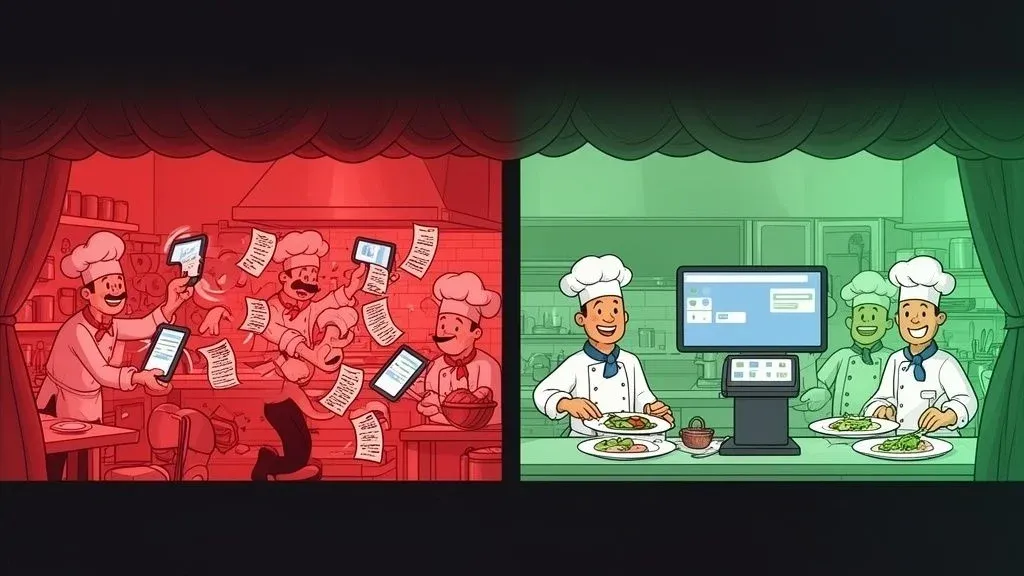
Picture a busy kitchen, and then add a row of tablets—one for DoorDash, another for Uber Eats, a third for Grubhub—all constantly beeping. This forces your skilled cooks to become data entry clerks, creating a chaotic and stressful environment that kills productivity.
The True Cost of Manual Order Entry for Restaurant Delivery
Every time a tablet dings, someone has to stop, walk over, and manually type the entire order into your POS system. These tiny interruptions create major bottlenecks and introduce hidden costs that quietly eat away at your profits.
- Increased Labor Costs: You’re paying your team to perform tedious data entry instead of cooking. This wasted time adds up, hour after hour.
- Higher Error Rates: Manually re-keying orders is a recipe for mistakes. A missed “no onions” modifier leads directly to wasted food, costly order redos, and bad reviews from unhappy customers.
- Slower Ticket Times: Juggling tablets adds minutes to every single delivery. Those delays frustrate hungry customers and can seriously damage your ratings on the delivery apps.
Real-World Example: In the current market, DoorDash commands a significant portion of delivery sales, while Uber Eats holds another large piece. To reach all your customers, you must be on multiple platforms. For a restaurant using a POS like Clover or Square, this means manually entering orders from each app, which is the root cause of these costly errors and wasted hours. Read the full research about these market dynamics.
Actionable Insight: The solution is automation. By eliminating manual entry, you can immediately reduce errors, save on labor costs, and increase your kitchen’s capacity. To learn more, check out our guide on what an order management system is and see how the right tech can solve these exact problems.
The Solution: Taming Tablet Hell with POS Integration
If you’ve ever felt like your Back of House is drowning in delivery tablets, there’s a better way: smart POS integration. In simple terms, this is technology that automatically feeds orders from DoorDash, Uber Eats, and other platforms directly into your main Point of Sale (POS) system. No more manual punching. It transforms that frantic, error-prone juggling act into a single, quiet, automated flow.
The Automated Workflow: A Food Tech Game-Changer
Let’s walk through a real-world scenario. An order from Uber Eats comes in. The old way? A cook stops what they’re doing and manually types the order into your POS. With integration, the moment a customer confirms their order on the app, it instantly appears in your POS and prints on your kitchen ticket line, just like a dine-in order. No extra steps, no manual entry, no errors.
This image below perfectly captures the pain of the manual process—a bottleneck that’s costing restaurants more than they realize.
Why it matters: The benefits of fixing this are immediate and hit your bottom line directly. You’re not just saving time; you’re cutting down on food waste from incorrect orders (error reduction) and dramatically increasing how many orders your kitchen can handle (staff productivity). For other administrative tasks, simple tools like a receipt generator can also help organize internal paperwork and keep things running smoothly.
The Numbers Don’t Lie: A Focus on Restaurant Operations
The online food delivery market is only getting bigger. It brought in $353 billion in the U.S. in 2026, with meal delivery alone accounting for over $95 billion. Trying to manage that volume by hand is simply not sustainable. Studies show that manual order entry can eat up 30 minutes of staff time per hour and that a staggering 40% of restaurants using multiple apps report order errors.
Manual Entry vs. Integrated POS Workflow
To see the difference clearly, let’s compare the two workflows side-by-side. The contrast highlights how automation removes friction and frees up your team.
Operational Step Manual Workflow (Without Integration) Automated Workflow (With OrderOut Integration) Order Received A tablet alarm sounds, interrupting kitchen flow. Order quietly appears in the POS queue. Order Entry A staff member must stop their task to manually re-enter the order into the POS. The order is automatically accepted and sent to the POS and kitchen printers. Error Potential High. Typographical errors, missed modifiers, and forgotten items are common. Near zero. The customer’s order is transmitted exactly as placed. Kitchen Ticket A ticket is printed from the POS after manual entry is complete. The kitchen ticket prints instantly, just like a dine-in order. Confirmation Staff must manually confirm the order on the delivery app tablet. Order confirmation is handled automatically by the system. Staff Focus Divided between cooking, prep, and managing multiple tablets. Focused entirely on food preparation and quality control.
Actionable Insight: Automation isn’t just a “nice-to-have.” It’s a fundamental operational upgrade that lets your BOH team focus on what they do best—cooking. This directly translates to cost savings, higher output, and improved staff morale.
Your Next Practical Step
The single most impactful thing you can do for your BOH right now is to take control of your food tech. Look for a solution that connects your delivery apps to the POS you already use. The right partner will offer technology that pays for itself quickly through saved labor, fewer mistakes, and higher sales. You can learn more about integrated POS systems in our article and see how this technology can fit into your specific restaurant. The goal is simple: get your team back to making incredible food and let technology handle the noise.
Your Takeaway: A More Efficient BOH is Within Reach
Getting a handle on what “BOH” means is one thing, but making it work for you is where the real magic happens. The explosion in food delivery puts incredible pressure on the kitchen, and a smart, connected approach is no longer a luxury—it’s a necessity. POS integration is the heart of that approach, cutting down on mistakes, saving precious labor hours, and giving your team the tools to do their best work.
With the global online food delivery market projected to hit $380.43 billion USD by 2026, managing that flood of orders by hand isn’t sustainable. Restaurants that automate this process typically get back 2-3 hours of labor per day and can boost profitability by 10-15%. You can dig deeper into the numbers in this comprehensive market analysis. A connected system also helps with everything from inventory to purchasing, optimizing your entire source to pay process.
Your Practical Next Step: Look at your current workflow with a critical eye. Where are manual entry mistakes costing you money in remade food and refunds? Our guide on creating effective restaurant operating procedures can help you build a stronger foundation.
Frequently Asked Questions
Once you’ve grasped the BOH meaning restaurant managers need to know, a few common questions always pop up. Here are straightforward answers to help you run a smarter, more efficient kitchen.
What Is the Most Common BOH Management Mistake?
The most common mistake is underestimating the real cost of manual labor. Many operators accept that someone has to manually punch every delivery order into the POS. What they don’t see is the slow drain on profits from wasted staff time, the cost of remaking food due to order errors, and the hit to kitchen speed during a rush.
Actionable Insight: Track your order errors for one week. Every incorrect order costs you food, labor, and potentially a customer. This number is your starting point for calculating the ROI of automation.
How Can I Improve BOH and FOH Communication?
First, use technology as your foundation. A reliable, integrated POS that sends clear orders and “86’d” item alerts from the FOH to the BOH without a hitch is non-negotiable.
Actionable Insight: Beyond tech, implement quick, daily pre-shift meetings. In just five minutes, the FOH can learn the specials, and the BOH can give a heads-up on low-stock items. This simple habit prevents countless problems during service.
Is POS Integration Difficult for a Small Restaurant?
Not anymore. Modern integration tools are designed for busy owners, not IT experts. You can connect your delivery apps, like DoorDash or Uber Eats, directly to your existing POS system, whether you’re running on Clover or Square, in just a few clicks.
Why it matters: By eliminating hours of manual data entry and preventing expensive order mistakes, POS integration pays for itself incredibly quickly. It is one of the smartest, most affordable investments you can make to improve your restaurant operations and see a real boost in profits and staff productivity.
Ready to stop juggling tablets and start focusing on growth? With OrderOut, you can automate your delivery orders and streamline your kitchen workflow. Start your onboarding for Free in just a few clicks.