
Back of the House Definition: Unlocking Restaurant Success
· Thibault Le Conte
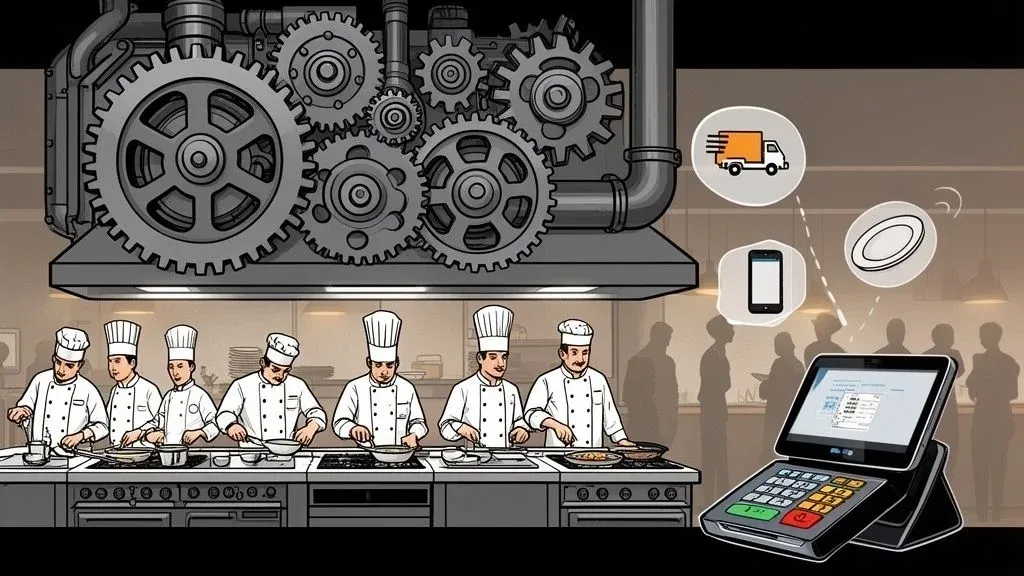
When you hear someone talk about a restaurant’s back of the house, they’re referring to the engine room. In simple terms, it’s every part of the operation that guests don’t see—the kitchen, the prep stations, the dishwashing area, and storage. This is the heart of the restaurant, the direct counterpart to the front of the house where all the customer-facing activity happens.
What Is the Back of the House in a Restaurant?

Simply put, the back of the house (BOH) is where your menu comes to life. While customers enjoy the dining room’s atmosphere, the BOH is a hub of focused activity geared towards production, speed, and quality. A chaotic BOH leads to slow service, incorrect orders, and wasted inventory—all of which directly impact your profits and reputation. This is why BOH efficiency is critical for restaurant survival and growth, especially in the age of online ordering and delivery.
The Core of Restaurant Operations
The BOH is the operational command center, juggling critical functions that keep the business running:
- Food Preparation and Cooking: From chopping vegetables to firing entrees during a dinner rush, this is the primary function.
- Inventory Management: The BOH team receives deliveries, organizes storage, and tracks stock levels to prevent shortages and reduce food waste.
- Sanitation and Cleaning: Maintaining a clean kitchen is non-negotiable for health and safety compliance, from the dish pit to deep cleaning equipment.
- Order Fulfillment: The kitchen crew works in sync to accurately and quickly prepare orders as they come in from the dining room and delivery apps.
Why it matters: An efficient BOH directly boosts your bottom line. Every second saved on a ticket and every ingredient saved from the trash translates to higher revenue, reduced costs, and happier customers. This is a core principle of great food service management. Integrating delivery orders from apps like DoorDash and Uber Eats directly into your POS system automates this process, saving staff time and drastically reducing manual errors.
How BOH and FOH Work Together in Restaurant Operations
A great restaurant doesn’t operate as two separate departments; it moves like a single, well-oiled machine. While the Back of the House (BOH) focuses on production and the Front of the House (FOH) manages the guest experience, their success is completely intertwined.
Think of it as a relay race. The FOH takes the order—the baton—and passes it cleanly to the BOH. The kitchen team then executes their leg, preparing the dish before handing it back to the FOH for the final delivery to the guest. A fumbled handoff, like a server forgetting to note an allergy, can cause a chain reaction of wasted food, a negative online review, and lost revenue. This is why seamless communication, often powered by technology, is the foundation of a profitable restaurant.
BOH vs FOH At a Glance
To understand how these two halves create a whole, it’s helpful to see their distinct roles side-by-side. For any manager looking to improve efficiency, understanding these differences is the first step toward better integration.
Aspect Back of the House (BOH) Front of the House (FOH) Primary Goal Speed, accuracy, and consistency of food production. Guest satisfaction, upselling, and creating a welcoming atmosphere. Key Roles Head Chef, Line Cooks, Prep Cooks, Dishwashers. General Manager, Servers, Hosts, Bartenders. Core Tools Ovens, grills, kitchen display systems (KDS), inventory software. Point-of-Sale (POS) systems, reservation software, payment terminals. Main Pressure Managing ticket times, reducing food waste, maintaining quality. Juggling multiple tables, handling customer complaints, processing payments.
This table highlights why a solid POS integration is a game-changer for restaurant efficiency. When a server enters an order into a Square or Clover terminal, that information must appear on the kitchen’s display system (KDS) instantly and accurately. Any delay or error in this digital handoff creates friction, slows down service, and opens the door for costly mistakes. The goal is to connect the BOH and FOH with technology that ensures everyone is on the same page, whether the order comes from a server on the floor or a driver from Uber Eats.
Key Players in Your BOH and Their Impact on Restaurant Delivery
The back of the house relies on a team of specialists working in perfect sync. From the moment an order from DoorDash or Uber Eats hits the system, every role must execute flawlessly to get food out the door quickly and correctly.
From Head Chef to Dishwasher
Let’s break down the core BOH roles and how they contribute to overall efficiency:
- Head Chef: The leader who designs the menu, sets quality standards, and ensures every plate meets those standards.
- Sous Chef: The operational manager who oversees daily prep, manages staff, and ensures a smooth flow of dine-in and delivery tickets.
- Line Cook: The station specialist (grill, sauté, fryer) responsible for consistent execution of each dish.
- Prep Cook: The foundation of the kitchen, handling ingredient prep (mise en place) that significantly reduces ticket times during peak hours.
- Dishwasher: A critical role that keeps the entire operation running by supplying a constant flow of clean plates, pans, and utensils.
“A single delay at the dish pit can cascade into longer wait times and lost delivery revenue.”
High BOH turnover is a silent profit killer. Replacing a single BOH employee can cost over $1,400, which is significantly more than filling a front-of-house role. For a kitchen with 8-10 staff members and a typical industry churn rate, a restaurant could easily spend $12,000-$15,000 a year on replacements alone. That’s a massive expense against an already thin 3-5% profit margin.
Why Staff Productivity Boosts Your Margins
Investing in your team and providing efficient tools saves money and reduces headaches. Providing professional uniforms with custom embroidery logo services, for example, can build team pride and reduce turnover.
Here are a few high-impact, actionable tactics to improve BOH productivity:
- Standardize recipes within your POS system to make training new cooks faster and ensure consistency.
- Cross-train staff on different stations so they can adapt during busy shifts and cover absences.
- Integrate delivery orders directly into the POS to eliminate manual entry. This frees up your skilled cooks to focus on food quality and speed, not administrative tasks.
When you use food tech to handle repetitive tasks, you empower your team to be more productive, which directly improves your profitability.
Common BOH Challenges and Their Impact on Profitability
Even the best-run kitchens face daily challenges that can quietly drain profits. Simply knowing the back of the house definition isn’t enough; identifying these pain points is the first step toward building a more resilient and profitable operation.
The most common issue is tablet chaos. Picture a busy line cook stopping to juggle separate tablets for Uber Eats, DoorDash, and other delivery services. They must then manually enter each order into the POS. This process is slow, frustrating, and a primary source of costly errors that lead to refunds and unhappy customers.
Communication Gaps, Food Tech Failures, and Costly Mistakes
Beyond technology, simple communication breakdowns between the BOH and FOH are just as damaging. A server forgets to note an allergy. A customer’s modification gets lost. The kitchen makes a dish that has to be discarded. The results are wasted food, longer ticket times, and a guest who may not return—all direct hits to your bottom line.
Maintaining impeccable hygiene is also non-negotiable. A single misstep can lead to health code violations or, worse, foodborne illness, which can destroy a restaurant’s reputation. For a deeper dive, check out a comprehensive guide to cleaning commercial kitchens.
Every incorrect order or wasted ingredient chips away at your profit margins. These aren’t just operational headaches; they are measurable financial losses that compound over time, making it harder to grow.
Finally, poor inventory management leads directly to food waste. Without a tight system, it’s easy to over-order produce or lose track of expiration dates. Soon, you’re throwing cash in the trash. Mastering your food cost percentage is essential, because every discarded item is lost profit.
Streamlining Restaurant Operations with POS Integration
The solution to these challenges lies in smart food tech, specifically Point of Sale (POS) and delivery integration. This isn’t just another gadget; it’s the central command system that can transform your BOH from a source of chaos into a fine-tuned engine of profitability.
By integrating, every order from DoorDash, Grubhub, and Uber Eats flows directly from the customer’s app into your kitchen’s display system. This single change eliminates manual entry errors, frees up staff to focus on cooking, and slashes ticket times. It’s the most impactful, actionable step you can take to overhaul your BOH operations and reduce staff stress.
This flowchart clearly illustrates how tablet chaos drains your profits.

When laid out visually, it becomes obvious that manual order entry is a massive weak link, creating a domino effect of errors and profit loss.
A Real-World Example of POS Integration
This isn’t just theory—it’s a proven strategy. For example, a busy pizzeria was struggling with order errors from multiple delivery tablets during its dinner rush. After implementing an integration solution that connected Uber Eats and DoorDash directly to its Square POS system, the restaurant reduced order entry errors by over 95% and cut ticket times by three minutes. This allowed them to handle a 20% increase in delivery volume without adding staff, leading to a significant boost in nightly revenue.
Why It Matters: Automating the flow of information between delivery apps and your kitchen isn’t an expense; it’s an investment in productivity. It transforms your BOH from a reactive, high-stress environment into a proactive, efficient machine, saving time, reducing errors, and directly increasing your capacity to generate revenue.
Tools like OrderOut solve this problem by consolidating all third-party delivery orders and sending them straight to POS systems like Clover or Square. This simple connection eliminates the manual data entry that can consume 15-20% of BOH staff time during peak hours. This is how top restaurants boost their throughput, reduce costs, and achieve higher profit margins. For more detail, our guide on POS software integration breaks it down.
The Future of BOH: Smart, Connected Food Tech
The back of the house is evolving rapidly. Automation and AI are no longer futuristic concepts; they are essential tools for any restaurant that wants to operate efficiently and grow. This isn’t about replacing people with robots. It’s about empowering your talented team with better tools to handle tedious, repetitive tasks that lead to burnout. This frees them to focus on what matters: creativity and food quality.
Building a More Resilient Kitchen with Restaurant Technology
The BOH of the future is built on smart systems that communicate with each other, reducing friction and streamlining workflows. These are practical solutions available today, as highlighted in our guide to hospitality technology trends.
What this looks like in practice:
- Predictive Inventory: AI tools analyze sales data to forecast ingredient needs, reducing food waste and preventing stockouts during busy shifts.
- Automated Scheduling: Smart software creates optimal staff schedules based on demand forecasts, preventing overstaffing and understaffing.
- Smart Kitchen Equipment: Connected ovens and fryers that ensure perfect, consistent results for every dish, every time.
A tech-enabled BOH allows your team to move from constantly putting out fires to proactively managing the kitchen. This shift builds a more profitable, competitive, and sustainable restaurant operation for the future.
Why This Matters for Your Restaurant
Ultimately, integrating this kind of food tech has a direct, positive impact on your bottom line. An automated system connecting Uber Eats directly to your Clover or Square POS eliminates a major source of errors and delays. As a result, order accuracy improves, staff stress decreases, and service gets faster. This combination of cost savings and increased staff productivity leads to higher revenue and a stronger foundation for long-term success.
Your Next Step: Build a Better Back of House
Understanding the back of the house definition is just the first step. Turning it into an efficient, profitable machine is what truly matters. Your BOH is the heart of your restaurant, but manual processes and tablet chaos from services like DoorDash and Uber Eats can drain your profits and exhaust your team.
The single most powerful, actionable step you can take is to integrate all your delivery orders directly into your POS system. This move reduces errors, saves labor costs, and builds a more resilient business from the inside out. It’s time to stop letting operational friction dictate your profitability.
Take back control of your kitchen. OrderOut syncs all your delivery apps straight to your POS, eliminating manual entry and giving your team back precious time. Start your free onboarding in just a few clicks at https://dashboard.orderout.co and build a more efficient and profitable BOH today.