
What Is Back of House? A Restaurant Owner’s Guide to BOH Operations
· Thibault Le Conte
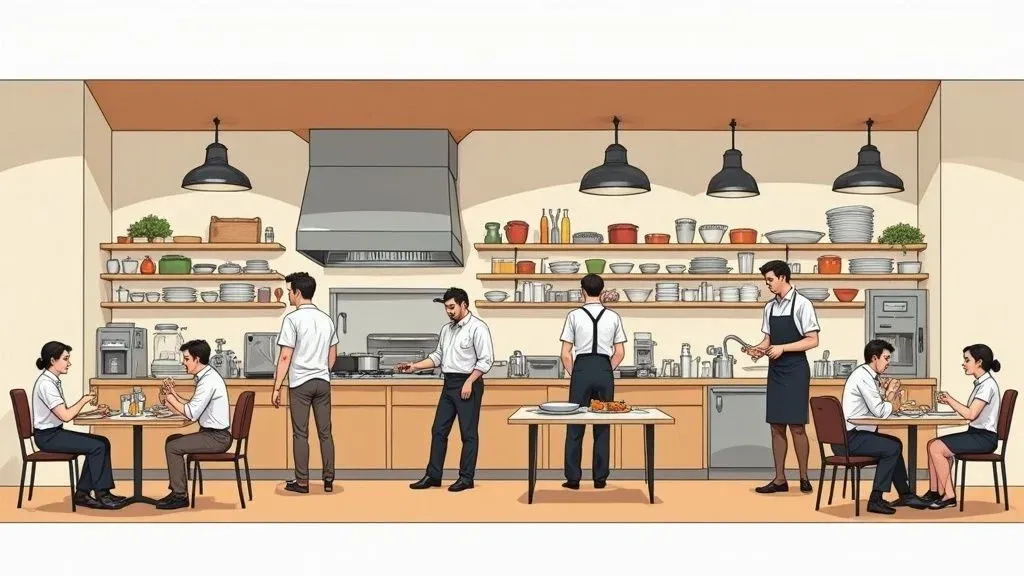
Ever wondered where the real magic of a restaurant happens? It’s not in the beautifully decorated dining room. It’s behind the scenes, in a whirlwind of heat, steam, and controlled chaos known as the back of house.
In simple terms, this is the operational core of your business—the kitchen, the prep stations, the storage areas—everything your customers don’t see. If the front of house is the stage, the back of house (BOH) is the entire backstage crew and production team making the show happen. Understanding this area is the first step toward improving restaurant efficiency, streamlining delivery, and maximizing your profits.
What Is the Back of House in a Restaurant? A Deeper Look at Restaurant Operations

The back of house (BOH) is the engine room of your restaurant. Technically, it encompasses all non-public areas where food is prepared, cooked, and plated, and where all supporting tasks take place. This is where your culinary vision comes to life, dish by dish, and raw ingredients are transformed into revenue.
This “house” isn’t just one room. It includes every space hidden from public view that’s crucial for day-to-day restaurant operations: the main cooking line, walk-in coolers, dry storage pantries, the dishwashing area, and any staff offices. The flow and function of your BOH have a direct, undeniable impact on food quality, speed of service, and ultimately, your profits. It’s a high-stakes environment where efficiency isn’t just a goal; it’s a necessity, as detailed in these BOH operational insights on HospitalityNet.
Why BOH Efficiency Matters for Your Bottom Line, Delivery, and POS Integration
A disorganized back of house directly costs you money. When workflows are messy, service slows down, online orders get delayed, and peak-hour revenue takes a nosedive. When inventory isn’t tracked properly, you’re literally throwing profits in the trash through food waste.
On the flip side, a well-oiled BOH powered by smart food tech is a profit-generating machine. It runs with a rhythm that ensures:
- Faster Ticket Times: Orders, both in-house and for delivery, fly out of the kitchen, improving customer satisfaction and enabling more sales.
- Reduced Errors: A clear system, especially one with POS integration for delivery apps, means fewer mistakes, less food waste, and fewer comped meals. This directly impacts your cost savings.
- Lower Food Costs: Smart prep and precise inventory management slash spoilage.
- Higher Staff Productivity: When your systems work, your team is less stressed and more focused on crafting amazing food, boosting morale and reducing costly turnover.
This operational excellence is critical in today’s market, where restaurant delivery is no longer optional. For businesses like ghost kitchens, the BOH is the entire operation. If you’re exploring that model, our guide on what is a cloud kitchen is a great place to start.
The Key Players Who Power Your BOH
Sure, the back of house is a physical space, but its real engine is the team. The kitchen brigade isn’t just a random collection of cooks; it’s a finely-tuned hierarchy where every single role is crucial for turning food costs into sales. If you want to build a BOH that absolutely crushes it, you first have to understand who does what.
At the very top, you have the Executive Chef. Think of them as the director of the whole show. They’re not just on the line cooking during a busy service; they’re the mastermind behind the menu, the one wrestling with food costs, and the person building relationships with suppliers. Their vision shapes the restaurant’s identity and, more importantly, its profitability. It’s a role that’s as much about spreadsheets as it is about sauces.
The Brigade in Action
Under the Executive Chef, you’ve got a team of specialists who make the day-to-day magic happen. Each one is a critical cog in the machine.
- Sous Chef: This is your second-in-command, the hands-on leader who runs the line. They’re the ones expediting orders, keeping the team in sync, and making sure every plate that goes out meets the Executive Chef’s standards. A great Sous Chef is the difference between a smooth service and a complete meltdown.
- Line Cooks: The heart and soul of the kitchen. These are the folks stationed at the grill, sauté, or fryer, executing dishes with speed and precision. Their ability to communicate and stay cool under pressure is what keeps ticket times down and food moving.
- Prep Cooks: These are the unsung heroes. They do all the thankless, time-sucking work—chopping mountains of onions, simmering stocks, and portioning out ingredients for service. This is what the pros call “mise en place,” and without it, the line cooks would grind to a halt.
- Dishwashers: Never underestimate the importance of the dish pit. When it gets backed up, the entire kitchen stops. No clean plates, no pans, no tools. A fast, organized dishwasher is the guardian of the kitchen’s workflow and sanitation.
Think of a well-run BOH team like a Formula 1 pit crew. Every person has a distinct job, and their synchronized, lightning-fast work is what gets the car—or in this case, the customer’s order—back in the race. One person fumbles, and the whole team’s performance suffers.
Nailing this team structure is a massive part of effective restaurant operations. When everyone knows their job and has what they need to do it well, your BOH becomes an absolute powerhouse. For a closer look at building and leading this team, check out our guide to restaurant management and operations.
Actionable Takeaway: Defining roles clearly and investing in training isn’t just an HR task—it directly leads to faster service, higher food quality, and better control over your costs. This improved efficiency is crucial for handling the high volume of modern restaurant delivery.
Tracing an Order Through the BOH Workflow
To an outsider, the back of house can look like pure chaos. In reality, it’s a highly coordinated dance. The journey of a single customer order shows how a well-run BOH turns complexity into efficiency.
It all starts the moment an order comes in—whether from a server, a kiosk, or a delivery app like Uber Eats. A ticket prints out or flashes up on a Kitchen Display System (KDS), and that’s the starting pistol. The expediter, who is essentially the kitchen’s air traffic controller, immediately takes charge. They’ll call out the order, sending different parts to the right stations. The grill cook gets the steak going, the sauté chef starts on the veggies, and the pantry chef assembles the salad.
The Symphony of Stations
Each station is a world of its own, but they all have to move in sync. The grill cook knows a medium-rare steak needs exactly eight minutes, while the sautéed spinach only takes two. They time their actions so every component of the dish is ready at the exact same moment. This ensures the plate goes out hot, fresh, and complete. This precision is what makes or breaks your restaurant delivery times and customer satisfaction.
This whole process relies on a clear hierarchy, where everyone knows their role and who to listen to.

As you can see, a well-defined chain of command is what keeps the engine running smoothly, preventing missteps and bottlenecks even when the dinner rush hits its peak.
The BOH is so much more than just the cooks on the line; it’s the entire support system. It’s the dish pit, the dry storage, and the manager’s office—all working together behind the scenes. Getting this flow right is a massive part of running a successful restaurant. You can find more strategies for dialing in your process in our guide to restaurant order management software.
Actionable Takeaway: A solid BOH workflow transforms potential chaos into a finely tuned machine. This directly translates to faster ticket times, fewer errors, and happier customers, which are essential for competing in the fast-paced world of food delivery.
How Food Tech and POS Integration Transform BOH Operations
https://www.youtube.com/embed/9YVwxFQ3ROQ
Technology is the secret weapon for a modern, efficient back of house. What used to be a chaotic dance of paper tickets and shouted orders can now be a surprisingly calm and highly productive system. The right food tech isn’t about flashy gadgets; it’s a direct line to your bottom line, helping you tame chaos, slash costly mistakes, and boost staff productivity.
The Magic of POS Integration for Restaurant Delivery
For any restaurant doing delivery, the single biggest game-changer is connecting your delivery platforms directly to your POS system. Think about the old, manual way: a DoorDash tablet dings, a staff member has to stop their task, run over, manually punch the entire order into the POS, and then try to get back in their groove. This process is slow, distracting, and a primary source of errors that cost you money.
Now, imagine that entire messy process is automated. An order comes in from Uber Eats, and bam—it flows straight into your POS, whether you use Clover or Square. From there, a ticket prints in the kitchen or pops up on a KDS screen. No middleman, no manual entry.
Why this matters: This isn’t a small improvement. You’ve just eliminated the need for a dedicated “tablet wrangler.” That’s a whole person freed up to help guests or support the kitchen. We’re talking about saving 30 to 60 minutes per employee, per shift, just by ditching manual order entry. This is a massive win for staff productivity and cost savings.
Let’s look at how this integration really changes the day-to-day for your team.
Impact of POS Integration on BOH Tasks
BOH Task Manual Process (Without Integration) Automated Process (With Integration) Order Entry A staff member hears a tablet alert, stops their task, walks to the tablet, and manually types the entire order into the POS. The order appears automatically in the POS and prints at the kitchen station. Zero manual typing needed. Menu Syncing Manually updating prices or 86’ing an item on each delivery tablet, one by one. Prone to missed updates. Update the item once in your POS, and the change is pushed out to all connected delivery platforms instantly. Order Pacing Guessing when to fire orders based on a jumble of paper tickets and verbal cues. A KDS or integrated printer provides a clear, time-stamped queue, making it easy to prioritize and pace the line. End-of-Day Reporting Staff must manually add up sales totals from each individual delivery tablet and reconcile them with the POS sales. All sales data is consolidated directly in your POS reports, giving you a single, accurate source of truth.
The difference is night and day. Automation removes the friction points that lead to stress and mistakes, allowing your team to focus purely on cooking.
From Paper Tickets to Digital Precision
Speaking of kitchen flow, the Kitchen Display System (KDS) is another piece of tech that brings some Zen to the BOH. Instead of flimsy paper tickets that get lost, stained with sauce, or misread in the heat of the moment, a KDS puts every order on a clean, digital screen. This instantly tightens up communication between your line cooks and the expediter.
If you’re curious, you can learn more about how restaurant kitchen display systems work in our deep-dive guide.
Switching to a more digital-first BOH delivers serious wins for your restaurant’s efficiency:
- Dramatically Fewer Errors: When you stop re-typing orders, accuracy goes way up. That means less food waste and fewer comped meals.
- A More Productive Team: Your crew can lock in on what they do best—prepping and plating great food—instead of playing tech support for a pile of tablets.
- Faster Throughput: A smoother, quicker workflow means your kitchen can handle more orders, which is exactly what you need to grow your restaurant delivery business.
Actionable Takeaway: Using food tech like POS integration is the fastest way to transform your back of house from a potential source of chaos into a powerhouse of efficiency, directly boosting your profitability and ability to scale.
Actionable Strategies for BOH Efficiency

Knowing the back of house definition is one thing. Actually optimizing it is how you build a profitable restaurant. Let’s move past theory and get into the practical, high-impact strategies that will boost performance, cut down on stress, and make a real difference to your bottom line.
A logical kitchen layout is completely non-negotiable. This isn’t just about where you put the ovens; it’s about designing a seamless workflow. Think in terms of mise en place—where everything has a specific home and every station flows into the next. When cooks aren’t scrambling for tools or ingredients, they can just cook. The result? Drastically lower ticket times and higher staff productivity.
Standardize Everything for Consistency and Cost Control
In the restaurant world, consistency is king. The only way to guarantee a dish tastes the same on a slow Tuesday as it does on a slammed Saturday is by standardizing everything. This is crucial for both in-house dining and restaurant delivery, where brand reputation is built on reliability.
- Documented Recipes: Create detailed recipe cards that spell out exact measurements and plating instructions. This is your first line of defense against food waste and your best tool for portion control, both of which directly reduce your costs.
- Prep Lists: Standardized prep lists for each station are a must. They ensure the line is always stocked and ready for service, preventing those dreaded delays that kill efficiency during a rush.
This level of control isn’t just nice to have; it’s vital. A staggering 4-10% of all food purchased by restaurants is wasted every year, often due to sloppy inventory management and inconsistent prep. By standardizing, you take direct control of that number and protect your margins.
Master Your Inventory and Communication
If you want a quick win, implement a strict First-In, First-Out (FIFO) inventory system. It’s simple: label all incoming products with the delivery date and train your team to always use the oldest items first. This single habit can slash spoilage and protect your profit margins overnight.
Just as important is creating unbreakable lines of communication between the BOH and FOH. Ditch the shouting and handwritten notes. A modern POS system with delivery integration creates a single source of truth for every order, eliminating mistakes and confusion before they start. For example, when an order from DoorDash flows through your POS to a kitchen printer, there’s no room for misinterpretation.
When everyone is on the same page, the entire operation runs smoother. To see just how technology can bridge that classic front-of-house/back-of-house divide, check out our guide on the power of POS system integration. These tools are built to make teamwork and efficiency second nature.
Actionable Takeaway: A truly efficient BOH is built on smart systems. From station layout and standardized recipes to inventory control and clear communication, every piece matters. Pick one of these strategies and start implementing it today to see immediate time and cost savings.
Solving Common Back of House Headaches
Every kitchen team knows the grind. There are a handful of persistent headaches that can throw a wrench into everything from staff morale to your profit margins. If you want to build a restaurant that lasts, you have to face these issues head-on. The big three? High staff turnover, ballooning food costs, and the constant battle for consistency.
Let’s start with staffing. It’s a huge pain point for a reason. Your BOH labor costs can easily eat up around 31% of your total sales. And with industry turnover rates hovering near a staggering 43% annually, just keeping a solid, experienced crew together feels like a victory. As this deep-dive BOH labor report points out, your best weapon against the revolving door is a positive culture that gives people a real path for growth.
Wrestling with Costs and Consistency Using Food Tech
When it comes to rising food costs, your best friends are a sharp eye on inventory and a near-obsession with tracking waste. This isn’t glamourous work, but smart purchasing and a rock-solid first-in, first-out (FIFO) system are the bedrock of a healthy food budget. Digging into your POS data is also a goldmine—it’ll show you exactly which dishes are making you money and which ones are just costing you.
Now, for consistency. Keeping every dish perfect, especially when the ticket machine is screaming, is where good process and good tech come together.
- Standardized Recipes: This is non-negotiable. Every dish has to be made the same way, every single time. It’s the only way to control quality and nail your food costs.
- POS Integration: Think about the chaos of a Friday night rush. Manually punching in orders from DoorDash is a recipe for disaster and leads to inconsistent order times and accuracy. When you automate that flow directly into your Square or Clover POS, you eliminate human error. Your team isn’t playing telephone; they’re just cooking. That focus is everything for maintaining quality under pressure.
Why this matters: An efficient, tech-savvy BOH isn’t just a nice-to-have. It’s your single best defense against the toughest challenges this industry can throw at you, reducing errors, saving labor time, and boosting overall staff productivity.
Actionable Takeaway: Stop letting manual processes create costly headaches. Automating your delivery orders is a high-impact first step to solving issues with consistency and staff stress.
What’s Your Next Move for a Smarter BOH?
If there’s one thing to take away from all this, it’s that your Back of House is the true heart of your restaurant. How well it runs—driven by efficiency and smart technology—directly determines your profitability and success. Getting a handle on the back of house definition is just the first step.
The single most impactful action you can take right now is to ditch manual order entry. Integrating your delivery services directly with your POS system is a game-changer. It instantly saves time, slashes costly errors, frees up your staff to focus on food quality, and makes your entire restaurant operation more streamlined.
Ready to build a BOH that’s more profitable and far less chaotic? Let OrderOut bridge the gap between your delivery apps and your POS. You can get started for free in just a few clicks.